How Science Is Learnt
Science is not a subject you can finish by memorising sentences. It is learnt by doing things: observing, testing, surveying, carrying out project work and building models. Observation means looking at an object or an event carefully. Testing means checking whether a guess of yours is right or wrong. A survey means collecting information by asking or measuring many times. Model building means making a small working copy of something so that you understand how it behaves.
Some of this work happens inside a laboratory and some of it happens outside. Visiting a mushroom farm to watch how mushrooms are grown, testing the soil of a field, or surveying how your school manages its waste are all outdoor science activities. It is from activities like these that the facts, the principles and the laws of science are discovered. Practical work, in other words, is not an extra. It is part of the study itself.
Observation: looking at an object, an event or a process carefully, using your senses, in order to collect information about it.
Whenever practical work is done, safety measures have to be taken. Care keeps accidents from happening. It also does a second job that students often miss: careful work is what brings out a correct result from an experiment, an observation or an investigation.
What a Science Laboratory Is
Science laboratory: a special room set aside for scientific study and for practical activities.
A laboratory is not an ordinary classroom. It holds the apparatus and the chemicals needed for scientific study and investigation. Test tubes, beakers, a spirit lamp, a balance and a microscope are kept there in their own places, and the chemicals stand in a separate cupboard in labelled bottles.
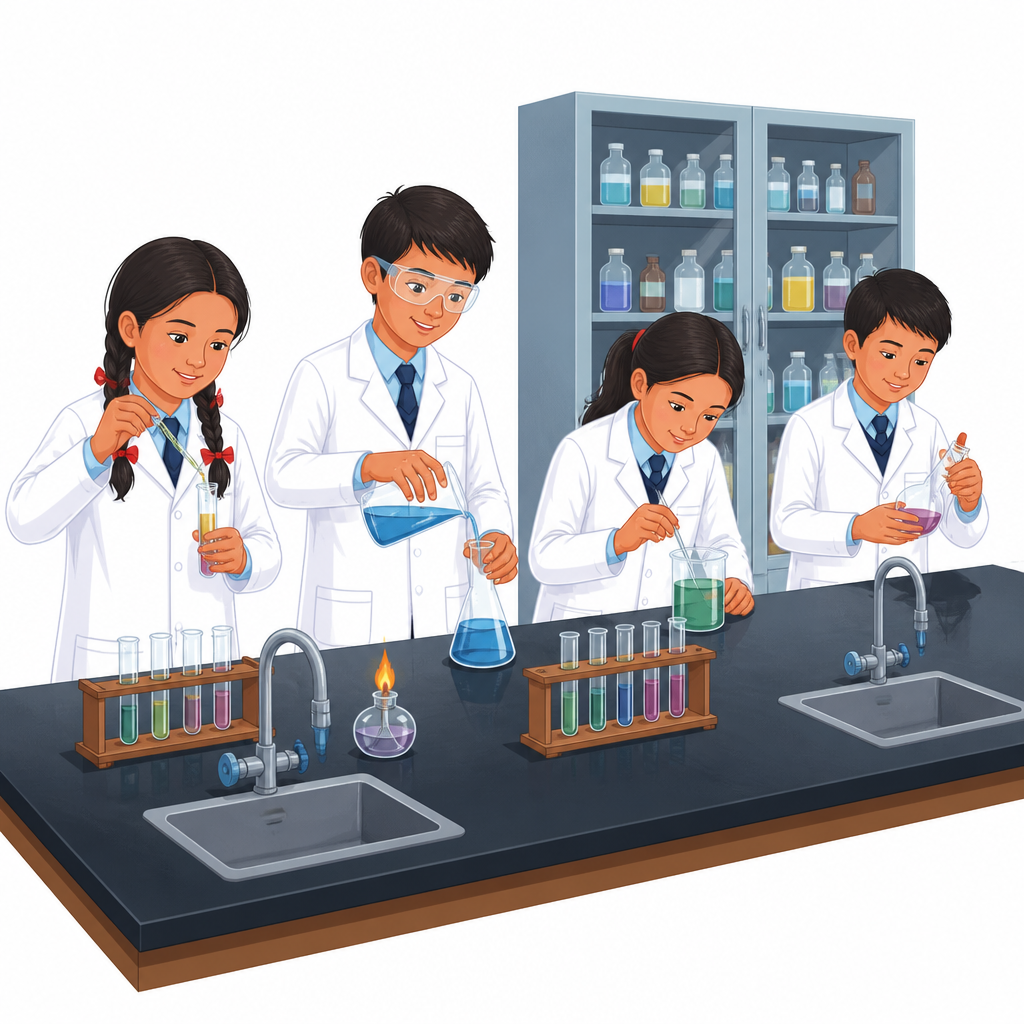
In a school laboratory, students observe, test and experiment with the facts, the principles, the objects and the substances they are studying in science. What happens to water when it is heated, whether a substance is an acid or a base, what the cells of a leaf look like: these are seen here with your own eyes. Work of that kind asks you to pay attention to a great many things at once.
The Signs on the Laboratory Wall
A science laboratory has notices with signs on them fixed to its walls. A notice like that carries very few words, because a single picture says the whole thing. A red circle with a slanting bar across it means that the action shown must not be done. A sign showing a piece of equipment means that the equipment must be worn. Look at the signs in your own laboratory and talk with your friends about what each one is telling you to do.
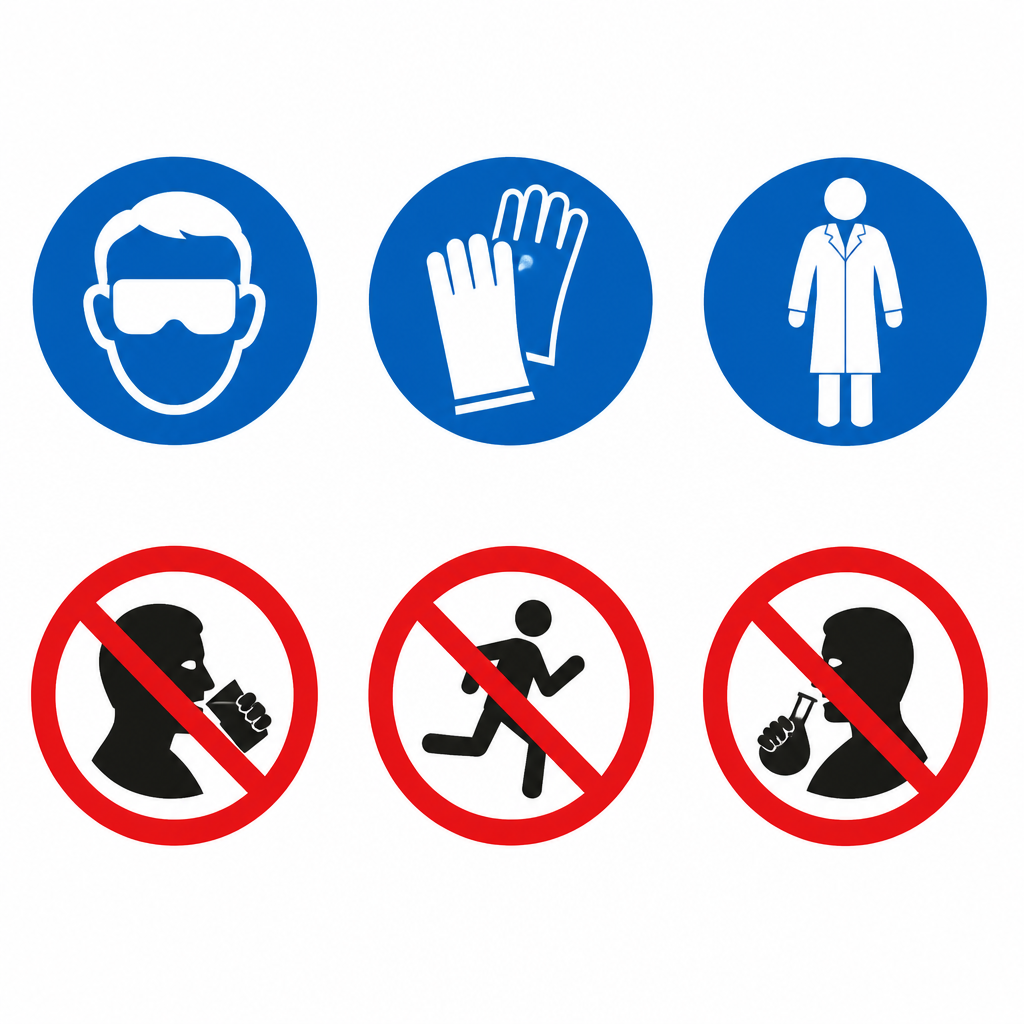
Some of those signs are about your mouth and your nose. Almost every laboratory carries a sign against tasting a chemical or sniffing at one, because that is the mistake students repeat most often.

Why Care Matters in the Laboratory
When scientific work is done in a careless way, without following the safety rules, two different things go wrong. The first is an accident: a burnt hand, a broken piece of glass, a chemical on the skin or in the eye. The second is quieter but just as serious: the result of the observation, the test or the experiment is affected.
Students usually forget the second one. A test tube that was not washed gives a false result. A quantity measured roughly leads to a conclusion that is wrong. So working cleanly, in order, and by the rules is not only about staying safe. It is how good science gets done.
Care does two jobs with one set of rules: it keeps you from being hurt, and it keeps your result honest.
Safety Rules for Practical Work
When practical work is done in a science laboratory, the following rules are generally to be followed.
- (a) Materials must not be handled carelessly.
- (b) When chemicals are used, a mask, gloves and goggles must be worn without fail.
- (c) An apron or a lab coat must be worn while working in the laboratory.
- (d) Everyone must know about the emergency door.
- (e) After the practical work is over, the hands must be washed well with soap and water.
- (f) Eating and drinking are not done in the laboratory.
- (g) No chemical in the laboratory is to be tasted or smelled.
- (h) Playing and teasing one another in the laboratory is not done.
- (i) Practical work in the laboratory must be done by the prescribed method.
- (j) Special care must be taken when heat is being used or a hot object is being touched.
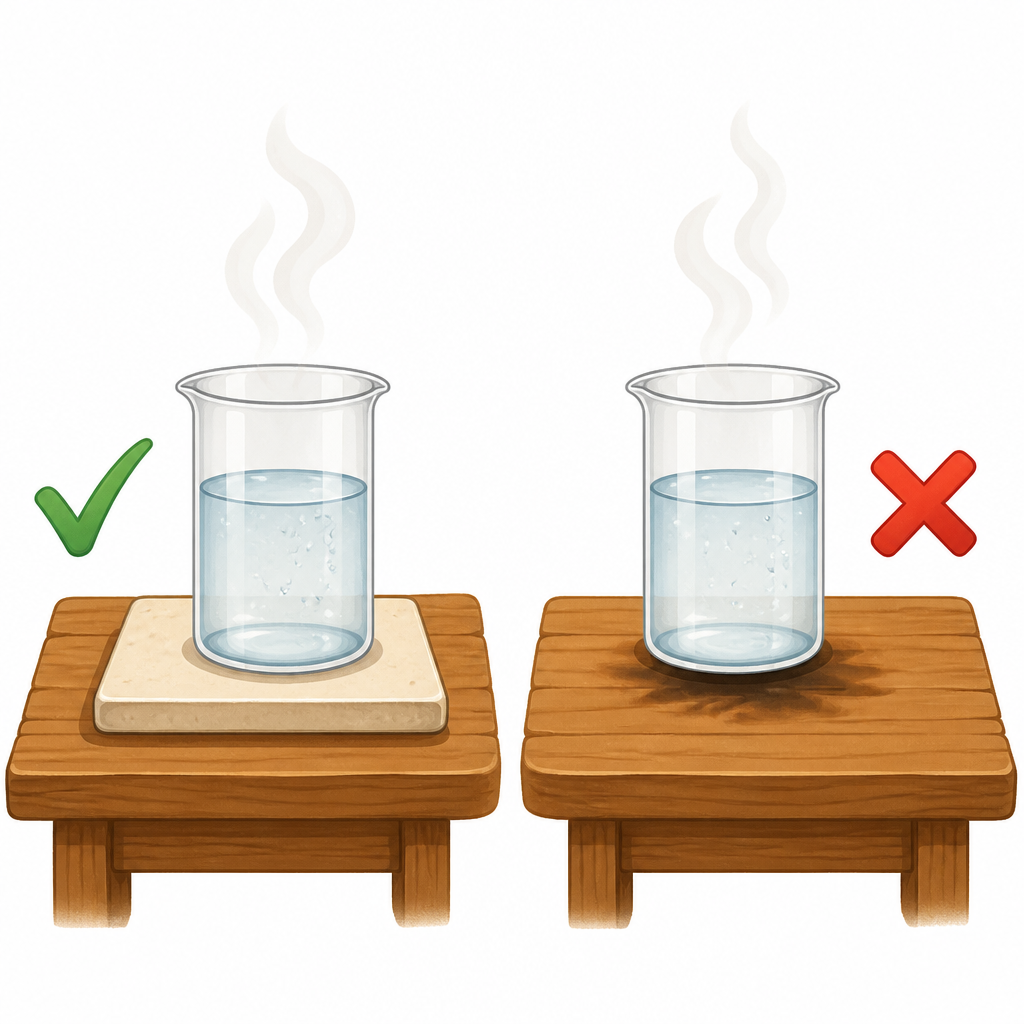
- (k) Apparatus that has been heated must not be placed straight down on the table.
Do not taste any chemical in the laboratory, and do not hold one near your face to smell it. A bottle with no label on it is more dangerous still. Do not eat or drink there either, because particles of a chemical can settle on your food.
When you work with chemicals, different parts of your body are protected by different things. The four below work as a set, and the protection is complete only when all four are on.
A mask keeps fumes and vapour out of your nose and mouth.
Gloves keep chemicals off the skin of your hands.
Goggles keep splashes out of your eyes.
An apron or lab coat protects your body and your clothes.
Apron or lab coat: a long covering garment worn over your own clothes while working in a laboratory.
Emergency door: a door made so that everyone can get out of the laboratory quickly if there is a fire or another accident.
Heat is where the greatest care is needed. A hot test tube or a hot beaker looks exactly like a cold one, so it must never be tested by touching it. Apparatus that has been heated will damage the table, or crack, if it is set straight down on it. Keep the flame of a spirit lamp turned away from people, and never point the open mouth of a test tube at yourself or at a friend.
Hot apparatus looks the same as cold apparatus. Never check by touching it to find out. Do not set heated apparatus straight down on the table, and always lift it with tongs or a holder.
Before, During and After: The Rules in Order
These rules are easier to hold on to when they are sorted by the moment at which you use them. The same order comes round in every practical you ever do.
| When | What you do |
| Before you begin | Put on the apron or lab coat; add mask, gloves and goggles if chemicals are involved; read the prescribed method; know where the emergency door is. |
| While you work | Handle materials properly; follow the prescribed method; no eating or drinking; no tasting or smelling chemicals; no playing about; take special care with heat. |
| After you finish | Do not set heated apparatus straight on the table; put every item back in its place; clean the bench; wash your hands well with soap and water. |

Playing about and teasing one another turns a small room into a dangerous one. One push and glass breaks, a chemical spills, a spirit lamp goes over. So the laboratory is worked in quietly and in an orderly way, and no chemical or piece of apparatus is touched without the teacher's instruction.
The full lesson is waiting for you
The notes are free to read in full. A free account opens the rest of the practice, and tracks your progress and confidence score for every subject. Presentations and videos need approval from Learn Yeti.