Heat at Home: Four Precautions and Their Reasons
Every kitchen is a small physics laboratory. We are told not to hold a hand over a boiling pot, not to pour boiling water into a cold glass in winter, not to leave a glass bottle full of water in the deep freeze, and not to lift a hot steel lid with bare fingers. These are not just household rules. Each one has a scientific reason, and the reasons all rest on one idea: the tiny particles that make up every substance are always moving, and heating them makes them move faster.
First precaution: do not put your hand over boiling water. In steam, the water molecules move very rapidly, so each one carries a lot of kinetic energy. When these fast molecules strike the skin, they easily penetrate it and burn the inner parts, not just the surface. That is why a burn from steam causes so much pain.
Never hold your hand or face over a pot of boiling water. When pouring from a kettle, pour so that the steam rises away from you.
Second precaution: do not pour boiling water into a thick glass tumbler in winter. The moment boiling water touches the inside of a cold, thick glass, the inner layer heats up and its volume increases. The heat from the inner part cannot be transferred to the outer part quickly, so the outer layer stays cold and does not expand. The swelling inner part creates pressure on the outer part, and that pressure cracks the glass.
Third precaution: do not keep a glass bottle full of water in the deep freeze. When the water freezes, its volume increases. The ice needs more room than the water did, the glass cannot stretch to give it that room, and so the bottle cracks.
Fourth precaution: do not take out a steel plate covering cooking food with bare hands. When different objects are heated, their temperatures do not rise at the same rate. The temperature of steel rises very quickly. For the same reason, if boiling water is poured into a steel glass we are holding, the temperature of the glass increases instantly and burns our hand.
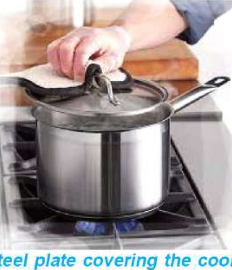
Use a dry cloth or a pot holder to lift a hot lid or pan handle.
Molecules Are Always Moving
Matter consists of a very large number of atoms or molecules, and these particles are always in motion. Even in a glass of water standing still on a table, the water molecules are moving about in every direction all the time. How fast they move depends on how hot the water is.
We cannot see molecules, but we can watch what they push around. Add an equal amount of food colouring or abir to three beakers holding boiled water, tap water and cold water from the refrigerator. The colour spreads fastest in the boiled water and slowest in the cold water. The colour particles are knocked about by the water molecules around them, so the faster the colour spreads, the faster the water molecules must be moving.
Anything that moves has energy because of its motion, called kinetic energy, and molecules are no exception. The kinetic energy of the molecules in lukewarm water is greater than that of the molecules in cold water. The molecules in hot water move even faster than those in lukewarm water. When water is boiled, the external energy supplied by the stove is what makes its molecules move faster.
Thermal Energy
Thermal energy: the sum of the kinetic energy of the molecules of a substance.
Because thermal energy is a total, it grows in two ways: when each molecule moves faster, and when there are more molecules to add up. Take equal masses of hot water, tap water and cold water. With equal masses, each sample has the same number of molecules, so the only difference between them is how fast those molecules move. Their thermal energy is ranked like this:
- Hot water: the fastest molecules, so the highest thermal energy.
- Tap water: molecules of medium speed, so medium thermal energy.
- Cold water: the slowest molecules, so the lowest thermal energy.
Imagine cooling a substance so far that its molecules have no kinetic energy left at all. It would then have zero thermal energy. That lowest possible temperature has its own name.
Absolute zero temperature: a theoretically considered state of zero thermal energy.
\[ 0\ \text{K} = -273.15\ ^\circ\text{C} \]
This state is theoretical: it is worked out by reasoning rather than reached in a laboratory. The zero of the kelvin scale sits exactly here, which is why a temperature in kelvin is never negative.
Temperature
Inside a beaker of water, the molecules do not all move at the same speed. Some are fast, some are slow, and each one speeds up or slows down as it collides with others. So the kinetic energy of all the atoms or molecules of a substance is not equal at any time. That is why their average kinetic energy is important. The average kinetic energy of the atoms or molecules of a substance determines its temperature.
Temperature: an index of the average kinetic energy of the molecules in a substance. The higher the average kinetic energy, the higher the temperature.
The SI unit of temperature is the kelvin (K), but the degree Celsius (°C) is the most commonly used unit. Temperature is measured using a thermometer. When a doctor checks for fever or a weather report gives the day's temperature, the reading is in degrees Celsius.
The kelvin is the unit of temperature, not of heat. Heat is a form of energy, so like every other form of energy its SI unit is the joule (J).
Temperature and Thermal Energy Are Not the Same
A small pan of water is boiling on the stove at 100 °C. Beside it stands a big bucket of lukewarm water at 30 °C. Which one has more thermal energy?
The pan is at the higher temperature, so the average kinetic energy of its molecules is much higher than that of the molecules in the bucket. But the number of water molecules in the pan is much less than in the bucket. When the kinetic energies of all the molecules are added up, the bucket's enormous number of slower molecules gives a bigger total than the pan's small number of fast ones. So the lukewarm water in the bucket has more thermal energy than the boiling water in the pan.
A comparison with money makes this clear. Ten people who each carry 100 rupees have 1,000 rupees between them. Two hundred people who each carry 30 rupees have 6,000 rupees between them. The first group has more money per person, just as the pan has more energy per molecule. The second group has more money in total, just as the bucket has more thermal energy in total.
The thermal energy of a substance depends on its mass and the average speed of its molecules. Temperature depends only on the average kinetic energy of the molecules, not on how many molecules there are.
Heat
Now pour the boiling water from the pan into the bucket of lukewarm water. The fast molecules of the boiling water collide with the slower molecules of the lukewarm water and pass on some of their energy. Thermal energy is transferred from the boiling water to the lukewarm water. Energy moving in this way has its own name.
Heat: the amount of thermal energy transmitted from one place to another due to a temperature difference.
Like other types of energy, the SI unit of heat is the joule (J). Heat can be measured using a calorimeter.
Heat is not stored in any object. An object has thermal energy, and heat is only the quantity of that energy transferred from one object to another. When heat is transmitted, the thermal energy of one object decreases and that of the other increases. Therefore the temperature of one object decreases and that of the other increases. In the mixed water above, the boiling water cools down and the lukewarm water warms up.
In everyday talk people say 'this tea has a lot of heat in it'. In science that is not correct. The tea has thermal energy and a high temperature. Energy is called heat only while it is passing from one object to another.
Heat is transmitted by three methods: conduction, convection and radiation.
Why Things Feel Hot or Cold
Our skin does not measure temperature directly. It senses which way heat is flowing. When we touch an object and heat enters our body from it, the object feels hot. When heat leaves our body and goes into the object, the object feels cold.
This explains a surprising experience. Dip the fingers of one hand in lukewarm water and the fingers of the other hand in cold water from the refrigerator. After a minute, put all the fingers into one beaker of tap water. The hand that was in lukewarm water feels the tap water as cold, because heat now leaves that hand. The hand that was in cold water feels the same tap water as warm, because heat now enters that hand. The water is the same; the feelings are opposite.
Thermal Equilibrium
Heat flows from a body at a higher temperature to a body at a lower temperature until both attain the same temperature. Once the temperatures are equal, the molecules of both bodies have the same average kinetic energy, and no more heat flows between them.
Thermal equilibrium: the state in which two bodies in contact have reached the same temperature, so heat no longer flows between them.
A cup of hot tea left on a table is an everyday example. Heat flows from the tea into the cooler air and table around it. The tea cools, and after a while it reaches the temperature of the room. The tea and the room are then in thermal equilibrium. The same happens when the pan of boiling water is mixed into the bucket: the mixture ends up at a single temperature.
Thermal Energy, Temperature and Heat Side by Side
| Point | Thermal energy | Temperature | Heat |
| What it is | Sum of the kinetic energy of the molecules | Index of the average kinetic energy of the molecules | Thermal energy transferred because of a temperature difference |
| Depends on | Mass and average speed of the molecules | Average kinetic energy of the molecules only | A temperature difference between two bodies |
| Held by an object? | Yes | It describes the object | No, it is only transferred |
| SI unit | joule (J) | kelvin (K) | joule (J) |
| Measured with | No single instrument reads it directly | Thermometer | Calorimeter |
The full lesson is waiting for you
The notes are free to read in full. A free account opens the rest of the practice, and tracks your progress and confidence score for every subject. Presentations and videos need approval from Learn Yeti.