What a thermometer does
Dip one hand in cold water and the other in hot water for a minute. Then put both hands into a bowl of lukewarm water. The same water feels warm to one hand and cool to the other. Our skin can only tell whether something is hotter or colder than the skin itself. It cannot give a number, and it is easily fooled. Temperature is the degree of hotness or coldness of a body, and to measure it properly we need an instrument that gives the same reading every time. That instrument is a thermometer.
Thermometer: a device used to measure the temperature of a body.
Every thermometer works on the same idea. It contains something whose property changes in a regular way when the temperature changes. In one kind a liquid expands, in another the electrical resistance of a material changes, and in a third the amount of infrared radiation given off by a body is measured. The thermometer turns that change into a reading on a scale or a number on a screen. Three types are common in daily life: the liquid in glass thermometer, the digital thermometer and the radiation thermometer.
Every thermometer measures one property that changes regularly with temperature, and turns that change into a temperature reading.
Liquid in glass thermometer
This thermometer is a thin glass tube with a small heat sensitive bulb at one end. The bulb holds a thermometric liquid, which is usually mercury. The tube attached to the bulb has a bore as narrow as a hair, so it is called a capillary tube. Because the bore is so narrow, even a tiny expansion of the liquid makes its thread move a clearly visible distance along the tube.
Thermometric liquid: the liquid inside a thermometer whose expansion and contraction show the temperature, such as mercury or alcohol.
When the bulb touches a hot object, heat flows from the object into the mercury. The mercury expands, and the expanded mercury moves forward through the capillary tube. The point where the mercury stops after expanding shows the temperature of the object, and we find its value by reading the scale marked on the outer wall of the tube. When the bulb is placed in something cold, the mercury contracts and its thread falls back down the tube.
Mercury is chosen as the thermometric liquid for these reasons:
- It is a good conductor of heat, so it takes heat from the object quickly and the bulb soon reaches the object's temperature.
- It is a high density liquid.
- It is shiny and opaque, so its thread is easy to see even inside a very narrow tube.
- It does not stick to glass, so it leaves no drops on the wall of the tube when it falls.
Mercury is poisonous. If a thermometer breaks, do not touch the mercury, do not bend close to it and breathe near it, and tell a teacher or a parent at once.
Digital thermometer
A digital thermometer contains no mercury. Instead it uses a heat sensitive thermistor connected to an electric circuit. A thermistor is a small component whose electrical resistance changes when its temperature changes.
Thermistor: a heat sensitive electrical component whose resistance changes as its temperature changes.
A digital thermometer measures temperature like this:
- The thermometer is switched on.
- The end holding the thermistor is placed in contact with the body.
- Heat from the body changes the resistance of the thermistor.
- Because the resistance changes, the electric current in the circuit changes.
- Based on this change in current, the measured temperature is shown as a number on the display panel.
There is no scale to read, because the answer appears directly as a number. It also contains no poisonous mercury, which is why homes and health posts now use it more and more for checking fever.
Radiation thermometer
Every warm body gives off infrared radiation, which our eyes cannot see. The hotter the body, the greater the intensity of the infrared radiation it gives off. A radiation thermometer works on the intensity of this radiation, and it measures the temperature of a body without touching it.
A radiation thermometer is used like this:
- The sensor of the device is turned towards the body.
- A lens inside the device focuses the infrared radiation coming from the body onto the sensor.
- Based on the heat carried by the radiation, the sensor produces electrical signals.
- From these signals, the temperature of the body is shown on the display panel.
This thermometer measures temperature very quickly and easily. Since it never touches anything, it is especially useful for checking many people one after another at the gate of a school or hospital, and for measuring objects too hot to touch.
Comparing the three thermometers
| Thermometer | What changes | Must it touch the body? | How the reading is shown |
| Liquid in glass | The mercury expands | Yes | On the scale marked on the glass |
| Digital | Resistance of the thermistor, so the current | Yes | As a number on a display |
| Radiation | Intensity of infrared radiation reaching the sensor | No | As a number on a display |
Calibration of a thermometer
A glass tube freshly filled with mercury has no marks on it. The mercury moves up and down, but nobody can say what its position means. It becomes a thermometer only when a scale is marked on it. The process of determining the scale of a thermometer is called calibration.
Calibration: the process of determining the scale of a thermometer. Two fixed points are found first, and the distance between them is then divided into a chosen number of equal parts.
Lower fixed point: the temperature of melting ice, taken as 0°C on the Celsius scale.
Upper fixed point: the temperature of the steam just above the surface of water boiling at one atmospheric pressure, taken as 100°C on the Celsius scale.
On the Celsius scale, the distance between these two points is divided into 100 equal parts, so each part stands for one degree:
\[ \frac{100^\circ\text{C} - 0^\circ\text{C}}{100} = 1^\circ\text{C} \]
A Celsius scale is marked on a blank thermometer in this order:
- The scale of the thermometer is covered by pasting white paper over it, so that the new marks can be written on the paper.
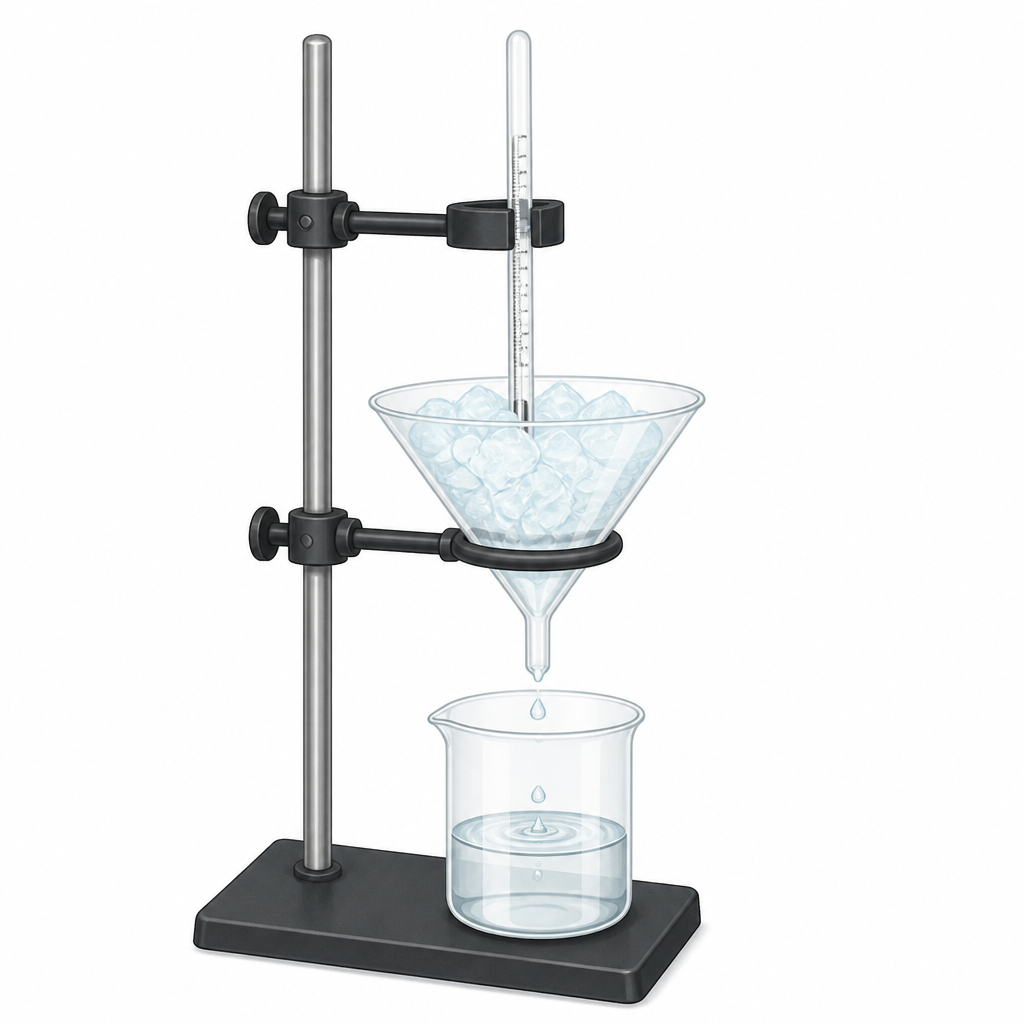
- The bulb is put into melting ice and held on a stand for a while. The mercury is watched as it falls in the capillary tube, and where it stops a mark is made and 0°C is written.
- The bulb is then held in the steam coming from water boiling at one atmospheric pressure. The mercury is watched as it rises, and where it stops a mark is made and 100°C is written.
- The space between the two marks is divided into equal parts. With 100 parts, each part is 1°C. For a rough scale, drawing 9 lines makes 10 parts, and each part is 10°C.
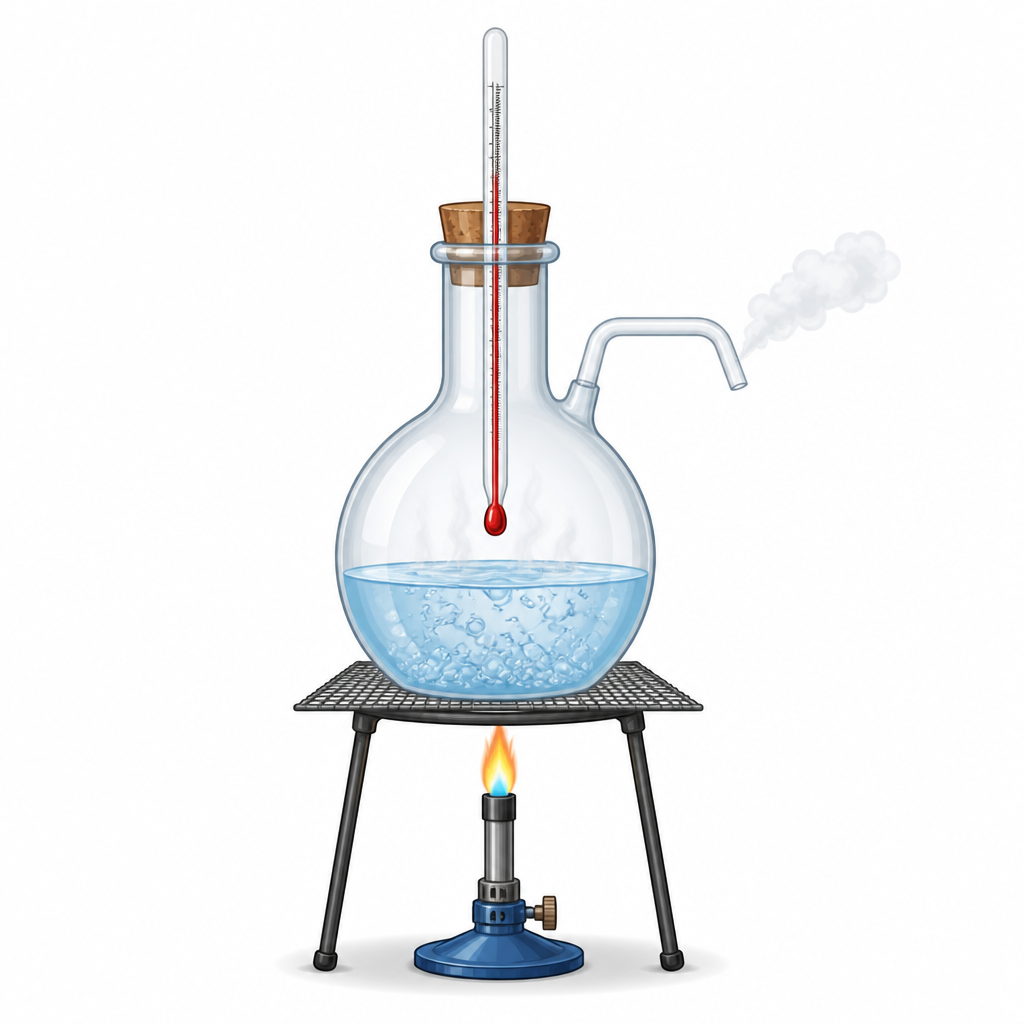
Steam from boiling water can burn even more badly than the boiling water itself. Keep your hands out of the steam, hold the thermometer with a stand, and light the burner only with a teacher watching.
Why melting ice and steam are chosen
A fixed point must be a temperature that can be produced easily anywhere and that stays steady for a while. While pure ice is melting, the heat it receives is used up in melting it, so the temperature stays at 0°C until all the ice has melted. That is why melting ice makes a good lower fixed point.
For the upper fixed point the bulb is held in the steam, not dipped into the boiling water. Impurities dissolved in water raise the temperature at which it boils, but they do not change the temperature of the steam just above the surface. Pressure matters too. At lower pressure, such as high in the mountains, water boils below 100°C. So the upper fixed point is always stated as the steam above water boiling at one atmospheric pressure.
Fixed points on the Celsius, Fahrenheit and Kelvin scales
All three scales use the same two temperatures: melting ice and steam at one atmospheric pressure. What differs is the number each scale gives to those two temperatures, and how many parts the gap between them is divided into.
| Scale | Lower fixed point | Upper fixed point | Equal parts between them |
| Celsius | 0°C | 100°C | 100 |
| Fahrenheit | 32°F | 212°F | 180 |
| Kelvin | 273 K | 373 K | 100 |
A Kelvin reading is written without the degree sign, so 273 K is read as two hundred and seventy three kelvin. Both the Kelvin and Celsius scales divide the gap between the fixed points into 100 parts, so one kelvin is the same size as one degree Celsius. The Fahrenheit scale divides the same gap into 180 parts, so one degree Fahrenheit is smaller than one degree Celsius.
The upper fixed point of the Fahrenheit scale is 212°F. The number 180 is how many parts lie between the two fixed points, not a fixed point itself. Adding 180 to 32 gives 212.
Reading one scale against another
Because all three scales mark the same two temperatures, any temperature sits the same fraction of the way from the lower fixed point to the upper fixed point on every scale. This gives the relation:
\[ \frac{C - 0}{100} = \frac{F - 32}{180} = \frac{K - 273}{100} \]
Example: The temperature of a healthy human body is 37°C. Convert it to the Fahrenheit and Kelvin scales.
Step 1: Writing the relation between the scales:
\[ \frac{C}{100} = \frac{F - 32}{180} = \frac{K - 273}{100} \]
Step 2: Taking the Celsius and Fahrenheit parts and putting \( C = 37 \):
\[ \frac{37}{100} = \frac{F - 32}{180} \]
Step 3: Multiplying both sides by 180:
\[ F - 32 = \frac{37 \times 180}{100} = 66.6 \]
Step 4: Adding 32 to both sides:
\[ F = 66.6 + 32 = 98.6 \]
So 37°C is the same temperature as 98.6°F.
Step 5: Taking the Celsius and Kelvin parts and putting \( C = 37 \):
\[ \frac{37}{100} = \frac{K - 273}{100} \]
Step 6: The denominators are equal, so the numerators are equal. Adding 273 to both sides:
\[ K = 37 + 273 = 310 \]
So normal body temperature is 37°C, 98.6°F and 310 K. The three numbers are different, but the temperature is exactly the same.
When converting to Fahrenheit, do not stop before adding 32. The 66.6 from \( 37 \times 180 \div 100 \) is not yet the answer, because the Fahrenheit scale starts at 32, not at 0.
The full lesson is waiting for you
The notes are free to read in full. A free account opens the rest of the practice, and tracks your progress and confidence score for every subject. Presentations and videos need approval from Learn Yeti.