How Particles Sit in Solids, Liquids and Gases
Every substance is made of tiny particles called atoms and molecules. What makes a solid different from a liquid or a gas is how close together these particles are and how freely they can move. Compare the distances between the particles in the three states.
- In a solid, the particles are packed close together in a fixed pattern. A strong force of attraction holds each one in its place. Even so, they are never completely still. They keep vibrating about their positions all the time.
- In a liquid, the particles are still close, but the attraction between them is weaker. They can slide past one another, which is why a liquid flows and takes the shape of its container.
- In a gas, the particles are far apart and rush about quickly in all directions. The attraction between them is very weak.
So even in a solid there is space between the particles, and the particles are always moving. That space and that movement are the key to understanding what heat does to the volume of a substance.
Why Heating Makes Matter Expand
When a solid is heated, its particles take in energy. With more energy they vibrate faster and swing further. As heating continues they vibrate rapidly, and each particle pushes harder against its neighbours. The force of attraction can no longer hold them as tightly as before, so the particles move a little further apart. The same number of particles now takes up more space. In other words, the volume of the object increases.
Expansion: the increase in the length, area or volume of a substance when it is heated.
No particle in the picture has grown. The particles keep their size, and only the gaps between them get wider. Add up a tiny extra gap between millions of particles and the whole object becomes measurably larger.
A heated iron rod gets longer because the spaces between its particles grow, not because each particle swells. The number of particles and their size stay the same.
Liquids and gases expand on heating for the same reason. Their particles are held less tightly than those of a solid, so they expand even more. This is why the liquid inside a thermometer climbs up its narrow tube when the thermometer gets warmer.
Why Cooling Makes Matter Contract
Cooling works the other way round. When an object gives out thermal energy, the average speed of its particles decreases. Since temperature depends on the average kinetic energy of the particles, the temperature of the object falls. The slower particles are pulled closer together by their force of attraction, and the object contracts.
Contraction: the decrease in the length, area or volume of a substance when it is cooled.
Most substances expand when their temperature increases and contract when their temperature decreases.
You can see this at home. If the metal lid of a glass jar is stuck, pour hot water over the lid alone. The metal expands more than the glass does, so the lid loosens a little and turns easily.
Seeing Expansion with a Ball and Ring
A simple test makes expansion visible. You need an iron ball with a small hook and an iron ring of similar size that the cold ball just fits through. At room temperature the ball slips through the ring easily. After the ball has been heated in a flame for some time, it no longer goes through. It sits stuck on top of the ring. Once the ball is left to cool down, it slips through again.
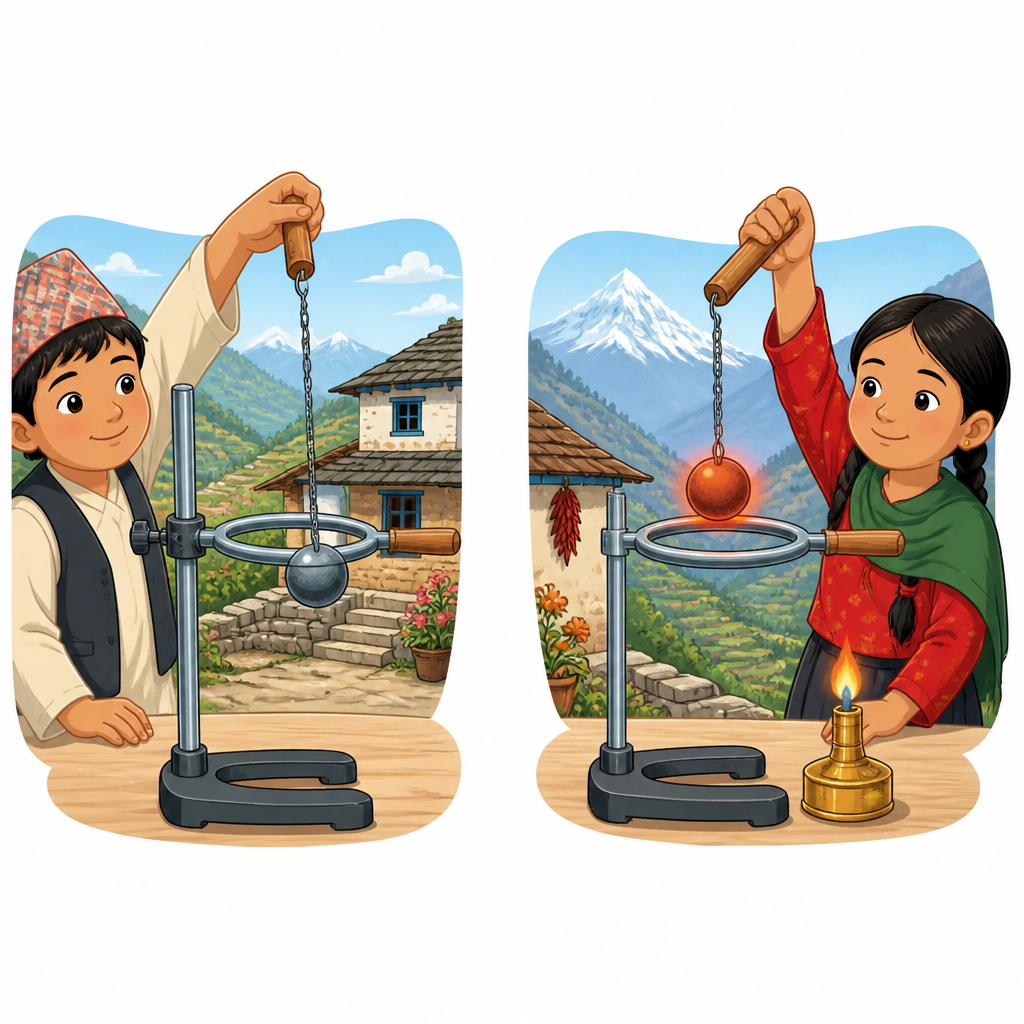
The heated ball stays hot for a long time. Hold it only by its hook, using tongs or an insulated handle. Never touch the ball with your bare hand.
Heating gave the iron molecules more energy. Their speed increased and the distance between them increased, so the ball became slightly larger than the hole in the ring. On cooling, the molecules slowed down, came closer together again, and the ball returned to its original size.
Anomalous Expansion of Water
Most substances obey the rule above. Water above 4°C obeys it too: heat it and it expands, cool it and it contracts, just like any other liquid. Between 0°C and 4°C, however, water behaves in exactly the opposite way.
- When water at 0°C is heated to 4°C, its volume decreases instead of increasing.
- When water at 4°C is cooled towards 0°C, its volume increases instead of decreasing.
Water has its smallest volume and its greatest density at 4°C.
Anomalous expansion of water: the unusual property of water by which it contracts when heated from 0°C to 4°C and expands when cooled from 4°C to 0°C.
Why does the smallest volume mean the greatest density? Density is mass divided by volume, \( \rho = \frac{m}{V} \). Take 1 kg of water. Its mass does not change with temperature, so when its volume is smallest, the same mass is squeezed into the least space and its density is highest. At 4°C, 1 kg of water takes up about 1000 cm³, which gives a density of about 1 g/cm³.
As water cools below 4°C, its molecules begin to settle into an open pattern with a lot of empty space inside it, the same pattern they have in ice. That is why water swells as it gets close to freezing. Ice takes up more room than the water it came from, so its density is lower than that of water, and ice floats.
The densest water is not at 0°C. It is at 4°C. Ice is not denser than water either. Ice floats precisely because its density is lower than that of water.
Reading the Volume and Density Graphs of Water
Two graphs make this behaviour easy to see. The first shows how the volume of 1 kg of water changes with temperature. The second shows how the density of water changes with temperature. Both have temperature from 0°C to 10°C along the horizontal axis.
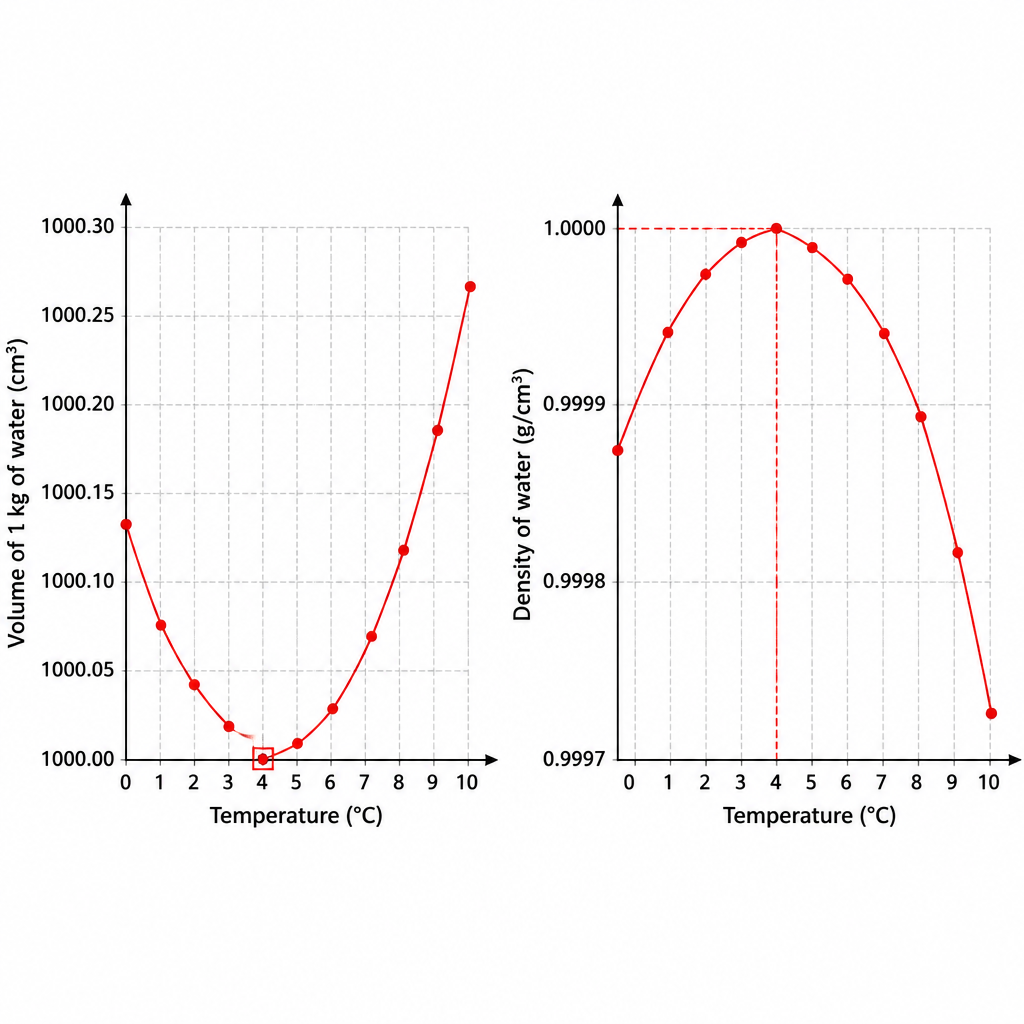
- The volume graph is shaped like the letter U. Starting at 0°C, the volume falls as the temperature rises, reaches its lowest point at 4°C, and then rises steadily as the temperature goes on increasing.
- The density graph is the upside down version, shaped like a hill. Density rises from 0°C, reaches its peak of about 1.0000 g/cm³ at 4°C, and falls away on both sides of it.
This means that if water at 4°C is either heated or cooled, its volume increases and its density decreases. Because the mass stays the same, the point where volume is lowest is exactly the point where density is highest. The table below puts this together.
| Change in temperature | Volume | Density |
| Heating from 0°C to 4°C | Decreases | Increases |
| Heating above 4°C | Increases | Decreases |
| Cooling from 10°C to 4°C | Decreases | Increases |
| Cooling from 4°C to 0°C | Increases | Decreases |
How Fish Survive a Frozen Winter
In very cold places, the temperature of the surroundings drops below 0°C in winter. As the air cools, the water in lakes and ponds also starts to cool from the top. The pond then settles into layers like this:
- The surface water cools. Cooler water is denser, so it sinks, and slightly warmer water from below rises to take its place.
- This goes on until the whole pond has reached 4°C. Water at 4°C is the densest of all, so it settles at the bottom.
- Now, when the surface water cools below 4°C, it becomes lighter, not heavier. So it no longer sinks and stays at the top.
- Layers form: 4°C at the bottom, then 3°C, 2°C, 1°C and 0°C going upwards.
- The top layer at 0°C freezes into ice. Ice is lighter than water, so it floats as a sheet on the water below.
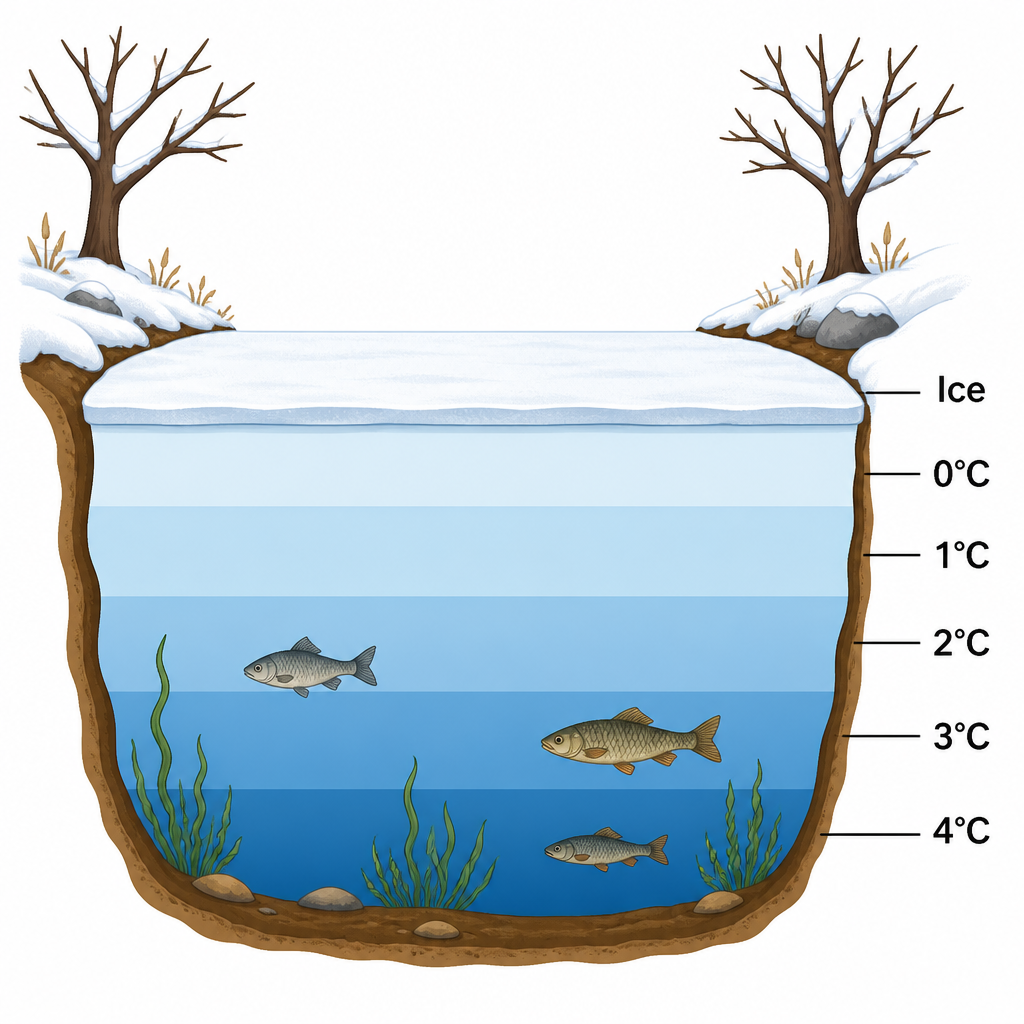
Under the ice, the water near the bottom stays liquid at about 4°C. Fish and other aquatic creatures can live there right through the winter. If water behaved like other liquids, the coldest water would sink, the pond would freeze from the bottom upwards, and the living things in it could not survive.
Why Water Pipes Burst in Winter
The same property can also do damage. In winter in very cold places, as the temperature of the surroundings slowly falls, the water inside a pipe cools too. Once it goes below 4°C its volume starts to increase, and it presses on the inner wall of the pipe. When the water freezes into ice, the pressure becomes very high and the pipe can crack or burst.
For the same reason, a bottle filled with water and kept in a deep freezer cracks. The ice needs more room than the water did, and the glass cannot stretch to make that room.
Do not put a closed glass bottle filled to the top with water in the freezer. When the water freezes the bottle can crack and leave sharp pieces of glass.
The full lesson is waiting for you
The notes are free to read in full. A free account opens the rest of the practice, and tracks your progress and confidence score for every subject. Presentations and videos need approval from Learn Yeti.