Why Some Things Get Hot Faster Than Others
On a sunny afternoon, put a few ordinary things side by side in the sun and leave them there for 15 to 20 minutes: a steel plate and a ceramic plate, a wooden chair and a plastic chair, a heap of dry sand and a heap of soil, a steel tumbler and a glass tumbler. Every object gets sunlight for exactly the same time. Yet when you touch them, they are not equally hot. The steel plate is much hotter than the ceramic one, the sand is hotter than the soil, and the steel tumbler is hotter than the glass tumbler.
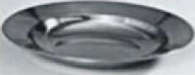
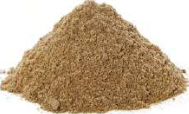
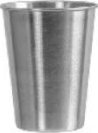
So the same sunshine does not raise the temperature of every substance by the same amount. Some materials take in heat and their temperature shoots up. Others take in the same heat and their temperature rises only a little. Even objects made of the same material can absorb heat at different rates and in different amounts, depending on their shape and the state they are in. A thin steel sheet, for example, heats up much faster than a thick block of the same steel.
What Decides How Much Heat a Substance Absorbs
The quantity of heat a substance absorbs while it warms up depends on three things:
- its mass: more matter needs more heat
- the change in its temperature: a bigger rise needs more heat
- the nature of the material: water, iron and sand each need a different amount of heat for the same warming
Heat is written as Q and measured in joules (J). Mass is written as m and measured in kilograms (kg). If the temperature starts at \( T_1 \) and ends at \( T_2 \), the change in temperature is \( T_2 - T_1 \), measured in degrees Celsius (°C).
Heat, Mass and Temperature Change
The first two factors can be tested with water, two beakers and two heat sources of the same capacity. Because the sources are identical, each gives out heat at the same rate, so the time a source runs tells us how much heat the water has received. Twice the heating time means twice the heat.
First, 200 g of water and 400 g of water at the same starting temperature are heated until each has risen by 10 °C. The 400 g beaker needs about twice as long, so it absorbs about twice as much heat. For the same rise in temperature, the heat absorbed is directly proportional to the mass:
\[ Q \propto m \quad (\mathrm{i}) \]
Next, only the 400 g of water is heated, once until its temperature rises by 10 °C and once until it rises by 20 °C. The 20 °C rise takes about twice as long, so it needs about twice the heat. For the same mass, the heat absorbed is directly proportional to the change in temperature:
\[ Q \propto (T_2 - T_1) \quad (\mathrm{ii}) \]
More mass needs more heat. A bigger temperature rise needs more heat. The same rules work in reverse: a substance that cools down gives out heat in the same proportions.
The Heat Equation
Step 1: Putting relations (i) and (ii) together, the heat depends on mass and temperature change at once:
\[ Q \propto m(T_2 - T_1) \]
Step 2: Replacing the proportional sign with an equals sign by bringing in a constant, written s:
\[ Q = ms(T_2 - T_1) \quad (\mathrm{iii}) \]
The constant s depends only on what the substance is. It is called the specific heat capacity of the substance. Equation (iii) says that the heat absorbed or released by a substance equals the product of its mass, its specific heat capacity and its change in temperature. It works for warming and for cooling alike.
Heat equation: The heat absorbed or released by a substance is equal to the product of its mass (m), its specific heat capacity (s) and its change in temperature \( (T_2 - T_1) \), that is \( Q = ms(T_2 - T_1) \).
- Q is the heat absorbed or released, in J
- m is the mass of the substance, in kg
- s is the specific heat capacity, in J/kg°C
- \( T_1 \) is the starting temperature and \( T_2 \) the final temperature, in °C
Specific Heat Capacity
Step 1: To see what s means, the heat equation (iii) is rearranged to make s the subject:
\[ s = \frac{Q}{m(T_2 - T_1)} \]
Step 2: Taking a mass of 1 kg and a temperature change of 1 °C:
\[ s = \frac{Q}{1 \times 1} = Q \]
So s is simply the heat needed to change the temperature of exactly 1 kg of the substance by exactly 1 °C. Each substance has its own value.
Specific heat capacity: The amount of heat required to change the temperature of a substance of 1 kg mass by 1 °C is the specific heat capacity of that substance. Its SI unit is joule per kilogram per degree Celsius, J/kg°C, also written \( \mathrm{J\,kg^{-1}\,{}^{\circ}C^{-1}} \).
A substance with a high specific heat capacity heats up slowly and cools down slowly, because it must take in or give out a lot of heat for every degree. A substance with a low specific heat capacity heats up and cools down quickly.
Specific Heat Capacities of Some Substances
Specific heat capacity changes with the nature of the material. The values below are all in J/kg°C.
| Substance | Specific heat capacity | Substance | Specific heat capacity |
| Water | 4200 | Aluminium | 884 |
| Ethyl alcohol | 2400 | Iron | 460 |
| Kerosene oil | 2010 | Copper | 385 |
| Ice | 2100 | Silver | 236 |
| Mercury | 126 | Gold | 130 |
Read the first row: 4200 J of heat changes the temperature of every 1 kg of water by 1 °C. For ice, the same job takes 2100 J. Ice and water are two states of the same substance, yet their specific heat capacities are different. Water has the highest value in the table, which is why it warms up so slowly and holds its heat so long. Mercury and gold sit at the bottom: given the same heat, their temperature rises about thirty times as much as that of the same mass of water.
The table also explains the steel plate in the sun. Steel is mostly iron, and iron's specific heat capacity is less than one ninth of water's, so a little sunshine raises its temperature a lot.
Ice and liquid water are the same substance, but they do not share a specific heat capacity. In a calculation about ice, use 2100 J/kg°C, not the 4200 J/kg°C that belongs to liquid water.
Worked Example 1: Heating Water in a Kettle
An electric kettle heats 5 kg of water from 10 °C to 100 °C. How much heat energy does it use? The specific heat capacity of water is \( 4200\ \mathrm{J\,kg^{-1}\,{}^{\circ}C^{-1}} \).
Given:
- mass of water, \( m = 5\ \mathrm{kg} \)
- specific heat capacity of water, \( s = 4200\ \mathrm{J/kg^{\circ}C} \)
- initial temperature, \( T_1 = 10^{\circ}\mathrm{C} \)
- final temperature, \( T_2 = 100^{\circ}\mathrm{C} \)
Step 1: Finding the change in temperature:
\[ T_2 - T_1 = 100 - 10 = 90^{\circ}\mathrm{C} \]
Step 2: Writing the heat equation:
\[ Q = ms(T_2 - T_1) \]
Step 3: Putting in the values:
\[ Q = 5 \times 4200 \times 90 \]
Step 4: Multiplying. Since \( 5 \times 4200 = 21000 \), this becomes:
\[ Q = 21000 \times 90 = 1890000\ \mathrm{J} \]
Step 5: Writing the answer in standard form:
\[ Q = 1.89 \times 10^{6}\ \mathrm{J} \]
The kettle uses \( 1.89 \times 10^{6} \) J of heat to raise 5 kg of water from 10 °C to 100 °C.
Write the unit J with the final answer. A number of joules written without its unit is marked wrong.
Worked Example 2: Mixing Hot and Cold Water
For a bath, 5 kg of water at 100 °C is mixed with 15 kg of water at 15 °C. What is the final temperature of the mixture? Take the heat lost to the surroundings as negligible.
When hot and cold substances are mixed and no heat escapes to the surroundings, the heat released by the hot one is equal to the heat absorbed by the cold one. Both end at the same final temperature.
Given, with the final temperature taken as T:
- hot water: \( m_1 = 5\ \mathrm{kg} \), starting at 100 °C
- cold water: \( m_2 = 15\ \mathrm{kg} \), starting at 15 °C
- both are water, so \( s = 4200\ \mathrm{J/kg^{\circ}C} \) for each
Step 1: The hot water cools from 100 °C down to T, so the heat it releases is:
\[ Q_1 = m_1 s(100 - T) \]
Step 2: The cold water warms from 15 °C up to T, so the heat it absorbs is:
\[ Q_2 = m_2 s(T - 15) \]
Step 3: Setting the heat released equal to the heat absorbed:
\[ 5 \times s \times (100 - T) = 15 \times s \times (T - 15) \]
Step 4: Cancelling s from both sides, since both liquids are water, and dividing both sides by 5:
\[ 100 - T = 3(T - 15) \]
Step 5: Opening the bracket:
\[ 100 - T = 3T - 45 \]
Step 6: Moving the T terms to one side and the numbers to the other:
\[ 100 + 45 = 3T + T \]
Step 7: Adding on each side:
\[ 145 = 4T \]
Step 8: Dividing both sides by 4:
\[ T = 36.25^{\circ}\mathrm{C} \]
With no heat lost to the surroundings, the bath water settles at 36.25 °C. The answer sits much closer to 15 °C than to 100 °C because there is three times as much cold water as hot water.
Uses of Specific Heat Capacity
Water has a very high specific heat capacity. Every kilogram of water absorbs or releases 4200 J of heat for each 1 °C change in its temperature. That single fact explains a car's cooling system, the hot water bag, the steadiness of our body temperature and the winds on a sea coast.
Water as a Coolant
Coolant: A substance used to carry heat away from a hot object so that it does not overheat.
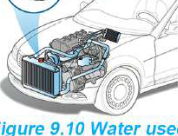
A running car engine produces a great deal of heat. Water flows through channels around the engine, absorbs this heat and carries it to the radiator at the front of the car, where moving air cools it before it goes back again. Because water's specific heat capacity is so high, it can take in a large amount of heat from the engine while its own temperature does not rise much. This makes water an effective coolant for hot objects. For the same reason, water is used as a coolant in thermal power stations that produce electricity.
Hot Water Bags and Wet Cloths
The same property works the other way when we want warmth. Hot water in a rubber hot water bag has stored a large amount of heat, and it gives that heat out slowly, over a long time, without cooling off quickly. That is why a hot water bag is used as a hot compress for soothing muscular pain. A cloth soaked in water and laid on the forehead of a person with fever works in the opposite direction: the water takes heat from the skin, and it can take a lot of heat before it becomes warm itself.
Water and Body Temperature
Water found naturally in the bodies of living things makes up about 70 to 90 percent of their body mass. Since this water must absorb or lose a great deal of heat before its temperature changes, the body does not heat up sharply on a hot afternoon or cool down sharply on a cold night. In this way, the water in the body controls body temperature.
Sea Breeze and Land Breeze
In coastal areas, the land and the seawater have very different specific heat capacities, and this keeps air circulating between the land and the sea.
During the day, the sun heats the land and the sea equally. But the specific heat capacity of land or sand is about five times less than that of water, so the temperature of the land rises faster than the temperature of the sea. The air above the ground becomes warm and light and rises, which creates low pressure above the land. Cooler air from the sea then flows in towards the land to fill the gap.
Sea breeze: The cool wind that blows from the sea towards the land during the day, because the land heats up faster than the sea.
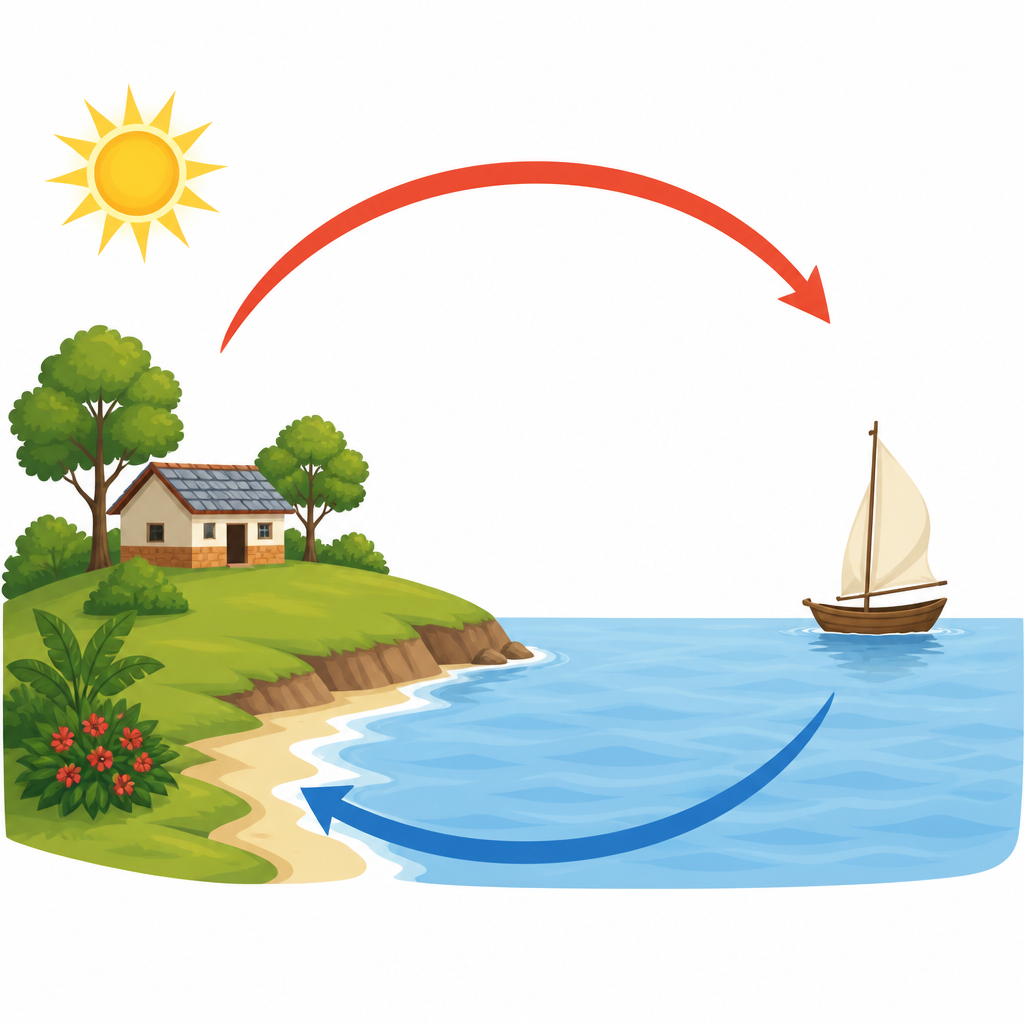
At night, both the land and the sea give out heat by radiation and their temperature falls. The land cools much faster. Because of the higher specific heat capacity of water, the sea stays warmer than the land. The warm air above the sea rises, the air pressure above the sea drops, and the cooler air from the land flows out towards the sea.
Land breeze: The cool wind that blows from the land towards the sea at night, because the land cools down faster than the sea.

So along a coast the wind changes direction between day and night: it blows from the sea to the land in the daytime and from the land to the sea at night.
The full lesson is waiting for you
The notes are free to read in full. A free account opens the rest of the practice, and tracks your progress and confidence score for every subject. Presentations and videos need approval from Learn Yeti.