Two Ways from Home to School
Suppose your home is at point A and your school is at point C. One short path runs straight from A to C. Another path takes you from A to a shop at point B, and then from the shop on to C. Both paths get you to school.
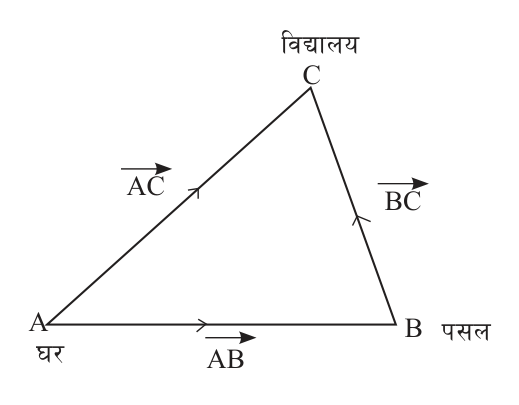
If you only count how far you walk, the two routes are not the same. The route through the shop is longer. In any triangle, the sum of two sides is greater than the third side, so the length AB plus the length BC is more than the length AC.
Now ask a different question: where did you start and where did you finish? On both routes you started at A and finished at C. As a change of position, going from A to B and then from B to C has exactly the same effect as going straight from A to C. A vector describes a change of position, with both magnitude and direction, so we write:
\[ \overrightarrow{AB} + \overrightarrow{BC} = \overrightarrow{AC} \]
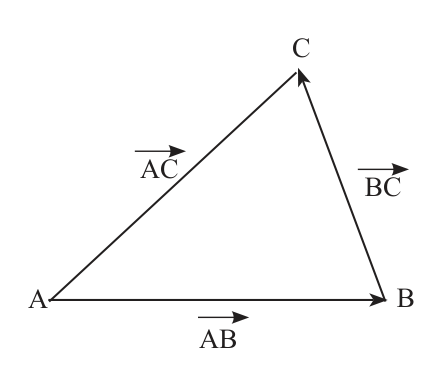
Triangle law of vector addition: when one vector ends where the next one begins, their sum is the vector from the start of the first to the end of the second. For any three points A, B and C, \( \overrightarrow{AB} + \overrightarrow{BC} = \overrightarrow{AC} \).
Adding lengths is not the same as adding vectors. As lengths, AB + BC is greater than AC. As vectors, \( \overrightarrow{AB} + \overrightarrow{BC} \) is exactly equal to \( \overrightarrow{AC} \), because only the start and the finish matter.
Vector geometry is the use of this law, together with multiplying a vector by a number, to prove facts about triangles and line segments. The facts proved here are the mid-point theorem, the position vector of a mid-point, and the two division theorems.
Position Vectors and the Vector Joining Two Points
Choose a fixed point O, the origin. The arrow from O to a point A is called the position vector of A. It is written \( \overrightarrow{OA} \), or in short with a small letter, \( \vec{a} \). When A has coordinates \( (x, y) \), its position vector has the same numbers as its components.
Position vector: the vector drawn from the origin O to a point. The position vector of A is \( \overrightarrow{OA} = \vec{a} \).
To travel from a point X to a point Y, you can go back from X to O and then out from O to Y. Going from X to O is the opposite of \( \overrightarrow{OX} \), so by the triangle law:
\[ \overrightarrow{XY} = \overrightarrow{OY} - \overrightarrow{OX} \]
Any vector joining two points is the position vector of the end point minus the position vector of the starting point. For example, \( \overrightarrow{AP} = \vec{p} - \vec{a} \) and \( \overrightarrow{PB} = \vec{b} - \vec{p} \).
Two more facts are used in the proofs that follow. First, two vectors of equal length pointing in opposite directions add up to the zero vector \( \vec{0} \). Second, if P lies on AB with AP : PB = m : n, and the vectors \( \overrightarrow{AP} \) and \( \overrightarrow{PB} \) point the same way, then cross multiplying the ratio gives the vector equation \( n\overrightarrow{AP} = m\overrightarrow{PB} \).
The Mid-point Theorem
Median: the line segment joining a vertex of a triangle to the mid-point of the opposite side. Every triangle has three medians.
Mid-point Theorem: in any triangle, the median vector drawn from a vertex to the mid-point of the opposite side is half of the sum of the vectors of the other two sides drawn from that same vertex.
In triangle ABC with D the mid-point of BC, the median from A is AD, and the theorem says:
\[ \overrightarrow{AD} = \frac{1}{2}\left(\overrightarrow{AB} + \overrightarrow{AC}\right) \]
Proving the Mid-point Theorem
Let D, E and F be the mid-points of the sides BC, CA and AB of triangle ABC. Then AD is the median from A. The idea of the proof is to reach D from A by two different routes and add them.
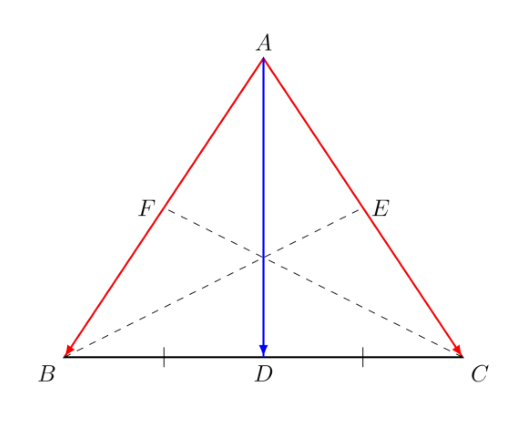
Step 1: In triangle ABD, going from A to B and then from B to D gives, by the triangle law:
\[ \overrightarrow{AD} = \overrightarrow{AB} + \overrightarrow{BD} \quad \text{(i)} \]
Step 2: In triangle ACD, going from A to C and then from C to D gives, by the same law:
\[ \overrightarrow{AD} = \overrightarrow{AC} + \overrightarrow{CD} \quad \text{(ii)} \]
Step 3: Adding equations (i) and (ii) side by side:
\[ 2\overrightarrow{AD} = \left(\overrightarrow{AB} + \overrightarrow{AC}\right) + \left(\overrightarrow{BD} + \overrightarrow{CD}\right) \]
Step 4: Since D is the mid-point of BC, the vectors \( \overrightarrow{BD} \) and \( \overrightarrow{CD} \) have the same length but point in opposite directions, so their sum is the zero vector:
\[ 2\overrightarrow{AD} = \overrightarrow{AB} + \overrightarrow{AC} + \vec{0} \]
Step 5: Dividing both sides by 2:
\[ \overrightarrow{AD} = \frac{1}{2}\left(\overrightarrow{AB} + \overrightarrow{AC}\right) \]
Exactly the same reasoning works for the other two medians. For the median from B to E, the mid-point of CA:
\[ \overrightarrow{BE} = \frac{1}{2}\left(\overrightarrow{BA} + \overrightarrow{BC}\right) \]
And for the median from C to F, the mid-point of AB:
\[ \overrightarrow{CF} = \frac{1}{2}\left(\overrightarrow{CA} + \overrightarrow{CB}\right) \]
The two side vectors must both START at the vertex the median starts from. For the median from B, use \( \overrightarrow{BA} \) and \( \overrightarrow{BC} \), not \( \overrightarrow{AB} \) or \( \overrightarrow{CB} \).
Using the Mid-point Theorem
Example: The vertices of triangle ABC are A(1, 5), B(-1, 1) and C(5, 3). D is the mid-point of BC. Find the median vector \( \overrightarrow{AD} \).
Step 1: Finding \( \overrightarrow{AB} \) as end point minus starting point:
\[ \overrightarrow{AB} = \begin{pmatrix} -1-1 \\ 1-5 \end{pmatrix} = \begin{pmatrix} -2 \\ -4 \end{pmatrix} \]
Step 2: Finding \( \overrightarrow{AC} \) the same way:
\[ \overrightarrow{AC} = \begin{pmatrix} 5-1 \\ 3-5 \end{pmatrix} = \begin{pmatrix} 4 \\ -2 \end{pmatrix} \]
Step 3: By the mid-point theorem, the median is half the sum of these two vectors:
\[ \overrightarrow{AD} = \frac{1}{2}\begin{pmatrix} -2+4 \\ -4+(-2) \end{pmatrix} \]
Step 4: Adding the components and halving each one:
\[ \overrightarrow{AD} = \frac{1}{2}\begin{pmatrix} 2 \\ -6 \end{pmatrix} = \begin{pmatrix} 1 \\ -3 \end{pmatrix} \]
Check: the mid-point of BC is D(2, 2), and going from A(1, 5) to D(2, 2) is 1 step right and 3 steps down, which is \( \begin{pmatrix} 1 \\ -3 \end{pmatrix} \). The two answers agree.
Position Vector of the Mid-point
Often the points are given by their coordinates instead of by vectors. Let A have coordinates \( (x_1, y_1) \) and B have coordinates \( (x_2, y_2) \), with position vectors \( \vec{a} \) and \( \vec{b} \). Let C be the mid-point of AB. Join O to A, B and C. Now OAB is a triangle and OC is its median from O, so the mid-point theorem gives:
\[ \overrightarrow{OC} = \frac{1}{2}\left(\overrightarrow{OA} + \overrightarrow{OB}\right) = \frac{\vec{a} + \vec{b}}{2} \]
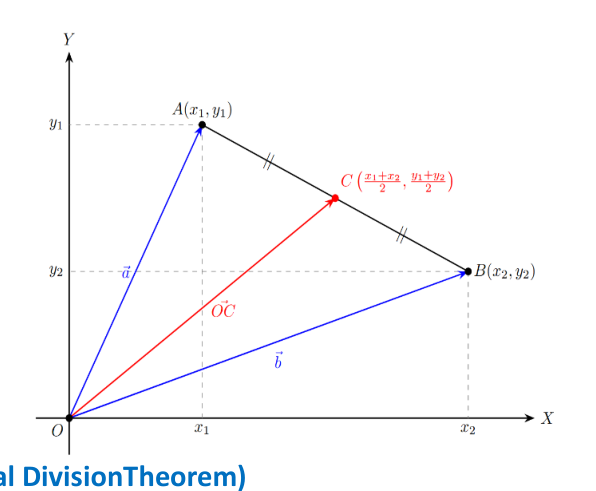
Writing this with coordinates, each coordinate of C is the average of the matching coordinates of A and B:
\[ \overrightarrow{OC} = \left(\frac{x_1 + x_2}{2}, \frac{y_1 + y_2}{2}\right) \]
Position vector of a mid-point: if C is the mid-point of AB, then \( \overrightarrow{OC} = \frac{\vec{a} + \vec{b}}{2} \). In coordinates, C is \( \left(\frac{x_1 + x_2}{2}, \frac{y_1 + y_2}{2}\right) \).
Example: ABCD is a quadrilateral with A(-2, 1), B(-1, -3), C(3, -2) and D(2, 2). Show that its diagonals AC and BD bisect each other.
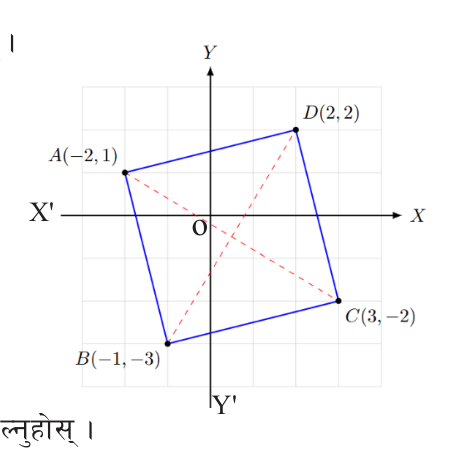
Step 1: Let M be the mid-point of AC. Averaging the coordinates of A(-2, 1) and C(3, -2):
\[ \overrightarrow{OM} = \left(\frac{-2+3}{2}, \frac{1-2}{2}\right) \]
\[ \overrightarrow{OM} = \left(\frac{1}{2}, -\frac{1}{2}\right) \]
Step 2: Let N be the mid-point of BD. Averaging the coordinates of B(-1, -3) and D(2, 2):
\[ \overrightarrow{ON} = \left(\frac{-1+2}{2}, \frac{-3+2}{2}\right) \]
\[ \overrightarrow{ON} = \left(\frac{1}{2}, -\frac{1}{2}\right) \]
Step 3: Comparing the two results: M and N have the same position vector, so they are the same point. That point is the mid-point of both diagonals, so the diagonals bisect each other. A quadrilateral whose diagonals bisect each other is a parallelogram, so ABCD is a parallelogram.
The Internal Division Theorem
A mid-point cuts a segment into two equal parts. A point can also cut a segment into unequal parts. If P lies on the segment AB, between A and B, and AP : PB = 1 : 2, then AP is one part and PB is two equal parts, so P is one third of the way from A to B.
Internal division: a point P divides the line segment AB internally in the ratio m : n when P lies between A and B and AP : PB = m : n.
Internal Division Theorem: if the position vectors of A and B are \( \vec{a} \) and \( \vec{b} \), the position vector of the point P that divides AB internally in the ratio m : n is \( \vec{p} = \frac{n\vec{a} + m\vec{b}}{m+n} \).
\[ \vec{p} = \frac{n\vec{a} + m\vec{b}}{m+n} \]
Proving the Internal Division Theorem
Let O be the origin, with \( \overrightarrow{OA} = \vec{a} \), \( \overrightarrow{OB} = \vec{b} \) and \( \overrightarrow{OP} = \vec{p} \). P divides AB internally in the ratio m : n.
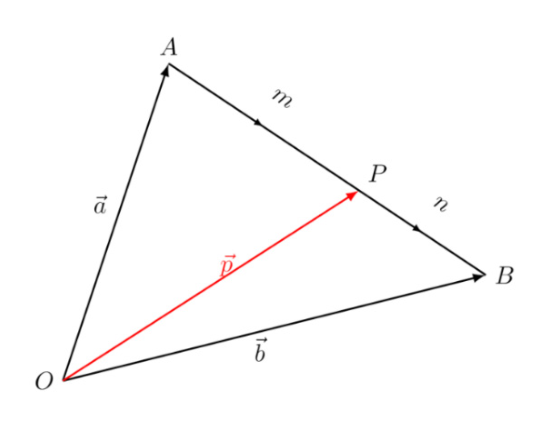
Step 1: Writing the given ratio as a fraction:
\[ \frac{AP}{PB} = \frac{m}{n} \]
Step 2: Cross multiplying. Since \( \overrightarrow{AP} \) and \( \overrightarrow{PB} \) point in the same direction along AB, this holds as vectors:
\[ n\overrightarrow{AP} = m\overrightarrow{PB} \quad \text{(i)} \]
Step 3: Writing each vector as end point minus starting point, using \( \overrightarrow{XY} = \overrightarrow{OY} - \overrightarrow{OX} \):
\[ \overrightarrow{AP} = \vec{p} - \vec{a} \]
\[ \overrightarrow{PB} = \vec{b} - \vec{p} \]
Step 4: Substituting these into equation (i):
\[ n(\vec{p} - \vec{a}) = m(\vec{b} - \vec{p}) \]
Step 5: Expanding both brackets:
\[ n\vec{p} - n\vec{a} = m\vec{b} - m\vec{p} \]
Step 6: Collecting the terms in \( \vec{p} \) on the left and the rest on the right:
\[ n\vec{p} + m\vec{p} = n\vec{a} + m\vec{b} \]
Step 7: Taking \( \vec{p} \) out as a common factor:
\[ (m+n)\vec{p} = n\vec{a} + m\vec{b} \]
Step 8: Dividing both sides by \( m+n \):
\[ \vec{p} = \frac{n\vec{a} + m\vec{b}}{m+n} \]
When A is \( (x_1, y_1) \) and B is \( (x_2, y_2) \), the same result written in coordinates gives the point P as:
\[ P\left(\frac{mx_2 + nx_1}{m+n}, \frac{my_2 + ny_1}{m+n}\right) \]
Put m = n = 1 in the internal division formula and it becomes \( \vec{p} = \frac{\vec{a} + \vec{b}}{2} \), the mid-point formula. A mid-point is simply the point dividing a segment internally in the ratio 1 : 1.
The number m goes with \( \vec{b} \) and n goes with \( \vec{a} \), crossed over. Each end is weighted by the part of the ratio on the far side of P. Swapping them gives the point that divides AB in the ratio n : m instead.
Using the Internal Division Formula
Example: A is the point (2, 3) and B is the point (8, 9). Find the point P that divides AB internally in the ratio 1 : 2.
Step 1: Here m = 1 and n = 2. Putting these into the internal division formula:
\[ \vec{p} = \frac{2\vec{a} + 1\,\vec{b}}{1+2} \]
Step 2: Substituting the position vectors and multiplying \( \vec{a} \) by 2:
\[ \vec{p} = \frac{1}{3}\left[\begin{pmatrix} 4 \\ 6 \end{pmatrix} + \begin{pmatrix} 8 \\ 9 \end{pmatrix}\right] \]
Step 3: Adding the two vectors and dividing each component by 3:
\[ \vec{p} = \frac{1}{3}\begin{pmatrix} 12 \\ 15 \end{pmatrix} = \begin{pmatrix} 4 \\ 5 \end{pmatrix} \]
So P is the point (4, 5). Check: \( \overrightarrow{AP} = \begin{pmatrix} 2 \\ 2 \end{pmatrix} \) and \( \overrightarrow{PB} = \begin{pmatrix} 4 \\ 4 \end{pmatrix} \). PB is twice AP and points the same way, so AP : PB = 1 : 2, as required.
The External Division Theorem
A point can also divide AB from outside. Extend the line AB beyond B and mark a point P on it. Then A, B and P are collinear, which means they lie on one straight line, but P is not between A and B. If AP : PB = 2 : 1, then P is twice as far from A as it is from B, which puts it beyond B at the same distance again as AB.
External division: a point P divides the line segment AB externally in the ratio m : n when P lies on the line AB extended, outside the segment AB, and AP : PB = m : n.
External Division Theorem: if the position vectors of A and B are \( \vec{a} \) and \( \vec{b} \), the position vector of the point P that divides AB externally in the ratio m : n is \( \overrightarrow{OP} = \vec{p} = \frac{m\vec{b} - n\vec{a}}{m-n} \).
\[ \vec{p} = \frac{m\vec{b} - n\vec{a}}{m-n} \]
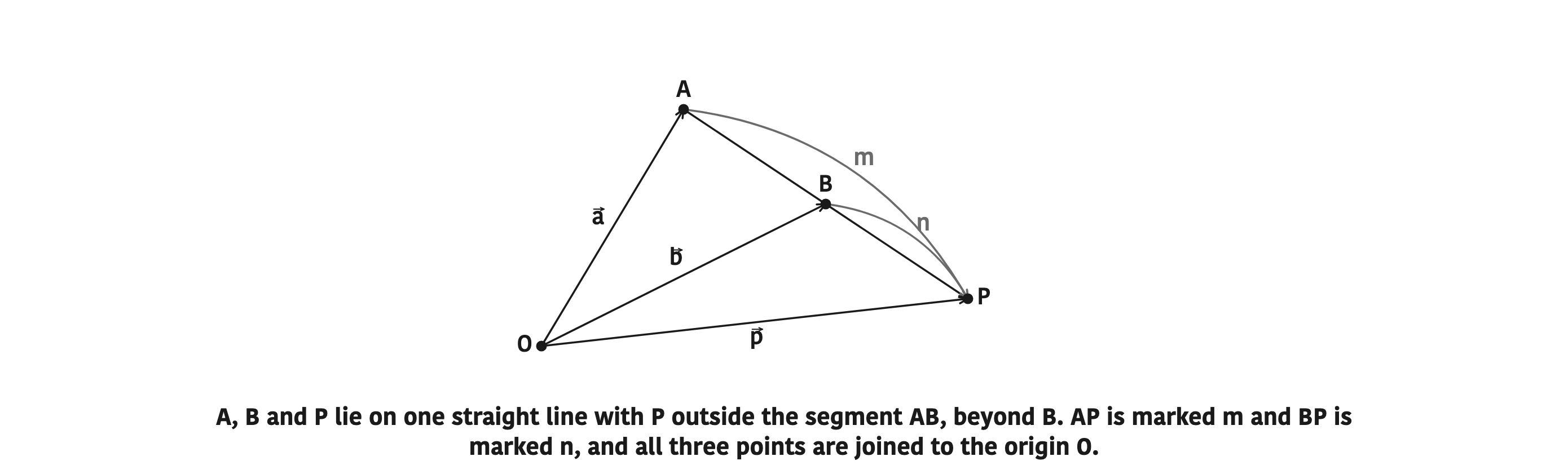
Proving the External Division Theorem
Let O be the origin, with \( \overrightarrow{OA} = \vec{a} \), \( \overrightarrow{OB} = \vec{b} \) and \( \overrightarrow{OP} = \vec{p} \). P divides AB externally in the ratio m : n, and A, B and P are collinear.
Step 1: Writing the given ratio as a fraction:
\[ \frac{AP}{PB} = \frac{m}{n} \]
Step 2: Cross multiplying. This time P is outside AB, so the two vectors that point the same way are \( \overrightarrow{AP} \) and \( \overrightarrow{BP} \), both heading towards P:
\[ n\overrightarrow{AP} = m\overrightarrow{BP} \quad \text{(i)} \]
Step 3: Writing each vector as end point minus starting point:
\[ \overrightarrow{AP} = \vec{p} - \vec{a} \]
\[ \overrightarrow{BP} = \vec{p} - \vec{b} \]
Step 4: Substituting these into equation (i):
\[ n(\vec{p} - \vec{a}) = m(\vec{p} - \vec{b}) \]
Step 5: Expanding both brackets:
\[ n\vec{p} - n\vec{a} = m\vec{p} - m\vec{b} \]
Step 6: Moving the terms in \( \vec{p} \) to the right and the terms in \( \vec{a} \) and \( \vec{b} \) to the left:
\[ m\vec{b} - n\vec{a} = m\vec{p} - n\vec{p} \]
Step 7: Taking \( \vec{p} \) out as a common factor:
\[ m\vec{b} - n\vec{a} = (m-n)\vec{p} \]
Step 8: Dividing both sides by \( m-n \):
\[ \vec{p} = \frac{m\vec{b} - n\vec{a}}{m-n} \]
When A is \( (x_1, y_1) \) and B is \( (x_2, y_2) \), the point P in coordinates is:
\[ P\left(\frac{mx_2 - nx_1}{m-n}, \frac{my_2 - ny_1}{m-n}\right) \]
External division needs m and n to be different. If m = n, the denominator \( m-n \) is zero and there is no such point: no point outside AB is equally far from A and from B along the line.
Using the External Division Formula
Example: A is the point (2, 3) and B is the point (5, 6). Find the point P that divides AB externally in the ratio 2 : 1.
Step 1: Here m = 2 and n = 1. Putting these into the external division formula:
\[ \vec{p} = \frac{2\vec{b} - 1\,\vec{a}}{2-1} \]
Step 2: Substituting the position vectors, multiplying \( \vec{b} \) by 2, and noting that the denominator is 1:
\[ \vec{p} = \begin{pmatrix} 10 \\ 12 \end{pmatrix} - \begin{pmatrix} 2 \\ 3 \end{pmatrix} \]
Step 3: Subtracting component by component:
\[ \vec{p} = \begin{pmatrix} 8 \\ 9 \end{pmatrix} \]
So P is the point (8, 9). Check: \( \overrightarrow{AP} = \begin{pmatrix} 6 \\ 6 \end{pmatrix} \) and \( \overrightarrow{BP} = \begin{pmatrix} 3 \\ 3 \end{pmatrix} \). AP is twice BP and both point the same way, so P lies beyond B with AP : PB = 2 : 1.
The Formulae Side by Side
| Result | Formula | Where the point lies |
| Mid-point theorem | \( \overrightarrow{AD} = \frac{1}{2}(\overrightarrow{AB} + \overrightarrow{AC}) \) | D is the mid-point of BC; AD is a median |
| Mid-point of AB | \( \frac{\vec{a} + \vec{b}}{2} \) | Halfway between A and B |
| Internal division, m : n | \( \frac{n\vec{a} + m\vec{b}}{m+n} \) | Between A and B |
| External division, m : n | \( \frac{m\vec{b} - n\vec{a}}{m-n} \) | On line AB, outside the segment; m and n different |
All four results come from the same two tools: the triangle law \( \overrightarrow{AB} + \overrightarrow{BC} = \overrightarrow{AC} \), and the rule that a vector joining two points is the end position vector minus the starting one. If a formula slips from memory, it can always be rebuilt from these two.
The full lesson is waiting for you
The notes are free to read in full. A free account opens the rest of the practice, and tracks your progress and confidence score for every subject. Presentations and videos need approval from Learn Yeti.