The Scalar Product and the Angle Between Two Vectors
Think of a girl pushing a loaded trolley across a shop floor. She pushes with a force of F newtons, and the trolley moves at v metres per second in the same direction as her push.
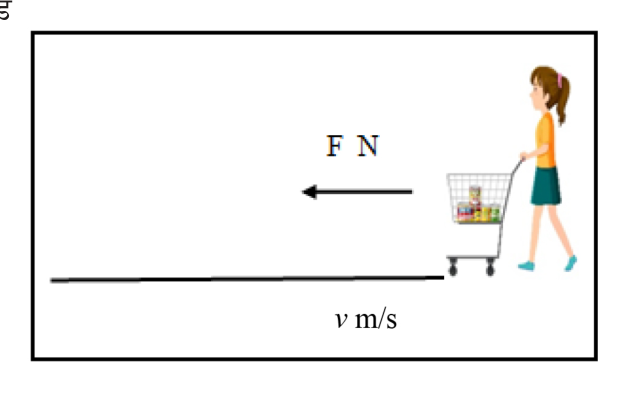
The power she delivers is the force multiplied by the velocity in the direction of the force: \( P = \vec{F}\cdot\vec{v} = |\vec{F}||\vec{v}|\cos\theta \), where \( \theta \) is the angle between the force and the motion. Two vectors go in, but the answer has size only and no direction. Power is a scalar quantity, measured in watts (W). That is exactly why this way of multiplying two vectors is called the scalar product.
Scalar product (dot product): If \( \vec{a} \) and \( \vec{b} \) are two vectors and \( \theta \) is the angle between them, where \( 0 \le \theta \le \pi \), then their scalar product is \( \vec{a}\cdot\vec{b} = |\vec{a}||\vec{b}|\cos\theta \). The answer is a number, not a vector.
Rearranging the same definition gives a way to find the angle between two vectors:
\[ \cos\theta = \frac{\vec{a}\cdot\vec{b}}{|\vec{a}||\vec{b}|} \]
Everything in this topic grows from these two lines. The value of \( \cos\theta \) depends on the angle, so the scalar product quietly tells us how two vectors are placed relative to each other.
Conditions for Parallel and Perpendicular Vectors
Two vectors are parallel when they lie along the same line or along parallel lines. They can point the same way, making an angle of 0°, or opposite ways, making an angle of 180°. We take the two cases one at a time.
Case 1, same direction: Putting \( \theta = 0^\circ \) into the definition:
\[ \vec{a}\cdot\vec{b} = |\vec{a}||\vec{b}|\cos 0^\circ \]
Since \( \cos 0^\circ = 1 \), this becomes:
\[ \vec{a}\cdot\vec{b} = |\vec{a}||\vec{b}| \]
Case 2, opposite directions: Putting \( \theta = 180^\circ \) into the definition:
\[ \vec{a}\cdot\vec{b} = |\vec{a}||\vec{b}|\cos 180^\circ \]
Since \( \cos 180^\circ = -1 \), this becomes:
\[ \vec{a}\cdot\vec{b} = -|\vec{a}||\vec{b}| \]
Condition for parallel vectors: Two vectors \( \vec{a} \) and \( \vec{b} \) are parallel when \( \vec{a}\cdot\vec{b} = \pm|\vec{a}||\vec{b}| \). The plus sign is for the same direction and the minus sign is for opposite directions.
Two vectors are perpendicular when they meet at a right angle, so \( \theta = 90^\circ \). Putting this into the definition:
\[ \vec{a}\cdot\vec{b} = |\vec{a}||\vec{b}|\cos 90^\circ \]
Since \( \cos 90^\circ = 0 \), the whole product becomes zero:
\[ \vec{a}\cdot\vec{b} = |\vec{a}||\vec{b}| \times 0 = 0 \]
Condition for perpendicular vectors: Two non-zero vectors \( \vec{a} \) and \( \vec{b} \) are perpendicular exactly when \( \vec{a}\cdot\vec{b} = 0 \).
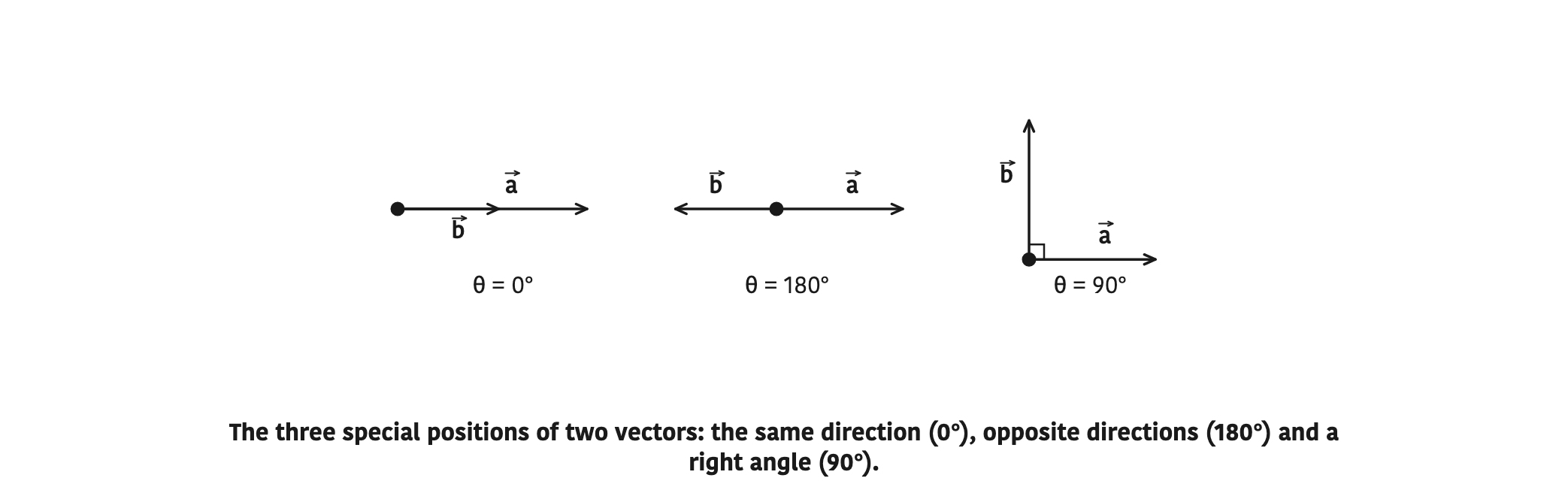
A scalar product of 0 shows a right angle only when both vectors have some length. If one of them is the zero vector, the product is 0 for every angle and tells us nothing about direction. That is why a question says \( |\vec{a}| \neq 0 \) and \( |\vec{b}| \neq 0 \) before asking for the angle.
Scalar Product in Terms of Coordinates
Most questions give vectors as components, not as lengths and angles. Let \( \vec{a} = (x_1, y_1) \) and \( \vec{b} = (x_2, y_2) \). Using the unit vector \( \vec{i} \) along the X-axis and \( \vec{j} \) along the Y-axis, they are written as:
\[ \vec{a} = x_1\vec{i} + y_1\vec{j} \]
\[ \vec{b} = x_2\vec{i} + y_2\vec{j} \]
First we need the scalar products of the unit vectors with each other. Each unit vector has length 1. A unit vector makes an angle of 0° with itself, and \( \vec{i} \) and \( \vec{j} \) make an angle of 90° with each other. So:
\[ \vec{i}\cdot\vec{i} = 1 \times 1 \times \cos 0^\circ = 1 \]
\[ \vec{j}\cdot\vec{j} = 1 \times 1 \times \cos 0^\circ = 1 \]
\[ \vec{i}\cdot\vec{j} = 1 \times 1 \times \cos 90^\circ = 0 \]
Step 1: Writing the product in terms of \( \vec{i} \) and \( \vec{j} \):
\[ \begin{aligned} \vec{a}\cdot\vec{b} &= (x_1\vec{i} + y_1\vec{j}) \\ &\quad \cdot (x_2\vec{i} + y_2\vec{j}) \end{aligned} \]
Step 2: Multiplying each term of the first bracket by each term of the second, which the distributive property allows:
\[ \begin{aligned} &= x_1x_2(\vec{i}\cdot\vec{i}) + x_1y_2(\vec{i}\cdot\vec{j}) \\ &\quad + y_1x_2(\vec{j}\cdot\vec{i}) + y_1y_2(\vec{j}\cdot\vec{j}) \end{aligned} \]
Step 3: Putting \( \vec{i}\cdot\vec{i} = \vec{j}\cdot\vec{j} = 1 \) and \( \vec{i}\cdot\vec{j} = \vec{j}\cdot\vec{i} = 0 \):
\[ = x_1x_2 + 0 + 0 + y_1y_2 \]
Step 4: Dropping the zeros gives the coordinate form:
\[ \vec{a}\cdot\vec{b} = x_1x_2 + y_1y_2 \]
In coordinates, multiply the x-components, multiply the y-components, and add. For \( \vec{a} = (x_1, y_1) \) and \( \vec{b} = (x_2, y_2) \), \( \vec{a}\cdot\vec{b} = x_1x_2 + y_1y_2 \).
This gives quick tests for the special positions. Perpendicular vectors have scalar product 0, so the test is \( x_1x_2 + y_1y_2 = 0 \). Parallel vectors are multiples of each other, \( \vec{b} = k\vec{a} \), so \( x_2 = kx_1 \) and \( y_2 = ky_1 \). Then \( x_1y_2 = kx_1y_1 \) and \( x_2y_1 = kx_1y_1 \), which are equal. So the test for parallel vectors is:
\[ x_1y_2 = x_2y_1 \]
| Position | Angle | Scalar product | Test with components |
| Same direction | 0° | \( |\vec{a}||\vec{b}| \) | \( x_1y_2 = x_2y_1 \) |
| Opposite directions | 180° | \( -|\vec{a}||\vec{b}| \) | \( x_1y_2 = x_2y_1 \) |
| Perpendicular | 90° | 0 | \( x_1x_2 + y_1y_2 = 0 \) |
Geometrical Meaning of Scalar Product
Let \( \overrightarrow{PA} = \vec{a} \) and \( \overrightarrow{PB} = \vec{b} \) be two vectors starting from the same point P, with angle \( \theta \) between them, where \( 0 \le \theta \le \pi \). From B, draw a perpendicular BM to the line PA. This makes a right-angled triangle PMB with the right angle at M.
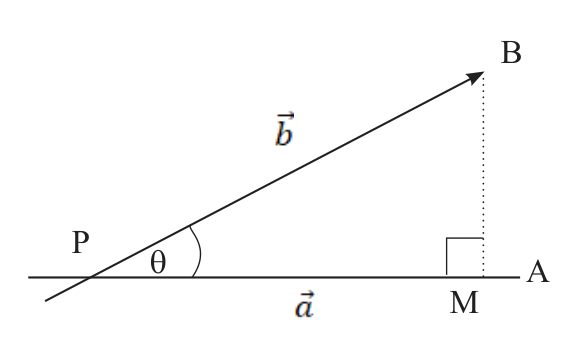
Step 1: In the right-angled triangle PMB, using the cosine ratio:
\[ \cos\theta = \frac{PM}{PB} = \frac{PM}{|\vec{b}|} \]
Step 2: Multiplying both sides by \( |\vec{b}| \):
\[ PM = |\vec{b}|\cos\theta \]
Projection: The length PM, equal to \( |\vec{b}|\cos\theta \), is the projection of \( \vec{b} \) on \( \vec{a} \). It is the part of \( \vec{b} \) that lies along the direction of \( \vec{a} \), like the shadow \( \vec{b} \) casts on the line of \( \vec{a} \) when light falls straight down on it.
Step 3: Grouping the definition of the scalar product so that PM appears:
\[ \vec{a}\cdot\vec{b} = |\vec{a}|\,(|\vec{b}|\cos\theta) = |\vec{a}| \times PM \]
So \( \vec{a}\cdot\vec{b} \) is the length of \( \vec{a} \) multiplied by the projection of \( \vec{b} \) on \( \vec{a} \). The grouping works the other way round too:
\[ \vec{a}\cdot\vec{b} = |\vec{b}|\,(|\vec{a}|\cos\theta) \]
This is the length of \( \vec{b} \) multiplied by the projection of \( \vec{a} \) on \( \vec{b} \).
Geometrically, the scalar product of two vectors is the length of the first vector times the projection of the second vector on the first. It is equally the length of the second vector times the projection of the first vector on the second.
For example, if \( |\vec{a}| = 6 \) and \( \vec{b} \) has a projection of 2 units on \( \vec{a} \), then \( \vec{a}\cdot\vec{b} = 6 \times 2 = 12 \). When the angle is 90°, the point M lands on P, the projection shrinks to nothing, and the product is 0. This is the picture behind the condition for perpendicular vectors.
Properties of Scalar Product
The scalar product follows five rules. Each one can be checked from the definition or from the coordinate form.
- (a) Commutative property: \( \vec{a}\cdot\vec{b} = \vec{b}\cdot\vec{a} \). The order does not matter. For example, \( (2, 3)\cdot(5, 1) = 10 + 3 = 13 \) and \( (5, 1)\cdot(2, 3) = 10 + 3 = 13 \).
- (b) Distributive property: \( \vec{a}\cdot(\vec{b} + \vec{c}) = \vec{a}\cdot\vec{b} + \vec{a}\cdot\vec{c} \). A scalar product spreads over a sum, just as multiplication of numbers spreads over addition.
- (c) Multiplication by a scalar: if k is a scalar, \( (k\vec{a})\cdot\vec{b} = \vec{a}\cdot(k\vec{b}) = k(\vec{a}\cdot\vec{b}) \). The number k can be moved to the front.
- (d) Maximum value: when the two vectors point in the same direction (\( \theta = 0^\circ \)), \( \vec{a}\cdot\vec{b} = |\vec{a}||\vec{b}| \). This is the greatest value the scalar product can take, because \( \cos\theta \) is never more than 1.
- (e) Minimum value: when the two vectors point in opposite directions (\( \theta = 180^\circ \)), \( \vec{a}\cdot\vec{b} = -|\vec{a}||\vec{b}| \). This is the smallest value, because \( \cos\theta \) is never less than -1.
One more result comes from the maximum value. A vector makes an angle of 0° with itself, so:
\[ \vec{a}\cdot\vec{a} = |\vec{a}||\vec{a}|\cos 0^\circ = |\vec{a}|^2 \]
Square of a vector: \( (\vec{a})^2 \) means \( \vec{a}\cdot\vec{a} \), and it always equals the square of the magnitude, \( (\vec{a})^2 = |\vec{a}|^2 \). For \( \vec{a} = (2, 3) \), \( (\vec{a})^2 = 2^2 + 3^2 = 13 \).
Triangle Law of Vector Addition
The points P(2, 1), Q(6, 1) and R(6, 4) are plotted on a grid. The vector \( \overrightarrow{PQ} \) moves a point from P to Q, and \( \overrightarrow{QR} \) then moves it from Q to R. The single vector \( \overrightarrow{PR} \) does the whole journey in one move, straight from P to R.
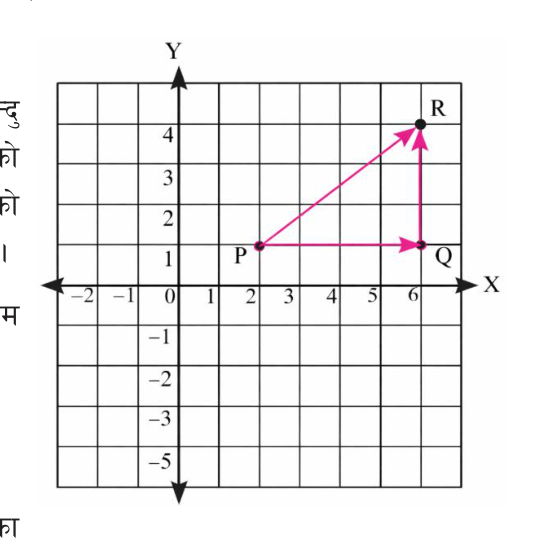
Step 1: Finding \( \overrightarrow{PQ} \) from P(2, 1) to Q(6, 1) by subtracting coordinates:
\[ \overrightarrow{PQ} = \begin{pmatrix} 6-2 \\ 1-1 \end{pmatrix} = \begin{pmatrix} 4 \\ 0 \end{pmatrix} \]
Step 2: Finding \( \overrightarrow{QR} \) from Q(6, 1) to R(6, 4):
\[ \overrightarrow{QR} = \begin{pmatrix} 6-6 \\ 4-1 \end{pmatrix} = \begin{pmatrix} 0 \\ 3 \end{pmatrix} \]
Step 3: Finding \( \overrightarrow{PR} \) from P(2, 1) to R(6, 4):
\[ \overrightarrow{PR} = \begin{pmatrix} 6-2 \\ 4-1 \end{pmatrix} = \begin{pmatrix} 4 \\ 3 \end{pmatrix} \]
Step 4: Adding the first two vectors component by component:
\[ \overrightarrow{PQ} + \overrightarrow{QR} = \begin{pmatrix} 4+0 \\ 0+3 \end{pmatrix} = \begin{pmatrix} 4 \\ 3 \end{pmatrix} \]
The sum is exactly \( \overrightarrow{PR} \), so \( \overrightarrow{PQ} + \overrightarrow{QR} = \overrightarrow{PR} \).
Triangle law of vector addition: If two vectors are represented in order by two sides of a triangle, their sum is represented by the third side taken in the opposite direction.
"In order" means the head of the first vector is the tail of the second, as Q is for \( \overrightarrow{PQ} \) and \( \overrightarrow{QR} \). The third side \( \overrightarrow{PR} \) runs from the first tail to the last head. That is against the direction of travel round the triangle from P to Q to R and back to P, which is what "opposite direction" means.
The law can be turned round to write any side using the other two. Since \( \overrightarrow{RQ} = -\overrightarrow{QR} \), going from P to R and then back from R to Q gives:
\[ \overrightarrow{PQ} = \overrightarrow{PR} - \overrightarrow{QR} \]
\[ \overrightarrow{QR} = \overrightarrow{PR} - \overrightarrow{PQ} \]
Check with the numbers: \( (4, 3) - (0, 3) = (4, 0) \), which is \( \overrightarrow{PQ} \).
Example 1: Scalar Product from Components
If \( \overrightarrow{OA} = \begin{pmatrix} 2 \\ 3 \end{pmatrix} \) and \( \overrightarrow{OB} = \begin{pmatrix} 5 \\ 1 \end{pmatrix} \), find \( \overrightarrow{OA}\cdot\overrightarrow{OB} \).
Step 1: Reading off the components:
\[ x_1 = 2,\ y_1 = 3,\ x_2 = 5,\ y_2 = 1 \]
Step 2: Writing the coordinate form of the scalar product:
\[ \overrightarrow{OA}\cdot\overrightarrow{OB} = x_1x_2 + y_1y_2 \]
Step 3: Substituting the components:
\[ = (2 \times 5) + (3 \times 1) \]
Step 4: Multiplying and then adding:
\[ = 10 + 3 = 13 \]
So \( \overrightarrow{OA}\cdot\overrightarrow{OB} = 13 \). The answer is a single number, as a scalar product always is.
Example 2: Scalar Product from Magnitudes and Angle
If \( |\vec{a}| = 5 \), \( |\vec{b}| = 6 \) and the angle between them is \( \theta = 60^\circ \), find \( \vec{a}\cdot\vec{b} \).
Step 1: The lengths and the angle are given, so the definition is used:
\[ \vec{a}\cdot\vec{b} = |\vec{a}||\vec{b}|\cos\theta \]
Step 2: Substituting the values:
\[ = 5 \times 6 \times \cos 60^\circ \]
Step 3: Since \( \cos 60^\circ = \frac{1}{2} \), multiplying out:
\[ = 5 \times 6 \times \frac{1}{2} = 15 \]
So \( \vec{a}\cdot\vec{b} = 15 \).
Choose the formula from what is given. Lengths and an angle: use \( |\vec{a}||\vec{b}|\cos\theta \). Components: use \( x_1x_2 + y_1y_2 \).
Example 3: Are Two Position Vectors Perpendicular?
The points A(1, -3) and B(3, 4) are given, and O(0, 0) is the origin. Are \( \overrightarrow{OA} \) and \( \overrightarrow{OB} \) perpendicular to each other? Justify the answer.
Step 1: Writing the position vectors. Since they start at the origin, their components are just the coordinates of A and B:
\[ \overrightarrow{OA} = \begin{pmatrix} 1 \\ -3 \end{pmatrix} \]
\[ \overrightarrow{OB} = \begin{pmatrix} 3 \\ 4 \end{pmatrix} \]
Step 2: Using the coordinate form \( x_1x_2 + y_1y_2 \):
\[ \overrightarrow{OA}\cdot\overrightarrow{OB} = (1 \times 3) + (-3 \times 4) \]
Step 3: Simplifying:
\[ = 3 - 12 = -9 \]
For two vectors to be perpendicular, their scalar product must be 0. Here it is -9, so \( \overrightarrow{OA} \) and \( \overrightarrow{OB} \) are not perpendicular. In fact the product is negative, so the angle AOB is more than 90°.
Example 4: What the Sign of the Scalar Product Tells Us
The points P(-2, 1), Q(3, -4) and R(2, 5) are plotted on a grid and joined to make triangle PQR.
- (a) Find \( \overrightarrow{PQ}\cdot\overrightarrow{QR} \).
- (b) If \( \overrightarrow{PQ}\cdot\overrightarrow{QR} \) comes out negative, decide whether the angle PQR is acute or obtuse.
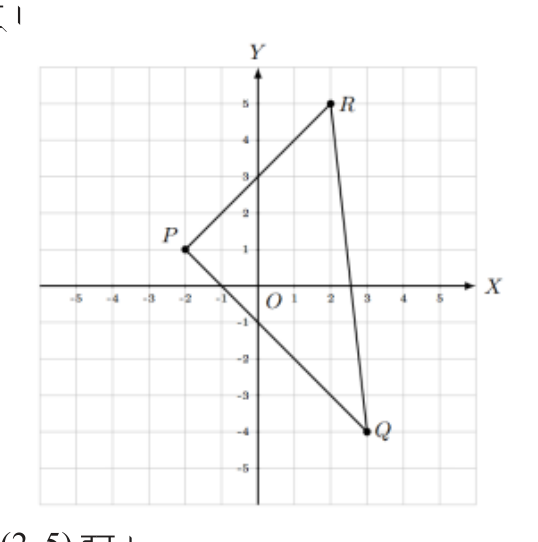
The vector between two points is found by subtracting the coordinates of the start from the coordinates of the end. For \( A(x_1, y_1) \) and \( B(x_2, y_2) \):
\[ \overrightarrow{AB} = \begin{pmatrix} x_2 - x_1 \\ y_2 - y_1 \end{pmatrix} \]
Part (a), Step 1: Finding \( \overrightarrow{PQ} \) from P(-2, 1) to Q(3, -4):
\[ \overrightarrow{PQ} = \begin{pmatrix} 3-(-2) \\ -4-1 \end{pmatrix} = \begin{pmatrix} 5 \\ -5 \end{pmatrix} \]
Step 2: Finding \( \overrightarrow{QR} \) from Q(3, -4) to R(2, 5):
\[ \overrightarrow{QR} = \begin{pmatrix} 2-3 \\ 5-(-4) \end{pmatrix} = \begin{pmatrix} -1 \\ 9 \end{pmatrix} \]
Step 3: Multiplying matching components and adding:
\[ \overrightarrow{PQ}\cdot\overrightarrow{QR} = 5 \times (-1) + (-5) \times 9 \]
Step 4: Simplifying:
\[ = -5 - 45 = -50 \]
Part (b): The scalar product is -50, which is negative. A negative scalar product means \( \cos\theta \) is negative, so the angle between the two vectors is obtuse (more than 90°). But look at where the two vectors sit. \( \overrightarrow{PQ} \) arrives at Q and \( \overrightarrow{QR} \) leaves Q, so the angle between them is the exterior angle at Q, outside the triangle. The exterior angle is obtuse, and together with the interior angle it makes 180°, so the angle PQR inside the triangle is acute.
Another way: For the angle inside the triangle at Q, both vectors must start at Q, so we use \( \overrightarrow{QP} \) and \( \overrightarrow{QR} \).
Step 1: Reversing \( \overrightarrow{PQ} \), which changes the sign of each component:
\[ \overrightarrow{QP} = -\overrightarrow{PQ} = \begin{pmatrix} -5 \\ 5 \end{pmatrix} \]
Step 2: Taking its scalar product with \( \overrightarrow{QR} \):
\[ \overrightarrow{QP}\cdot\overrightarrow{QR} = (-5)(-1) + (5)(9) \]
Step 3: Simplifying:
\[ = 5 + 45 = 50 \]
The product is positive, so the angle PQR is acute. Both methods agree.
The sign of the scalar product describes the angle between two vectors. Positive: the angle is acute. Zero: the angle is a right angle. Negative: the angle is obtuse.
To find the angle at a corner of a triangle, both vectors must start from that corner. Using one vector that arrives at the corner and one that leaves it gives the exterior angle instead of the angle inside the triangle.
Example 5: Finding an Unknown Component
Two vectors \( \overrightarrow{OA} = \begin{pmatrix} 5 \\ m \end{pmatrix} \) and \( \overrightarrow{OB} = \begin{pmatrix} 4 \\ -2 \end{pmatrix} \) are given, and the angle between them is \( \angle AOB = 90^\circ \).
- (a) If two vectors are perpendicular, what is their scalar product?
- (b) Find \( \overrightarrow{OA}\cdot\overrightarrow{OB} \) and use it to find m.
- (c) If \( \overrightarrow{OA} \) and \( \overrightarrow{OB} \) were parallel instead of perpendicular, what would m be? Compare the two values.
Part (a): The scalar product of two perpendicular vectors is always 0, so \( \overrightarrow{OA}\cdot\overrightarrow{OB} = 0 \).
Part (b), Step 1: Using the coordinate form with \( (x_1, y_1) = (5, m) \) and \( (x_2, y_2) = (4, -2) \):
\[ \overrightarrow{OA}\cdot\overrightarrow{OB} = 5 \times 4 + m \times (-2) \]
Step 2: Simplifying:
\[ = 20 - 2m \]
Step 3: Since \( \angle AOB = 90^\circ \), the product equals 0:
\[ 20 - 2m = 0 \]
Step 4: Adding 2m to both sides:
\[ 20 = 2m \]
Step 5: Dividing both sides by 2:
\[ m = 10 \]
Part (c), Step 1: For parallel vectors the test is \( x_1y_2 = x_2y_1 \). Substituting:
\[ 5 \times (-2) = 4 \times m \]
Step 2: Multiplying out:
\[ -10 = 4m \]
Step 3: Dividing both sides by 4:
\[ m = -2.5 \]
So the vectors are perpendicular when m = 10 and parallel when m = -2.5. The two conditions are different, so they give different values of m. Each value can be checked: with m = 10, \( 20 - 20 = 0 \); with m = -2.5, \( \overrightarrow{OA} = (5, -2.5) \), which is \( \frac{5}{4} \) times \( (4, -2) \).
Example 6: Three Vectors That Add to Zero
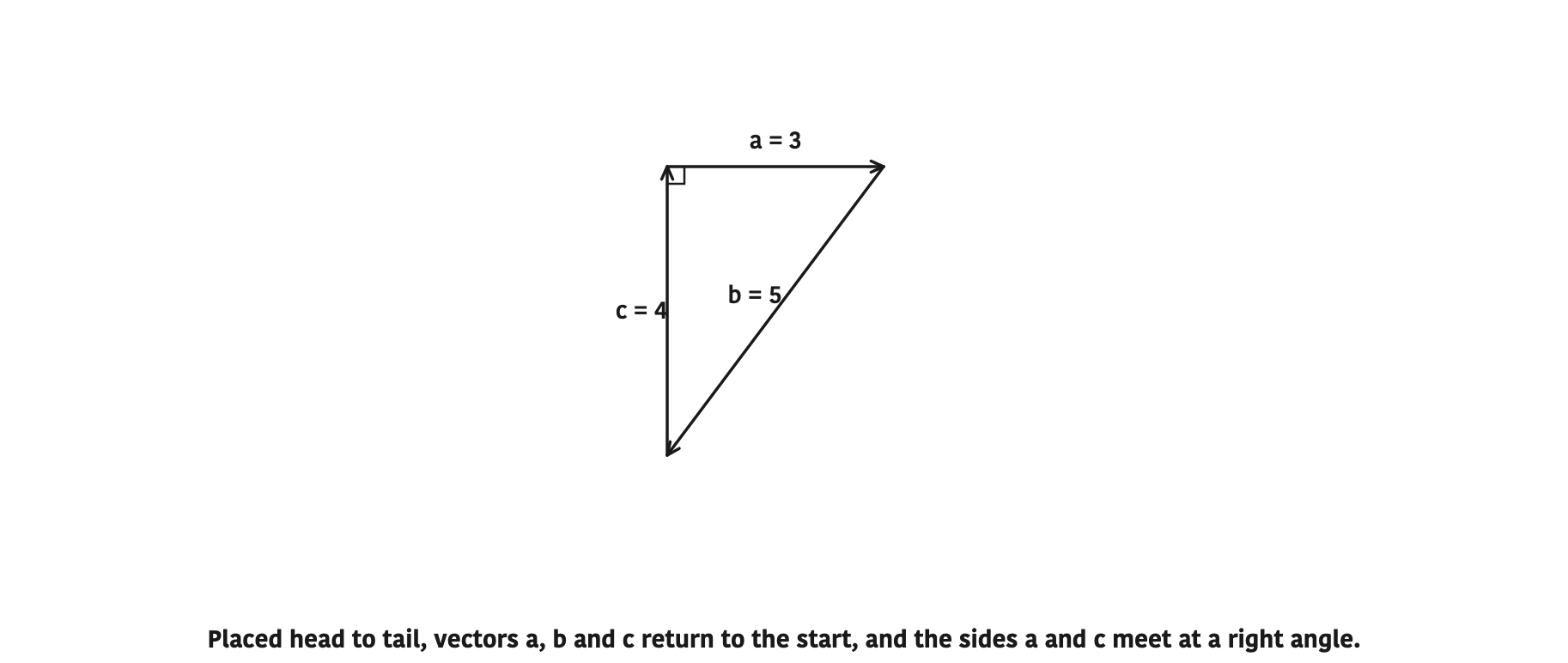
Three vectors \( \vec{a} \), \( \vec{b} \) and \( \vec{c} \) have \( |\vec{a}| = 3 \), \( |\vec{b}| = 5 \), \( |\vec{c}| = 4 \), and \( \vec{a} + \vec{b} + \vec{c} = (0, 0) \).
- (a) Write the relationship between the square of a vector \( (\vec{a})^2 \) and the square of its magnitude \( |\vec{a}|^2 \).
- (b) Find the value of \( \vec{a}\cdot\vec{c} \).
- (c) Using the value of \( \vec{a}\cdot\vec{c} \) and the lengths of the sides, decide what type of triangle the three vectors form.
Part (a): The square of any vector is always equal to the square of its magnitude, \( (\vec{a})^2 = |\vec{a}|^2 \).
Part (b), Step 1: Moving \( \vec{b} \) to the other side of \( \vec{a} + \vec{b} + \vec{c} = 0 \):
\[ \vec{a} + \vec{c} = -\vec{b} \]
Step 2: Squaring both sides:
\[ (\vec{a} + \vec{c})^2 = (-\vec{b})^2 \]
Step 3: Expanding the left side with the distributive property. The middle term is doubled because \( \vec{a}\cdot\vec{c} = \vec{c}\cdot\vec{a} \):
\[ (\vec{a})^2 + 2\,\vec{a}\cdot\vec{c} + (\vec{c})^2 = (\vec{b})^2 \]
Step 4: Replacing each square of a vector by the square of its magnitude:
\[ |\vec{a}|^2 + 2\,\vec{a}\cdot\vec{c} + |\vec{c}|^2 = |\vec{b}|^2 \]
Step 5: Substituting the lengths:
\[ 3^2 + 2\,\vec{a}\cdot\vec{c} + 4^2 = 5^2 \]
Step 6: Working out the squares:
\[ 9 + 2\,\vec{a}\cdot\vec{c} + 16 = 25 \]
Step 7: Adding 9 and 16:
\[ 25 + 2\,\vec{a}\cdot\vec{c} = 25 \]
Step 8: Subtracting 25 from both sides:
\[ 2\,\vec{a}\cdot\vec{c} = 0 \]
Step 9: Dividing both sides by 2:
\[ \vec{a}\cdot\vec{c} = 0 \]
Part (c): Since \( \vec{a}\cdot\vec{c} = 0 \), the vectors \( \vec{a} \) and \( \vec{c} \) are perpendicular. The statement \( \vec{a} + \vec{b} + \vec{c} = 0 \) means that the three vectors placed head to tail come back to the starting point, so they make a closed triangle with sides 3, 4 and 5. The sides of length 3 and 4 meet at a right angle, so the triangle is right-angled. As a check, \( 3^2 + 4^2 = 9 + 16 = 25 = 5^2 \), which is Pythagoras' theorem.
Checking a Quadrilateral with Vectors
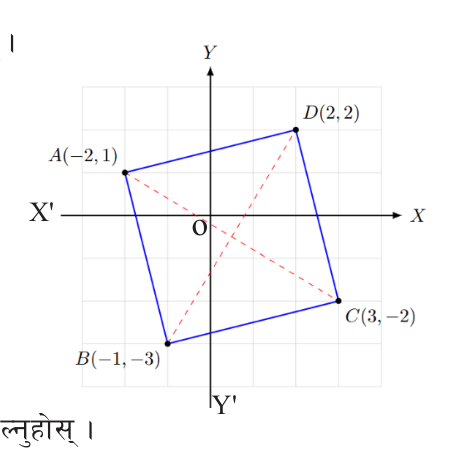
The same tools decide what kind of quadrilateral four points make. Each side is a vector. Its length comes from its magnitude, and a right angle between two sides shows up as a scalar product of 0.
- Step 1: Write each side as a column vector by subtracting the coordinates of its start from those of its end.
- Step 2: Find the length of each side from its components.
- Step 3: Find the scalar product of two sides that meet at a corner. If it is 0, that corner is a right angle.
- Step 4: Decide. Four equal sides with a right angle make a square. Opposite sides equal with a right angle, but neighbouring sides unequal, make a rectangle.
For the quadrilateral with A(-2, 1), B(-1, -3), C(3, -2) and D(2, 2), the first side is:
\[ \overrightarrow{AB} = \begin{pmatrix} -1-(-2) \\ -3-1 \end{pmatrix} = \begin{pmatrix} 1 \\ -4 \end{pmatrix} \]
Carrying on the same way for BC, CD and DA, and then testing one corner with the scalar product, settles whether ABCD is a rectangle or a square. The scalar product of the diagonals \( \overrightarrow{AC} \) and \( \overrightarrow{BD} \) also shows whether the diagonals cross at a right angle.
The full lesson is waiting for you
The notes are free to read in full. A free account opens the rest of the practice, and tracks your progress and confidence score for every subject. Presentations and videos need approval from Learn Yeti.