Proving Geometry with Vectors
In plane geometry you proved facts about triangles using congruent triangles, parallel lines and angle facts. Vectors give a second, often shorter, way to prove many of the same facts. The idea is simple. Every side of a figure is written as a vector. One vector is then written as a sum of others using the triangle law, and the algebra is tidied until the result appears.
Two tools do most of the work: the scalar multiple of a vector and the triangle law of vector addition. When a theorem is about a right angle, a third tool joins them: the scalar product. A vector proof is laid out exactly like a geometry proof, in this order:
- Given: what we are told about the figure.
- To prove: the result we must reach, written in vector form.
- Construction: an extra line we draw, only when the proof needs one.
- Proof: the chain of vector statements, each with its reason.
- Conclusion: the theorem stated again in words.
Tools Used in Every Proof
Triangle law of vector addition: if two vectors are represented by two sides of a triangle taken in order, their sum is represented by the third side from the start of the first to the end of the second. In triangle ABC, \( \overrightarrow{AB} + \overrightarrow{BC} = \overrightarrow{AC} \).
Parallel vectors: two vectors are parallel when one is a scalar multiple of the other, \( \vec{a} = k\vec{b} \). If k is positive they point the same way, and the length of \( \vec{a} \) is k times the length of \( \vec{b} \).
Perpendicular vectors: two non-zero vectors are perpendicular exactly when their scalar product is zero, \( \vec{a}\cdot\vec{b} = 0 \).
Three smaller facts are used again and again. Reversing a vector changes its sign, so \( \overrightarrow{BA} = -\overrightarrow{AB} \). If M is the mid-point of AB, then \( \overrightarrow{AM} = \overrightarrow{MB} = \tfrac{1}{2}\overrightarrow{AB} \). The scalar product of a vector with itself is the square of its length, \( \vec{a}\cdot\vec{a} = |\vec{a}|^2 \), which is often written \( (\vec{a})^2 \).
The scalar product opens out like ordinary brackets, and \( \vec{a}\cdot\vec{b} = \vec{b}\cdot\vec{a} \). So the two middle terms cancel exactly as they do in \( (a+b)(a-b) = a^2 - b^2 \), and we get an identity that two of the four proofs depend on:
\[ (\vec{a}+\vec{b})\cdot(\vec{a}-\vec{b}) = |\vec{a}|^2 - |\vec{b}|^2 \]
Theorem 1: The Mid-point Theorem
Mid-point theorem: the line segment joining the mid-points of any two sides of a triangle is parallel to the third side and is half of it.
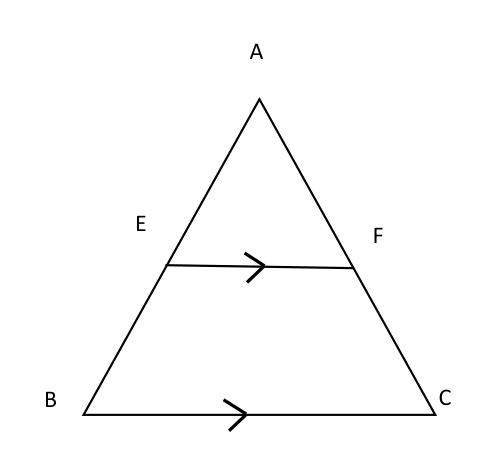
Given: ABC is a triangle. E and F are the mid-points of the sides AB and AC respectively.
To prove: \( \overrightarrow{EF} = \tfrac{1}{2}\overrightarrow{BC} \) and \( EF \parallel BC \).
Step 1: In triangle AEF, the triangle law of vector addition gives:
\[ \overrightarrow{EF} = \overrightarrow{EA} + \overrightarrow{AF} \quad \text{(i)} \]
Step 2: E is the mid-point of AB, so EA is half of BA and points the same way:
\[ \overrightarrow{EA} = \tfrac{1}{2}\overrightarrow{BA} \]
Step 3: F is the mid-point of AC, so AF is half of AC:
\[ \overrightarrow{AF} = \tfrac{1}{2}\overrightarrow{AC} \]
Step 4: Substituting these two halves into equation (i):
\[ \overrightarrow{EF} = \tfrac{1}{2}\overrightarrow{BA} + \tfrac{1}{2}\overrightarrow{AC} \]
Step 5: Taking out the common factor one half:
\[ \overrightarrow{EF} = \tfrac{1}{2}(\overrightarrow{BA} + \overrightarrow{AC}) \]
Step 6: In triangle ABC the triangle law gives \( \overrightarrow{BA} + \overrightarrow{AC} = \overrightarrow{BC} \), so the bracket becomes BC:
\[ \overrightarrow{EF} = \tfrac{1}{2}\overrightarrow{BC} \]
Now read the result. It has the form \( \overrightarrow{EF} = k\,\overrightarrow{BC} \) with \( k = \tfrac{1}{2} \). By the meaning of parallel vectors, EF is parallel to BC, and its length is half the length of BC. Hence the line segment joining the mid-points of any two sides of a triangle is parallel to the third side and half of it.
The whole proof is the triangle law used twice and the word "half" used twice. Most vector proofs are built from exactly these pieces.
Theorem 2: The Mid-point of the Hypotenuse
The mid-point of the hypotenuse of a right-angled triangle is equidistant from its three vertices.
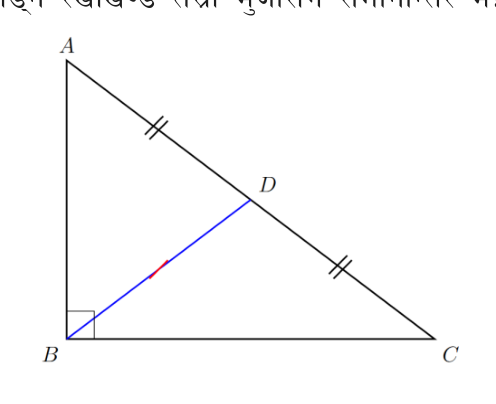
Given: ABC is a right-angled triangle with \( \angle B = 90^\circ \). AC is the hypotenuse and D is the mid-point of AC.
To prove: the distances from D to A, B and C are equal, that is, AD = BD = CD.
Step 1: Since \( \angle ABC = 90^\circ \), the vectors BA and BC are perpendicular, so their scalar product is zero:
\[ \overrightarrow{BA}\cdot\overrightarrow{BC} = 0 \quad \text{(i)} \]
Step 2: Writing BA through the point D, by the triangle law in triangle ABD:
\[ \overrightarrow{BA} = \overrightarrow{BD} + \overrightarrow{DA} \]
Step 3: Writing BC through D in the same way, by the triangle law in triangle BCD:
\[ \overrightarrow{BC} = \overrightarrow{BD} + \overrightarrow{DC} \]
Step 4: Substituting both into equation (i):
\[ (\overrightarrow{BD} + \overrightarrow{DA})\cdot(\overrightarrow{BD} + \overrightarrow{DC}) = 0 \]
Step 5: D is the mid-point of AC, so DC is as long as DA but points the opposite way. Replacing \( \overrightarrow{DC} \) by \( -\overrightarrow{DA} \):
\[ (\overrightarrow{BD} + \overrightarrow{DA})\cdot(\overrightarrow{BD} - \overrightarrow{DA}) = 0 \]
Step 6: Using the identity \( (\vec{a}+\vec{b})\cdot(\vec{a}-\vec{b}) = |\vec{a}|^2 - |\vec{b}|^2 \):
\[ |\overrightarrow{BD}|^2 - |\overrightarrow{DA}|^2 = 0 \]
Step 7: Writing the lengths plainly and moving one term across:
\[ BD^2 = DA^2 \]
Step 8: Taking the positive square root, because a length is never negative:
\[ BD = DA \]
D is the mid-point of AC, so DA = DC as well. Therefore AD = BD = CD. Hence the mid-point of the hypotenuse of a right-angled triangle is equidistant from all three vertices. Another way to say this: a circle with centre D and radius DA passes through A, B and C.
DC and DA have the same length, but they are not the same vector. DA points from D towards A and DC points from D towards C, in opposite directions, so \( \overrightarrow{DC} = -\overrightarrow{DA} \). Writing \( \overrightarrow{DC} = \overrightarrow{DA} \) makes both brackets identical and the proof falls apart.
Theorem 3: Mid-points of the Sides of a Quadrilateral
The quadrilateral formed by joining the mid-points of the sides of any quadrilateral, in order, is a parallelogram.
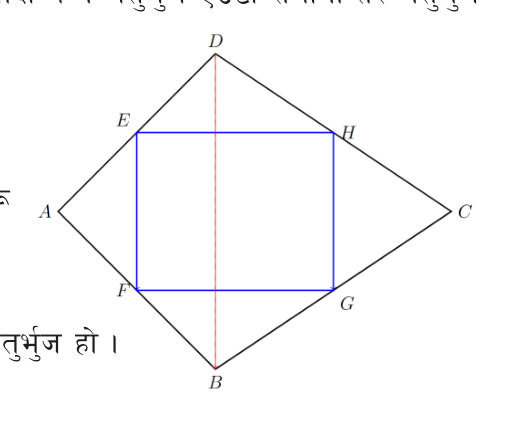
Given: ABCD is a quadrilateral. F, G, H and E are the mid-points of the sides AB, BC, CD and AD respectively, and they are joined in order to form the quadrilateral EFGH.
To prove: EFGH is a parallelogram, that is, \( \overrightarrow{EF} = \overrightarrow{HG} \) and \( \overrightarrow{EH} = \overrightarrow{FG} \).
Construction: Join the vertices B and D.
Step 1: In triangle ABD, F and E are the mid-points of AB and AD. By the mid-point theorem, the segment joining them is half of the third side DB:
\[ \overrightarrow{EF} = \tfrac{1}{2}\overrightarrow{DB} \quad \text{(i)} \]
Step 2: In triangle CBD, H and G are the mid-points of CD and CB. By the mid-point theorem again:
\[ \overrightarrow{HG} = \tfrac{1}{2}\overrightarrow{DB} \quad \text{(ii)} \]
Step 3: Both (i) and (ii) equal half of DB, so they equal each other:
\[ \overrightarrow{EF} = \overrightarrow{HG} \]
Equal vectors have the same length and the same direction. So EF = HG and \( EF \parallel HG \).
Step 4: Now join A and C instead. In triangle ACD, E and H are the mid-points of AD and CD, and in triangle ACB, F and G are the mid-points of AB and CB. The mid-point theorem in each triangle gives:
\[ \overrightarrow{EH} = \tfrac{1}{2}\overrightarrow{AC} = \overrightarrow{FG} \]
So EH = FG and \( EH \parallel FG \). Both pairs of opposite sides of EFGH are equal and parallel, so EFGH is a parallelogram. Hence joining the mid-points of the sides of a quadrilateral in order always gives a parallelogram.
Nothing in this proof used a special shape. The result holds for a square, a kite, a trapezium or a completely irregular quadrilateral.
Theorem 4: The Angle in a Semicircle
The angle in a semicircle is a right angle.
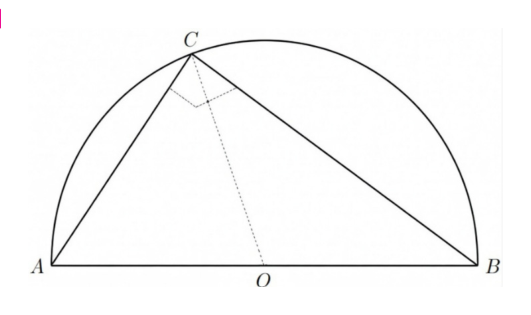
Given: O is the centre of a semicircle, AB is its diameter, and C is any point on the arc of the semicircle.
To prove: \( \angle ACB \) is a right angle.
The distance from the centre to any point of the circle is the radius r, so \( |\overrightarrow{OA}| = |\overrightarrow{OB}| = |\overrightarrow{OC}| = r \). Also O is the mid-point of AB, so OB points exactly opposite to OA: \( \overrightarrow{OB} = -\overrightarrow{OA} \).
Step 1: Writing AC and BC as differences of vectors from O, since \( \overrightarrow{AC} = \overrightarrow{OC} - \overrightarrow{OA} \) and \( \overrightarrow{BC} = \overrightarrow{OC} - \overrightarrow{OB} \), the scalar product \( \overrightarrow{AC}\cdot\overrightarrow{BC} \) becomes:
\[ (\overrightarrow{OC} - \overrightarrow{OA})\cdot(\overrightarrow{OC} - \overrightarrow{OB}) \]
Step 2: Replacing \( \overrightarrow{OB} \) by \( -\overrightarrow{OA} \), because O is the mid-point of AB:
\[ (\overrightarrow{OC} - \overrightarrow{OA})\cdot(\overrightarrow{OC} + \overrightarrow{OA}) \]
Step 3: Using the identity \( (\vec{a}-\vec{b})\cdot(\vec{a}+\vec{b}) = |\vec{a}|^2 - |\vec{b}|^2 \):
\[ |\overrightarrow{OC}|^2 - |\overrightarrow{OA}|^2 \]
Step 4: Both OC and OA are radii of length r:
\[ r^2 - r^2 = 0 \]
So \( \overrightarrow{AC}\cdot\overrightarrow{BC} = 0 \). The scalar product is zero, so AC and BC are perpendicular, and \( \angle ACB = 90^\circ \). Hence the angle in a semicircle is a right angle, wherever C is placed on the arc.
Theorems 2 and 4 are one fact seen from two sides. Theorem 2 says the mid-point of a hypotenuse is the centre of a circle through all three vertices. Theorem 4 says any triangle drawn on a diameter has its right angle on the circle.
The Four Theorems Side by Side
| Theorem | What it says | Key vector step |
| Mid-point theorem | Segment joining mid-points of two sides is parallel to the third side and half of it | EF = EA + AF, each part a half |
| Mid-point of hypotenuse | It is equally far from all three vertices | BA · BC = 0 and DC = -DA |
| Mid-points of a quadrilateral | Joined in order they form a parallelogram | EF and HG both equal half of DB |
| Angle in a semicircle | It is a right angle | AC · BC = r squared minus r squared = 0 |
Worked Example 1: Position Vector of a Mid-point
The mid-point of AB sits exactly halfway between A and B, so its position vector is the average of theirs: \( \overrightarrow{OM} = \tfrac{1}{2}(\overrightarrow{OA} + \overrightarrow{OB}) \).
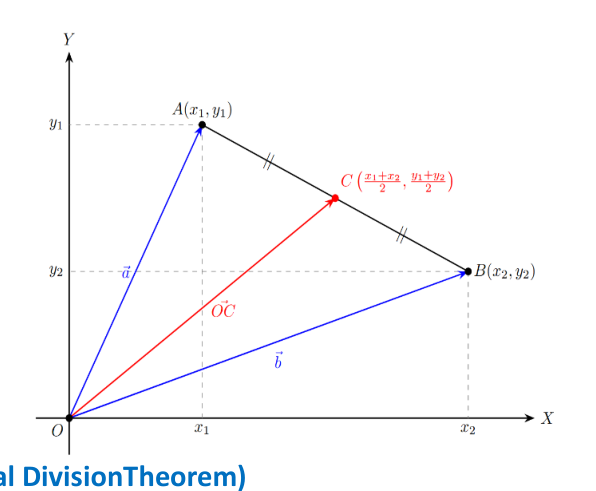
Problem: The position vectors of A and B are \( 4\vec{i} + 3\vec{j} \) and \( 2\vec{i} - \vec{j} \). Find the position vector of the mid-point M of AB.
Step 1: Writing down the given position vectors:
\[ \overrightarrow{OA} = 4\vec{i} + 3\vec{j} \]
\[ \overrightarrow{OB} = 2\vec{i} - \vec{j} \]
Step 2: Putting them into the mid-point formula:
\[ \overrightarrow{OM} = \tfrac{1}{2}(4\vec{i} + 3\vec{j} + 2\vec{i} - \vec{j}) \]
Step 3: Collecting the \( \vec{i} \) terms and the \( \vec{j} \) terms inside the bracket:
\[ \overrightarrow{OM} = \tfrac{1}{2}(6\vec{i} + 2\vec{j}) \]
Step 4: Multiplying each term by one half:
\[ \overrightarrow{OM} = 3\vec{i} + \vec{j} \]
So M is the point (3, 1). A quick check: 3 is halfway between 4 and 2, and 1 is halfway between 3 and \( -1 \).
Reading a Ratio as a Vector Equation
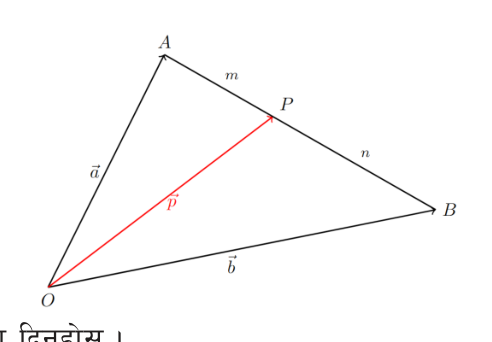
When a point P divides AB internally in the ratio m : n, it means AP : PB = m : n. P lies between A and B, so the parts AP and PB point the same way along the line.
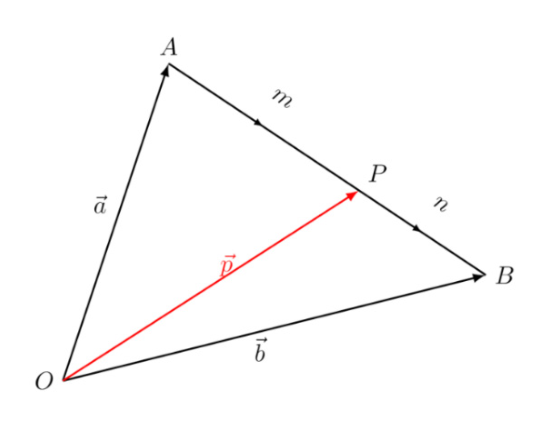
From \( \frac{AP}{PB} = \frac{m}{n} \) we get n AP = m PB for the lengths. Because the two parts also have the same direction, the same equation holds for the vectors:
\[ n\,\overrightarrow{AP} = m\,\overrightarrow{PB} \]
Solving this with \( \overrightarrow{AP} = \vec{p} - \vec{a} \) and \( \overrightarrow{PB} = \vec{b} - \vec{p} \) gives the internal section formula:
\[ \vec{p} = \frac{m\vec{b} + n\vec{a}}{m+n} \]
When P divides AB externally, P lies on the line AB extended, outside the segment. Then AP and BP point the same way, so \( n\,\overrightarrow{AP} = m\,\overrightarrow{BP} \), and solving gives the external section formula:
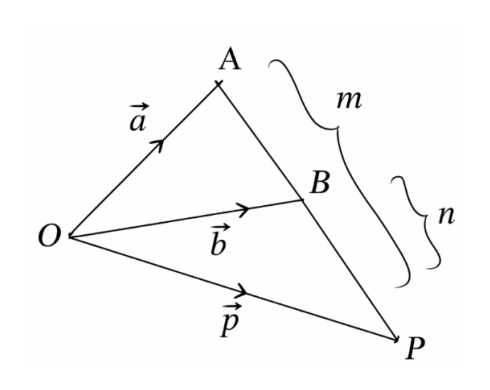
\[ \vec{p} = \frac{m\vec{b} - n\vec{a}}{m-n} \]
Two special cases follow from these formulas. When m = n the internal formula becomes \( \frac{\vec{a} + \vec{b}}{2} \), the mid-point. When m = n the external formula has \( m - n = 0 \) in its denominator, so no point divides a segment externally in the ratio 1 : 1.
Worked Example 2: The Section Formula in Components
Problem: The position vectors of A and B are \( x_1\vec{i} + y_1\vec{j} \) and \( x_2\vec{i} + y_2\vec{j} \). A point P divides AB internally in the ratio m : n. Write the position vector of P in terms of \( \vec{i} \) and \( \vec{j} \).
Step 1: Naming the given position vectors:
\[ \overrightarrow{OA} = x_1\vec{i} + y_1\vec{j} \]
\[ \overrightarrow{OB} = x_2\vec{i} + y_2\vec{j} \]
Step 2: Writing the internal section formula:
\[ \overrightarrow{OP} = \frac{m\overrightarrow{OB} + n\overrightarrow{OA}}{m+n} \]
Step 3: Substituting, the numerator becomes:
\[ m(x_2\vec{i} + y_2\vec{j}) + n(x_1\vec{i} + y_1\vec{j}) \]
Step 4: Opening the brackets and grouping the \( \vec{i} \) terms and the \( \vec{j} \) terms, the numerator is:
\[ (mx_2 + nx_1)\vec{i} + (my_2 + ny_1)\vec{j} \]
Step 5: Dividing each part by m + n:
\[ \overrightarrow{OP} = \frac{mx_2 + nx_1}{m+n}\vec{i} + \frac{my_2 + ny_1}{m+n}\vec{j} \]
The two fractions are exactly the coordinates of P given by the section formula in coordinate geometry. The vector method and the coordinate method agree.
Worked Example 3: Internal and External Division
Problem: The position vectors of A and B are \( \overrightarrow{OA} = 4\vec{i} + 3\vec{j} \) and \( \overrightarrow{OB} = 3\vec{i} - 4\vec{j} \).
- (a) M divides AB internally in the ratio 3 : 2. Find the position vector of M.
- (b) N divides AB externally in the ratio 5 : 3. Find the position vector of N.
(a) Here m : n = 3 : 2 and the division is internal.
Step 1: Writing the internal section formula:
\[ \overrightarrow{OM} = \frac{m\overrightarrow{OB} + n\overrightarrow{OA}}{m+n} \]
Step 2: Substituting m = 3, n = 2 and the two vectors:
\[ \overrightarrow{OM} = \frac{3(3\vec{i} - 4\vec{j}) + 2(4\vec{i} + 3\vec{j})}{3+2} \]
Step 3: Multiplying out the brackets:
\[ \overrightarrow{OM} = \frac{9\vec{i} - 12\vec{j} + 8\vec{i} + 6\vec{j}}{5} \]
Step 4: Collecting like terms, 9 + 8 = 17 and \( -12 + 6 = -6 \):
\[ \overrightarrow{OM} = \frac{17}{5}\vec{i} - \frac{6}{5}\vec{j} \]
(b) Here m : n = 5 : 3 and the division is external.
Step 1: Writing the external section formula:
\[ \overrightarrow{ON} = \frac{m\overrightarrow{OB} - n\overrightarrow{OA}}{m-n} \]
Step 2: Substituting m = 5, n = 3 and the two vectors:
\[ \overrightarrow{ON} = \frac{5(3\vec{i} - 4\vec{j}) - 3(4\vec{i} + 3\vec{j})}{5-3} \]
Step 3: Multiplying out, taking care that the minus sign changes both terms of the second bracket:
\[ \overrightarrow{ON} = \frac{15\vec{i} - 20\vec{j} - 12\vec{i} - 9\vec{j}}{2} \]
Step 4: Collecting like terms, 15 minus 12 is 3 and \( -20 - 9 = -29 \):
\[ \overrightarrow{ON} = \frac{3}{2}\vec{i} - \frac{29}{2}\vec{j} \]
In the external formula, the minus sign in front of \( n\overrightarrow{OA} \) belongs to every term of that bracket. Opening \( -3(4\vec{i} + 3\vec{j}) \) gives \( -12\vec{i} - 9\vec{j} \). Writing \( +9\vec{j} \) is the slip that spoils most answers.
Using the Theorems: Medians of a Triangle
A median of a triangle joins a vertex to the mid-point of the opposite side. The same tools show that a median is half the sum of the two sides that meet at its vertex.
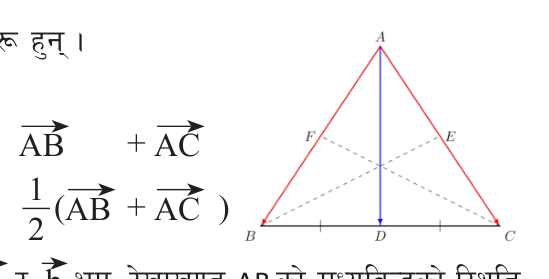
Step 1: Going from A to D through B, by the triangle law in triangle ABD:
\[ \overrightarrow{AD} = \overrightarrow{AB} + \overrightarrow{BD} \]
Step 2: Going from A to D through C, by the triangle law in triangle ACD:
\[ \overrightarrow{AD} = \overrightarrow{AC} + \overrightarrow{CD} \]
Step 3: Adding the two equations. D is the mid-point of BC, so BD and CD are equal in length and opposite in direction, and \( \overrightarrow{BD} + \overrightarrow{CD} = \vec{0} \):
\[ 2\overrightarrow{AD} = \overrightarrow{AB} + \overrightarrow{AC} \]
In the same way \( 2\overrightarrow{BE} = \overrightarrow{BA} + \overrightarrow{BC} \) and \( 2\overrightarrow{CF} = \overrightarrow{CA} + \overrightarrow{CB} \). Adding all three, each side appears once in each direction, for example \( \overrightarrow{AB} + \overrightarrow{BA} = \vec{0} \). So the three medians of a triangle add up to the zero vector: \( \overrightarrow{AD} + \overrightarrow{BE} + \overrightarrow{CF} = \vec{0} \).
Direction Matters in the Mid-point Theorem
The mid-point theorem can be written with the arrows either way round, as long as both sides of the equation point the same way. In the triangle below, F is the mid-point of AB and E is the mid-point of AC.
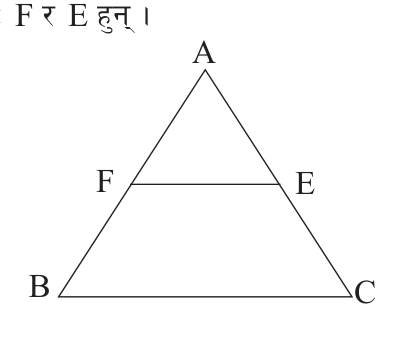
Step 1: Going from E to F through A, by the triangle law:
\[ \overrightarrow{EF} = \overrightarrow{EA} + \overrightarrow{AF} \]
Step 2: E is the mid-point of AC and F is the mid-point of AB, so each part is half of a side:
\[ \overrightarrow{EF} = \tfrac{1}{2}\overrightarrow{CA} + \tfrac{1}{2}\overrightarrow{AB} \]
Step 3: Taking out one half and using \( \overrightarrow{CA} + \overrightarrow{AB} = \overrightarrow{CB} \):
\[ \overrightarrow{EF} = \tfrac{1}{2}\overrightarrow{CB} \]
Reversing every arrow gives the same fact the other way round, \( \overrightarrow{FE} = \tfrac{1}{2}\overrightarrow{BC} \). Both statements are correct. What is never correct is to mix the directions and write \( \overrightarrow{EF} = \tfrac{1}{2}\overrightarrow{BC} \) for this triangle, because EF and BC point opposite ways.
Checking the Mid-point Theorem with Coordinates
A theorem proved in general can be checked on one real triangle. Take A(2, 3), B(4, 1) and C(6, 5), so \( \overrightarrow{OA} = 2\vec{i} + 3\vec{j} \), \( \overrightarrow{OB} = 4\vec{i} + \vec{j} \) and \( \overrightarrow{OC} = 6\vec{i} + 5\vec{j} \). Let D be the mid-point of AB and E the mid-point of AC.
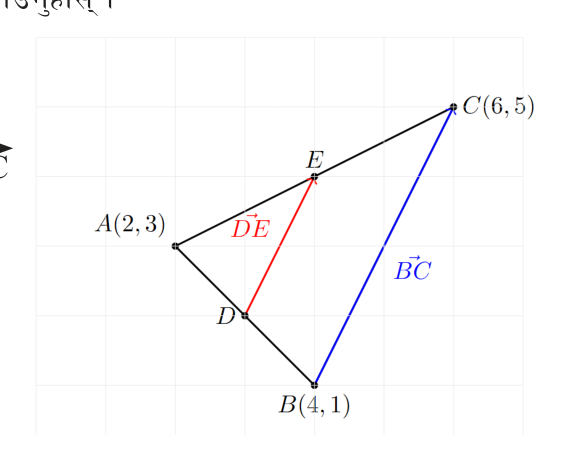
Step 1: Finding the position vector of D, the mid-point of AB:
\[ \overrightarrow{OD} = \tfrac{1}{2}(6\vec{i} + 4\vec{j}) = 3\vec{i} + 2\vec{j} \]
Step 2: Finding the position vector of E, the mid-point of AC:
\[ \overrightarrow{OE} = \tfrac{1}{2}(8\vec{i} + 8\vec{j}) = 4\vec{i} + 4\vec{j} \]
Step 3: Finding DE by subtracting position vectors:
\[ \overrightarrow{DE} = \overrightarrow{OE} - \overrightarrow{OD} = \vec{i} + 2\vec{j} \]
Step 4: Finding BC in the same way:
\[ \overrightarrow{BC} = \overrightarrow{OC} - \overrightarrow{OB} = 2\vec{i} + 4\vec{j} \]
Comparing the two, \( \overrightarrow{DE} = \tfrac{1}{2}\overrightarrow{BC} \). The scalar one half is positive, so DE is parallel to BC and half as long, exactly as the mid-point theorem says.
The full lesson is waiting for you
The notes are free to read in full. A free account opens the rest of the practice, and tracks your progress and confidence score for every subject. Presentations and videos need approval from Learn Yeti.