Scalars and Vectors
Some quantities are complete as soon as you give a number and a unit. If a bag of rice has a mass of 5 kg, or a football match lasts 90 minutes, nothing more needs to be said. Other quantities are not complete with a number alone. If a friend tells you to walk 200 m to reach a shop, you still cannot find it. You need to know which way to walk. "Walk 200 m towards the east" is complete, because it gives both a size and a direction.
Scalar quantity: A quantity that has magnitude (size) only is called a scalar. Mass, time, distance, work and power are scalars.
Vector: A physical quantity that has both magnitude and direction is called a vector. Displacement, force and velocity are vectors.
A vector is written with a small arrow above its letter, such as \( \vec{a} \), \( \vec{F} \) or \( \vec{d} \). Its magnitude, which is its size without the direction, is written between two upright bars. So \( |\vec{a}| \) is read as "the magnitude of vector a". A magnitude is just a number, so \( |\vec{a}| \) is always a scalar. When there is no confusion, the magnitude of \( \vec{F} \) is often written simply as F.
How Vectors Came Into Mathematics
The idea behind vectors is old. It is linked with the geometry of the ancient Greeks, who studied lines and directions. But vectors as a working tool only took shape in the 19th century, when scientists needed a way to solve problems in physics and mathematics in which direction mattered as much as size.
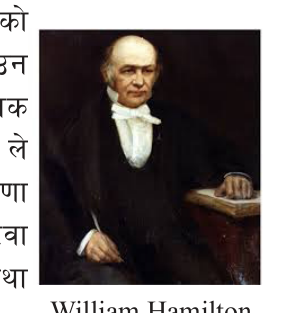
The modern analysis of vectors began after the Irish mathematician William Rowan Hamilton (1805 to 1865) invented the quaternion in 1843. Through his theory of quaternions he found a way to express magnitude and direction together in one mathematical object. Hamilton's ideas were powerful but difficult to use. Later, the American scientist Josiah Willard Gibbs and the British engineer Oliver Heaviside simplified them and developed vector analysis in the form we use today. This helped the growth of modern engineering and science a great deal. Vectors are now used to solve problems in physics, mathematics, engineering and computer science.
Work: Force Multiplied by Displacement
Think of a man cutting grass with a lawnmower. He pushes along the handle AC with a force of F newtons. The handle is slanted, so his push makes an angle \( \theta \) with the flat ground. The mower moves forward a distance d, from B to C.
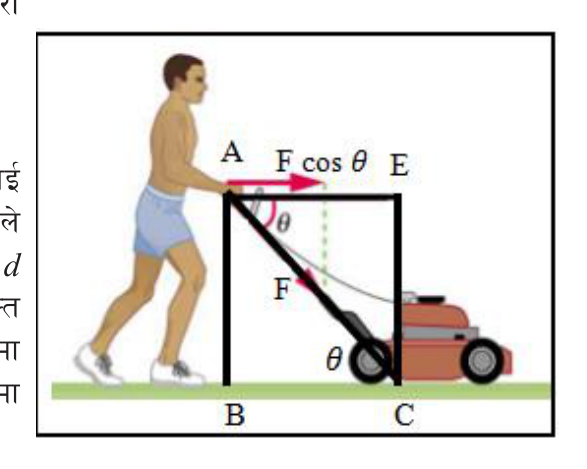
The slanting push does two jobs at once. Part of it drives the mower forward along the ground. The other part presses the mower down into the grass, and that part does not move the mower forward at all. So only the forward part does the work of moving the mower through the distance d.
How big is the forward part? Picture a right angled triangle with the slanting force F as its hypotenuse and the horizontal ground as its base. The angle between them is \( \theta \). The side next to \( \theta \) is the forward part, and since \( \cos\theta = \frac{\text{base}}{\text{hypotenuse}} \), the forward part is \( F\cos\theta \). So the man is really applying a force of \( F\cos\theta \) in the direction the mower moves.
Now compare the three quantities. The force F has a size and a direction, so it is a vector. The displacement d also has a size and a direction, so it is a vector too. The work W tells us only how much work was done. It has no direction, so work is a scalar. Work is the forward part of the force multiplied by the distance moved:
\[ W = \vec{F}\cdot\vec{d} = F\cos\theta \times d \]
Writing F and d as magnitudes of the two vectors gives the form we use most:
\[ W = |\vec{F}||\vec{d}|\cos\theta \]
Look at what has happened. Two vectors, \( \vec{F} \) and \( \vec{d} \), have been multiplied, and the answer W is a scalar. Because this way of multiplying two vectors produces a scalar, it is called the scalar product. The unit of work is the joule (J).
Work: When a force is applied on an object, the product of the part of the force in the direction of displacement and the distance the object moves is called work. Work shows magnitude only, so it is a scalar. Work = force × displacement, that is, \( W = \vec{F}\cdot\vec{d} = |\vec{F}||\vec{d}|\cos\theta \). Its unit is the joule.
Example 1: A man pushes a lawnmower with a force of 50 N along its handle. The handle makes an angle of \( 60^\circ \) with the ground, and the mower moves 20 m. Find the work done.
Step 1: Writing the formula for work:
\[ W = |\vec{F}||\vec{d}|\cos\theta \]
Step 2: Putting in \( |\vec{F}| = 50 \) N, \( |\vec{d}| = 20 \) m and \( \theta = 60^\circ \):
\[ W = 50 \times 20 \times \cos 60^\circ \]
Step 3: Since \( \cos 60^\circ = \frac{1}{2} \), multiplying the numbers:
\[ W = 1000 \times \frac{1}{2} = 500 \]
So the man does 500 J of work.
Multiplying the whole force by the distance, 50 × 20 = 1000 J, is wrong whenever the force is slanted. Only the part F cos θ moves the object forward, so cos θ must always appear in the calculation.
Power: Force Multiplied by Velocity
Now think of a girl pushing a shopping trolley along a flat road. She pushes with a force of F newtons in a straight line, and for t minutes the trolley moves forward with a uniform velocity of v metres per second.
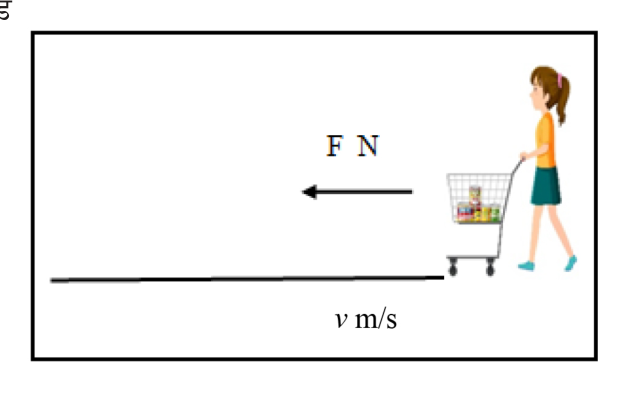
Once again, only the part of her push along the direction of motion counts. If her push makes an angle \( \theta \) with the direction in which the trolley moves, that part is \( F\cos\theta \). The force F and the velocity v both have size and direction, so both are vectors. The power P she uses tells only how fast she is doing work. It has no direction, so power is a scalar. Power is the forward part of the force multiplied by the velocity:
\[ P = \vec{F}\cdot\vec{v} = F\cos\theta \times v \]
\[ P = |\vec{F}||\vec{v}|\cos\theta \]
Here too, two vectors, \( \vec{F} \) and \( \vec{v} \), are multiplied and the answer is a scalar. So this is also a scalar product of vectors. The unit of power is the watt (W).
Power: When a force is applied on an object, the product of the part of the force in the direction of displacement and the velocity with which the object moves in the direction of that force is called power. Power shows magnitude only, so it is a scalar. Power = force × velocity, that is, \( P = \vec{F}\cdot\vec{v} = |\vec{F}||\vec{v}|\cos\theta \). Its unit is the watt.
Example 2: A girl pushes a trolley straight along a level road with a force of 40 N, and the trolley moves with a uniform velocity of 1.5 m/s. Find the power she uses.
Step 1: Finding the angle. She pushes in exactly the direction the trolley moves, so the angle between force and velocity is:
\[ \theta = 0^\circ, \quad \cos 0^\circ = 1 \]
Step 2: Putting the values into \( P = |\vec{F}||\vec{v}|\cos\theta \):
\[ P = 40 \times 1.5 \times 1 = 60 \]
So she uses a power of 60 W.
Example 3: A boy pulls a cart with a rope. The rope makes an angle of \( 30^\circ \) with the road, he pulls with a force of 40 N, and the cart moves with a uniform velocity of 2 m/s. Find the power.
Step 1: Writing the formula for power:
\[ P = |\vec{F}||\vec{v}|\cos\theta \]
Step 2: Putting in \( |\vec{F}| = 40 \) N, \( |\vec{v}| = 2 \) m/s and \( \theta = 30^\circ \):
\[ P = 40 \times 2 \times \cos 30^\circ \]
Step 3: Since \( \cos 30^\circ = \frac{\sqrt{3}}{2} \), multiplying:
\[ P = 80 \times \frac{\sqrt{3}}{2} = 40\sqrt{3} \]
Step 4: Taking \( \sqrt{3} \approx 1.732 \) to get a decimal value:
\[ P \approx 40 \times 1.732 = 69.28 \]
So the power is \( 40\sqrt{3} \) W, which is about 69.28 W.
What Work and Power Have in Common
Put the two situations side by side and the same pattern appears in both.
| Quantity | First vector | Second vector | Formula | Unit |
| Work (W) | Force \( \vec{F} \) | Displacement \( \vec{d} \) | \( |\vec{F}||\vec{d}|\cos\theta \) | joule |
| Power (P) | Force \( \vec{F} \) | Velocity \( \vec{v} \) | \( |\vec{F}||\vec{v}|\cos\theta \) | watt |
In each case we take the magnitude of the first vector, multiply it by the magnitude of the second vector, and multiply again by the cosine of the angle between them. Two vectors go in, and a single number comes out. This is exactly what is meant by the scalar product of two vectors.
The scalar product of two vectors is the product of the magnitude of the first vector, the magnitude of the second vector and \( \cos\theta \). The answer is always a scalar, and that is where the name comes from.
The Scalar Product of Two Vectors
Now leave force, displacement and velocity behind and take any two vectors \( \vec{a} \) and \( \vec{b} \). Draw them starting from the same point. The angle \( \theta \) between them is the opening between the two arrows, and it can be anything from \( 0 \) to \( \pi \), that is, from \( 0^\circ \) to \( 180^\circ \).
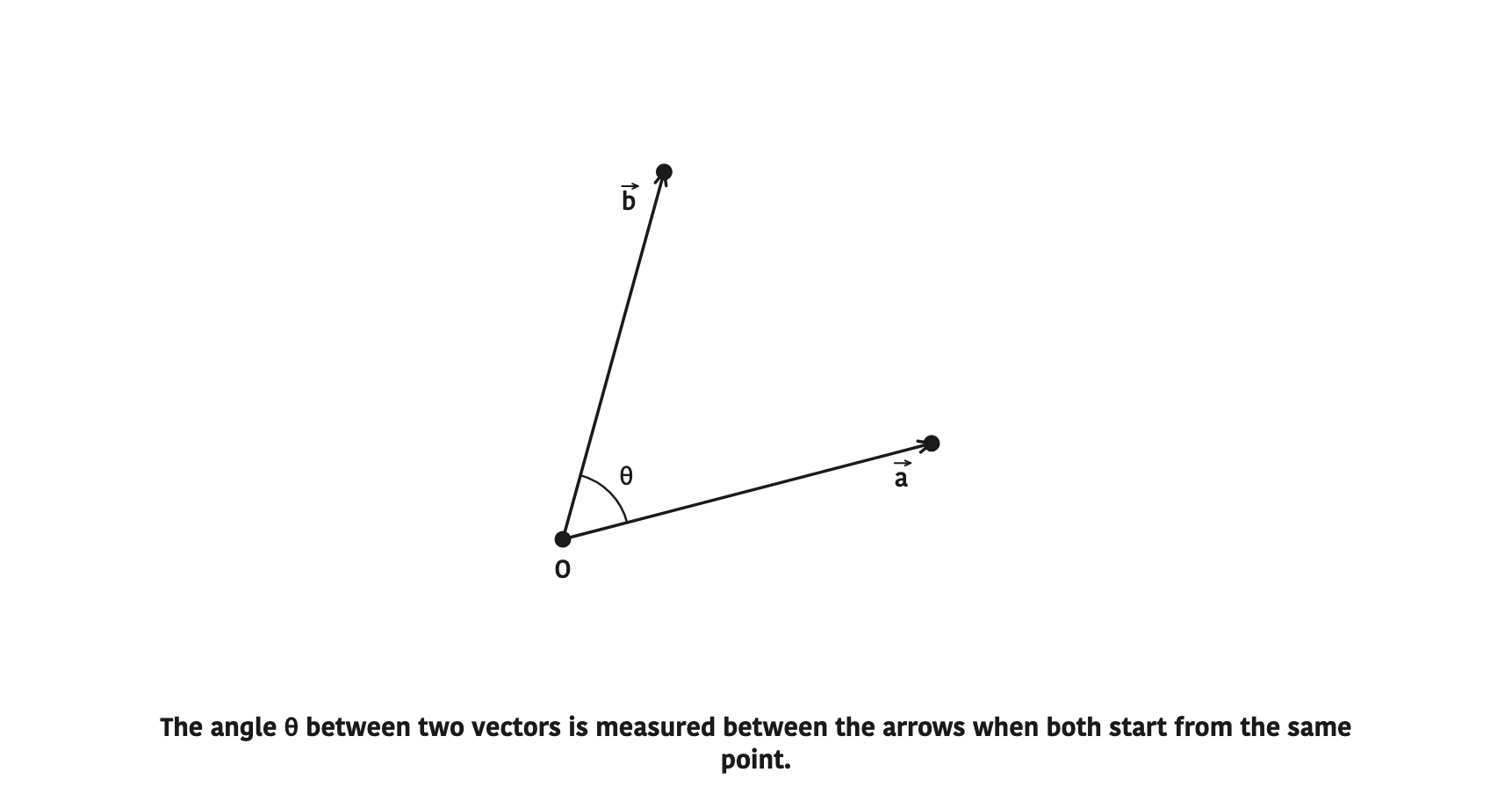
Scalar product: If \( \vec{a} \) and \( \vec{b} \) are two vectors and \( \theta \) \( (0 \le \theta \le \pi) \) is the angle between them, the scalar product of \( \vec{a} \) and \( \vec{b} \) is defined as \( \vec{a}\cdot\vec{b} = |\vec{a}||\vec{b}|\cos\theta \). The scalar product is also called the dot product.
\[ \vec{a}\cdot\vec{b} = |\vec{a}||\vec{b}|\cos\theta \]
The expression \( \vec{a}\cdot\vec{b} \) is read as "a dot b". The dot between the two vectors is what gives the dot product its name. The right hand side is made only of numbers: two magnitudes and a cosine. So the answer is a scalar.
The same formula can be turned round to find the angle between two vectors. Dividing both sides by \( |\vec{a}||\vec{b}| \) gives:
\[ \cos\theta = \frac{\vec{a}\cdot\vec{b}}{|\vec{a}||\vec{b}|} \]
Since the two magnitudes are always positive, the sign of \( \vec{a}\cdot\vec{b} \) is the sign of \( \cos\theta \). A positive dot product means the angle is acute, and a negative dot product means the angle is obtuse.
A dot product is a number, so never draw an arrow over the answer. Also write the dot clearly between the two vectors: \( \vec{a}\cdot\vec{b} \) is the scalar product, while \( \vec{a}\vec{b} \) written with no sign means nothing.
Using the Scalar Product
Example 4: The magnitudes of two vectors are \( |\vec{a}| = 4 \) and \( |\vec{b}| = 5 \), and the angle between them is \( 60^\circ \). Find \( \vec{a}\cdot\vec{b} \).
Step 1: Writing the definition of the scalar product:
\[ \vec{a}\cdot\vec{b} = |\vec{a}||\vec{b}|\cos\theta \]
Step 2: Putting in the magnitudes and the angle:
\[ \vec{a}\cdot\vec{b} = 4 \times 5 \times \cos 60^\circ \]
Step 3: Since \( \cos 60^\circ = \frac{1}{2} \), multiplying:
\[ \vec{a}\cdot\vec{b} = 20 \times \frac{1}{2} = 10 \]
Example 5: If \( |\vec{a}| = 6 \), \( |\vec{b}| = 4 \) and \( \vec{a}\cdot\vec{b} = 12 \), find the angle between \( \vec{a} \) and \( \vec{b} \).
Step 1: Writing the formula for the angle:
\[ \cos\theta = \frac{\vec{a}\cdot\vec{b}}{|\vec{a}||\vec{b}|} \]
Step 2: Putting in the given values:
\[ \cos\theta = \frac{12}{6 \times 4} = \frac{12}{24} = \frac{1}{2} \]
Step 3: Since \( \cos 60^\circ = \frac{1}{2} \), the angle is:
\[ \theta = 60^\circ \]
Example 6: If \( |\vec{a}| = 3 \), \( |\vec{b}| = 4 \) and \( \vec{a}\cdot\vec{b} = -6 \), find the angle between the two vectors.
Step 1: Putting the values into the formula for the angle:
\[ \cos\theta = \frac{-6}{3 \times 4} = \frac{-6}{12} \]
Step 2: Simplifying the fraction:
\[ \cos\theta = -\frac{1}{2} \]
Step 3: Since \( \cos 120^\circ = -\frac{1}{2} \) and \( \theta \) lies between \( 0^\circ \) and \( 180^\circ \), the angle is:
\[ \theta = 120^\circ \]
The negative dot product told us in advance that the angle would be obtuse, and it is.
The full lesson is waiting for you
The notes are free to read in full. A free account opens the rest of the practice, and tracks your progress and confidence score for every subject. Presentations and videos need approval from Learn Yeti.