Triangles on the Same Base and Between the Same Parallels
You already know about parallelograms that stand on the same base and lie between the same pair of parallel lines. In the figure below, ABCD and ABQP share the base AB, and the top side of each lies on the line ST, which is parallel to AB. Wherever the top side slides along ST, the distance between the two lines does not change. So the two parallelograms have equal areas.
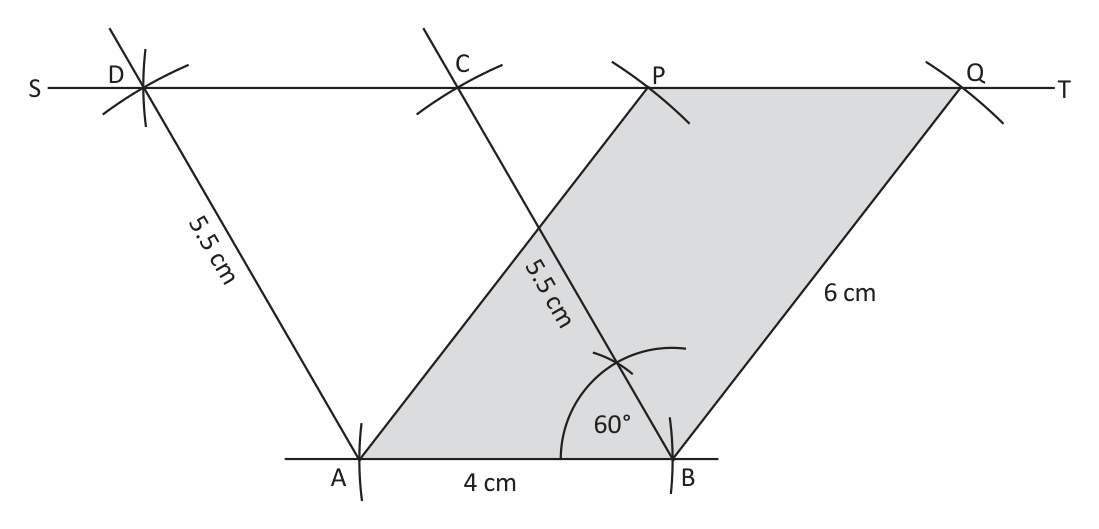
Any triangle is exactly half of a parallelogram with the same base and the same height. So the rule that works for parallelograms works for triangles too. Every construction in this topic rests on that one fact.
Triangles equal in area: Triangles standing on the same base and lying between the same parallel lines are equal in area.
Two parts of that statement need care. 'Same base' means the two triangles share one side, such as BC. 'Between the same parallels' means the third vertex of each triangle lies on one line drawn parallel to that base. When both conditions hold, the triangles have the same area, however different their shapes look.
Why a Line Parallel to the Base Keeps the Area the Same
The area of a triangle is worked out from its base and its height:
\[ A = \frac{1}{2} \times b \times h \]
Here A is the area, b is the base and h is the height.
Height of a triangle: the perpendicular distance from a vertex to the opposite side, which is taken as the base.
Parallel lines: lines in the same plane that never meet and are the same distance apart wherever they are measured.
Suppose \( \triangle ABC \) has base BC, and a line ST is drawn through A parallel to BC. Parallel lines are the same distance apart everywhere, so every point on ST is at the same height h above BC. Now choose any point D on ST and join it to B and C. The new \( \triangle DBC \) has the same base BC and the same height h.
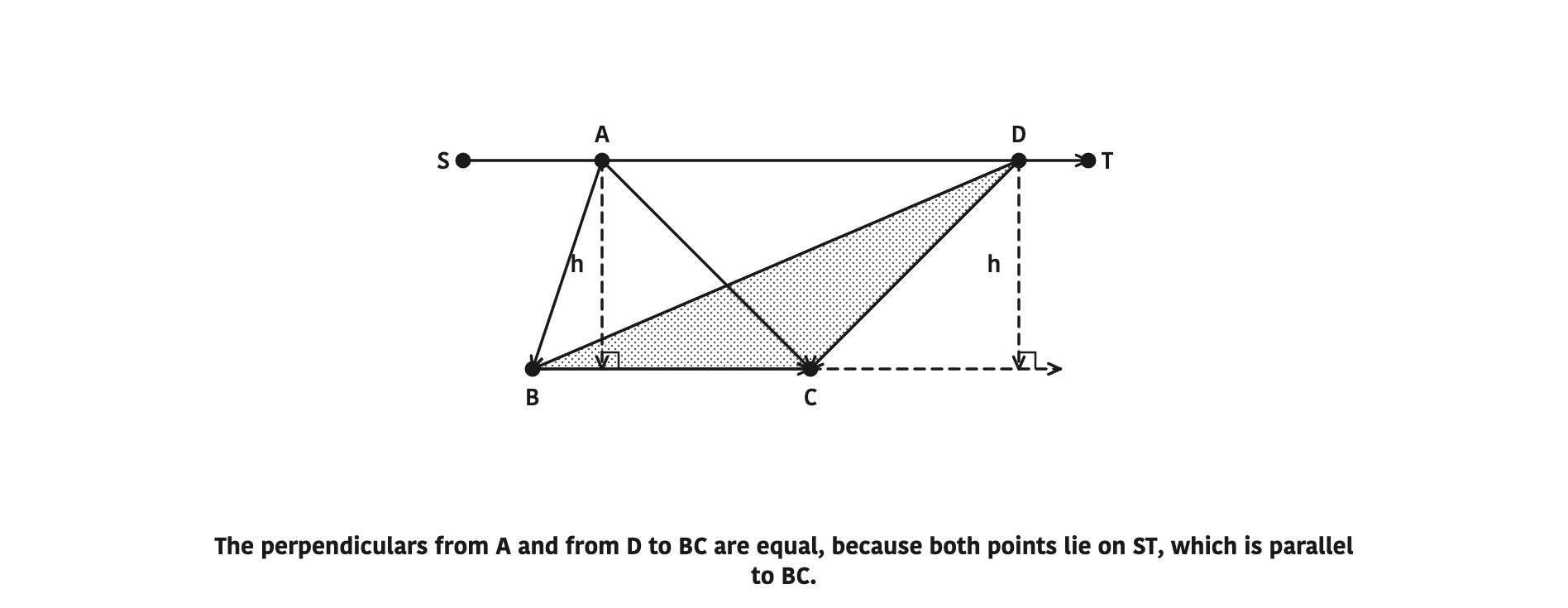
Written with the formula, the two areas come out the same. Here ar stands for area:
\[ \text{ar}(\triangle ABC) = \frac{1}{2} \times BC \times h \]
\[ \text{ar}(\triangle DBC) = \frac{1}{2} \times BC \times h \]
To make a new triangle with the same area, keep the base BC and slide the third vertex along the line through A parallel to BC. Stop at the point where the new condition, such as a given angle or a given side length, is met.
Drawing a Line Through a Vertex Parallel to the Base
Every construction in this topic needs the line ST through A parallel to BC. It is made by copying \( \angle ABC \) at the point A, on the other side of AB, so that \( \angle BAS = \angle ABC \). The line AB crosses both ST and BC, and these two angles sit on opposite sides of AB. Angles placed like this are called alternate angles, and when alternate angles are equal the two lines are parallel.
Alternate angles: when one line crosses two other lines, a pair of angles that lie between those two lines and on opposite sides of the crossing line. If a pair of alternate angles is equal, the two lines are parallel.
The angle is copied with a compass like this:
- With centre B and any convenient radius, draw an arc cutting both BC and BA.
- With the same radius and centre A, draw another arc that cuts AB and spreads to the side of AB away from C.
- Set the compass to the distance between the two points where the first arc cut BC and BA.
- With the point where the second arc cuts AB as centre, and that same distance, cut the second arc.
- Draw a line through A and this crossing point and extend it both ways. Name its two ends S and T.
Copy the angle on the side of AB away from C. If it is copied on the same side as C, the line through A slopes, it is not parallel to BC, and points on it are at different heights.
The Given Triangle ABC
Both constructions start from the same triangle: \( \triangle ABC \) in which BC = 4.4 cm, \( \angle ABC = 60^\circ \) and AB = 5.5 cm. Before picking up any instrument, make a rough sketch with the given measurements written on it, so you can see where each point will go.
Rough sketch: a quick freehand drawing with the given measurements written on it, made before the exact construction to plan where each point goes.
- Draw a straight line and mark BC = 4.4 cm on it.
- At B, construct an angle of \( 60^\circ \) with the compass.
- With centre B and radius 5.5 cm, cut the arm of the \( 60^\circ \) angle and name the point A.
- Join A and C. This is the given \( \triangle ABC \).
Construction 1: Triangle DBC Having an Angle of 120°
The task: construct \( \triangle DBC \), equal in area to \( \triangle ABC \), with \( \angle BCD = 120^\circ \). The base BC is kept, so the only thing that changes is where the third vertex D sits. D must lie on ST, and the \( 120^\circ \) angle made at C decides exactly which point of ST it is.
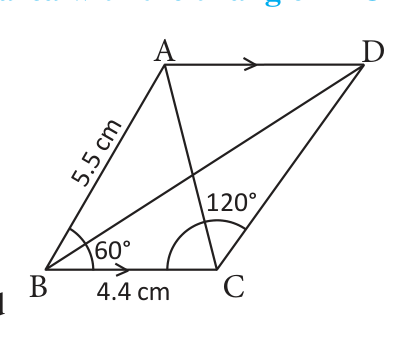
- Draw a rough sketch and write the given measurements on it.
- Construct \( \triangle ABC \) with BC = 4.4 cm, \( \angle ABC = 60^\circ \) and AB = 5.5 cm.
- Through A, draw \( ST \parallel BC \) by making \( \angle BAS = \angle ABC \).
- At C, construct \( \angle BCD = 120^\circ \). With centre C draw an arc cutting CB, then step the same radius twice along the arc, moving upward. The line from C through the second mark makes \( 120^\circ \) with CB.
- Extend this arm until it meets ST, and name the meeting point D. This arm is the side CD.
- Join D and B. \( \triangle DBC \) is the required triangle.
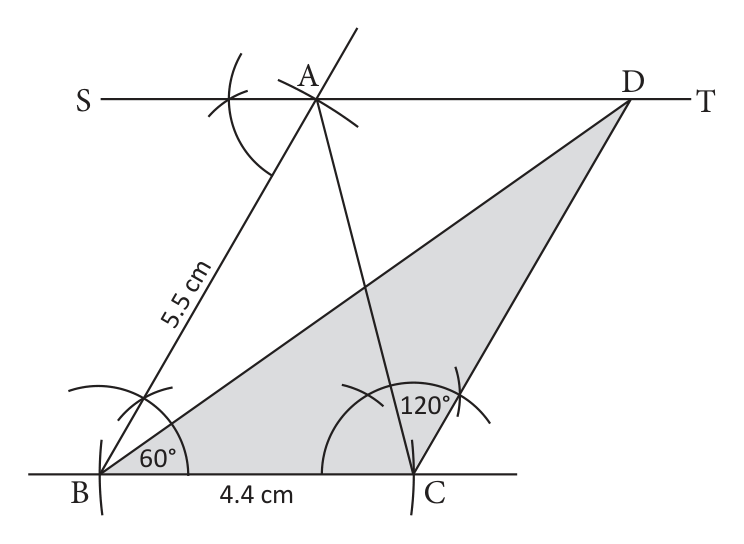
Why are they equal? \( \triangle ABC \) and \( \triangle DBC \) stand on the same base BC and lie between the same parallels BC and ST. So:
\[ \text{ar}(\triangle DBC) = \text{ar}(\triangle ABC) \]
Construction 2: Triangle DBC Having a Side of 6.2 cm
The task: construct \( \triangle DBC \), equal in area to the same \( \triangle ABC \), with one side BD = 6.2 cm. This time D is found by a distance from B instead of an angle. All points 6.2 cm from B lie on a circle of radius 6.2 cm centred at B, so D is where that arc cuts ST.
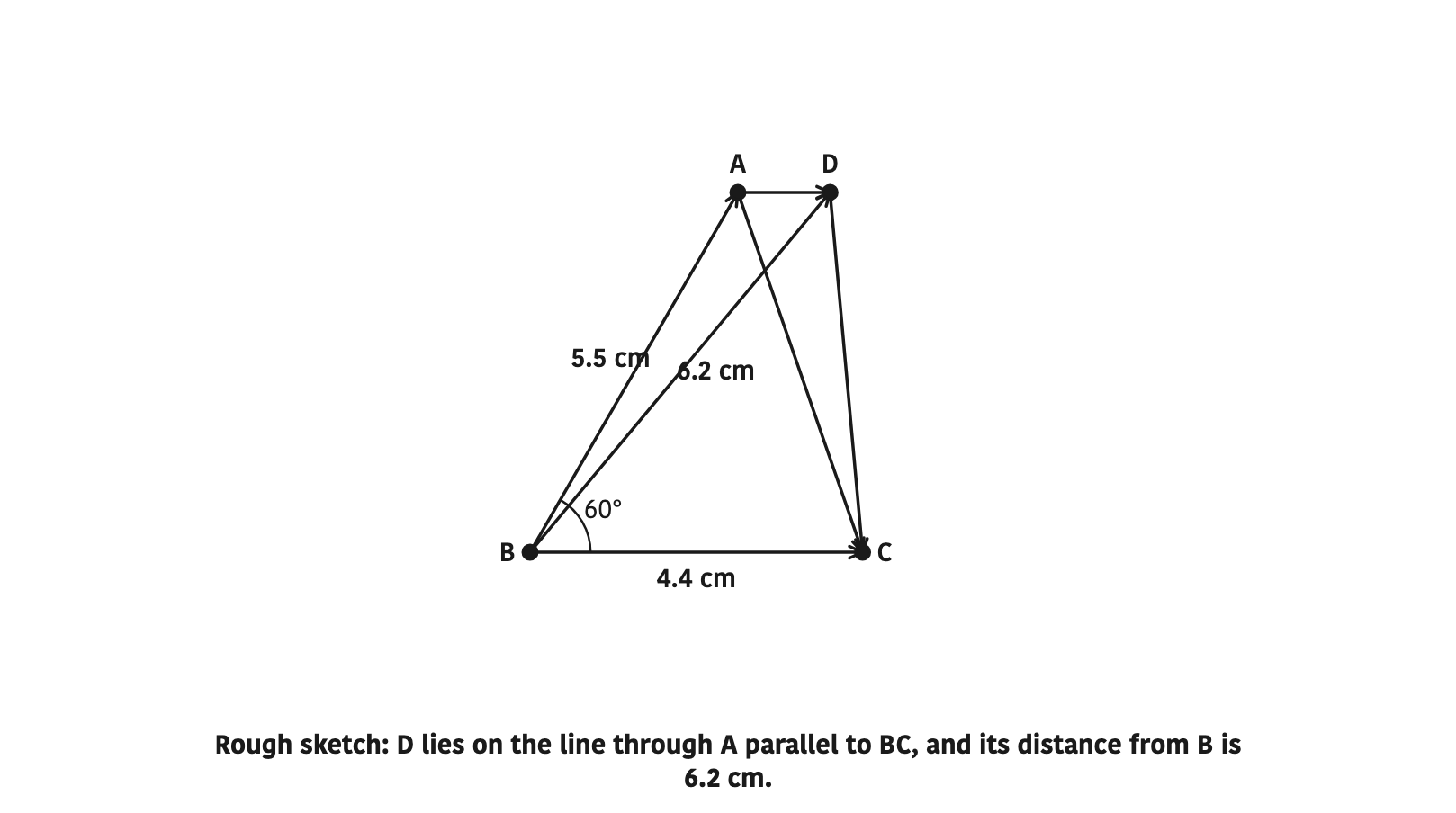
- Draw a rough sketch of \( \triangle ABC \) and write the given measurements on it.
- Construct \( \triangle ABC \) in which BC = 4.4 cm, \( \angle ABC = 60^\circ \) and AB = 5.5 cm.
- Through A, draw \( ST \parallel BC \) by making \( \angle BAS = \angle ABC \).
- With centre B and radius 6.2 cm, draw an arc cutting ST. Name the point where it cuts D.
- Join D to B and to C. \( \triangle DBC \) is the required triangle.
The reason is the same as before. Both triangles stand on the same base BC and lie between the same parallels BC and ST, so their areas are equal.
The arc centred at B can cut ST in two places, one on each side. A triangle made with either point has base BC and the same height, so both are correct answers. The point on the same side as C is usually chosen because it keeps the drawing compact.
The arc reaches ST only if its radius is longer than the height of A above BC. Here that height is about 4.8 cm, so 6.2 cm works. An arc of radius 4 cm would never reach ST, which means no such triangle with BD = 4 cm can be drawn.
| Feature | Construction 1 | Construction 2 |
| Condition given for D | \( \angle BCD = 120^\circ \) | BD = 6.2 cm |
| How D is found | Arm of 120° from C meets ST | Arc of 6.2 cm from B cuts ST |
| What stays fixed | Base BC and line ST | Base BC and line ST |
Checking the Constructions by Measurement
A construction can be tested with a ruler and a set square. Here is the check for Construction 1, using measured heights.
Step 1: Measuring the perpendicular from A to BC gives the height of \( \triangle ABC \):
\[ h_1 \approx 4.8 \text{ cm} \]
Step 2: Putting the base 4.4 cm and this height into the area formula:
\[ \text{ar}(\triangle ABC) = \frac{1}{2} \times 4.4 \times 4.8 \]
Step 3: Multiplying, since \( 4.4 \times 4.8 = 21.12 \) and half of that is taken:
\[ \text{ar}(\triangle ABC) \approx 10.56 \text{ cm}^2 \]
Step 4: Measuring the perpendicular from D to BC gives the height of \( \triangle DBC \):
\[ h_2 \approx 4.8 \text{ cm} \]
Step 5: The base is still BC = 4.4 cm, so putting the values into the formula again:
\[ \text{ar}(\triangle DBC) = \frac{1}{2} \times 4.4 \times 4.8 \]
Step 6: Multiplying gives the same area as before:
\[ \text{ar}(\triangle DBC) \approx 10.56 \text{ cm}^2 \]
Using trigonometry, the height is \( h = 5.5 \times \sin 60^\circ \approx 4.76 \) cm, so the exact area is about 10.48 \( \text{cm}^2 \). A ruler reads only to the nearest millimetre, so 4.8 cm and 10.56 \( \text{cm}^2 \) are what a careful drawing gives. What matters is that both triangles give the same answer.
Construction 1 has one more check. The angles at B and C add up like this:
\[ \angle ABC + \angle BCD = 60^\circ + 120^\circ = 180^\circ \]
These are co-interior angles between BA and CD, and since they add up to \( 180^\circ \), \( CD \parallel BA \). AD is also parallel to BC, so ABCD is a parallelogram. That means AD should measure about 4.4 cm and CD about 5.5 cm on your drawing. In Construction 2, BD should measure exactly 6.2 cm, and the height of D should again be about 4.8 cm.
The full lesson is waiting for you
The notes are free to read in full. A free account opens the rest of the practice, and tracks your progress and confidence score for every subject. Presentations and videos need approval from Learn Yeti.