The Area Facts Behind These Constructions
Two figures can have exactly the same area even when they look nothing alike. A long thin rectangle and a short wide triangle may cover the same amount of paper. In geometry we can do more than notice this. Using only a ruler and a pair of compasses, we can construct a new figure that is certain to have the same area as a given one. Every construction here rests on a few area facts about triangles and parallel lines.
Figures equal in area: two plane figures are equal in area when they enclose the same amount of surface. Their shapes, sides and angles do not have to match.
Between the same parallels: two figures lie between the same parallels when each has its base on one line and its opposite vertex or side on a second line parallel to the first. The distance between two parallel lines never changes, so such figures always have the same height.
The area of any triangle depends only on its base and its height:
\[ A = \frac{1}{2} \times b \times h \]
Here \( b \) is the base and \( h \) is the height. This formula shows that a triangle may lean in any direction and still keep its area, as long as its base and height stay the same.
Triangles on the same base and between the same parallels are equal in area. They share the base, and the parallels give them the same height, so \( \frac{1}{2} \times b \times h \) is the same number for every one of them.
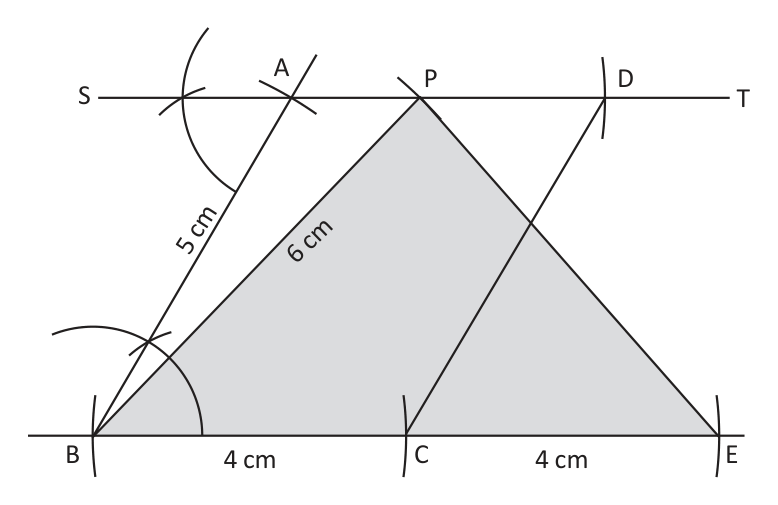
A second fact links triangles to parallelograms. A triangle on the same base as a parallelogram and between the same parallels has half the parallelogram's area. So a triangle between the same parallels whose base is twice as long as the parallelogram's base has exactly the parallelogram's area. In the figure below, BE is twice BC. A rectangle is a special parallelogram, so the same fact holds for rectangles too.
The Idea: Moving a Corner Without Changing the Area
Picture a triangle on base XY whose top vertex sits on a line parallel to XY. Slide that vertex along the parallel line, left or right. The triangle leans more and more, but its base is unchanged and its height is unchanged, so its area does not change at all.
Now look at a quadrilateral PQRS. The diagonal SQ cuts it into two triangles, PSQ and SQR. Leave triangle PSQ alone. Triangle SQR has base SQ. Slide its vertex R along a line parallel to SQ, and the area of triangle SQR stays the same wherever R goes. Keep sliding until R lands on the line PQ extended, and call that landing point G. Now Q lies on the straight line PG, so the corner at Q disappears. The four sided figure has become a three sided one, triangle PSG, and no area was added or lost on the way.
A quadrilateral becomes a triangle of the same area when one vertex is slid, parallel to the diagonal joining its two neighbours, until it lands on a neighbouring side extended.
Constructing a Triangle Equal in Area to a Quadrilateral
Problem: Construct a quadrilateral PQRS in which PQ = 5 cm, PS = 4 cm, QR = 4.4 cm, RS = 3.6 cm and diagonal PR = 6.4 cm. Then construct a triangle PSG equal in area to PQRS.
Diagonal: a line segment joining two opposite vertices of a quadrilateral. In PQRS the diagonals are PR and SQ.
Rough sketch: a quick freehand drawing, not to scale, made before the accurate construction to show the given measurements and the plan.
Start with a rough sketch. It shows where each given length goes and where the new point G will appear, so the accurate drawing has a plan to follow.
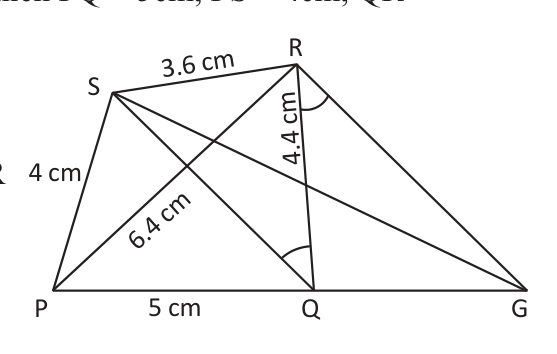
The accurate construction goes like this:
- Step 1: Draw the base PQ = 5 cm.
- Step 2: With P as centre and radius 6.4 cm, draw an arc. With Q as centre and radius 4.4 cm, draw another arc cutting the first. Name the crossing point R and join PR and QR.
- Step 3: With P as centre and radius 4 cm, and with R as centre and radius 3.6 cm, draw two arcs that cut each other on the side of diagonal PR away from Q. Name this point S and join PS and RS. Quadrilateral PQRS is now complete.
- Step 4: Join the diagonal SQ.
- Step 5: At R, copy the angle SQR on the other side of QR so that \( \angle QRH = \angle SQR \). These are alternate angles, so the line RH is parallel to SQ.
- Step 6: Extend PQ beyond Q until it meets RH. Name the meeting point G.
- Step 7: Join S and G. Triangle PSG is the required triangle.
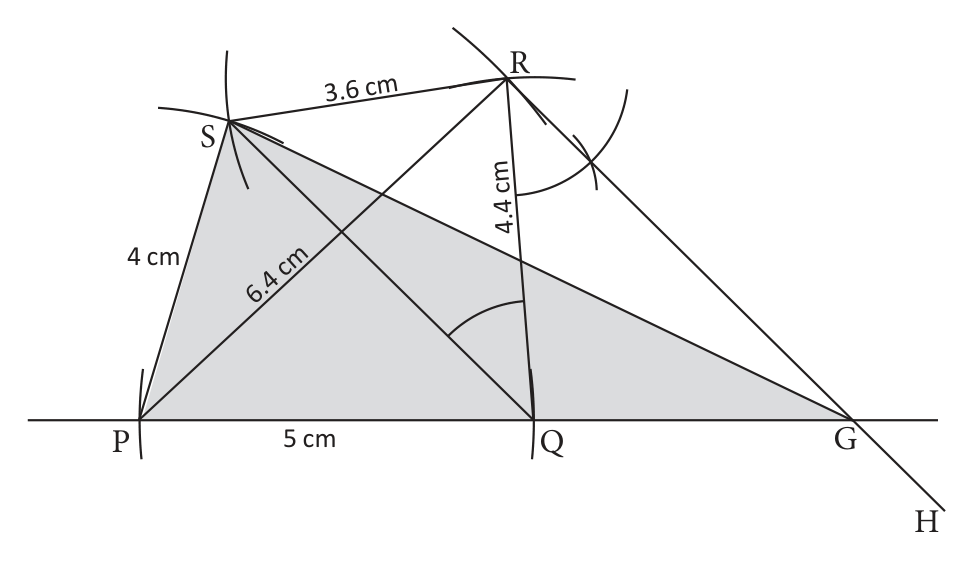
The parallel line goes through R, the corner being removed, and it is parallel to SQ, the diagonal joining R's two neighbours. Drawing it parallel to PR, or drawing it through Q, gives a triangle whose area is not equal to PQRS.
Do not rub out the construction arcs. The arcs at P, Q, R and S and the angle copied at R are the proof that the figure was constructed and not simply guessed.
Why Triangle PSG Has the Same Area as PQRS
The construction made RG parallel to SQ. Everything else follows from the fact about triangles between the same parallels.
Step 1: Triangles SQR and SQG stand on the same base SQ and lie between the same parallels SQ and RG, so their areas are equal:
\[ \begin{aligned} &\text{Area of } \triangle SQR \\ &= \text{Area of } \triangle SQG \end{aligned} \]
Step 2: Adding the area of triangle PSQ to both sides:
\[ \begin{aligned} &\text{Area of } (\triangle SQR + \triangle PSQ) \\ &= \text{Area of } (\triangle SQG + \triangle PSQ) \end{aligned} \]
Step 3: The two triangles on the left make up quadrilateral PQRS, and the two on the right make up triangle PSG. So:
\[ \begin{aligned} &\text{Area of quad. } PQRS \\ &= \text{Area of } \triangle PSG \end{aligned} \]
The heart of the proof is one sentence: since SQ is parallel to RG, triangles SQR and SQG are equal in area. After that, the same piece PSQ is simply added to both.
Choosing Which Corner to Remove
Triangle PSG is not the only triangle equal in area to PQRS. Any one of the four corners can be removed, and the method never changes: find the two neighbours of that corner, join them with a diagonal, draw a line through the corner parallel to that diagonal, and let it meet one of the neighbouring sides extended.
| Corner removed | Its neighbours | Diagonal to draw | The parallel meets |
| R | Q and S | SQ | PQ beyond Q, or PS beyond S |
| Q | P and R | PR | SP beyond P, or SR beyond R |
| S | P and R | PR | QP beyond P, or QR beyond R |
| P | Q and S | QS | RQ beyond Q, or RS beyond S |
Each corner can be pushed onto either of the two sides next to it, so one quadrilateral gives eight different triangles, all of the same area. When a question names the triangle, the name itself tells you which corner has to go.
A second example: construct a triangle DAE equal in area to a quadrilateral ABCD in which AB = 5 cm, BC = 4 cm, CD = 4.5 cm, DA = 3.5 cm and diagonal BD = 5.5 cm. Triangle DAE keeps D and A and adds a new vertex E. Remove C: its neighbours are B and D, so the diagonal to use is BD, which is already given. E will lie on AB extended, so B ends up on the side AE of the new triangle.
- Step 1: Construct triangle ABD with AB = 5 cm, AD = 3.5 cm and BD = 5.5 cm.
- Step 2: On the side of BD away from A, construct triangle BCD with BC = 4 cm and DC = 4.5 cm.
- Step 3: At C, make \( \angle BCX = \angle DBC \) as alternate angles, so that the line CX is parallel to BD.
- Step 4: Extend AB beyond B. The point where it meets CX is E.
- Step 5: Join D and E. Triangle DAE is the required triangle. Measured, AE comes out close to 10.2 cm.
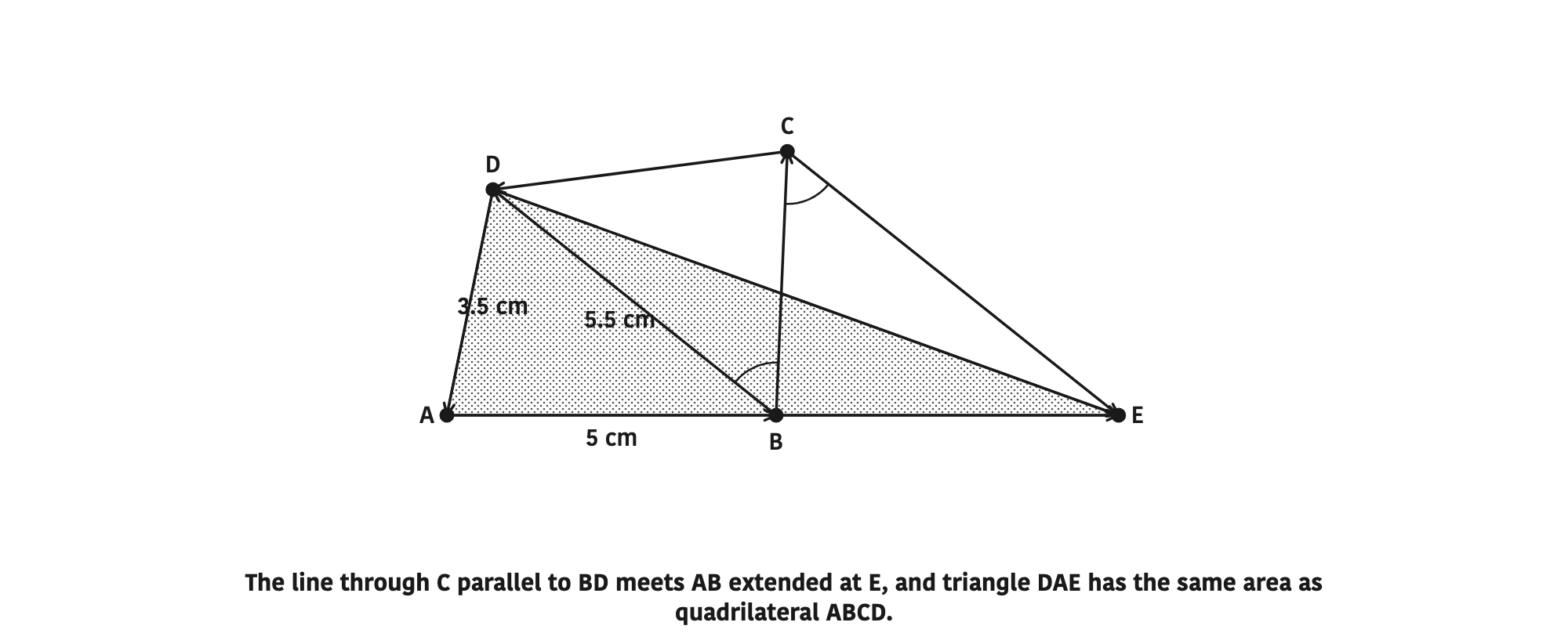
Reason: triangles DBC and DBE stand on the same base DB between the same parallels DB and CE, so they are equal in area. Adding triangle DAB to both:
\[ \begin{aligned} &\triangle DBC + \triangle DAB \\ &= \triangle DBE + \triangle DAB \end{aligned} \]
The left side makes up quadrilateral ABCD and the right side makes up triangle DAE, so the two are equal in area.
Worked Example: A Rectangle Equal in Area to a Triangle
Problem: Construct a triangle ABC in which AB = 2.6 cm, BC = 3.4 cm and CA = 4 cm. Then construct a rectangle whose area is equal to the area of triangle ABC.
Plan: a rectangle is a parallelogram. A rectangle standing on half of BC, between BC and a line through A parallel to BC, has the same area as triangle ABC. Its breadth is half of BC and its length is the height of the triangle. So we need the midpoint of BC and a parallel line through A.
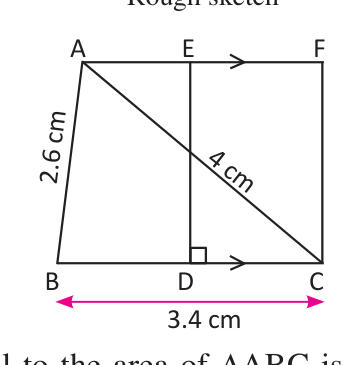
Perpendicular bisector: a line that passes through the midpoint of a line segment and makes a right angle with it.
- Step 1: Draw BC = 3.4 cm.
- Step 2: With B as centre and radius 2.6 cm, and with C as centre and radius 4 cm, draw arcs cutting at A. Join AB and AC.
- Step 3: At A, copy the angle ACB on the other side of AC so that \( \angle EAC = \angle ACB \). These are alternate angles, so this line through A is parallel to BC. Extend it both ways.
- Step 4: Draw the perpendicular bisector of BC. It cuts BC at its midpoint D and meets the parallel line at E.
- Step 5: At C, draw a line perpendicular to BC to meet the parallel line at F.
- Step 6: CDEF is the required rectangle. Shade it.
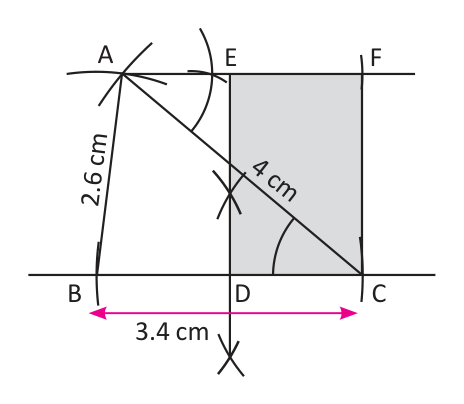
Why Rectangle CDEF Has the Same Area as Triangle ABC
Let \( h \) be the height of triangle ABC, the perpendicular distance from A to BC.
Step 1: Writing the area of triangle ABC with base BC and height h:
\[ \begin{aligned} &\text{Area of } \triangle ABC \\ &= \frac{1}{2} \times BC \times h \end{aligned} \]
Step 2: D is the midpoint of BC, so the breadth of the rectangle is:
\[ DC = \frac{1}{2} \times BC \]
Step 3: EF is parallel to BC, so the length DE equals the height of the triangle:
\[ DE = h \]
Step 4: Multiplying the length and breadth of the rectangle:
\[ \begin{aligned} \text{Area of } CDEF &= DC \times DE \\ &= \frac{1}{2} \times BC \times h \end{aligned} \]
Step 5: Comparing with Step 1, both areas equal the same expression, so:
\[ \begin{aligned} &\text{Area of } CDEF \\ &= \text{Area of } \triangle ABC \end{aligned} \]
To make a rectangle equal in area to a triangle, halve the base and keep the height. The midpoint gives half the base, and the parallel line through the top vertex gives the full height.
Checking a Construction by Measuring
A ruler can tell you whether a construction came out right. When the drawing is neat, the areas worked out from measurements come very close to each other. In triangle PSG, measure PG and the height of S above PG.
Step 1: Measuring the base PG gives about:
\[ PG \approx 9.1 \text{ cm} \]
Step 2: Measuring the height of S above PG gives about:
\[ h \approx 3.85 \text{ cm} \]
Step 3: Using half of base times height for triangle PSG:
\[ \begin{aligned} A &\approx \frac{1}{2} \times 9.1 \times 3.85 \\ &\approx 17.5 \text{ cm}^2 \end{aligned} \]
Quadrilateral PQRS can be checked too, by cutting it along diagonal PR into two triangles. The height of R above PQ is close to 4.39 cm, and the height of S from PR is close to 2.05 cm. So its area is about \( \frac{1}{2} \times 5 \times 4.39 + \frac{1}{2} \times 6.4 \times 2.05 \), which is about 17.5 square centimetres, matching triangle PSG. The rectangle can be checked the same way: the height of triangle ABC comes out close to 2.58 cm, so both areas are about \( 1.7 \times 2.58 \approx 4.4 \text{ cm}^2 \).
An area worked out from measurements is a check, not a proof. The thickness of a pencil line or a slightly wide arc can shift the last decimal place. What proves the two figures equal is the argument about parallel lines.
The full lesson is waiting for you
The notes are free to read in full. A free account opens the rest of the practice, and tracks your progress and confidence score for every subject. Presentations and videos need approval from Learn Yeti.