Area on the Same Base and Between the Same Parallels
Every construction in this topic rests on one fact about area. Two figures can look very different, one standing upright and the other leaning far over, and still cover exactly the same amount of surface. The fact tells us when this happens: the two figures must stand on the same base and lie between the same pair of parallel lines.
Same base and between the same parallels: two figures share one side as their base, that base lies on one of two parallel lines, and the opposite side (or the top vertex, for a triangle) of each figure lies on the other parallel line.
Height of a parallelogram: the perpendicular distance between its base and the side opposite the base. Figures between the same parallels always have the same height, because the gap between two parallel lines is the same everywhere along them.
A square grid is a good place to see this, because area can simply be counted in squares. In the grid below every small square also has both of its diagonals drawn, so slanted lines and half squares are easy to draw and easy to count.
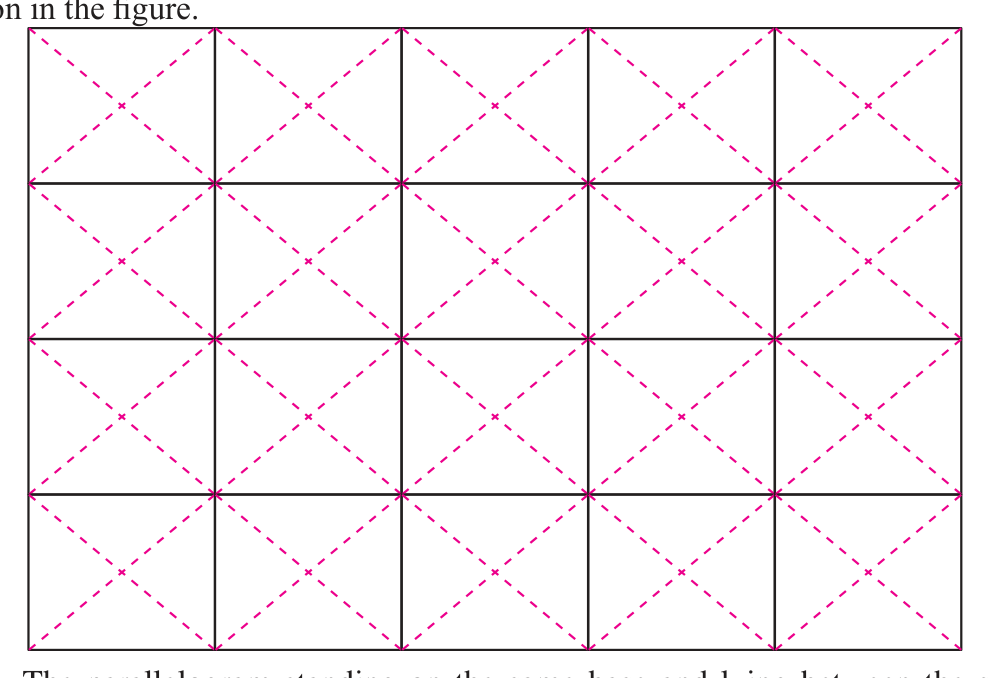
Copy this grid into your exercise book. Three results can be found on it and shaded:
- (a) Parallelograms standing on the same base and lying between the same parallels are equal in area.
- (b) A triangle is half the area of a parallelogram standing on the same base and lying between the same parallels.
- (c) Triangles standing on the same base and lying between the same parallels are equal in area.
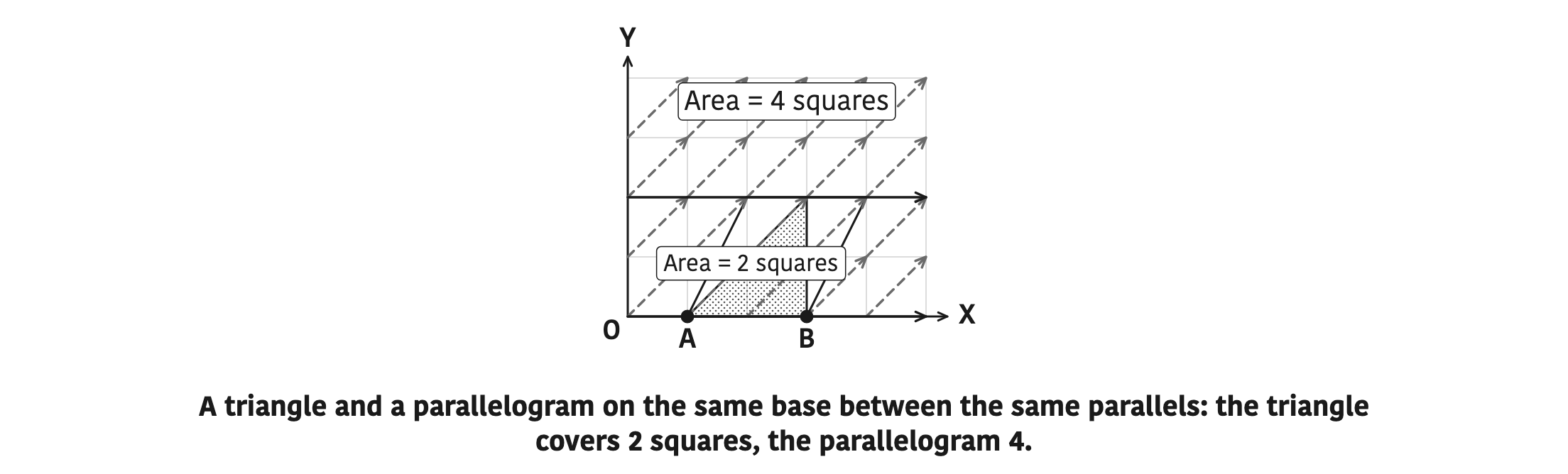
For result (a), take a base two squares long on the bottom line of the grid, and take the grid line two squares above it as the second parallel. A rectangle on this base covers 4 squares. Now draw a parallelogram on the same base whose top side is also two squares long, but pushed two squares to the right. It leans, yet it also covers 4 squares. The triangle it loses on the left side is exactly the same size as the triangle it gains on the right side.
For result (b), keep the same base and the same two parallels. Join both ends of the base to any one point on the upper line. The triangle this makes covers 2 squares, which is half of the 4 squares covered by the parallelogram.
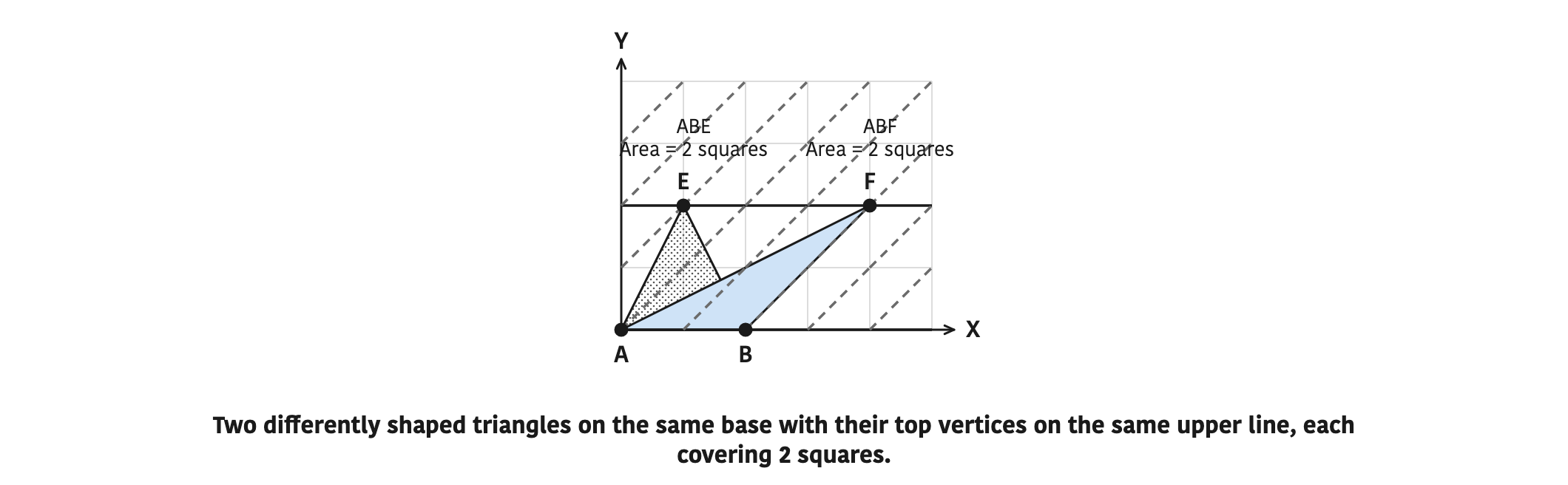
For result (c), slide that top point anywhere along the upper line and join it to the ends of the base again. The triangle changes its shape, but its base and its height do not change, so it still covers 2 squares. Every such triangle has the same area.
Why the Areas Are Equal
Counting squares shows the result on one grid. The reason it is true for every parallelogram lies in the area formula. The area of a parallelogram is its base multiplied by its height:
\[ A = b \times h \]
Here \( b \) is the base and \( h \) is the height. Two parallelograms on the same base have the same \( b \). If they lie between the same parallels, they also have the same \( h \). Same \( b \) and same \( h \) give the same product, so the areas are equal, however far one of them leans.
A triangle on the same base and the same height has exactly half of that area:
\[ A = \frac{1}{2} \times b \times h \]
Keep the base and keep the two parallel lines, and the area is fixed. You are then free to choose the angle or the slanting side of the new parallelogram. That freedom is what the constructions below use.
General Steps of a Construction
For a construction you need a sharp pencil, a ruler, a compass and, for checking angles, a protractor. Whatever figure is asked for, the work is done in the same three stages:
- (a) Draw a rough sketch with a ruler and pencil, showing the figure the question describes.
- (b) Write the given lengths and angles on the rough sketch, in their correct places.
- (c) Construct the accurate figure with a compass and a ruler, following the steps, and name every point.
Rough sketch: a quick freehand or ruler drawing, not to scale, that shows the shape of the required figure and where each given measurement belongs.
The rough sketch is not a formality. It lets you see, before touching the compass, which point the angle is drawn at, which side is the base and which line has to be extended. Most wrong constructions start from a missing or careless sketch.
Constructing the Given Parallelogram ABCD
The task is this. Construct a parallelogram ABCD with \( AB = 4 \text{ cm} \), \( BC = 5.5 \text{ cm} \) and \( \angle ABC = 60^\circ \). Then construct a parallelogram ABQP whose area is equal to the area of ABCD, first with an angle of \( 120^\circ \) and then with one side of 6 cm.
The plan comes straight from the area fact. Keep AB as the base of the new parallelogram too. Extend DC in both directions to make a long line ST, which is parallel to AB. Any parallelogram on AB whose top side lies on ST has the same area as ABCD. The only job left is to pick P and Q on ST so that the extra condition is met.
First, ABCD itself is constructed:
- Step 1: Draw a rough sketch of ABCD and mark 4 cm on AB, 5.5 cm on BC and \( 60^\circ \) at B.
- Step 2: Draw the base \( AB = 4 \text{ cm} \).
- Step 3: At B, construct an angle of \( 60^\circ \) with the compass. With B as centre and radius 5.5 cm, draw an arc cutting this arm, and name the point C.
- Step 4: With A as centre draw an arc of radius 5.5 cm, and with C as centre draw an arc of radius 4 cm. Name the point where the two arcs cross D.
- Step 5: Join D to C and A to D. ABCD is the parallelogram.
Step 4 works because a parallelogram has its opposite sides equal: AD must equal BC, which is 5.5 cm, and DC must equal AB, which is 4 cm.
It helps to know the area that both parallelograms must share. It is not needed for the drawing, but it is a good check.
Step 1: The height is the perpendicular distance from C down to AB, found from the slanting side BC and the angle at B:
\[ h = 5.5 \times \sin 60^\circ = 5.5 \times 0.866 \]
Step 2: Multiplying out the height:
\[ h \approx 4.763 \text{ cm} \]
Step 3: Multiplying the base by the height gives the area:
\[ A = 4 \times 4.763 \approx 19.05 \text{ cm}^2 \]
Every parallelogram built on AB with its top side on ST will also have an area of about \( 19.05 \text{ cm}^2 \).
(a) Parallelogram ABQP Having an Angle of 120°
The angles of ABCD are \( 60^\circ \) and \( 120^\circ \). The new parallelogram ABQP is to have \( \angle ABQ = 120^\circ \), measured from the arm BA. So where ABCD leans to the left, ABQP will lean to the right. With ABCD already drawn, continue like this:
- Step 1: Extend DC in both directions. Name the end beyond D as S and the end beyond C as T. The line ST is parallel to AB.
- Step 2: At B, construct an angle of \( 120^\circ \) with the compass, measured from BA. Extend its arm until it meets ST, and name the meeting point Q.
- Step 3: Open the compass to the length of AB, which is 4 cm. With Q as centre, cut QS and name the point P.
- Step 4: Join A to P. ABQP is the required parallelogram.
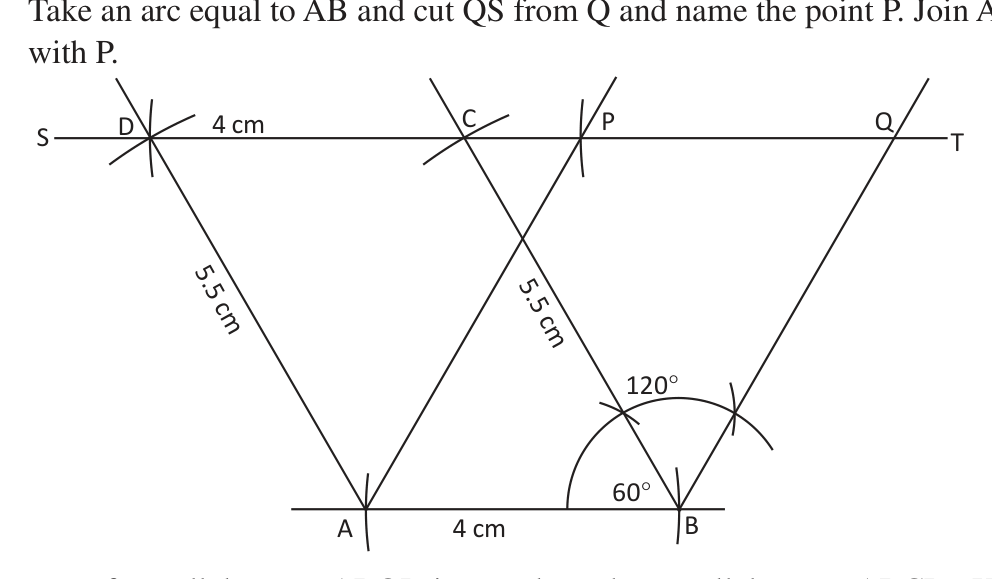
ABQP is a parallelogram because PQ lies on ST, so it is parallel to AB, and PQ was cut equal to AB. A quadrilateral with one pair of opposite sides both equal and parallel is a parallelogram. This is why the arc in Step 3 has to be exactly the length of AB.
Parallelograms ABCD and ABQP stand on the same base AB and lie between the same parallels \( AB \parallel ST \), so they are equal in area.
(b) Parallelogram ABQP Having One Side of 6 cm
This time no angle is given. Instead the slanting side AP of the new parallelogram must be 6 cm long. Start again from a rough sketch showing ABCD, the line ST and the 6 cm side, then construct:
- Step 1: Construct ABCD with \( AB = 4 \text{ cm} \), \( BC = 5.5 \text{ cm} \) and \( \angle ABC = 60^\circ \), exactly as before. Extend CD both ways to make the line ST.
- Step 2: With A as centre and radius 6 cm, draw an arc cutting ST. Name the point P.
- Step 3: With B as centre and radius equal to AP, which is 6 cm, draw an arc cutting ST on the same side as P, further along. Name the point Q.
- Step 4: Join A to P and B to Q with a ruler and pencil. ABQP is the required parallelogram.
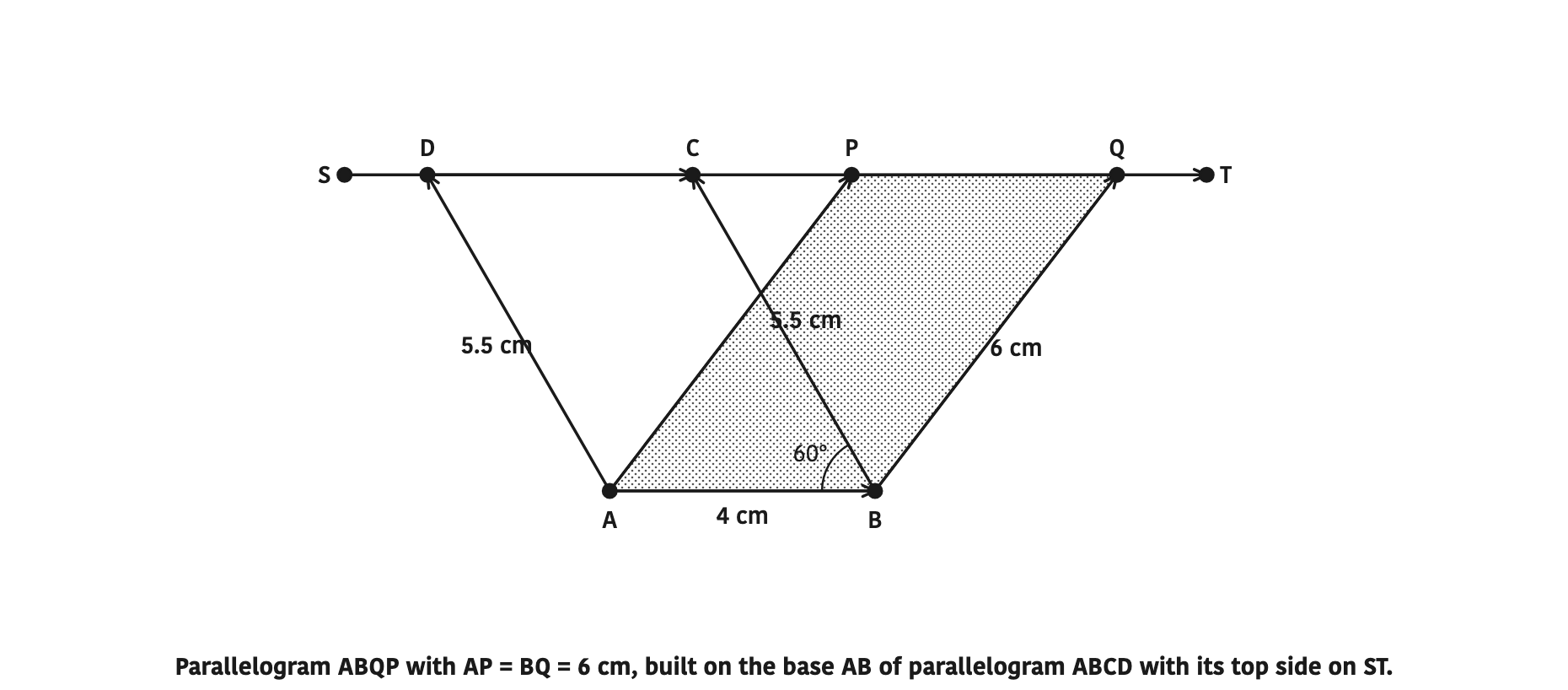
AP and BQ are equal and lean the same way between the same two parallel lines, so PQ comes out equal to AB. Measure it with the compass and you will find 4 cm. PQ is also parallel to AB, since it lies on ST. So ABQP is a parallelogram, and because it stands on the base AB between \( AB \parallel ST \), its area equals the area of ABCD.
Whether the extra condition is an angle or a side, the method is the same: keep the base AB, keep the line ST, and use the condition only to decide where P and Q sit on ST.
Points to Watch While Constructing
These constructions are short, so a single wrong move shows up at once in the final figure. The cautions below are the ones that matter most.
Measure the \( 120^\circ \) from the arm BA. If you measure it from the extension of AB beyond B, the arm you draw makes \( 60^\circ \) with AB, runs along BC and meets ST at C, and you have simply drawn ABCD again.
The slanting side must be at least as long as the height. Here the height is about 4.76 cm, so a side of 6 cm reaches ST, but an arc of 4 cm from A never touches ST and no such parallelogram exists.
An arc of 6 cm from A cuts ST at two points, one on each side. Either one gives a correct answer, but once P is chosen, Q must be cut on the same side so that AP and BQ lean the same way.
Finally, draw ST long enough before you start. P and Q must lie exactly on this line. A point that is only close to it gives a figure of a different height, and then the area is no longer equal.
The full lesson is waiting for you
The notes are free to read in full. A free account opens the rest of the practice, and tracks your progress and confidence score for every subject. Presentations and videos need approval from Learn Yeti.