Area facts behind these constructions
Every construction in this part rests on one simple idea: the area of a triangle or a parallelogram depends on its base and its height, not on how much the shape leans. Two parallel lines stay the same distance apart all along their length. So any triangle or parallelogram that has its base on one of the lines and its top on the other has exactly that distance as its height.
- Area of a triangle \( = \frac{1}{2} \times b \times h \)
- Area of a parallelogram \( = b \times h \)
- Here \( b \) is the base and \( h \) is the perpendicular height, the distance between the base line and the parallel line through the top.
Between the same parallels: two figures lie between the same parallels when each has its base on one straight line and its top vertex or top side on a second line parallel to the first. All such figures have the same height.
Figures equal in area: two figures are equal in area when they cover the same amount of surface, even though their shapes are different. A triangle and a parallelogram can be equal in area.
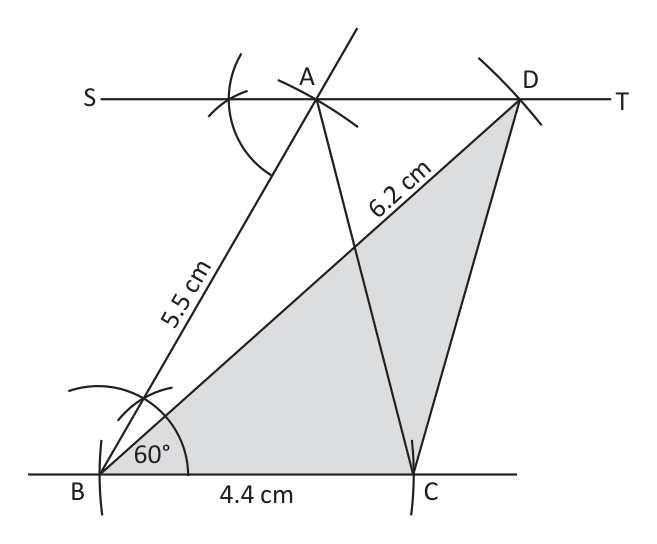
Two facts you already know are used again and again here. First, triangles on the same base and between the same parallels are equal in area. In the figure below, triangles ABC and DBC both stand on the base BC, and both have their top vertex on the line ST, which is parallel to BC. They have the same base and the same height, so their areas are equal, although one looks much wider than the other.
Second, a triangle and a parallelogram on the same base and between the same parallels are not equal in area. The parallelogram takes the whole base times the height, while the triangle takes only half of that product. So the triangle is exactly half of the parallelogram.
A triangle is half of the parallelogram standing on the same base and between the same parallels. Both constructions in this part work by making up for that factor of one half through a change in the base.
Drawing skills used in this part
The constructions use only a ruler, a pair of compasses and a pencil. Before starting, make sure you can do each of these:
- Constructing angles of 60° and 120° with compasses. For 120°, step the same radius round the arc twice.
- Drawing a line through a point parallel to a given line, by copying an angle so that the alternate angles are equal.
- Bisecting a line segment with compasses to find its midpoint.
- Producing a line segment, which means extending it beyond one end, and marking off on it a length equal to another length.
- Cutting a line with an arc: an arc of radius r drawn from a point marks the place on the line that is exactly r away from that point.
Each construction also begins with a rough sketch. A quick freehand drawing with all the given values written on it shows where every point will go, so the accurate drawing does not run off the page or end up on the wrong side of a line.
Worked construction: a parallelogram equal in area to a triangle
A parallelogram on the same base as a triangle, between the same parallels, has twice the triangle's area. To bring it down to exactly the triangle's area, keep the height and halve the base. So the parallelogram is built on half of the triangle's base, with its top side on the parallel line through the triangle's vertex.
A parallelogram constructed on half the base of a triangle, and between the same parallels, is equal in area to the triangle.
Problem: Construct a triangle ABC in which AB = 4 cm, BC = 6.5 cm and \( \angle ABC = 120^\circ \). Then construct a parallelogram having a side PB = 5 cm and equal in area to \( \triangle ABC \). Begin with a rough sketch that shows the plan: the parallel line through A, the midpoint D of BC, and the parallelogram PBDQ.
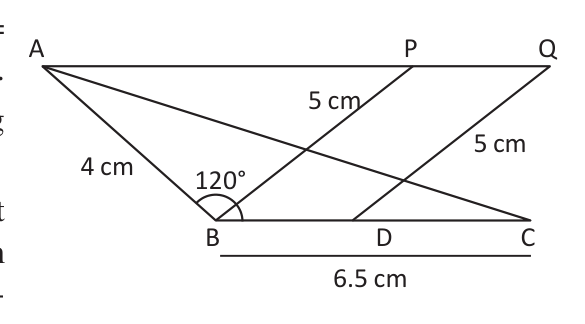
Now draw it accurately, following these steps in order:
- Step 1: Draw BC = 6.5 cm. At B construct an angle of 120° and cut off BA = 4 cm on its arm. Join A and C. This is \( \triangle ABC \).
- Step 2: At A, copy \( \angle ABC \) on the other side of AB so that \( \angle BAS = \angle ABC = 120^\circ \). Extend the line both ways and name it ST. The alternate angles are equal, so ST is parallel to BC.
- Step 3: Bisect BC and mark its midpoint D. Now BD = DC = 3.25 cm.
- Step 4: With centre B and radius 5 cm, draw an arc cutting the line ST. Name the point P and join B and P.
- Step 5: With centre D and radius BP, that is 5 cm, draw an arc cutting PT. Name the point Q and join D and Q.
The quadrilateral PBDQ is the required parallelogram. Its bottom side BD lies on BC, its top side PQ lies on ST, and PB = DQ = 5 cm.
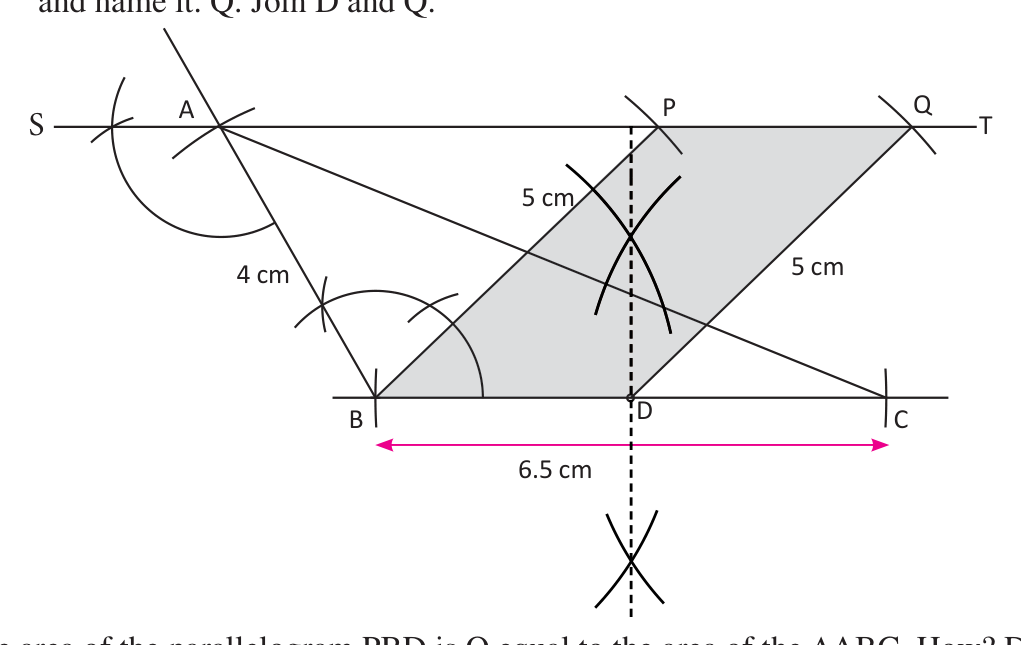
The arc drawn from D can cut the line ST at two points. Choose the one on the far side of P, so that PQ = BD = 3.25 cm. Measure PQ to check. With the other point PQ is not equal to BD, and the figure is not a parallelogram.
Why parallelogram PBDQ has the same area as triangle ABC
Let \( h \) be the distance between the parallel lines ST and BC. The vertex A of the triangle is on ST, and the top side PQ of the parallelogram is also on ST, so both figures have height \( h \).
Step 1: Writing the area of the triangle with base BC and height \( h \):
\[ \text{Area of } \triangle ABC = \frac{1}{2} \times BC \times h \]
Step 2: D is the midpoint of BC, so the base of the parallelogram is half of BC:
\[ BD = \frac{1}{2} \times BC \]
Step 3: Writing the area of the parallelogram with base BD and height \( h \):
\[ \text{Area of } PBDQ = BD \times h \]
Step 4: Putting \( BD = \frac{1}{2} \times BC \) into this area:
\[ \text{Area of } PBDQ = \frac{1}{2} \times BC \times h \]
Step 5: Comparing with Step 1, the two right-hand sides are the same, so:
\[ \text{Area of } PBDQ = \text{Area of } \triangle ABC \]
Another way to see it: a parallelogram on the whole of BC between these parallels would have area \( BC \times h \), twice the triangle. Taking only half of BC as the base gives half of that area, which is exactly the triangle.
Checking with numbers: measure the perpendicular distance between ST and BC on your drawing. It comes to about 3.5 cm. Area of the triangle with base 6.5 cm and height 3.5 cm:
\[ \frac{1}{2} \times 6.5 \times 3.5 = 11.375 \text{ cm}^2 \]
Area of the parallelogram with base 3.25 cm and the same height 3.5 cm:
\[ 3.25 \times 3.5 = 11.375 \text{ cm}^2 \]
The two areas agree. Whatever the exact height turns out to be, the same number multiplies both, so the answers always match.
Worked construction: a triangle equal in area to a parallelogram
Now go the other way. A triangle on the same base as a parallelogram, between the same parallels, has only half the parallelogram's area. To make up the missing half, keep the height and double the base. So the triangle is built on a base twice as long as the parallelogram's base, with its top vertex on the parallelogram's upper side extended.
A triangle constructed on a base twice the base of a parallelogram, and between the same parallels, is equal in area to the parallelogram.
Problem: Construct a parallelogram ABCD in which AB = 5 cm, BC = 4 cm and \( \angle ABC = 60^\circ \). Then construct a triangle PBE with a side PB = 6 cm and equal in area to the parallelogram ABCD. As before, start with a rough sketch.
Now draw it accurately:
- Step 1: Draw BC = 4 cm. At B construct an angle of 60° and cut off BA = 5 cm on its arm.
- Step 2: With centre A and radius 4 cm, and with centre C and radius 5 cm, draw two arcs that meet at D. Join A to D and C to D. ABCD is the parallelogram, because both pairs of opposite sides are equal.
- Step 3: Produce BC beyond C to a point E so that CE = BC = 4 cm. Use the compasses with radius BC and centre C. Now BE = 8 cm.
- Step 4: Produce AD both ways and name the line ST. Opposite sides of a parallelogram are parallel, so ST is parallel to BE.
- Step 5: With centre B and radius 6 cm, draw an arc cutting ST and name the point P.
- Step 6: Join B and P, and also P and E. Triangle PBE is the required triangle.
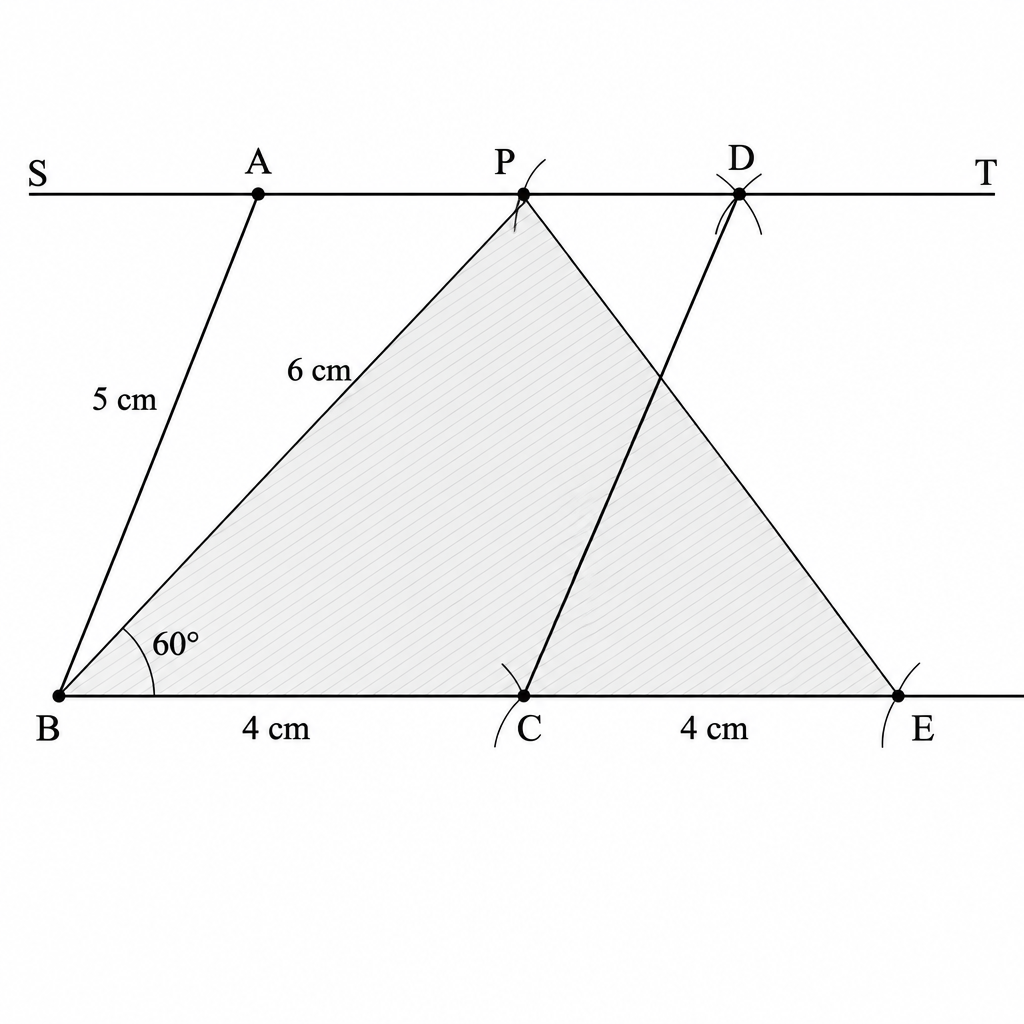
The radius of the arc from B must be the length given for PB, which here is 6 cm. A different radius still gives a triangle of the right area, but its side PB will not be the side the question asked for.
Why triangle PBE has the same area as parallelogram ABCD
Let \( h \) be the distance between the parallel lines ST and BE. The side AD of the parallelogram and the vertex P of the triangle are both on ST, so both figures have height \( h \).
Step 1: Writing the area of the parallelogram with base BC and height \( h \):
\[ \text{Area of } ABCD = BC \times h \]
Step 2: E was marked so that CE = BC, so the base of the triangle is:
\[ BE = BC + CE = 2 \times BC \]
Step 3: Writing the area of the triangle with base BE and height \( h \):
\[ \text{Area of } \triangle PBE = \frac{1}{2} \times BE \times h \]
Step 4: Putting \( BE = 2 \times BC \) into this area:
\[ \text{Area of } \triangle PBE = \frac{1}{2} \times 2BC \times h \]
Step 5: Cancelling \( \frac{1}{2} \) against 2:
\[ \text{Area of } \triangle PBE = BC \times h \]
This is the same as the area of the parallelogram in Step 1, so the triangle PBE and the parallelogram ABCD are equal in area. The doubled base cancels the half in the triangle formula.
Checking with numbers: the height of this parallelogram measures about 4.3 cm. Area of the parallelogram with base 4 cm:
\[ 4 \times 4.3 = 17.2 \text{ cm}^2 \]
Area of the triangle with base BE = 8 cm and the same height:
\[ \frac{1}{2} \times 8 \times 4.3 = 17.2 \text{ cm}^2 \]
How long can the given side be?
In both constructions the side PB is simply a slanting line from B up to the upper parallel. Every point on that line is at the same height, so the area does not depend on which point P is. That is why the question is free to fix the length of PB. The arc from B usually cuts the line at two points, and either one gives a correct figure, leaning a different way.
There is one limit. The shortest path from B to the upper parallel is the perpendicular, whose length is the height \( h \). So PB can never be shorter than \( h \). In the first construction the height is about 3.5 cm, so PB = 5 cm works easily, but an arc of radius 3 cm drawn from B would stop short of ST and never cut it.
D must be the exact midpoint of BC, found by bisecting it, and CE must be exactly equal to BC. A point marked by eye gives a base that is not exactly half or exactly double, and the areas will not be equal.
The two constructions side by side
| Triangle to parallelogram | Parallelogram to triangle | |
| Given figure | Triangle ABC on base BC | Parallelogram ABCD on base BC |
| Upper parallel | ST drawn through A, parallel to BC | AD produced both ways to ST |
| New base | BD, half of BC | BE, twice BC |
| How the base is found | Bisect BC at D | Produce BC to E with CE = BC |
| Why the areas match | \( BD \times h = \frac{1}{2} BC \times h \) | \( \frac{1}{2} BE \times h = BC \times h \) |
Read the table as one rule used in two directions. The height never changes, because both figures always stay between the same parallels. Only the base changes, and it changes by exactly the factor needed to cancel the half in the triangle's area: halve it when a triangle becomes a parallelogram, double it when a parallelogram becomes a triangle.
The full lesson is waiting for you
The notes are free to read in full. A free account opens the rest of the practice, and tracks your progress and confidence score for every subject. Presentations and videos need approval from Learn Yeti.