Micronutrients: Needed in Tiny Amounts
Some nutrients in our food are needed in large amounts every day. Carbohydrates, proteins and fats from rice, bread, lentils and ghee are measured in many grams. Other nutrients are needed in far smaller amounts: less than a single gram across a whole day. Even so, the body cannot work properly without them.
Micronutrients are the nutrients our body needs in amounts of less than one gram every day.
Micronutrients come in two groups: minerals and vitamins. Both are needed only in tiny amounts, yet a shortage of either brings disease and other health problems. The focus here is on minerals.
What a Mineral Is
A mineral is a non-living (inorganic) substance found in mines and in soil, which the human body needs in small amounts.
Only a little of each mineral is needed, but without minerals we could not carry out any physical or mental activity at all. Running, playing, reading, thinking and even the beating of the heart all depend on them. That is why minerals are counted as nutrients even though the amounts are so small. Inside the human body, minerals are present in a soluble form, which means they are dissolved in the body's fluids.
From Soil to Plate: How Minerals Reach Us
Living things cannot make minerals for themselves. Minerals are already in the soil, and they travel from there to our food in a chain:
- Plants and leafy vegetables soak up minerals from the soil through their roots.
- Grass-eating animals take in those minerals when they eat the plants.
- In this way the meat of animals and birds also comes to contain minerals.
- People get their minerals from vegetables, other foods, meat and eggs.
We do not dig minerals out of the ground to eat them. The minerals in the soil pass through plants and animals and reach our plate as food.
Major Minerals and Minor Minerals
The body does not need every mineral in the same amount. Some are needed in larger quantities and some only in traces. So minerals are divided into two main groups according to how much of each the body needs.
Major minerals are the minerals our body needs in larger amounts.
There are seven major minerals. About 90 percent of all the minerals in the body are these seven:
- Calcium
- Magnesium
- Sodium
- Potassium
- Phosphorus
- Sulphur
- Chloride
Minor minerals are the minerals our body needs only in small amounts.
The minor minerals include:
- Iron
- Zinc
- Iodine
- Copper
- Boron
- Tin
- Silver
- Gold, and others
'Minor' tells you the amount needed, not the importance. Iron and iodine are both minor minerals, yet a shortage of iron causes anaemia and a shortage of iodine causes goitre.
Of all these, seven minerals matter most to our body: iron, calcium, iodine, phosphorus, zinc, sodium and potassium. The work, the sources and the shortage problems of each are set out one by one below.
Iron
Iron is one of the most important elements for building healthy blood. Blood is what carries oxygen to every cell in the body, and iron is needed to make haemoglobin, the substance in blood that holds that oxygen. Without enough iron, blood cannot carry all the oxygen the body needs.
A shortage of iron causes a disease called anaemia. A person with anaemia gets tired quickly and feels weak.
Good sources of iron are red meat, liver, chicken, fruits, fenugreek leaves, green leafy vegetables, beetroot, finger millet, buckwheat and wheat. Cooking vegetables in an iron pot also adds iron to the food.
Calcium
Calcium keeps bones and teeth healthy and strong. It also keeps the digestive system, the muscles and the heart working efficiently.
Calcium does two different jobs with blood. In normal conditions it keeps blood from clotting, so that blood keeps flowing through the vessels. But when a blood vessel bursts and blood starts to flow out, calcium helps the blood to clot, and this is how bleeding stops.
Calcium also helps the body produce hormones, and it plays an important part in physical and mental growth and development. When a person lacks calcium, their muscles cannot work properly, and they suffer from muscle cramps.
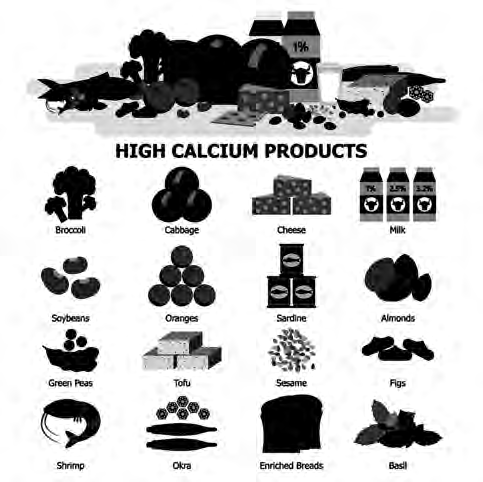
Calcium is found in egg yolk, broccoli, green leafy vegetables, spinach, fenugreek leaves and foods made from milk.
Iodine
Iodine is a mineral the body needs only in a very small amount, but it cannot do without it. When the body lacks iodine, the thyroid gland in the neck grows larger.
Goitre is the condition in which the thyroid gland becomes enlarged because the body is short of iodine.
Iodine is found in sea fish and in plants that grow in the sea. Nepal is far from the sea, so in the past many people here suffered from goitre. Today the Government of Nepal has iodine mixed into salt before the salt is sold, and packets of this iodised salt carry a mark showing two children. Because of this, goitre has become much less common.
Phosphorus
After calcium, phosphorus is the mineral the human body needs in the greatest amount. Phosphorus works together with calcium to build bones and teeth, and it supports growth and development. It also helps the body take in protein from food.
Without enough phosphorus, a child's bones cannot develop properly. Phosphorus is found in milk, cottage cheese, cheese, fish, meat, beans and pulses, green leafy vegetables and fruits.
Calcium and phosphorus are a team: together they build bones and teeth, and milk and milk products supply both of them.
Zinc
Zinc makes memory stronger. It fights viruses and the tiny germs that spread disease, and in this way it builds up the body's immune system. Zinc is also needed for growth and development. It helps keep digestion and metabolism in balance; metabolism means the processes inside the body that put food to use.
When zinc is short, the body's ability to fight disease falls, and the person may fall ill easily. Sources of zinc are fruits, dry fruits such as cashews, almonds and walnuts, and milk.
Sodium
Sodium helps the body make up for a shortage of water. It helps carry messages back and forth between the organs of the body and the brain. The muscles also need sodium to work properly.
Salt is the main source used to make up a shortage of sodium. Sodium is also found in carrots, beetroot, spinach leaves, milk, cottage cheese and eggs. A person short of sodium gets headaches, feels tired, feels sick and may vomit. They also become restless.
Too much sodium is as harmful as too little. When the amount of sodium in the body is high, it leads to high blood pressure, obesity, heart disease and kidney problems.
Potassium
Almost every cell and organ in the body needs potassium to work correctly. Potassium keeps blood pressure balanced and helps the heart run smoothly. It also makes the muscles strong, which makes a person more active in their work.
A shortage of potassium makes the hands and feet tingle and go numb. Sources of potassium include cooked broccoli, sweet potato, peas, mushrooms and milk.
Minerals at a Glance: Work and Deficiency
Putting the main work of the seven minerals and the problem their shortage causes into one table makes them easy to revise:
| No. | Mineral | Work in the body | Disease or problem when short |
| 1 | Iron | Makes haemoglobin | Anaemia |
| 2 | Calcium | Keeps blood from clotting and keeps the digestive system, muscles and heart working efficiently | Muscle cramps |
| 3 | Iodine | Stops the thyroid gland from enlarging and so prevents goitre | Goitre |
| 4 | Phosphorus | With calcium, builds bones and teeth and supports growth and development | Poor bone development |
| 5 | Zinc | Strengthens memory, fights viruses and germs to build up the immune system, supports growth | Lower ability to fight disease |
| 6 | Sodium | Makes up a shortage of water and helps carry messages between the organs and the brain | Restlessness and headache |
| 7 | Potassium | Keeps blood pressure balanced, helps the heart run smoothly, strengthens muscles | Tingling and numbness in hands and feet |
One Food, Many Minerals
Looking back over the sources of all seven minerals, some foods turn up again and again. This means a single food can supply more than one mineral. So a diet with many different kinds of food, rather than the same food every day, covers all the minerals easily.
| Food | Minerals it supplies |
| Milk and milk products | Calcium, phosphorus, zinc, sodium, potassium |
| Green leafy vegetables | Iron, calcium, phosphorus |
| Fruits | Iron, phosphorus, zinc |
| Fenugreek leaves | Iron, calcium |
| Spinach | Calcium, sodium |
| Beetroot | Iron, sodium |
| Broccoli | Calcium, potassium |
| Eggs | Calcium (in the yolk), sodium |
| Fish | Phosphorus; sea fish also give iodine |
Iodised salt supplies both sodium and iodine. It can be recognised by the mark of two children on the packet.
The full lesson is waiting for you
The notes are free to read in full. A free account opens the rest of the practice, and tracks your progress and confidence score for every subject. Presentations and videos need approval from Learn Yeti.