What Malnutrition Is
Our bodies need nutrients to grow, to work and to fight disease. Getting too little of them harms the body, and so does getting too much. In simple words, malnutrition means the body having less of the nutrients it needs, or more than it needs. So a thin, weak child is malnourished, and so is a person who carries far more body fat than is healthy.
Malnutrition: the condition in which a child's physical and mental development is blocked or slowed because their food has too little or too much of the nutrients needed for their age. It is also the unhealthy state the body reaches when it goes without a balanced diet for a long time.
Doctors say that malnutrition is the main cause of illness among children in Nepal. Because of it, the physical and mental growth of many Nepali children has been held back. The largest number of its victims are children under two years of age.
How Malnutrition Harms a Child
Malnutrition does not only affect a child's body. It also affects how the child thinks and how they get along with others. Its effects fall into three groups.
| Kind of effect | What can be seen |
| Physical | Not tall enough or heavy enough for their age, too light for their height, poorly developed muscles, a body made weak by repeated diarrhoea |
| Mental | Slow to understand, poor memory, unable to make quick decisions, dull intelligence |
| Social | Does not play with friends, does not help friends, does not join in with a group |
Causes of Malnutrition
Malnutrition rarely has a single cause. Many things, from the food in a home to the poverty of a whole society, work together to bring it about. The main causes are:
- Not enough food and not enough nutrients
- Disease and infection
- Lack of knowledge about nutrition
- Unhealthy food
- Babies not being breastfed
- Lack of food for children, pregnant women and mothers who have just given birth
- Population growth and pollution of the environment
- Social exploitation and inequality
- Low wages
Some of these causes lie inside the home, such as unhealthy food and not knowing about nutrition. Others belong to society, such as poverty, low wages and inequality. Long-term malnutrition and poverty can only be reduced when the social and economic inequalities in society are removed.
Classification of Malnutrition
Malnutrition is studied in four classes, depending on which nutrient is missing or which is in excess:
- Protein energy malnutrition
- Vitamin deficiency malnutrition
- Mineral deficiency malnutrition
- Obesity
The first three are caused by too little of something. The fourth, obesity, is caused by too much.
Protein Energy Malnutrition
Protein energy malnutrition: disease caused by a shortage of protein, carbohydrate and fat in the diet.
Carbohydrate and fat give the body energy, while protein builds and grows the body's cells. When the diet is short of these, the body has neither the fuel to work nor the material to grow. Two serious diseases come under this class: marasmus and kwashiorkor.
Marasmus
Marasmus: a severe form of malnutrition caused when the diet has very little carbohydrate and is also short of protein and other nutrients.
In marasmus the child's body wastes away. It is seen most often in children under 5 years of age. Once it takes hold, the child's weight drops sharply, the muscles shrink away, and the skin becomes thin and wrinkled.
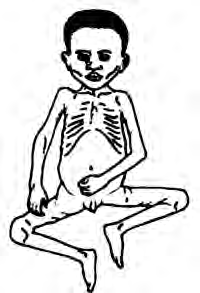
Marasmus is caused by:
- A lack of carbohydrate and protein in food
- Worms and attacks of various infectious diseases
- Poverty and hunger
- Ignorance
- Being a victim of conflict
- Lack of education
The signs of marasmus are:
- The child is irritable and keeps crying out
- The face looks like an old person's
- The skin becomes wrinkled
- When the skin is pinched and let go, it goes back into place only slowly
- The eyes are sunken
- The child is fretful and startles easily
- The child is very hungry
- The body weight is very low
Kwashiorkor
Kwashiorkor is a form of malnutrition just as serious as marasmus. A child with it cries and whines so much that it is also known as the crying disease.
Kwashiorkor: a serious form of malnutrition caused by a lack of protein in the diet.
Once a baby is 6 months old, breast milk alone is no longer enough for its body. If the baby does not then get extra food, such as soft cereal porridge and a mash of rice and lentils, it runs short of protein and this disease follows. This is why it is seen especially in children who depend on mother's milk alone. It usually appears in children aged 3 to 5 years, but older children and even adults can get it.
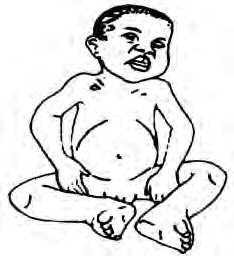
Kwashiorkor is caused by:
- Lack of protein in food
- Worms and attacks of various infectious diseases
- Poverty or hunger
- Ignorance
- No balanced diet, together with unhealthy eating habits and behaviour
- Lack of education
The signs of kwashiorkor are:
- First the feet swell, and as the condition gets worse the swelling spreads to the lower legs, the hands and the face
- The face looks round like the moon
- The weight is low
- The child's body, arms, legs, belly and face swell up
- The child has anaemia, a shortage of blood
- Teeth and bones develop poorly
A child with kwashiorkor may look chubby. That roundness is not healthy flesh or fat. It is swelling. Taking a swollen child for a well-fed one is a serious error.
Telling Marasmus and Kwashiorkor Apart
Both diseases are forms of protein energy malnutrition. In both, the child loses weight and is irritable or tearful. These differences tell them apart:
| Point | Marasmus | Kwashiorkor |
| Main shortage | Very little carbohydrate, plus too little protein and other nutrients | Mainly a lack of protein |
| Usual age | Under 5 years | 3 to 5 years; it begins when extra food is not given after 6 months |
| Body | Muscles wasted, only skin and bone | Body, arms, legs, belly and face swollen |
| Face | Like an old person's | Round like the moon |
| Other signs | Wrinkled skin, sunken eyes, great hunger | Anaemia, weak growth of teeth and bones |
Preventing Marasmus and Kwashiorkor
The ways to prevent marasmus and kwashiorkor are of two kinds: immediate measures, taken straight away, and long-term measures, kept up over time. The immediate measures are:
- Pregnant women and new mothers eat more food rich in protein and carbohydrate, and of better quality
- As soon as a baby is born, it is given the mother's thick yellow first milk, called colostrum
- The child is vaccinated against infectious diseases
- Complementary food is arranged for the child after 6 months
- After 6 months the child is fed nourishing foods such as cereal porridge, rice and lentil mash, rice pudding, rice, flatbread, vegetables, fish, meat, eggs, cow or buffalo milk and fruit
- Different nourishing foods are given morning, afternoon and evening, and because a child's stomach is small, it is fed small amounts many times a day
- The child is kept warm
- Depending on how ill the child is, the child is treated in hospital
- Food is never allowed to run short of protein and calories
- The child is not fed milk from a bottle
The long-term measures are:
- First find out which type of malnutrition it is, and if it is severe, admit the child to hospital for treatment
- Find out whether the child also has diarrhoea or another infection
- Give medicine against worms from time to time
- Restore the child's nutrition to a healthy level
- Take a doctor's advice from time to time
Two moments in a baby's first year matter a great deal: colostrum straight after birth, and extra food once the baby reaches 6 months. Not missing these two is the first step in keeping marasmus and kwashiorkor away.
Vitamin Deficiency Malnutrition: Night Blindness
A lack of vitamins causes diseases such as rickets, pellagra, scurvy and night blindness. Of these, night blindness is the one seen most often.
Night blindness: a disease, caused by a lack of vitamin A, in which a person sees well in daylight but can see nothing in the dim light of evening or in the dark at night.
It mostly affects children between 3 and 5 years old, and it has become a common problem. Night blindness caused by a lack of vitamin A goes away once the child eats foods rich in vitamin A. Night blindness that is inherited in a family, however, cannot be cured. A lack of vitamin A also causes xerophthalmia, a disease in which the eyes become dry.
A young child with night blindness does not know that they cannot see at night, so they never say so. If a child refuses to move about at dusk and would rather stay indoors than go anywhere at night, it may be night blindness. Only some children older than 10 notice the problem themselves.
Night blindness is caused by:
- Too little vitamin A in daily food
- Disease of the retina of the eye
- Too few local sources of vitamin A, too few means and resources, and too little knowledge
The signs of night blindness are:
- In the evening and in the dark, the child sits quietly in one place
- The child keeps rubbing their eyes
- Adults, too, find it hard to walk about, ride a motorcycle or drive at night
- On coming from bright light into a room, the person cannot see
Night blindness is prevented and treated by:
- If it comes from a lack of vitamin A, eating foods rich in vitamin A cures it
- Young children should be given plenty of green leafy vegetables and yellow fruit
- The Government of Nepal gives out vitamin A capsules from time to time to children under 5 to control and wipe out night blindness, so children should be brought to this programme and given vitamin A
- Awareness of this disease should be spread among the public
Mineral Deficiency Malnutrition: Goitre
The thyroid gland in the neck makes a hormone called thyroxin, and it needs iodine to make it. When there is too little iodine in the body or in food, the thyroid cannot release thyroxin, or releases too little. To make up the shortfall, the gland works harder. Working this hard, it swells until it looks like a lump hanging from the neck.
Goitre: a disease in which a lack of iodine makes the thyroid gland swell, so that a lump appears to hang from the neck.
In Nepal this disease is seen more among people who live in the mountain and hill regions.
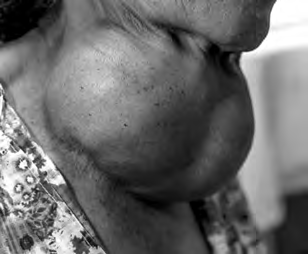
Goitre has one cause: too little iodine and minerals in food. Its signs are:
- A fleshy lump appears on the neck
- Children may suffer deafness and disability
- Tiring quickly
- The skin feels thick
- Memory becomes weaker
- The heart beats fast
- Blood pressure rises
Goitre is prevented by:
- Always using iodised salt
- Breastfeeding babies
- Eating food from the sea, because it contains iodine
- Seeing a doctor for advice and treatment as soon as the disease is suspected
- Making the community aware of this disease through health education
Nepal has no sea, so seafood is not part of most families' daily meals. In such a country, iodised salt, which goes into food every day, is the easiest way to get iodine.
Obesity
Malnutrition caused by too much of the nutrients is growing day by day. Obesity is one form of it.
Obesity: the build-up of more fat in the body than it needs.
Obesity harms the body in many ways. It leads to heart disease, diabetes, high blood pressure and kidney disease. It is not a problem of one age group only. People of any age can become obese.
BMI and the BMI Chart
BMI (Body Mass Index): a number worked out from a person's weight and height, which shows whether the person is underweight, a healthy weight or overweight.
Obesity is measured from a person's weight and height. A normal person's BMI is between 16 and 25. A BMI above 29 means obesity. The BMI chart divides the values into smaller groups:
| BMI | Category |
| Below 18 kg/m² | Underweight |
| 18 to 23 kg/m² | Ideal body weight |
| 23 to 25 kg/m² | Overweight |
| Above 25 kg/m² | Obese |
When you define obesity or list its signs, write 'a BMI above 29'. The BMI chart, however, already puts any BMI above 25 kg/m² in the Obese group. So a BMI past 25 is a warning sign, and past 29 it is clearly obesity.
Working Out BMI
To find BMI, weight is measured in kilograms and height in metres. The weight is then divided by the square of the height:
\[ \text{BMI} = \frac{W}{H^2} \]
Here \( W \) is the weight in kilograms and \( H \) is the height in metres, which is why BMI is written in kg/m².
Example: A student weighs 50 kg and is 1.6 m tall. Find her BMI and the group she belongs to.
Step 1: Putting the weight and height into the formula:
\[ \text{BMI} = \frac{50}{1.6^2} \]
Step 2: Squaring the height:
\[ 1.6 \times 1.6 = 2.56 \]
Step 3: Dividing the weight by the squared height:
\[ \frac{50}{2.56} \approx 19.5 \text{ kg/m}^2 \]
Step 4: Comparing the result with the BMI chart:
\[ 18 < 19.5 < 23 \]
A BMI of 19.5 kg/m² lies in the 18 to 23 group, so this student has an ideal body weight.
Do not forget to square the height. Dividing 50 by 1.6 alone gives 31.25, which would wrongly make a healthy student look obese. If the height is given in centimetres, change it to metres first: 160 cm is 1.6 m.
Causes, Signs and Prevention of Obesity
Obesity is caused by:
- Inherited causes that run in the family
- Not doing physical exercise, and living a life of too much ease
- A habit of overeating, and eating a lot of sweets, chocolate and ready-made food between meals
- Eating food with a lot of ghee, fat and carbohydrate
- Diseases of the endocrine, or hormone, glands
The signs of obesity are:
- A BMI above 29
- The hips grow larger
- Weight is more than it should be for the person's age and height
Obesity is prevented by:
- Doing about 30 minutes of physical exercise and yoga regularly to control weight
- Using less fat in food, and taking more water, green vegetables and fruit
- Not eating ready-made food
- Having the body checked from time to time as a doctor advises
- Raising public awareness of obesity and the health problems it brings
Malnutrition is not only hunger. Too little of the right food brings marasmus, kwashiorkor, night blindness and goitre, while too much food and too little activity bring obesity. The answer to both is the same: a balanced diet and an active life.
The full lesson is waiting for you
The notes are free to read in full. A free account opens the rest of the practice, and tracks your progress and confidence score for every subject. Presentations and videos need approval from Learn Yeti.