What Nutrition Does and the Two Groups of Nutrients
Food does much more than fill the stomach. Good nutrition keeps a person healthy and free from disease. It helps the body grow and develop, repairs cells and tissues that are damaged, gives the energy for work and play, protects the body and strengthens its power to resist disease. For this reason every person should choose nutritious food that suits their own age, weight and height.
The body does not need every nutrient in the same amount. In one day we eat hundreds of grams of rice, bread or porridge, yet some nutrients are needed in amounts smaller than a single gram. Nutrients are therefore divided into two groups by how much of them the body needs: macronutrients and micronutrients. Minerals and vitamins, which are needed in amounts of less than one gram a day, are the micronutrients. Here we study the macronutrients, the ones needed in large amounts.
Macronutrients
Macronutrient: a nutrient that the body needs in an amount of more than one gram every day.
There are three macronutrients:
- carbohydrate
- protein
- fat
All three can give the body energy, but each has a different main job. Carbohydrate is the chief source of energy, protein builds and repairs cells, and fat stores a large amount of energy. Each of them is divided further into kinds of its own. The chart below shows the whole family in one place.
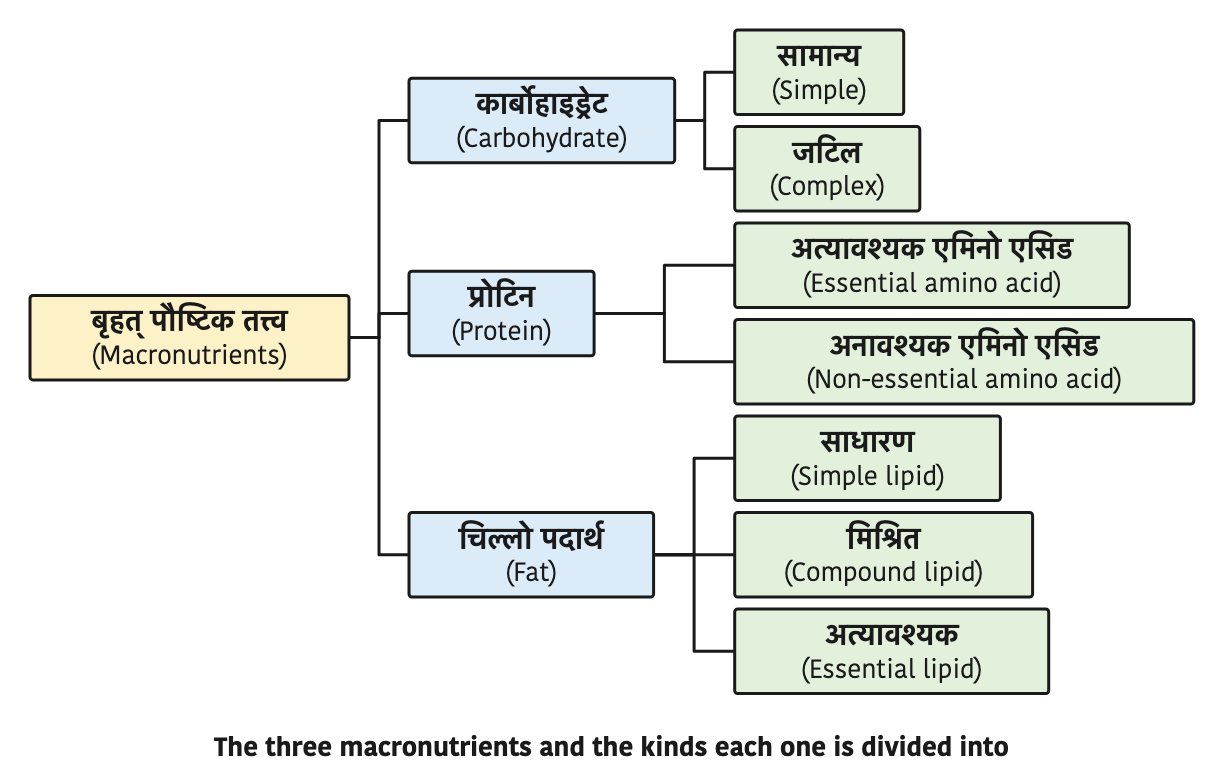
One gram of carbohydrate gives 4 calories of energy, while one gram of fat gives 9 calories.
Carbohydrate: The Main Source of Energy
A student who eats rice in the morning can run, play and study all day at school. Most of that energy comes from carbohydrate. Carbohydrate is the most important source of energy for the body. It gives the body the heat and the strength it needs. Inside the body, one gram of carbohydrate gives four calories of energy.
Carbohydrate is made of three elements joined together: carbon, hydrogen and oxygen. The body changes the carbohydrate we eat into glucose, fructose and galactose, because only in these forms can it be absorbed. If the body receives more carbohydrate than it needs for energy, the extra is changed into a fat called triglyceride and stored in different parts of the body. As this stored fat builds up, a person starts to look fat.
Carbohydrate supplies sugar, starch and fibre in different amounts. The carbohydrate in food is divided into two kinds: simple carbohydrate and complex carbohydrate.
Simple and Complex Carbohydrate
Simple carbohydrate: the carbohydrate we get from sweet foods.
Simple carbohydrates include monosaccharides and disaccharides. Glucose is a monosaccharide, while sucrose, maltose and lactose are disaccharides. Honey, sugar, milk, sugarcane and the juice of sweet fruits are sources of simple carbohydrate. It dissolves easily in water and is absorbed quickly by the body, so the energy it gives does not last long. After a glass of sweet juice you feel lively at once, but you soon feel hungry and tired again.
Complex carbohydrate: carbohydrate whose sugar does not dissolve in water and does not break down easily. It is also called polysaccharide.
In complex carbohydrate the sugar molecules are joined tightly to one another. It is found in cereals, rice, wheat, millet, pulses and vegetables. It breaks down slowly in the stomach and intestines and takes time to digest, so the energy it gives lasts a long time. A farmer who eats millet porridge or rice and lentils in the morning can keep working in the field until afternoon for exactly this reason. Complex carbohydrate is considered good for health.
| Point | Simple carbohydrate | Complex carbohydrate |
| Other name | monosaccharide and disaccharide | polysaccharide |
| In water | dissolves easily | does not dissolve |
| Digestion | absorbed quickly | broken down slowly |
| Energy | short lived | long lasting |
| Sources | honey, sugar, milk, sugarcane, sweet fruit juice | cereals, rice, wheat, millet, pulses, vegetables |
Sources of Carbohydrate
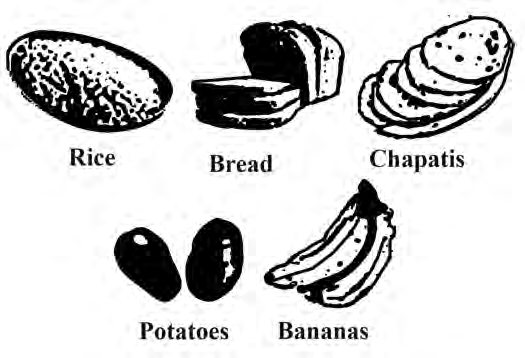
Carbohydrate is the nutrient we eat most of in our daily meals. Its sources can be put into three groups:
- Cereals: bread, rice, maize, barley, wheat and so on.
- Vegetables that grow under the soil: potato, sweet potato, taro, yam and so on.
- Other sources: chocolate, sugar, sugarcane, honey, jam and so on.
Functions of Carbohydrate
Carbohydrate does these jobs in the body:
- It gives the body the energy it needs.
- It protects children from malnutrition.
- It keeps the skin soft, smooth and healthy.
- It helps the body digest protein and other foods.
- It helps protein to be stored, because when enough carbohydrate is present the body does not have to burn protein for energy.
Protein: The Builder of Cells
The cell is the smallest unit of the human body. When a child grows taller, a wound heals or a muscle gets stronger, new cells are being made. Protein is what builds cells and makes them grow and develop. A complete protein molecule is made mainly of carbon, hydrogen, nitrogen and oxygen. Nitrogen, which carbohydrate does not contain, is what marks protein out.
When the body lacks carbohydrate and fat, protein supplies energy instead. Protein also helps in digesting food and helps the body make its many kinds of hormones and enzymes.
Amino acid: one of the small, simple chemical units that join together to make a protein.
A protein is made of amino acids joined one after another, like beads threaded on a necklace. The protein food we eat is broken into amino acids during digestion, and only then can the body take it in. Some amino acids come from food, while others are made naturally inside the body. When children do not get enough protein they suffer from a disease called kwashiorkor.
Essential and Non-essential Amino Acids
Amino acids are divided into two kinds according to whether the body can make them itself.
Essential amino acid: an amino acid that the body badly needs but cannot make for itself, so it must come from food.
If essential amino acids are lacking, both physical and mental growth are held back. Examples are valine, histidine and leucine.
Non-essential amino acid: an amino acid that the body can build inside itself when it has enough nitrogen, so it does not have to come from food.
Examples are proline, serine and cystine.
Non-essential does not mean the body has no use for it. It only means it need not come from food, because the body can make it.
Sources of Protein
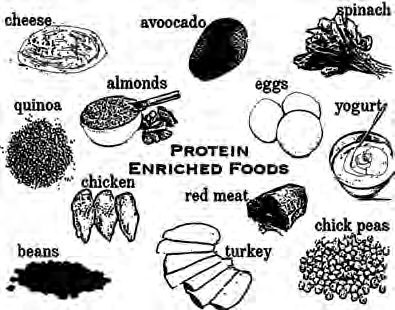
Protein comes from both animals and plants. A person who does not eat meat can still get enough protein from beans, pulses and lentils.
- Animal sources: fish, meat, liver, eggs, milk, cheese, butter and so on.
- Plant sources: soybeans, chickpeas, peas, beans, groundnuts, cowpeas, lentils, cashews and so on.
Functions of Protein
Protein does these jobs in the body:
- It makes the body grow and develop, and repairs it.
- It gives the body the power to fight disease.
- It helps keep acids and alkalis in the body in balance.
- It protects children from malnutrition.
- It gives the body emergency energy when carbohydrate and fat are not available.
Fat: Stored Energy
Fat is another nutrient the body needs. One gram of carbohydrate gives four calories of energy, but one gram of fat gives nine. So a spoonful of ghee carries more than twice the energy of the same weight of sugar. Fat is stored easily in the body, and when food runs short the body draws on this store for energy.
Fat also helps the body use its other nutrients, and it is needed to absorb the vitamins that dissolve only in fat. If fat is lacking for a long time, the body becomes dry, the skin itches and the person feels weak.
Eating more fat than the body needs raises the chance of obesity, high blood pressure, diabetes and heart disease.
The Three Kinds of Fat
Fat is usually divided into three kinds: simple lipid, compound lipid and essential lipid. Lipid is the scientific name for a fat.
Simple lipid: a fat made of fatty acids and glycerol only. Ghee and cooking oil are simple lipids.
Because simple lipids contain little cholesterol, they are used a great deal, for example in milk, butter, cheese, coconut oil and mustard oil. Simple lipids are of two types, saturated fat and unsaturated fat. Put a jar of ghee and a bottle of mustard oil side by side on a cold winter morning and you can see the difference for yourself.
Saturated fat: a fat like ghee, which sets solid in the cold and melts in the heat.
Unsaturated fat: a fat like mustard oil, which does not set even in the cold.
Unsaturated fats such as mustard oil, linseed oil and soybean oil are good for health.
Compound lipid: a fat made of fatty acids and glycerol together with other substances such as glucose, alcohol, phosphoric acid, nitrogen or sulphate.
Phospholipids, glycolipids and lipoproteins are compound lipids. Phospholipids are found in the different organs and cells of the human body. Lipoproteins are made by the liver, and they contain cholesterol and triglyceride. These fats are essential for running the body's activities, but too much of them in the blood harms health.
Essential lipid: a fat that the body greatly needs but cannot make by building it from other fats, so it must come from food.
The essential lipids are linolenic acid, known as omega 3 fat, and linoleic acid, known as omega 6 fat. Children need them for physical growth and development, and everyone needs them for healthy skin and a healthy heart. Fish oil, soybean oil and sissoo seed oil are sources of essential lipids.
| Kind | What it is made of | Examples |
| Simple lipid | fatty acids and glycerol | ghee, mustard oil, coconut oil, butter, cheese |
| Compound lipid | fatty acids, glycerol and other substances | phospholipid, glycolipid, lipoprotein |
| Essential lipid | cannot be made by the body, must come from food | omega 3 and omega 6 fats; fish, soybean and sissoo seed oil |
Sources of Fat
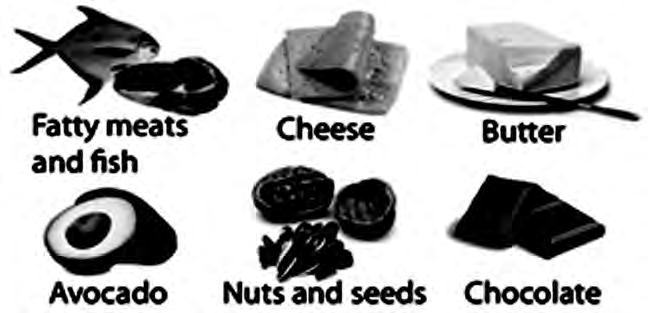
- Animal sources: fish, meat, milk, cheese, butter and so on.
- Plant sources: soybeans, mustard seed, coconut, sesame, linseed, sissoo seed and so on.
Functions of Fat
Fat does these jobs in the body:
- It keeps the body warm.
- It stores the fat soluble vitamins A, D, E and K.
- It makes food tasty.
- It keeps the skin soft and smooth.
- It protects the main organs of the body: the heart, the kidneys and the eyes.
Daily Needs, Local Sources and Deficiency Problems
The table below brings together how much of each macronutrient is needed every day, which local foods supply it, and what happens when it is lacking.
| Nutrient | Daily need | Local sources | Problems caused by a lack |
| Carbohydrate | children: 200 to 250 grams; adults: 300 to 700 grams; women who have just given birth: 500 to 750 grams | bread, rice, maize, barley, wheat, potato, sweet potato, taro, yam, sugar, sugarcane | too few calories, which leads to weight loss, slowness at work, tiredness and less power to fight disease |
| Protein | children: 29 grams; adults: 55 grams; women who have just given birth: 100 grams | fish, meat, eggs, milk, cheese, butter, soybeans, chickpeas, peas, beans, groundnuts, cowpeas, lentils, cashews | a long lack harms physical and mental growth and causes kwashiorkor |
| Fat | children: 25 grams; adults: 40 to 60 grams; women who have just given birth: 45 grams | ghee, butter, animal fat, groundnuts, coconut, soybeans, mustard oil, sesame oil, vegetable ghee | too little makes the body dry, itchy and weak; too much can cause obesity, high blood pressure, diabetes and heart disease |
Reading the table carefully, a woman who has just given birth needs the most carbohydrate and protein. Her body has to rebuild its own strength after the birth and also produce milk for the baby. Look at protein: 29 grams for a child, 55 grams for an adult and 100 grams for a new mother, which is almost twice what an ordinary adult needs. The amounts for fat are the smallest in the table, because a little fat already gives a lot of energy.
The body needs all three macronutrients, but in the right amounts. Too little makes a person ill, and so, for fat especially, does too much.
The full lesson is waiting for you
The notes are free to read in full. A free account opens the rest of the practice, and tracks your progress and confidence score for every subject. Presentations and videos need approval from Learn Yeti.