What Nutrition Means
From the moment we wake up until we fall asleep, our bodies are busy. We walk to school, read, play and help with work at home. To do all of this, the body has to be healthy, strong and fit, and it stays that way only when it gets nutrition regularly. That nutrition comes from food. Food gives us the energy for our daily activities, and it also supplies the materials the body needs in order to grow and develop.
Nutrition is one of the main foundations of the body and of good health. A well nourished person has a strong power to resist disease and falls ill less often. Good nutrition keeps people of every age healthy and fit, from a small baby to a grandparent.
Nutrition: the process by which the body uses the food it receives.
Food and Nutrition Are Not the Same Thing
Many people use the words food and nutrition as if they meant the same thing, but they do not. Food is anything that can be eaten, such as rice, bread, milk or an apple. Nutrition is a dynamic process, which means it is work that keeps going on inside the body. In this process the food we eat is digested, its nutrients are absorbed into the body, and the body puts those nutrients to use. The process runs in this order:
- The food is eaten.
- Digestion breaks the food down.
- The nutrients are absorbed, which means they pass into the body.
- The body uses those nutrients for its work.
A plate of rice and lentils shows the difference clearly. While it sits on the plate, it is food. Once you eat it, it is digested. The energy from the rice is spent when you run on the playground, and the protein from the lentils makes your muscles stronger. All of that work inside the body, after the eating, is nutrition.
Eating food and being nourished are not always the same. Nutrition is complete only when the food has been digested, absorbed and used by the body.
What Our Body Is Made Of
When the human body is examined from the point of view of chemistry, it turns out to be a mixture of many chemical elements. The main ones are carbon, hydrogen, nitrogen, sulphur, phosphorus and calcium. As the body works each day, these elements are used up, old cells wear out and new cells have to be made. So the body needs these elements again and again, and food is where they come from.
The body needs nutrition for all its activities to run properly, and the nutrition it needs comes from food.
Classification of Food
We eat a great many kinds of food. Sorting them into groups makes them easier to understand, and it lets us check what is on our plate and what is missing. Food is classified on two different bases:
- By function: according to the job the food does in the body.
- By composition: according to the nutrients the food is made of.
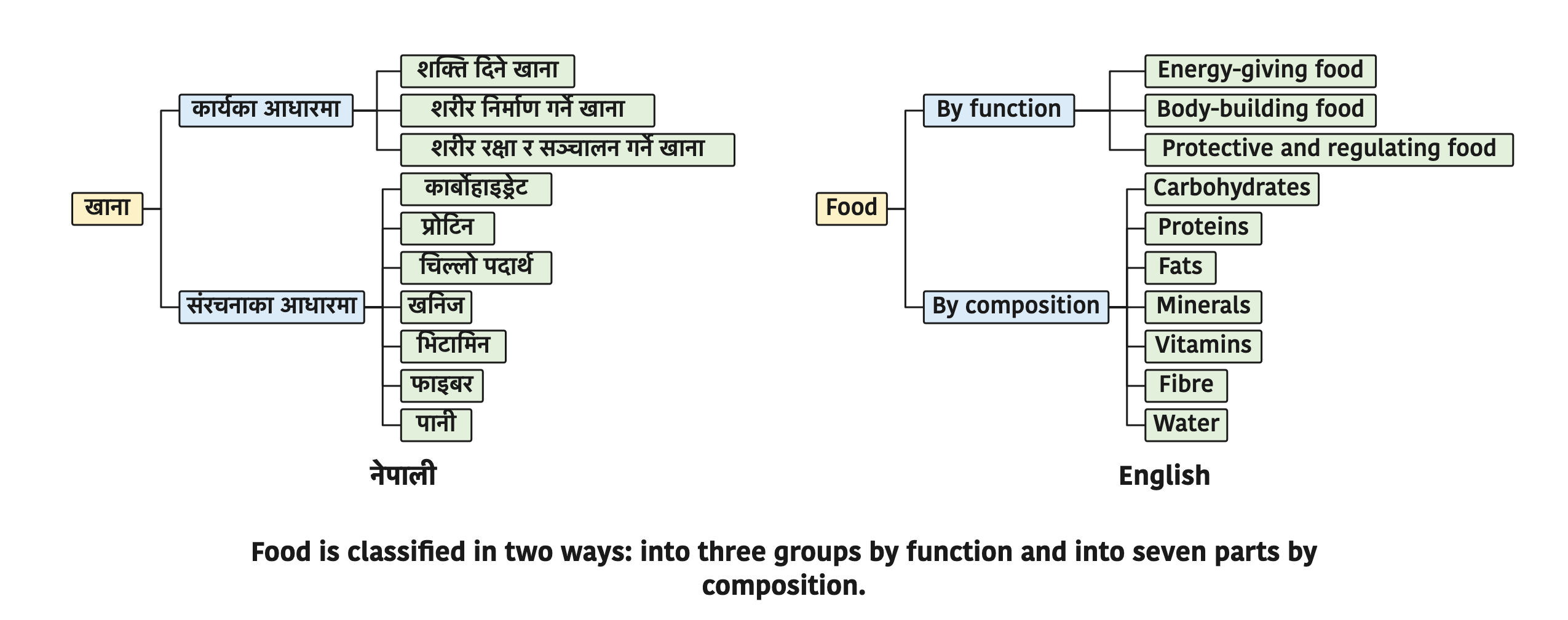
Three Groups by What Food Does
By function, food is divided into three groups. Each group is named after the job it does, so once you understand the name you already know the job.
(a) Energy-Giving Food
Energy-giving food: food that provides the body with heat and energy.
Food in this group is rich in carbohydrates and fats. Grains such as rice, wheat, millet, maize and barley are full of carbohydrates, while ghee and cooking oil supply fat. A farmer who eats millet porridge or bread on a winter morning before going to the fields gets the strength for a whole day's work from exactly these foods. Even while we sleep, the heart keeps beating and the lungs keep breathing, and the energy for that also comes from this group.
(b) Body-Building Food
Body-building food: food that repairs damaged cells and tissues and helps the body grow and develop.
This group contains proteins and minerals. Fish, meat, liver, milk, peanuts and soybeans are examples. If you fall during a game and scrape your knee, the wound heals within a few days. The uniform you wore in class 6 no longer fits by class 10. New tissue in a wound and a taller body both need building material, and this group supplies it. That is why teenagers, who are still growing, need these foods in particular.
(c) Protective and Regulating Food
Protective and regulating food: food that guards the body against various diseases and keeps it running properly and safely.
This group contains vitamins, minerals and water. Milk, green leafy vegetables, eggs, liver and fruit are examples. Regulating means keeping the body's inner work running smoothly. Seasonal greens and fruit such as mustard greens, spinach, oranges and guavas keep the body ready to fight disease, and enough water supports every job the body does.
| Group | Main nutrients | Examples | Main job |
| Energy-giving food | Carbohydrates, fats | Rice, wheat, millet, maize, barley, ghee, oil | Gives heat and energy |
| Body-building food | Proteins, minerals | Fish, meat, liver, milk, peanuts, soybeans | Repairs cells and tissues, helps growth |
| Protective and regulating food | Vitamins, minerals, water | Milk, green leafy vegetables, eggs, liver, fruit | Guards against disease, keeps the body running |
Milk and liver appear both as body-building food and as protective food, and minerals appear in both groups too. One food can hold several nutrients, so one food can belong to more than one group. If asked which group milk belongs to, both groups are correct.
Classification by Composition
Food can also be sorted by the nutrients it contains. This is classification by composition. On this basis, food is divided into seven parts:
- Carbohydrates
- Proteins
- Fats
- Minerals
- Vitamins
- Fibre
- Water
The two ways of classifying are linked. Foods rich in carbohydrates and fats fall in the energy-giving group. Foods rich in proteins and minerals fall in the body-building group. Foods rich in vitamins, minerals and water fall in the protective and regulating group. So if you know which nutrient a food is rich in, you can work out what job it does in the body.
Sorting a Meal into Groups
Suppose an evening meal has rice, lentils, fish, ghee, mustard greens and an orange. To sort this meal into groups by function, work like this:
- Step 1: Write down each food on the plate, one at a time.
- Step 2: Decide which nutrient each food is richest in.
- Step 3: Use that nutrient to place the food in its group by function.
- Step 4: Check whether all three groups are present on the plate.
| Food | Richest in | Group by function |
| Rice | Carbohydrates | Energy-giving food |
| Ghee | Fats | Energy-giving food |
| Lentils | Proteins | Body-building food |
| Fish | Proteins, minerals | Body-building food |
| Mustard greens | Vitamins, minerals | Protective and regulating food |
| Orange | Vitamins, water | Protective and regulating food |
All three groups are on this plate, so the meal gives the body energy, building material and protection together. A plate of only rice and ghee would fill the stomach, but it would leave out both the body-building and the protective foods.
Why Nutrition Matters
When all three groups of food do their work, the body is fully nourished. The importance of nutrition can be set out like this:
- It supports a person's physical growth and development.
- It repairs and maintains damaged and destroyed tissues.
- It plays an important part in keeping regular body activities going.
- It produces heat in the body and so protects it.
- It protects against diseases caused by a lack of nutrients.
- It helps build up the power to resist disease.
These points match the three groups. Heat and energy come from energy-giving food. Growth and the repair of tissues come from body-building food. Protection from disease and the smooth running of the body come from protective food. If one group is missing, the job linked to it becomes weak. This is why nutrition is called the foundation of health.
Nutrition makes the body grow, repairs it, keeps it working, keeps it warm and protects it from disease.
The full lesson is waiting for you
The notes are free to read in full. A free account opens the rest of the practice, and tracks your progress and confidence score for every subject. Presentations and videos need approval from Learn Yeti.