Three Sides of a Healthy School
A student spends a large part of every day at school. Most of their reading, writing, playing and time with friends happens there. So the school has to be healthy and safe if both the body and the mind of a student are to grow well. A healthy school environment is looked at in three parts:
- (a) the physical environment
- (b) the mental environment
- (c) sanitation
Of these three, the physical environment is the easiest to notice. The building, the rooms, the windows, the desks and benches and the ground you see the moment you walk through the school gate are all part of it. It is everything in a school that you can see and touch.
What the Physical Environment Means
Physical environment: the proper arrangement of the physical things inside a school, such as the school building, classrooms, light, ventilation, furniture, drinking water, drainage and the playground.
The physical environment matters a great deal. Imagine a very good teacher in a room with a leaking roof, little light and stale air. However good the teaching is, the students cannot keep their attention on the lesson. Until the physical environment is suitable, teaching and learning cannot happen properly. That is why the physical environment is treated as the first infrastructure of a school. It is the base that everything else stands on.
A school's physical environment must be both healthy and safe. Healthy means it does no harm to the body. Safe means it protects students from accidents.
The physical environment has many parts. Five of the most important are:
- (a) school building construction
- (b) furniture
- (c) proper light
- (d) ventilation
- (e) the playground
(a) School Building Construction
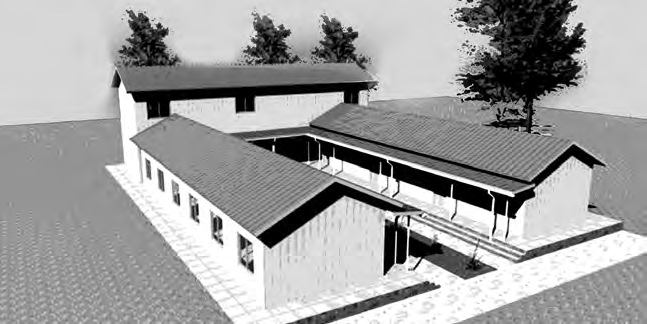
A school building is where students spend most of their time gaining knowledge and skills. A place this important must be built in a healthy, safe and suitable way. When the building is safe and healthy, teaching and learning work well.
Earthquakes happen in Nepal. So a school building must be earthquake-resistant, which means it is built so that it does not easily fall when the ground shakes. It must also be safe from other natural disasters such as floods and landslides. A school built on a river bank, or on a steep slope where landslides happen, can be in danger every monsoon.
It is not only the outside of the building that must be safe. The stairs, classrooms, windows and doors inside must all be safe too. If they are not, accidents can happen. For example, on a staircase with no railing, students rushing down when the bell rings can easily fall.
If you see a broken window, a loose door, a shaky railing or a cracked stair, do not play near it. Tell a teacher straight away.
A good school building has these features:
- built on high ground where possible
- built in an open place that is free from noise
- earthquake-resistant
- safe from floods and landslides
- a strong, permanent roof
- spacious classrooms with enough windows
- safe stairs, windows and doors
(b) Furniture
The desks, benches, tables and chairs in a classroom have a direct effect on students' health. Students sit at them to read and write for five or six hours a day. So furniture must be made to suit the height and age of the students who use it.
Take an example. Put a small class 2 child at a tall class 10 desk, and their feet will not reach the floor and they must lift their shoulders to write. Give a tall student a low bench and desk, and they will bend their back all day to write. In both cases, sitting like this to read and write affects different parts of the body in different ways.
When the size of the bench and desk does not suit the student, the joints can be affected. When the sitting posture is wrong day after day, problems of the nerves and bones can follow. So furniture must be the right size and safe.
How the furniture is arranged matters just as much. Desks and benches of the right size, placed in neat order, play a big part in making a classroom healthy. Benches crammed so close that students bump into them, tables that block the way, or furniture with nails sticking out get in the way of movement and can cause injuries.
Classroom desks and benches must be healthy and safe: sized for the students' height and age, allowing a good posture, and arranged in order.
(c) Proper Light
Every classroom in a school should let in plenty of sunlight. If not enough light comes into a room, the letters on the blackboard and the words in a book become hard to read, and the students' learning is disturbed.
When not enough light gets into a classroom, students have to strain their eyes or hold their books close to their faces to read. Over a long time, this can weaken their eyesight.
Sunlight has one more benefit. The human body also needs sunlight to get vitamin D.
So windows must be placed so that enough light comes into every classroom. When there are several large windows, light reaches even the corners, and students at the back can read the blackboard easily.
(d) Ventilation
Ventilation: the proper arrangement by which clean, fresh air from outside comes into a classroom and the stale, dirty air inside goes out.
Many students sit and breathe together in one classroom. When we breathe, we take in oxygen and give out carbon dioxide. In a room with the doors and windows shut, this carbon dioxide has nowhere to go. So when a classroom has no proper ventilation, the amount of carbon dioxide in it keeps rising.
In a room where carbon dioxide has built up, these problems can appear:
- feeling lazy and dull
- feeling sleepy
- feeling restless and uneasy
- getting a headache
These problems get in the way of study. When many students start yawning in a shut room after lunch, this is exactly what is happening. So every classroom needs suitable vents and large windows for good ventilation.
Ventilation has a direct effect on making a school environment healthy. So every school needs to manage it properly.
(e) The Playground
Sport plays an important part in the physical and mental development of students. Running, jumping and playing in a team make the body strong, lighten the mind and build the habit of working together. For all this, a school needs a good playground.
A good playground has these features:
- spacious and safe
- cleaned every day
- bricks, stones and other objects removed
- holes and pits filled in
- on level land, wide and surrounded by greenery
- friendly to students
- suitable for students with different abilities too
- getting plenty of sunlight
- in a place free from dust and smoke
If you see a brick, a stone or a pit on the ground, do not run near it. Tell a teacher about it.
Being suitable for students with different abilities means, for example, having a path and a level surface so that a student in a wheelchair can also reach and use the ground. A playground is for everyone. The right kind of playground helps to build a healthy school environment.
The Five Parts at a Glance
| Part | What it needs | What happens without it |
| Building | Earthquake-resistant, safe from floods and landslides, high open place, strong roof | Accidents can happen, teaching and learning suffer |
| Furniture | Sized for height and age, safe, neatly arranged | Joints affected, nerve and bone problems |
| Proper light | Plenty of sunlight, enough windows | Learning disturbed, eyesight weakens |
| Ventilation | Suitable vents and large windows | Carbon dioxide rises, dullness, sleepiness, restlessness, headache |
| Playground | Wide, clean, level, green, free from dust and smoke | Physical and mental growth held back, injuries |
These five parts are linked to one another. Large windows give both light and ventilation. A building placed on a well-chosen site also leaves safe space for a playground. Only when all of them come together does a school's physical environment become healthy and safe.
The full lesson is waiting for you
The notes are free to read in full. A free account opens the rest of the practice, and tracks your progress and confidence score for every subject. Presentations and videos need approval from Learn Yeti.