The Idea of Risk
Dangers surround us all the time. The ground can shake, a river can swell, a fire can break out. We only see broken houses and injured people after such an event has happened, but the chance of that damage was there long before. A weak house is already weak before the earthquake comes. That chance of damage is what we call risk.
Risk: Risk is the condition in which damage can happen because of the effect of a possible danger. In other words, risk is the possibility of loss that a disaster, arising from any hazard, may bring.
A disaster does not harm just one thing. It can reach almost every part of people's lives. Risk mainly means the possibility that a disaster will damage the following:
- people
- homes
- school and office buildings
- roads and bridges
- farmland
- domestic animals and birds
- the many sources people earn their living from
Take an earthquake as an example. An earthquake can strike at any moment, in the middle of a school day or at night while everyone is asleep. It can bring down buildings, bridges and roads, and it can injure or kill people. The damage an earthquake could do to buildings and to human beings is the risk. Even while the ground is still, a weak building and the people inside it are already at risk.
Risk and damage are not the same thing. Damage is what we see after an event. Risk is the possibility of damage before the event happens, which is exactly why risk can be reduced in advance.
Preparation Lowers Risk
Disasters such as earthquakes, floods, landslides and fires can bring risk to our homes and our schools. We cannot say exactly when one will come, but taking precautions beforehand keeps us safe. Students who have practised an earthquake drill know what to do when the shaking starts and where to gather afterwards. Students who have never practised may panic and run in any direction. Because a disaster can happen at any time, staying prepared for the ones that are likely lets us reduce much of the risk they carry.
We cannot always stop a disaster from coming, but preparation and precaution can greatly reduce the risk it brings.
Types of Risk
Risk can exist anywhere and at any time. If players are careless on the playground, an accident can happen and someone can fall and be hurt, so the playground carries a risk of harm. In the same way, a school building put up on sloping land with weak, unbaked materials faces a greater risk of floods and landslides. That is why a school building should stand on flat land and be built of strong, permanent materials.
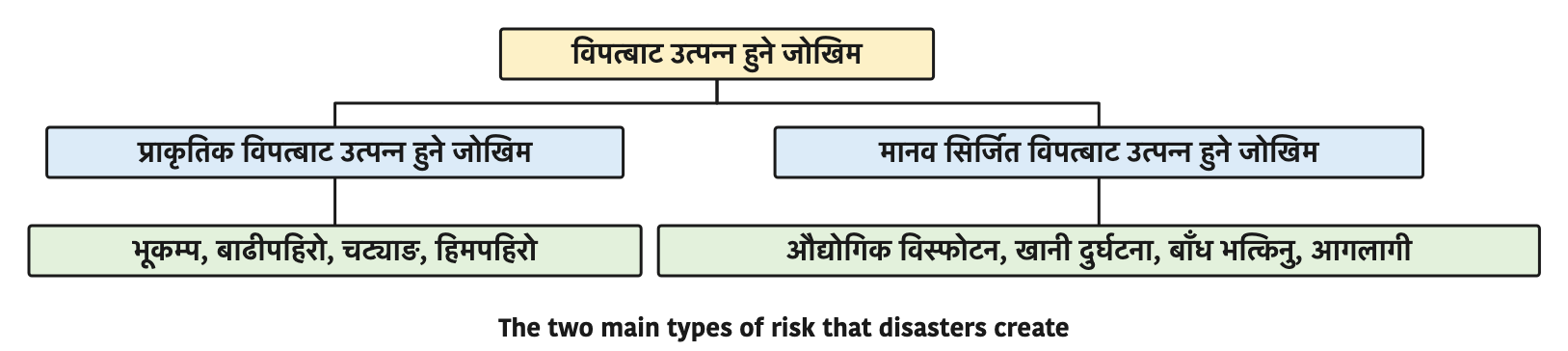
The risk that disasters create is mainly divided into two groups:
- (a) risk arising from natural disasters
- (b) risk arising from human-made disasters
Risk from Natural Disasters
Natural processes go on all the time, both beneath the Earth's surface and above it. Layers of rock shift underground, winds and clouds move across the sky, snow piles up on the mountains. Most of the time these processes run quietly, but now and then they cause sudden, heavy loss of life and property.
Risk from natural disasters: The risk that comes from disasters caused suddenly by natural processes is called risk from natural disasters.
The following natural hazards can cause great loss of life and property:
- earthquake
- flood and landslide
- inundation, when land stays under water
- heavy snowfall
- hailstorm
- windstorm
- sea storm, such as a cyclone
- lightning
- avalanche
We have to take precautions early to protect our homes and schools from these natural disasters. A school building should not be built on steep land where landslides can happen. It should be built on fairly flat land and made earthquake resistant. Schools should also run awareness programmes from time to time about staying safe in natural disasters, such as a talk on earthquake safety, a discussion on how to stay safe from lightning, or a session on floods and landslides.
Risk from Human-Made Disasters
Risk from human-made disasters: The risk that an event caused by human activity will do great damage and harm people's lives is called risk from human-made disasters.
On one side, the fast growth of science and technology has made many things possible that once seemed impossible. Industries, mines, large dams and electricity have made our lives easier. On the other side, the same growth has raised risk just as much. The more factories, mines and power lines there are, the more chances there are for them to cause an accident. The risks that come from human activity are these:
- risk of loss of life and property from an explosion in an industry
- risk from machinery accidents in industries
- risk from mine accidents
- risk to settlements from floods when dams break
- risk of landslides when forests are destroyed
- risk from different kinds of social conflict and war
- risk from fires and electrical accidents
This list includes landslides and floods, which also appear among natural disasters. The difference lies in the cause. When people cut down a forest, the soil loosens and a landslide follows. Because human activity caused that landslide, its risk counts as human-made.
| Point | Risk from natural disasters | Risk from human-made disasters |
| Cause | natural processes inside and above the Earth | activities carried out by people |
| Examples | earthquake, lightning, avalanche | industrial explosion, mine accident, war |
Risks Found in a School
Apart from the risks above, a school has risks of its own. Because a school gathers many students in one place, these risks need special attention. The risks that can be found in a school are these:
- risk from different chemicals leaking in the school laboratory
- risk of cuts and injuries on the playground
- risk of the school wall collapsing if it is weak
- risk of violence against students at school
- risk from floods, landslides and windstorms at school
- risk that an earthquake can bring to the school
These risks are part of everyday school life. If chemical bottles in the laboratory are not stored properly, they can leak and hurt students. Playing beside an old, cracked wall can end in injury if the wall falls. Violent risk means the danger of students being beaten, attacked or mistreated, which hurts the mind as well as the body. A school near a river or on sloping ground faces a greater risk of floods, landslides and windstorms.
Measures to Reduce Risk
A disaster can come at any time and cause heavy loss of life and property, so we must prepare in advance and take precautions. To reduce the risk from disasters and hazards, the community and the school should identify and put to use their local resources and build up their own ability to cope. Local resources are the things found close at hand, such as an open ground, a health post, volunteers and supplies. The school and the community should work together to run trainings on managing different hazards and programmes that raise public awareness. When a school building is built, it should stand on flat land and be made earthquake resistant.
Always move with care when playing on the playground and when walking on the road.
Steps a School Should Take
To reduce the risks that may arise in a school, the following measures should be adopted:
- The school maps its risks and identifies its risk areas.
- It identifies a safe place where everyone gathers in an emergency.
- It makes its buildings and walls earthquake resistant, and builds embankments and walls to protect against floods and landslides.
- Students and teachers practise regularly how to escape and stay safe in emergencies such as earthquakes, floods, landslides and fires.
- Students are taught the ways to protect themselves from disaster risk.
- The school forms a disaster management committee.
- The school runs first aid training from time to time.
Mapping risk means marking the dangerous spots on a map of the school, such as a weak wall, a steep edge, the room where chemicals are kept and any bare electric wires. Everyone then knows where to take extra care. When everyone gathers in the same open, safe ground after an earthquake, the teachers can count at once whether anyone is missing. The disaster management committee plans and leads all of this work. Regular drills mean that, in a real emergency, people remember what to do instead of panicking.
Knowing the risks, preparing early, practising often, and the school and community working together are what keep a school safe when disaster strikes.
The full lesson is waiting for you
The notes are free to read in full. A free account opens the rest of the practice, and tracks your progress and confidence score for every subject. Presentations and videos need approval from Learn Yeti.