School and Community Co-operation
A school never stands alone. It is set up inside a community, for the wider good of the people who live there. Very often the land, the labour and the money that built it came from that same community. In return, the school gives itself to the development and progress of society. So the two grow side by side, each helping and coordinating with the other. This mutual help is another important element of the school health programme.
School and community co-operation: the mutual help and coordination between a school and the community around it, through which both move forward together for the health and development of everyone.
A school and its community are like the two sides of one coin. Take away one side and you no longer have a coin. In the same way, neither the school nor the community can reach its goals by working alone. Each has to help the other, and the two have to move forward together.
The goals of the school health programme are reached only when the school and the community help each other and move forward together.
The School's Role in Its Community
A school in a community has a large part to play in moving that community forward. It should promote the good practices already found in society and help remove the harmful ones. At school, students learn health knowledge, skills, attitudes and behaviour. The place where they put all of that to use is the community. When students practise at home and in their neighbourhood what they learned in class, the community itself becomes healthier. That is why the school and the community need a warm, friendly relationship.
For this reason, the school should teach, as part of its curriculum, the problems that the community actually faces:
- communicable diseases that can break out in the community
- drug abuse and addiction
- malnutrition
- environmental problems
- superstitions that harm people's health
Take an example. A girl learns in class that washing hands with soap and water before eating protects against diarrhoea. At home she asks her family to keep soap beside the tap. Her little brother copies her, and before long the neighbours do too. One lesson in one classroom has changed the habits of several homes. Superstition pulls the other way. If a sick child is taken to a faith healer instead of the health post, the child's condition can get worse. By teaching the facts and talking them over with parents, the school helps remove such beliefs.
Importance of School and Community Co-operation
Both the school and the community can develop only through a close, warm relationship and mutual help. For the school health programme to work well, the school and the community must walk forward hand in hand. A close relationship also helps teaching and learning, and every other school activity, to succeed. The co-operation matters for these reasons:
- It helps run the school health programme and other educational programmes.
- It builds coordination and an exchange of help between the school, the home and the community.
- It makes students feel responsible towards their community.
- It helps parents form a positive view of the school.
- It helps remove superstitions and unhealthy habits and behaviour from the community.
- It helps students carry the health knowledge and behaviour they learn at school into their homes and community.
- It develops positive health knowledge and attitudes among the people of the community.
- It helps solve health problems, large and small, that arise in the school and the community, by working on them together.
- It lets the school use the resources available in the community.
Programmes that Build the School and Community Relationship
To keep the relationship warm, the school and the community should run different programmes together. These joint programmes make teaching and learning more effective and help the school health programme move forward smoothly. Some are held in the school with the community taking part, and some are held in the community with the school taking part. The four main ones follow.
Parents' Day
Parents' Day: a programme held once a year to inform parents about the programmes the school has run and about its educational and administrative activities.
Parents' Day puts the school and the community in direct contact, and that contact deepens their relationship. On this day the school presents its educational, administrative and financial activities of the whole year. Parents learn about the educational progress of their own children. The school also shares its problems and says what it expects from society.
To make every parent an active participant rather than someone who just watches, the day can include:
- sports competitions
- cultural programmes
- drama
- poetry and essay competitions
- speech contests
- quiz contests
- art exhibitions
When parents watch their own children act in a play, talk with teachers about results, and hear for themselves how the school spent its money, the school starts to feel like theirs. Programmes like these build a warm, friendly relationship and real co-operation between parents and the school family.
Exhibition
A school can display posters and pictures on subjects such as communicable diseases, non-communicable diseases, the environment, nutrition and family planning. Parents are invited from the community and the display gives them messages that raise awareness. Charts and posters can show useful methods, for example how to make the best weaning flour for babies and how to keep water pure.
For instance, class 10 students could show on a chart the steps for making weaning flour from roasted grains and pulses. Another group could show on a poster how to make water safe by boiling or filtering it. When a mother goes home from the exhibition and starts making that flour for her baby, the exhibition has done its job.
One exhibition is not enough. They should be held from time to time. They make the relationship between parents and the school warmer, and parents gain health knowledge that lets them change their own behaviour.
School Participation in Community Sanitation
To keep our lives healthy, the environment around us must be clean. Cleaning only the school compound is not enough, because students live, walk, drink water and play in the community too. So these public places in the community must also be clean:
- monasteries and temples
- sources of drinking water
- roadside resting platforms
- public toilets
- playgrounds
- roads and paths
- town squares
- ponds
- wells
- taps and public water spouts
The school and the community should take the lead in protecting and cleaning these places. When the school leads a cleanliness campaign, people's knowledge, attitudes and behaviour towards cleanliness change for the better. A campaign to make the community clean and green can be run like this:
- The school and the community hold joint meetings.
- Through discussion, they decide when and how the cleanliness campaign will be run.
- They make the rules needed for keeping places clean.
- Both the school and the community follow those rules and keep the community and the school clean.
Programmes like these make the relationship between the school and the community warmer, and teaching and learning in the school become more effective as well.
Community Support in Building a Healthy School Environment
Help does not flow in only one direction. Just as the school helps clean the community, the community should take part in keeping the school's surroundings clean. With the school taking the first step, community members can join activities such as:
- cleaning the roads and paths that lead from the community to the school
- cleaning and tending the school garden
- clearing the bushes around the school
- taking an active part in the seminars, workshops and rallies held at the school
When the community is involved actively like this, the relationship becomes warmer and a healthy environment is built in the school.
The Four Programmes Side by Side
| Programme | Where it happens | What it does |
| Parents' Day | In the school, with parents taking part | Reports the year's activities and each child's progress |
| Exhibition | In the school, with the community invited | Spreads health awareness through posters and charts |
| Community sanitation | In the community, led by the school | Protects and cleans public places |
| Community support for the school | In the school, with the community helping | Keeps the school surroundings clean and joins school events |
Child-Friendly and Inclusive Environment
When a school has a healthy environment, teaching and learning work well. Keeping both the physical and the mental environment of a school healthy needs the help and participation of the school family and the community. For a school environment to be truly healthy, the school must be child friendly and it must be inclusive. The two ideas are explained one at a time below.
Child-Friendly School Environment
Child-friendly school environment: an environment in which children learn with enjoyment, at their own pace and according to their own ability. It is also described as the whole physical and mental environment of a school, taken together, that motivates children to learn.
The school environment should be easy, suitable and friendly for the students who study there. The school grounds should always be the kind of place that draws children in. Suitable classrooms, teachers who treat students kindly, and good relations among the students themselves are what make a school child friendly. There should also be physical facilities for reading, writing, playing and having fun that suit the students' age and interests.
The basic features of a child-friendly school environment are:
- a safe playground
- desks and benches that suit the students' age
- soap and water in the toilets
- separate toilets for boys and girls
- safe drinking water
Safe drinking water does not need costly equipment. With help from the community, a school can build a simple filter: a covered container with layers of brick chips, fine sand, wood charcoal and coarse sand, through which tap water is passed before it reaches the students.
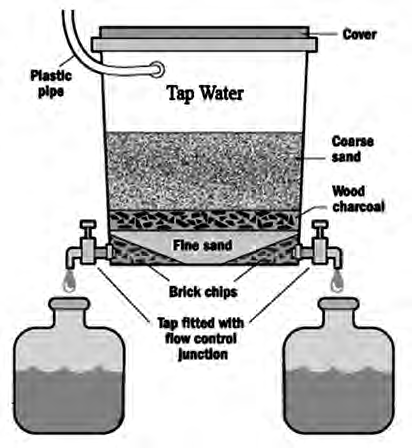
When a school is child friendly, students develop well physically, mentally and socially, and their academic progress is of good quality too. When these basic features are present in adequate amounts, teaching and learning are effective. Children cannot enjoy learning in a room where the benches are too high for them to sit comfortably, or in a school whose toilets have no water.
Inclusive Environment
Inclusive environment: an environment in which students of different castes, religions, genders, languages, traditions and cultures read, write and play together, with no one discriminating against anyone else.
Students with disabilities and students who belong to sexual and gender minorities must be taught without any discrimination. No one in a school should be treated differently because of their caste, religion, gender, language, economic status, or physical or mental weakness. This applies to children outside the school as well as to those inside it.
Never tease or mock anyone because of their caste, religion, language, economic status, or physical or mental weakness. Calling it a joke does not stop it from being discrimination.
Everyone should read, write and play together. If someone is physically or mentally weak, the rest of us should help them to write, read, play and walk. Students of every ability should get an equal chance to study, and the school must create the conditions for that. All students should take part equally in school programmes. Everyone should be treated the same way, so that every student feels safe and feels that the school belongs to them.
Imagine a new girl joins class 8. She walks with crutches and speaks a different language at home. Her classmates carry her bag, the teacher moves the class to the ground floor, and everyone learns a few words of her language. In games she is given a part she can play. She becomes a full member of the class like anyone else. That is an inclusive environment, and when a school builds one, all of its programmes move forward effectively.
How the Two Environments Differ
| Aspect | Child-friendly environment | Inclusive environment |
| Main question | Is the school a pleasant, suitable place for children to learn? | Is every student treated equally, without discrimination? |
| What it looks at | Children's pace, ability, age and interests | Differences of caste, religion, gender, language, economic status and ability |
| Examples | Safe playground, benches that suit age, safe water | Helping a weaker classmate, equal part in programmes for all |
Good buildings, desks and toilets do not make a school inclusive by themselves. If some students are mocked or left out of programmes, the school is not inclusive. A healthy school needs both environments at the same time.
The full lesson is waiting for you
The notes are free to read in full. A free account opens the rest of the practice, and tracks your progress and confidence score for every subject. Presentations and videos need approval from Learn Yeti.