Components of the School Health Programme
Education is more than reading books. A child who is ill, hungry or frightened does not learn well, however many hours they sit in class. For this reason the school health programme is treated as an essential part of education itself, not as something extra. A school looks after the health of three groups of people: the students who study there, the teachers who teach there and the staff who work there. Everything the school does for their health, taken together, is called the school health programme. It is not optional. Every school needs one.
School health programme: the range of health-related programmes carried out in a school to promote the health of the students studying there, the teachers teaching there and the staff working there.
No single activity can keep a whole school healthy. Students need check-ups, good food, a clean place to study, games and exercise, and someone to talk to when something is worrying them. So the school health programme is made up of eight parts, called its components. Each component takes care of one side of health, and the programme is complete only when all eight are working together. The eight components are:
- (1) School health service: health check-ups, first aid and similar care
- (2) School nutrition programme: nourishing tiffin and learning about good food
- (3) Healthful school environment: a school that is clean, safe and pleasant
- (4) Health education: lessons that build health knowledge, habits and behaviour
- (5) School and community cooperation: work the school and the local community do together
- (6) Physical education and extra activities: sports, exercise and other activities outside ordinary lessons
- (7) Counselling and mental health programme: advice and support for worries and problems of the mind
- (8) Health promotion for teachers and staff: looking after the health of the adults who run the school
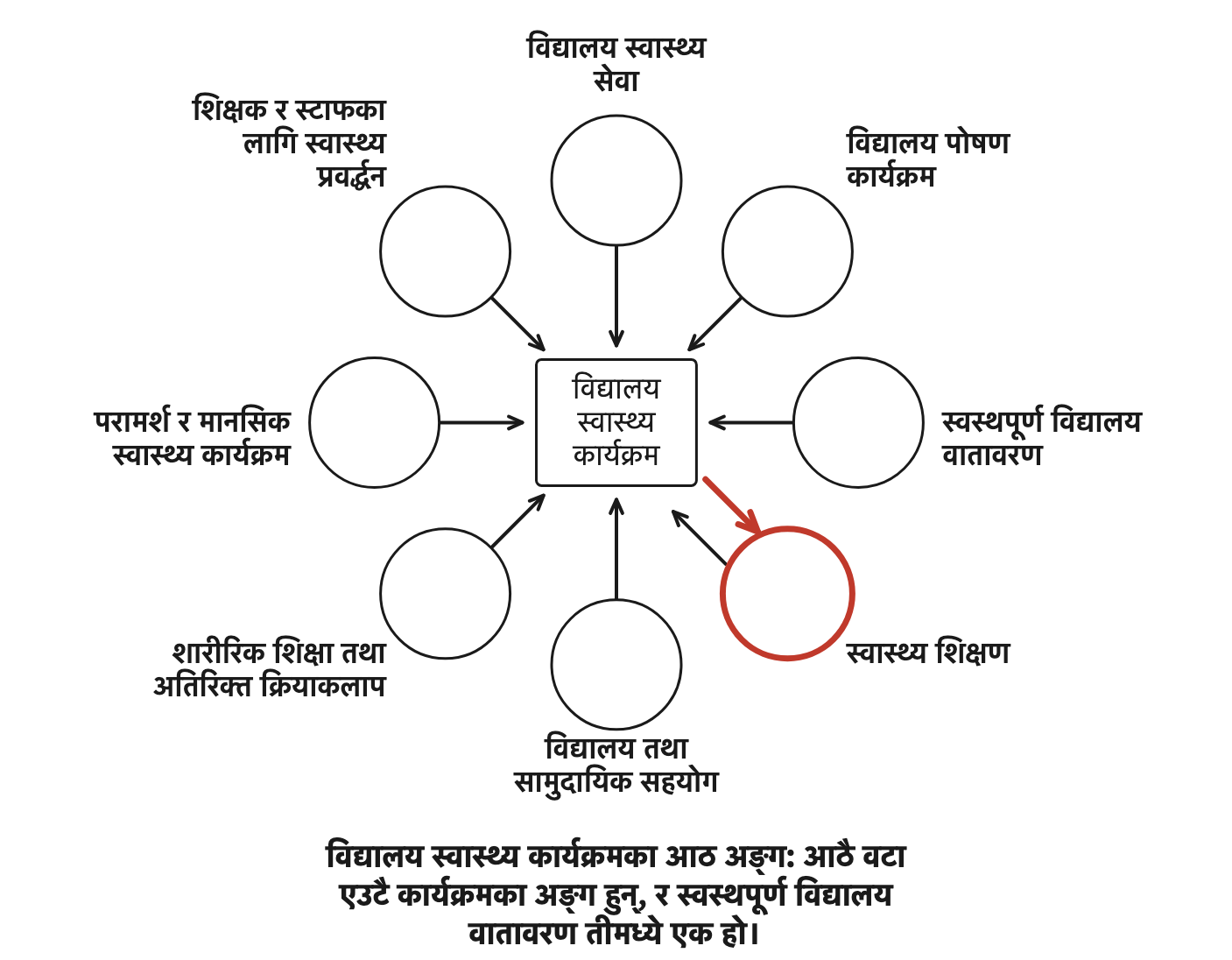
Among these eight, the healthful school environment has a special place, because every other component happens inside it. A nutrition programme run in a dirty school can still make children sick through spoiled food, and a health lesson taught in a stuffy, dark room still leaves students tired and restless. The rest of this topic looks closely at this one component.
Do not mix up the eight components with the three areas. The eight components belong to the whole school health programme. Physical environment, mental environment and sanitation are the three areas inside just one of those components, the healthful school environment. They are not components of their own.
Healthful School Environment
Childhood is one of the most important stages of life, and a large part of it is spent at school. A student is in school six days a week for about six hours a day. That adds up to roughly 36 hours every week, more than we regularly spend in any place except home. Whatever a school is like, clean or dirty, safe or dangerous, friendly or harsh, a child lives inside it for all those hours. So the school and its surroundings must be clean, fresh and green. For a child to grow well in body, mind and social life together, which is called all-round development, the school environment has to be healthful.
A school environment becomes healthful when the following are in place, both inside the buildings and around them:
- clean and tidy grounds
- clean, fresh air
- safe drinking water
- safe buildings, furniture and equipment
- a safe playground
- clean toilets
- control of diseases
- a warm relationship between teachers and students
- healthy arrangements for teaching and learning
Healthful school environment: a school, inside and outside, that has clean and tidy surroundings, clean air, safe drinking water, safe physical facilities, a safe playground, clean toilets, control of diseases, a warm relationship between teachers and students, and healthy arrangements for teaching and learning.
There is a second way of saying the same thing. The definition above lists what a school must have. The one below describes what those things lead to. Here, adjustment means being able to settle in and feel at ease with the place and the people around you.
Healthful school environment (second definition): the condition in a school in which all students and teachers are able to experience good adjustment and happiness.
A healthful school environment is not a luxury. It is a need that cannot be done without. When the environment is healthful, students develop healthy habits, behaviour and conduct, and because of that their health improves.
A Healthful School and an Unhealthy One
Picture two schools. In the first, the classrooms are dusty and dim, the benches are broken, the tap is dry and the toilet smells. In the second, the rooms are bright and airy, the garden is green and the teachers speak to students kindly. Nobody needs to be told which one a child would rather go to each morning. The table sets the two side by side.
| Feature | Unhealthy environment | Healthful environment |
| Classroom | dusty, dark, stuffy | clean, bright, fresh air through the windows |
| Desks and benches | broken, with nails sticking out | sturdy and neatly arranged |
| Drinking water | dirty or missing | safe and always available |
| Toilets | smelly, no water | clean, with water |
| Playground | stones and broken glass | clean and safe |
| Relationships | fear and quarrels | friendship and respect |
In the second school both students and teachers are happy, and a happy learner learns well. A clean school, desks and benches arranged safely and neatly, a decorated classroom, a safe playground, clean toilets, a green school garden, friendly relations among students and a good relationship between teachers and students all help us to stay in good health. Notice that this is not only a list of buildings and objects. The way people treat each other is part of the environment too.
Objectives of Healthful School Environment
Any plan needs a clear aim. The healthful school environment has one main objective and several more specific ones.
Main objective: to make the school clean and pure, so as to keep students and teachers healthy, and to prepare an environment that suits healthy habits, healthy behaviour and good teaching and learning.
Its other objectives are:
- (1) To choose a safe, clean and pleasant site for the school and build its buildings there
- (2) To provide safe water and clean toilets in the school
- (3) To dispose of the waste produced in the school in a proper way
- (4) To arrange proper light, furniture and ventilation inside the classrooms
- (5) To keep the playground clean and safe
- (6) To create a green, pleasant and peaceful setting in the school compound with a garden, flower beds and planted trees
- (7) To build friendly relations among students, teachers, staff and parents
- (8) To run the school's daily teaching and learning regularly and effectively
- (9) To make sure that no health problem of any kind arises in students or teachers because of the school
- (10) To make the school a place that attracts students
The ten are easier to remember in groups. The first is about the site and the building. The second and third deal with water, toilets and waste. The fourth is about the inside of the classroom, where ventilation means a way for fresh air to come in and stale air to go out. The fifth and sixth concern the playground and greenery outside. The seventh is about relationships between people, and the eighth is about keeping lessons running regularly. The last two sum up the whole aim: nobody should fall ill because of the school, and students should actually want to come to it.
Areas of Healthful School Environment
Teaching and learning work well only in a healthful school. As long as the school environment is unhealthy, the health of its teachers and students cannot be good either. A healthful school environment covers a great many things, so they are grouped into three areas:
- (a) Physical environment
- (b) Mental environment
- (c) Sanitation
| Area | What it covers |
| Physical environment | school building, classrooms, light, ventilation, furniture, drinking water, drainage, playground |
| Mental environment | relations among students, teachers and staff, and lessons that are enjoyable and free of fear |
| Sanitation | cleaning of the grounds, classrooms and toilets, and proper disposal of waste |
One school day shows the three areas clearly. Fitting wide windows in a new building is work on the physical environment. Stopping anyone from being teased in class is work on the mental environment. Putting wrappers and leaf plates in the bin after tiffin is sanitation. A school is fully healthful only when all three areas are looked after.
Everyone's Part in a Healthful School
A healthful school is not made once and then left. A toilet cleaned today must be cleaned again tomorrow, and a young tree needs water every day. So teachers, students, staff and the community all have to keep working, without stopping, to create a healthy environment and to keep it that way. Students can do a great deal themselves, every day:
- put litter in the bin instead of dropping it anywhere
- flush the toilet after use and wash hands with soap and water
- never write on or scratch desks, benches and walls
- help with the garden and with planting trees
- get along with classmates and never bully anyone
- tell a teacher about a broken window, a leaking tap or a cracked bench
When small actions like these happen every day, the school becomes a place students enjoy coming to, and everyone who spends their day there stays healthier.
The full lesson is waiting for you
The notes are free to read in full. A free account opens the rest of the practice, and tracks your progress and confidence score for every subject. Presentations and videos need approval from Learn Yeti.