The Mental Environment of a School
A healthy school needs more than a strong building, a wide playground and clean classrooms. The way the people inside the school treat one another matters just as much. So, alongside the physical environment, the mental environment is a main part of a healthy school.
Mental environment: the human relationships inside a school, such as those between teachers and students, among students and among teachers, together with warmth, mutual help and goodwill, are called the mental environment of the school.
In a school with a healthy mental environment, teachers, students and staff all feel that they belong to one family. Nobody lives in fear. Everyone feels safe, and everyone's self-respect is protected. Picture a student who has not understood a maths problem. If that student is afraid that classmates will laugh or the teacher will scold, the question never gets asked and the confusion stays. In a school free of fear, the same student asks openly and learns.
Even when the physical environment of a school is excellent, teaching and learning do not work well if the mental environment is poor. These are the practices that make a school's mental environment healthy:
- Everyone in the school respects everyone else.
- Teachers behave kindly towards students.
- Students' problems are listened to and understood.
- Students show respect to their teachers.
- Mutual understanding is kept up at all times.
- Positive thinking is encouraged.
A healthy mental environment rests on four things: the student and teacher relationship, the relationship among students, the relationship among teachers, and the organizing of extra-curricular activities.
Student and Teacher Relationship
For a school to have a healthy mental environment, the relationship between students and teachers must be pleasant, warm and based on helping each other. Until this relationship is good, a healthy mental environment cannot even be imagined. It does not work from one side only. Teachers and students each have a part to play.
| What teachers should do | What students should do |
| Treat students with sympathy and affection | Always show respect to teachers |
| Respect each student's ability and talent | Be honest and disciplined |
| Plan teaching around students' interests, wishes and needs | Follow the teacher's guidance properly |
Any problem that comes up in school should be solved by teachers and students together. Suppose a class does not have enough benches. When the teacher listens to the students before deciding what to do, trust grows on both sides. To bring teachers and students closer, the school should hold picnics, educational tours and open discussions on any subject from time to time. On a tour, walking and eating together, students begin to see the teacher as a guide rather than someone to fear. A friendly relationship built this way helps create a healthy mental environment.
Student and Student Relationship
All the students of a school, from every class, should share a warm relationship like brothers and sisters. Quarrels, anger, revenge and unhealthy competition among students can bring the whole mental environment of a school crashing down. Teaching and learning then stop working well, because a student who is worried about the next fight cannot keep their mind on study.
So students should help one another and treat one another with goodwill and friendship. They should sit together and play together. An older student showing a newcomer where the classrooms and the library are, or lending notes to a friend who missed school through illness, is exactly this kind of friendly behaviour. Only when students get on well does the mental environment of the whole school become healthy. To strengthen these bonds, the school should organize sports competitions and picnics from time to time.
Competition is not bad in itself. Sports competitions actually improve relationships. What harms a school is unhealthy competition: hiding a classmate's notebook to get ahead, hurting someone on purpose in a game, or taking revenge after losing.
Teacher-Teacher Relationship
The relationship among teachers also has a direct effect on the mental environment. If teachers hold grudges, pull against each other, stay angry or compete in an unhealthy way, the whole learning atmosphere of the school turns cloudy. Students notice this quickly. When two teachers do not speak to each other, or one contradicts the other in front of the class, students become confused and lose trust in the school.
That is why all the teachers need warmth, a spirit of helping and closeness among themselves. With this, a healthy mental environment forms and teaching becomes effective too. For example, when the science teacher and the health teacher plan a cleanliness week together, students learn both subjects at once. To keep relations friendly, teachers should hold regular meetings, discuss things together and organize picnics from time to time.
Organizing Extra-Curricular Activities
Extra-curricular activities: activities organized by a school outside regular class teaching, such as quiz contests, debates, speech contests and sports competitions.
The main aim of a school health programme is to promote the health of students and teachers. To promote health, and to build a healthy mental environment, a school should organize extra-curricular activities from time to time. Some examples:
- Quiz contest
- Debate competition
- Speech contest
- Various sports competitions
These activities build students' physical, mental and emotional growth. A race strengthens the body, a quiz sharpens quick thinking, and losing a debate teaches a student to stay calm. Because extra-curricular activities and sports are mostly done in groups, they also build the ability to take on different roles and responsibilities. The captain of a football team, the first speaker in a debate and the student keeping score at a quiz each learn to carry a duty. Such programmes also bring students, teachers and school staff closer and create a good mental environment. To keep teaching effective, they should be held regularly.
Sanitation in and around the School
Sanitation: the work of keeping a school and its surroundings free of dirt and waste, clean and green.
To keep a school healthy, its surroundings must be cleaned all the time. If the school compound becomes dirty, everyone who studies and works there can fall ill. So the area in and around the school should always be kept clean and green. School sanitation covers three main things:
- Safe drinking water
- Toilets
- Management of solid waste
Safe Drinking Water
Every school must provide clean and safe drinking water. Teachers, students and staff spend about 6 to 7 hours a day at school, so the water their bodies need during that time has to be drunk at school. When the body runs short of water, several health problems can appear. Drinking dirty, unhealthy water is just as risky, because it can cause various diseases. For both reasons, a school must supply enough clean drinking water.
Water that is clean at its source can pick up dirt on its way to the cup. So when a school manages its water, all four of these must be kept clean:
- The source of the water: a spring, well or tap
- The pipes that carry the water
- The tank where water is stored
- The cups and vessels used for drinking
To strain out soil and dirt, a school can use a layered filter like the one below. Tap water arrives through a plastic pipe and falls into the container from the top. It then trickles down through a layer of coarse sand, a layer of wood charcoal, a layer of fine sand and a bed of brick chips. Finally it flows out through taps fitted with a flow control junction into clean jars. The cover on top keeps out dust and insects.
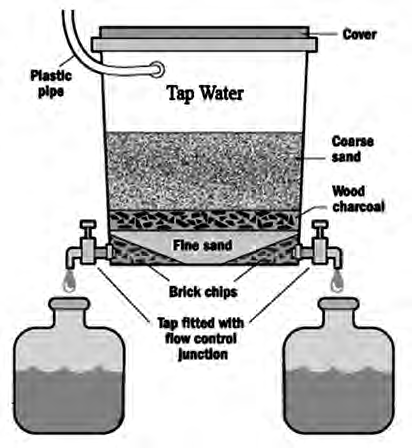
Water that looks clear is not necessarily fit to drink. Whether a school's drinking water is safe must be tested by the concerned authority.
Toilets
Human excreta is one of the things that pollute the environment around a school. When people relieve themselves anywhere in the open, many kinds of disease spread and the surroundings become polluted. That is why a school needs toilets even more than it needs classrooms. A class can be taught under a tree for a while, but without toilets the health of the whole school is at risk.
A good school toilet should meet these needs:
- Separate toilets for teachers, boys and girls.
- Toilets that suit children, suit girls, and can be used by people with disabilities. They must always be built so that a person with a disability can use them easily.
- Enough water and soap.
- Proper ventilation so that fresh air moves through.
- Sanitary pads for girls, and a safe place to dispose of used pads.
A clean toilet does a great deal to keep a school healthy. Building toilets is only half the job. Keeping them clean every day matters just as much.
Management of Solid Waste
Solid waste: waste such as bits of paper, plastic, cloth and wood thrown inside and outside the classrooms of a school.
Solid waste from a school must not be left scattered around. It is managed like this:
- Collect all the solid waste and keep it in one place.
- Burn waste such as paper in one corner of the school grounds.
- Do not burn pieces of plastic. Dig a pit and bury them instead.
- Bury fruit peels, leftover snacks, rotten fruit, weeds and fallen leaves from around the school in a pit as well.
Never burn plastic. The smoke from burning plastic pollutes the air. Plastic must be buried in a pit.
| Kind of waste | What is done with it |
| Bits of paper, cloth and wood | Collected in one place and burned in a corner of the school |
| Pieces of plastic | Not burned. Buried in a pit |
| Fruit peels, leftover snacks, rotten fruit | Buried in a pit |
| Weeds and fallen leaves | Buried in a pit |
If waste is not handled this way, it pollutes the area around the school. Flies and mosquitoes multiply, bad smells spread and the risk of disease rises. When solid waste is managed well, the school environment becomes healthy. It starts with each student: the habit of putting a sweet wrapper or a scrap of paper in the collection place, not on the floor.
The full lesson is waiting for you
The notes are free to read in full. A free account opens the rest of the practice, and tracks your progress and confidence score for every subject. Presentations and videos need approval from Learn Yeti.