What the Rules of Netball Do
Netball is a team game played between two teams on a rectangular court. Each team passes the ball from player to player until it reaches the ring at the opponents' end, and a player then shoots it through the ring to score. Nobody may run with the ball, touch it with a foot or push an opponent. So the whole game rests on quick, accurate passing and on every player staying in the right place.
The rules settle every question a match can raise: how big the court is, how long play lasts, how the game starts and restarts, how long a player may hold the ball, how points are scored and how players must behave. There are 17 of them. Alongside the rules, a player must also know the three parts of the court, the seven positions and the officials who control a match. Even in a school tournament, a match only runs smoothly when the players and the classmates watching all understand why the whistle blew.
The Court, the Time and the Players
- Rule 1: The netball court must be 30.5 metres long and 15.25 metres wide.
- Rule 2: A match lasts 60 minutes. It is played as a first half of 30 minutes and a second half of 30 minutes, with a 5 minute interval after the first half. The 60 minutes may also be divided into four quarters of 15 minutes each, with a 3 minute interval between them.
- Rule 3: Each team has 7 players on the court and 5 extra players.
The court's length is exactly twice its breadth. Its area is found by multiplying the two: \( 30.5 \times 15.25 = 465.125 \) square metres. As for time, a match played in two halves and a match played in four quarters both last 60 minutes of play, because \( 4 \times 15 = 60 \). The only difference is the rest: two halves have one 5 minute interval, while four quarters have a 3 minute break between each.
A team therefore has 12 players in all, but only 7 are on the court at any one time. The other 5 are the extra players who wait off the court, ready to take the place of a teammate who is tired or hurt.
Starting the Game: Toss and Centre Pass
- Rule 4: The game begins with a Centre Pass. Before the Centre Pass, the referee holds a toss, and the team that wins the toss chooses its side of the court.
- Rule 5: The Centre Pass at the start of the game, and the one after every goal, is taken from the centre circle.
Toss: the coin toss the referee holds before the game to decide which team chooses its side of the court.
Centre Pass: the pass made from the centre circle in the middle of the court that starts or restarts play.
Picture a match between two schools. The referee tosses a coin, and the team that wins picks the end it will play from. A player standing in the centre circle then passes the ball to a teammate, and play begins. Each time either team scores, play stops and begins again the same way, with a Centre Pass from the centre circle. The centre circle is where the game starts and where it restarts after every goal.
Rules for Holding the Ball
- Rule 6: When a player catches the ball, the foot that lands first may not be moved along, shifted, or lifted and hopped on.
- Rule 7: No player may hold the ball for more than 3 seconds.
In netball nobody runs with the ball. Wherever the first foot lands as the ball is caught, that foot stays there. The player can still step with the other foot and turn the body, which is called pivoting. Because of this rule, the player holding the ball cannot run forward, and the only way to move the ball up the court is to pass it.
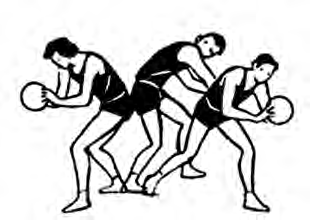
When looking for a better angle to pass, many players drag the landing foot a little or hop on it. That is a fault. Keep the first foot on the ground and use only the other foot to turn.
Three Second Rule: a player must pass or shoot within 3 seconds of catching the ball, and may not hold it any longer.
Three seconds is about as long as it takes to say "one thousand and one, one thousand and two, one thousand and three". In that short time the player must decide where the ball goes next. A good player looks for a free teammate before the ball even arrives. The rule keeps the game fast and stops any one player from keeping the ball to slow the match down.
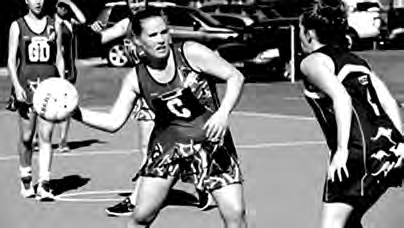
In netball the ball moves forward only by passing: nobody may run with it, hold it longer than 3 seconds or touch it with a foot.
Scoring and Restarting Play
- Rule 8: When a shot goes into the net, the team gets only 1 point.
- Rule 9: After a successful shot, the opposing team restarts play by passing the ball to a teammate from the centre circle.
- Rule 10: If the ball goes out of the court after touching a player, a player from the other team throws it in from outside to a teammate and play starts again.
Throw-in: throwing the ball back onto the court to a teammate from outside the line after it has gone out, to restart play.
Every successful shot in netball is worth the same: 1 point. However near or far the shooter stands, a ball that drops through the net adds just 1 point. After a goal, the ball goes to the other team, which restarts with a Centre Pass from the centre circle. This gives both teams a fair turn at attacking.
Who takes the throw-in depends on who touched the ball last before it went out. For example, if the ball bounces off a player from one school's team and crosses the side line, a player from the other school throws it in to a teammate. In other words, the team that sends the ball out loses it.
A Player's Area and Conduct
- Rule 11: No player of either team may go outside their own assigned area to play.
- Rule 12: No player may touch the ball with a foot.
- Rule 13: During play, no player may pull, push or hold an opponent. The team that commits the fault must give up the ball.
- Rule 14: A player blocking an opponent must stay 3 feet away from that opponent.
- Rule 15: No player may protest against the referee's decision. A player who does so may, depending on how serious the offence is, be sent off, or the other team may be given a throw-in.
Every netball player has a fixed area to play in, and playing outside it breaks the rules. This stops everyone crowding round the ball and spreads the game across the whole court. Which areas a player may enter depends on that player's position.
Netball is a no-contact game. A team that pulls, pushes or holds an opponent must hand the ball over as its penalty. Even when blocking, a player must keep 3 feet away: arms can be raised to get in the way, but bodies must not collide. The referee's decision is final. Arguing with it can get a player sent off or give the other team a throw-in, depending on how serious the offence is.
In a fast game, a push or a pull can send an opponent crashing onto a hard court and injure them. Always keep 3 feet away when blocking, and use only raised arms.
Winning, and Passing Through the Centre Third
- Rule 16: The team that scores the most points within the fixed time wins.
- Rule 17: The ball must be passed in the centre third before it can be taken into a goal third.
The result is decided by points: when the 60 minutes are over, the team with more points wins. Rule 17 controls how the ball travels. The court is split into three parts, a goal third at each end and a centre third in the middle. The ball may not be thrown straight from one goal third over to the other. It reaches a goal third only after a player has caught it in the centre third. This rewards short, accurate passes over long hopeful throws.
The Three Thirds of the Court
A netball court is divided into 3 sections: 2 goal thirds and 1 centre third. Two lines drawn across the court's width, the transverse lines, separate them. At the far end of each goal third is a half circle called the goal circle, also known as the Shooting Circle. In the exact middle of the centre third is the small centre circle where the Centre Pass is taken. The long edges of the court are the side lines, and the short edges are the goal lines.
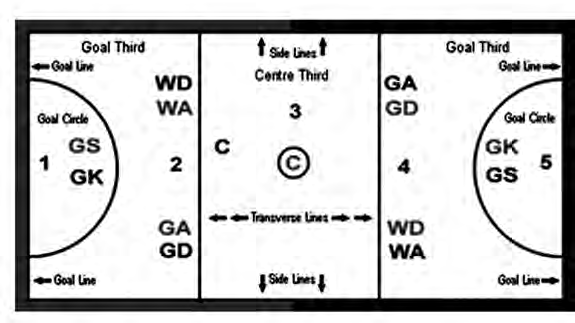
Goal third: the third of the court at each end, which holds the goal circle and the ring.
Centre third: the middle third of the court, between the two goal thirds, with the centre circle at its middle.
To say exactly where each player may go, the court is also numbered into five zones:
- Zone 1: the goal circle at one end
- Zone 2: the rest of that goal third, outside the goal circle
- Zone 3: the centre third
- Zone 4: the other goal third, outside its goal circle
- Zone 5: the goal circle at the other end
The Seven Positions and Their Zones
Each of the seven players on court has a fixed position. The position is printed as short letters on the player's bib: GS, GA, WA, C, WD, GD or GK. That way the referee and the spectators can tell at a glance which zones each player is allowed in.

For a team attacking the goal in zone 1, the seven positions may enter these zones:
| Position | Zones allowed |
| Goal Shooter (GS) | 1, 2 |
| Goal Attack (GA) | 1, 2, 3 |
| Wing Attack (WA) | 2, 3 |
| Centre (C) | 2, 3, 4 |
| Wing Defense (WD) | 3, 4 |
| Goal Defense (GD) | 3, 4, 5 |
| Goal Keeper (GK) | 4, 5 |
The table has a clear pattern. Only the attackers GS and GA may enter zone 1, the goal circle they shoot at. Only the defenders GD and GK may enter zone 5, the goal circle they protect. The Centre plays in zones 2, 3 and 4, everywhere except the two goal circles, so the Centre covers more ground than anyone. It also follows that only GS and GA can ever shoot, because only they can stand in the goal circle.
What Each Player Does
- Goal Shooter (GS): plays only in zones 1 and 2. Gets in front of the opposing GK, catches the ball and scores.
- Goal Attack (GA): plays in zones 1, 2 and 3. Also works to stop the ball the opponents are carrying forward.
- Wing Attack (WA): plays in zones 2 and 3. Marks and defends against the opposing WD.
- Centre (C): plays in zones 2, 3 and 4, but never in a Shooting Circle. Links the team's passing together.
- Wing Defense (WD): plays in zones 3 and 4. Tries to take the force out of the opponents' attack.
- Goal Defense (GD): plays in zones 3, 4 and 5. Blocks the opposing GA, stops the ball and snatches it away.
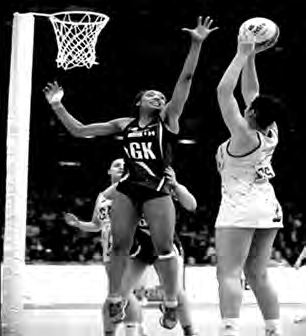
- Goal Keeper (GK): plays only in zones 4 and 5. Stops the opposing Goal Shooter from scoring.
On court the players face each other in pairs. One team's GS is marked by the other team's GK, GA by GD, WA by WD, and Centre by Centre. That is why GS and GK appear together in the same goal circle on the court plan. A team attacks and defends well only when all seven keep to both their job and their zones.
The Officials
A netball match is run by 6 officials in all: 2 umpires, 2 timekeepers and 2 scorers. The umpires apply the rules and give decisions on faults. The timekeepers watch the time of each half or quarter and each interval. The scorers record every point each team scores.
Officials: the people who run a match according to the rules, such as the umpires, timekeepers and scorers.
| Official | Number |
| Umpire | 2 |
| Timekeeper | 2 |
| Scorer | 2 |
| Total | 6 |
The full lesson is waiting for you
The notes are free to read in full. A free account opens the rest of the practice, and tracks your progress and confidence score for every subject. Presentations and videos need approval from Learn Yeti.