What Is Badminton?
Badminton is played either by one player on each side of a net or by two players on each side. The net hangs across the middle of the court and divides it into two halves. A player uses a racket to hit the shuttlecock over the net into the other half, and the opponent tries to hit it back. All of this happens inside a court marked out with lines, so badminton is a game played within a fixed area.
Badminton: a game played within a fixed area in which the shuttlecock is hit over the net with a racket.
A shuttlecock is very light. Sometimes it drops fast and sometimes it floats slowly through the air, so a player must rush forward, step back, bend low and jump, often within a second or two. To become skilled at badminton, a player needs four physical qualities:
- Physical agility: the energy to move quickly and react at once.
- Flexibility: a body that bends and stretches easily, so that even a far shot can be reached.
- Stability: the body and the arm stay steady at the moment of hitting.
- Balance: staying firmly on your feet while running, jumping and bending.
How Badminton Began and Grew
Badminton is believed to have started around 1820 to 1830 at a place called Pune in India. The word believed matters here: this is what most people accept, not something recorded on the day it happened. At first the game was played differently from place to place. Around 1877, organised rules for the game were made, so that everyone could play by the same rules.
Once the rules were fixed, the game kept spreading. In 1893 the Badminton Association of England was set up. In 1934 the IBF (International Badminton Association) was set up, and since then it has organised the World Cup badminton competition and many other tournaments. Badminton has also been included in the Olympic Games, and it has been part of the Asian Games since 1962.
| Year | What happened |
| Around 1820 to 1830 | The game is believed to have begun at Pune, India |
| Around 1877 | Organised rules for the game were made |
| 1893 | The Badminton Association of England was set up |
| 1934 | The IBF was set up |
| 1962 | Badminton was included in the Asian Games |
An easy way to hold the order: born in Pune, rules written, an association in England, the IBF for the whole world, then the Asian Games.
Badminton in Nepal
It is believed that Nepalis who served in the British army brought badminton to Nepal. They came to know the game while serving, and it came home with them. Today national-level competitions are held in Nepal from time to time, and Nepali players take part in various international competitions.
Requirements for Badminton Game
Five things are needed to play badminton. Each one has fixed measurements, so the game is the same wherever it is played.
- The playing court
- The net
- The posts
- The shuttlecock
- The racket
Measurements are given in feet and inches as well as in metres and centimetres. The number in brackets is the same length written in the other unit, not a second, different measurement.
1. The Playing Court
A badminton court needs two sets of measurements, because the singles game and the doubles game each have their own. Both sets of lines are marked on the same court.
Singles game: a game with one player on each side of the net.
Doubles game: a game with two players on each side of the net.
| Measurement | Singles | Doubles |
| Length | 44 ft (13.40 m) | 44 ft (13.40 m) |
| Width | 17 ft (5.18 m) | 20 ft (6.10 m) |
| Diagonal line | 14.366 m | 48.332 ft (14.723 m) |
Do not think the doubles court is longer. Both games use a length of 44 ft (13.40 m). Only the width changes: the doubles court is 3 ft wider than the singles court.
Reading the Lines of the Court
The drawing below shows the court from above. The dotted line across the middle is the net, with a post at each end. Every line has a name, and knowing them makes the drawing easy to read.
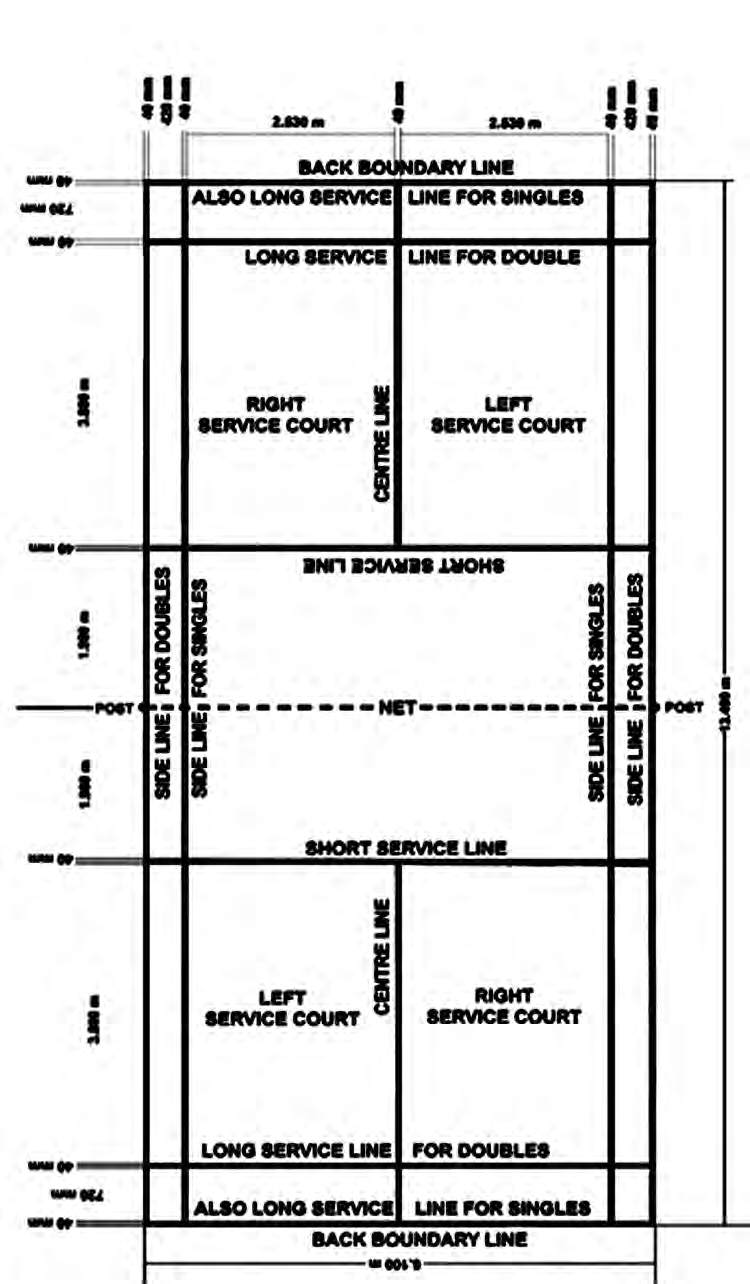
- Side lines: each long edge of the court has two. The inner one is for singles and the outer one is for doubles. The narrow strip between them is what makes the doubles court wider.
- Back boundary line: the last line at each end of the court. In singles it also works as the long service line.
- Long service line for doubles: a line drawn a little inside the back boundary line.
- Short service line: a line close to the net, on both sides of it.
- Centre line: the line running from the short service line to the back, which separates the right service court from the left service court.
The Diagonal Line
Diagonal line: the straight line from one corner of the court to the opposite corner.
When a court is marked out, the diagonal is measured to check that all four corners are right angles. If both diagonals are equal and match the given value, the court is a true rectangle. The diagonal comes from the length and the width:
\[ d = \sqrt{l^2 + b^2} \]
Here \( l \) is the length, \( b \) is the width and \( d \) is the diagonal. Checking it for the singles court:
Step 1: Squaring the length:
\[ 13.40^2 = 179.56 \]
Step 2: Squaring the width:
\[ 5.18^2 = 26.8324 \]
Step 3: Adding the two squares:
\[ 179.56 + 26.8324 = 206.3924 \]
Step 4: Taking the square root of the sum:
\[ \sqrt{206.3924} \approx 14.366 \text{ m} \]
This matches the singles diagonal of 14.366 m exactly. For the doubles court the same working gives \( \sqrt{13.40^2 + 6.10^2} \approx 14.723 \) m, which is 48.332 ft.
2. The Net
The net divides the court exactly in half. A badminton net must be dark in colour, so that the white shuttlecock stands out clearly against it. Its measurements must be:
| Measurement | In feet and inches | In metres or centimetres |
| Length | 20 ft | 6.10 m |
| Width, from top edge to bottom edge | 2 ft 6 in | 76 cm |
| Height at the centre | 5 ft | 1.524 m |
| Height at the post | 5 ft 1 in | 1.55 m |
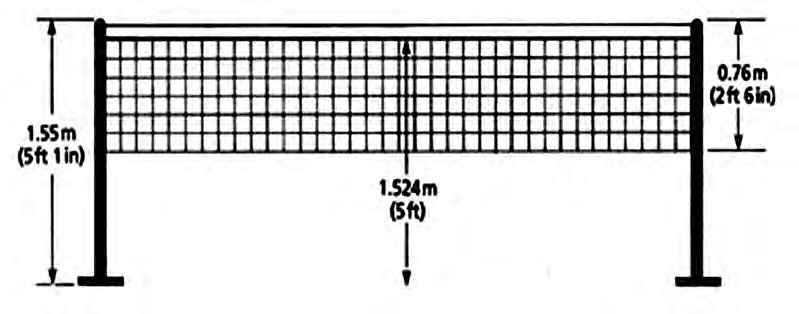
The net is 20 ft (6.10 m) long, exactly the width of the doubles court, so it stretches from one outer side line to the other.
The net is not the same height all along. It is 5 ft 1 in at the posts but sags slightly to 5 ft at the centre. Do not mix up the two heights.
3. The Posts
Posts hold the net up and keep it stretched from both ends. There must be 2 poles, each 5 ft 1 in (1.55 m) tall, one on each side of the middle line of the court, which is the line where the net hangs. In the court drawing the posts stand on the outer side lines of the doubles court.
The height of a post and the height of the net at the post are the same: 5 ft 1 in (1.55 m).
4. The Shuttlecock
Shuttlecock: the object hit with the racket in badminton, made of a rounded cork base with a flared skirt of feathers or plastic fixed into it. It is also written shuttle cork.
Shuttlecocks are of two kinds:
- Feather: real feathers are fixed into the cork.
- Plastic: a plastic skirt takes the place of the feathers.
A shuttlecock must meet these measurements:
| Measurement | Value |
| Weight | 4.74 to 5.50 g |
| Number of feathers | 14 to 16 |
| Length of each feather | 6.4 to 7 cm |
| Spread of the open top | 5.4 to 6.4 cm |
| Diameter of the cork | 2.5 to 2.8 cm |
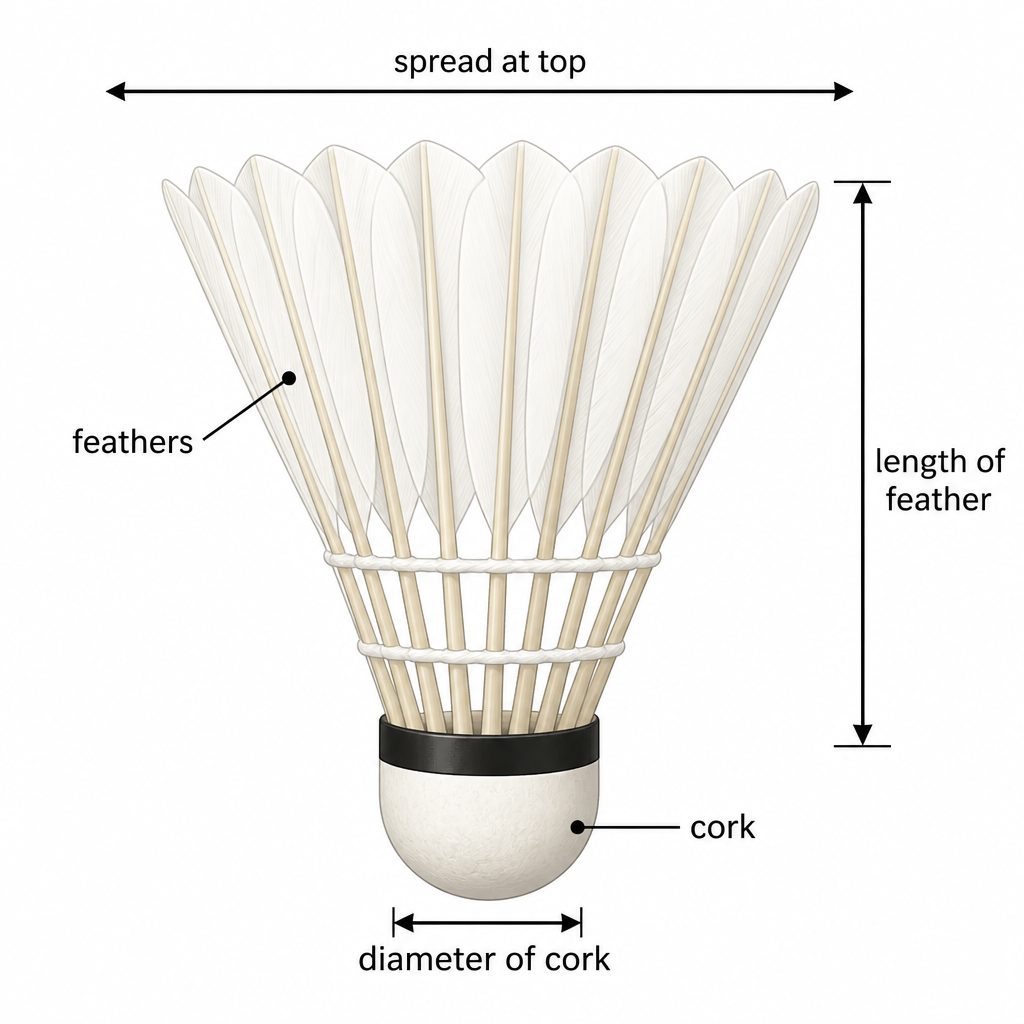
Do not mix up the three centimetre measurements. The cork diameter is the smallest (2.5 to 2.8 cm), the spread of the top is larger (5.4 to 6.4 cm) and the feather length is the longest (6.4 to 7 cm). The weight is in grams, not kilograms.
5. The Racket
The racket is what the shuttlecock is hit with. It must weigh 100 to 130 g. A light racket can be swung quickly, so a player can return even a fast shuttle in time. From top to bottom, a racket has these parts:
- Head: the rounded top part. Inside it is the stringed area, where the shuttle is struck.
- Throat: the point where the head joins the shaft.
- Shaft: the long thin rod joining the head to the handle.
- Handle: the part the player holds.
- Frame: the whole body of the racket from head to handle.
The full lesson is waiting for you
The notes are free to read in full. A free account opens the rest of the practice, and tracks your progress and confidence score for every subject. Presentations and videos need approval from Learn Yeti.