What Netball Is
Netball is a team game played between two sides. Players pass the ball to their own teammates, work it up the court, and then try to drop it through a ring that has a net hanging from it. Getting the ball through that ring is the whole aim of the game. Netball can be played both indoors and outdoors: in a roofed sports hall, or on an open school ground.
Netball: a game, played both indoors and outdoors, in which players score by putting the ball through a net.
Netball is a fast, quick and skilful team game. It is fast because the ball moves from one pair of hands to the next in a moment. It is quick because players must change direction sharply to find open space. It is skilful because catching, passing and shooting all take practice. No single player can win a match alone. The result depends on how well the whole team works together.
How Netball Began and Spread
Netball traces its beginning to James Naismith, who started the game in 1891. In its early years the game was played in different ways in different places. In 1960 the rules of netball were fixed. Once there was one set of rules, teams from any country could play each other in the same way.
As the game grew more popular, an international body was needed to introduce it to new regions and to develop it in an organised way. So in 1960, the same year the rules were fixed, the International Federation of Netball Association (IFNA) was founded. The first Netball World Cup was held in Britain in 1963, and the World Cup is now held once every four years. The game spread across Asia too, and in 1986 the Asian countries formed the Asian Netball Federation.
| Year | Event |
| 1891 | James Naismith starts the game |
| 1960 | The rules of netball are fixed |
| 1960 | IFNA is founded |
| 1963 | First Netball World Cup, held in Britain |
| 1986 | The Asian Netball Federation is formed |
Two big things happened in 1960: the rules were fixed and IFNA was founded. The World Cup came three years later, in 1963, and is now held every four years.
Netball in Nepal
In Nepal, netball has a short history. The Netball Association of Nepal (NAN) was set up under the National Sports Council in 2068 BS, the year counted in Nepal's own calendar. Having a national association gave the game an organised base to grow from inside the country.
Since then netball has been played regularly as a popular game in clubs, associations, schools and universities. It needs little equipment and one court can keep many students busy, so it is easy for a school to start.
Basic Requirements for the Netball Game
A netball match cannot start until a few things are ready. If the court is the wrong size, the ball the wrong size or weight, the number of players wrong, or there is no post to hold the net, the game cannot be played by the rules. Because these measurements are the same everywhere, a team that trains in Kathmandu can play just as comfortably on any court in the world. Netball has four basic requirements:
- a playing court
- a netball, the ball itself
- players
- a net support at each end
1. The Playing Court
A netball court is a rectangle. Its length is 30.5 m and its width is 15.25 m. Look closely at those two numbers: the length is exactly double the width, because \( 15.25 \times 2 = 30.5 \). Remember it that way and one measurement gives you the other.
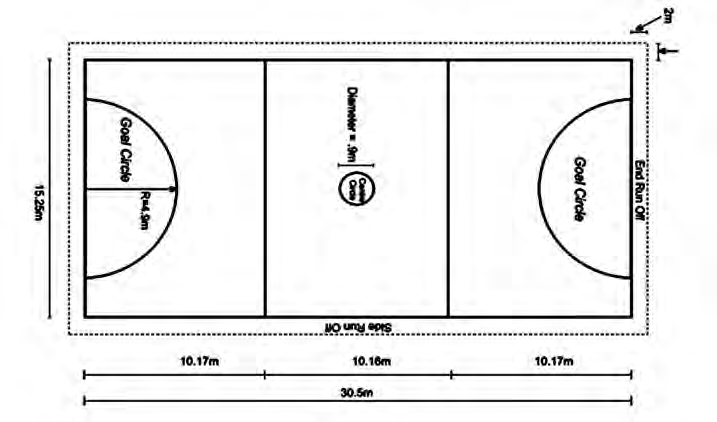
Study the court diagram and find each of these:
- Two lines drawn across the width split the court into three parts along its length. The two end parts are 10.17 m long and the middle part is 10.16 m long.
- Right at the centre of the middle part is a small centre circle with a diameter of 0.9 m.
- At each end, a semicircle of radius 4.9 m is drawn with its centre at the middle of the end line. This is the goal circle.
- A clear strip 2 m wide is left all round outside the court boundary, shown by the dotted line. The strip beyond the ends is marked End Run Off and the strip along the sides is marked Side Run Off.
Now check that the three parts really add up to the full length of the court.
Step 1: Writing the three lengths as one sum:
\[ 10.17 + 10.16 + 10.17 \]
Step 2: Adding the first two parts:
\[ 10.17 + 10.16 = 20.33 \]
Step 3: Adding the third part:
\[ 20.33 + 10.17 = 30.50 \]
The three parts together make exactly 30.5 m, the full length of the court. The sum works out because the middle part is 1 cm shorter than the two end parts.
2. The Ball
The ball used in netball is round, and both its size and its weight are fixed. Its circumference must be 27 to 28 inches and its weight 397 to 451 grams. A bigger or heavier ball would be harder to catch and to throw far. So in a competition every team uses a ball of the same size, and nobody gains an unfair advantage.
Circumference of a ball: the distance once all the way round the widest part of the ball.
To measure the circumference, wrap a measuring tape once round the middle of the ball. If the tape reads between 27 and 28 inches, the ball is the right size. To check the weight, put the ball on a scale; it should read somewhere from 397 to 451 grams.
The circumference is given in inches and the weight in grams. Writing "27 to 28 centimetres" in an answer makes it wrong. Always write the correct unit with the number.
3. Players
Netball is played between two teams. Each team must have 7 players on the court and 5 extra players. That makes 12 players in a team, but only 7 of them play on the court at any one time. The extra players wait ready beside the court.
Extra players (substitutes): the members of a team who are not among the 7 on court and who can come on to play in place of a court player when needed.
| On court | Extra | Total | |
| One team | 7 | 5 | 12 |
| Both teams | 14 | 10 | 24 |
A netball team is not just 7 players. With 7 on court and 5 extra, a team has 12. At any moment there are 14 players on the court, 7 from each side.
4. The Net Support
The net needs a strong support to hold it up above the court. So a pillar of iron or cement is set at the middle of each end line, one at each end, to carry the net. A court therefore has two pillars, and each one stands at the centre point of its goal circle.
Net support: the iron or cement pillar at the middle of each end line that holds up the ring and net.
A metal ring is fixed near the top of the pillar, and the net hangs down from the ring. A diagram of the post shows these measurements:
- The top of the ring is 3.05 m above the floor.
- The ring is 380 mm across and is made of 15 mm steel rod.
- The ring sticks out 150 mm from the post.
- The net is a steel mesh of about 20 mm, or a white cotton net.
- The post can be made of 65 mm galvanised pipe.
The post may be fixed into a socket in the ground, or it may stand on a metal base.
A metal base holding the post must never stick out onto the court. A running player could hit it, fall and be injured.
Requirements at a Glance
| Requirement | Fixed size or number |
| Playing court | Length 30.5 m, width 15.25 m |
| Ball | Circumference 27 to 28 inches, weight 397 to 451 g |
| Players | 7 on court and 5 extra in each team |
| Net support | One iron or cement pillar at the middle of each end line |
Words from This Lesson
- indoor and outdoor: inside a roofed hall, and out on open ground
- to start a game: to put it forward for the very first time
- association or federation: an organisation of members who share one purpose
- length: the measurement of the court's long side
- width: the measurement of the court's short side
- circumference: the distance all the way round a round object
- weight: how heavy an object is
- end line: the line along each short end of the court
- pillar: a strong upright post
- extra player: a team member kept ready to play in place of a court player
The full lesson is waiting for you
The notes are free to read in full. A free account opens the rest of the practice, and tracks your progress and confidence score for every subject. Presentations and videos need approval from Learn Yeti.