Life Develops from Simple to Complex
The millions of kinds of living things we see on Earth today were not always like this. Tiny organisms with a simple body plan appeared first, and step by step more and more complex organisms developed from them. The evidences of organic evolution are the facts from nature that support this claim, that living things developed gradually from simple forms to complex ones. From one ancient ancestor, branch after branch spread out into trees, insects, fish, frogs, reptiles, birds and mammals, all the way to human beings, and nature itself keeps the proof of this journey.
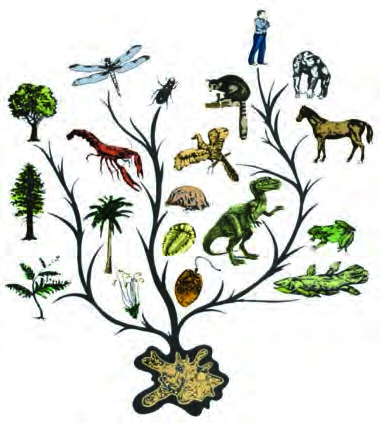
The main evidences of organic evolution are these:
- Evidence from fossils
- Evidence from comparative morphology and anatomy
- Evidence from vestigial organs
- Evidence from bridge animals
- Embryonic evidence
Evidence from Fossils
Parts, imprints or marks of animals and plants that died long ago are found preserved inside sedimentary rocks. These remains give direct information about organisms that lived hundreds of thousands of years ago, so evidence from fossils is regarded as the strongest basis of organic evolution.
A fossil is any part, imprint or mark of an animal or plant that died many years ago, found preserved in sedimentary rock.
Paleontology is the branch of science that studies fossils.
How a Fossil Forms
Fossils are found only in sedimentary rock, because sedimentary rock is the only rock that builds up layer by layer. A fossil forms like this:
- After an organism dies, streams and rivers carry its dead body away along with soil and sand.
- The body finally reaches a big lake or the sea and slowly settles down on the bottom.
- This process goes on continuously, so on the bed of the lake or sea one layer forms after another.
- After hundreds of thousands of years these layers harden into sedimentary rock.
- The soft parts and muscles of any organism trapped in a layer rot away, but bone and cellulose do not. These remain as imprints in the layers of the rock, and these imprints are the fossils.
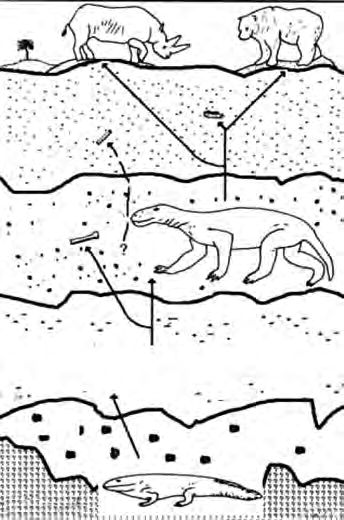
In the sedimentary rock formed this way, the lowest layer holds fossils of simple organisms such as algae, while the upper layers hold fossils of mammals. Since the lowest layer is the oldest and the upper layers are newer, this makes it clear that organisms developed step by step from simple structures towards complex ones. To find out how old a rock is, its age is determined by the carbon dating and uranium dating methods, and a fossil inside the rock is taken to be the same age as the rock. On this basis we can learn about organisms that existed hundreds of thousands of years ago.
Sedimentary rock is like the Earth's diary: the deeper the layer, the older the time and the simpler the organism. Seeing organisms grow more complex layer by layer is itself the proof of evolution.
Evidence from Comparative Morphology and Anatomy
Every animal and plant found in nature has its own kind of body structure. Even so, these organisms share certain common characters. This shows that they must have originated from the same ancestor. Comparing the structure of organs across different animals makes this even clearer.
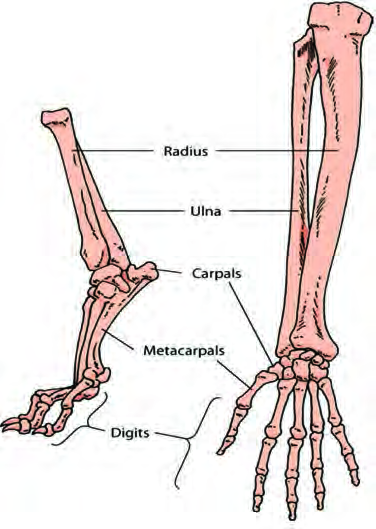
Homologous organs are organs that have the same embryonic origin but are used for different kinds of work.
For example, the bones found in the human hand, the foreleg of a horse, the wing of a bat and the flipper of a whale match one another closely. In the human hand and the horse's foreleg the bones come in the same order: Humerus, Radius, Ulna, Carpals, Metacarpals and Phalanges. Although the work each limb does is different, the plan and order of the bones are the same, which proves that these animals developed from an ancestral group.
Analogous organs are organs that have different embryonic origins but are used for the same kind of work.
For example, the wings of an insect, a bat and a bird are all used for flying, yet the internal structure of an insect's wing is quite different from that of a bird's or a bat's wing. This proves that birds, bats and insects have ancestors from different groups. Similar comparisons can be made with other organs too, so the study of homologous and analogous organs helps to confirm organic evolution.
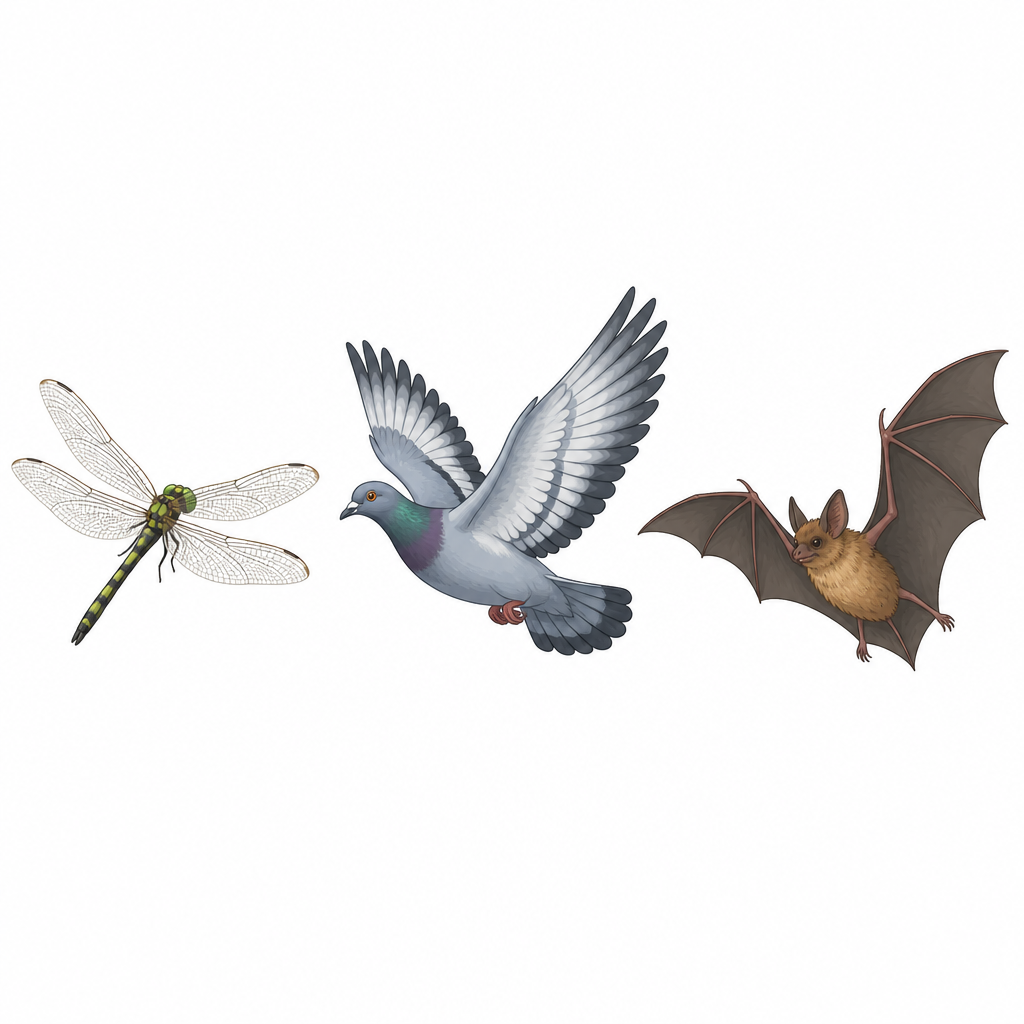
| Basis | Homologous organ | Analogous organ |
| Origin | Same | Different |
| Work | Different | Same |
| Example | Human hand, horse's foreleg, bat's wing | Wings of insect, bird and bat |
| What it proves | Ancestors from the same group | Ancestors from different groups |
Many students swap homologous and analogous organs in the exam. The way to remember: same origin means homologous, same work only means analogous. The bat's wing appears in both lists: compared with the human hand it is homologous, compared with the insect's wing it is analogous.
Evidence from Vestigial Organs
Our body has many organs. Some of them are no longer used, so they lie inactive in us, while the very same organs are developed and fully working in other animals.
Vestigial organs are organs that are no longer used, remain inactive, and stay in the body only as leftover samples.
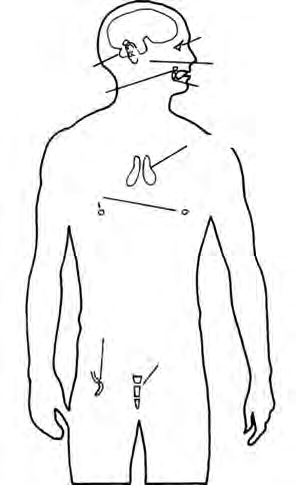
Such vestigial organs exist in different animals and plants. The human body itself carries several of them, for example:
- Canine teeth
- The tail vertebrae at the lower end of the backbone
- The muscles that could move the ears
- The vermiform appendix in the digestive system
- The remnant of the nictitating membrane in the eye
- The wisdom teeth, tonsils, thymus gland and pineal gland also remain as such leftover samples.
On the basis of these vestigial organs it can be said that the ancestors of human beings could crack hard fruits like walnuts with their teeth, had tails, were plant eaters and could move their ears. On this same basis, human beings are believed to have evolved from apes.
Evidence from Bridge Animals
Some animals show the characters of two different classes in one body. Animals like these join two rungs of the ladder of evolution and let us see the connection directly.
A bridge animal is an animal that carries the characters of a lower class and a higher class together and so joins the two classes.
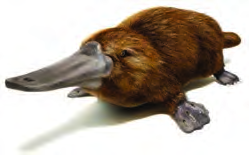
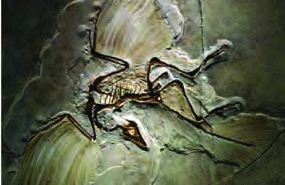
When the body of the duck billed platypus is studied, the characters of two classes of animals are found in it. Its bill is like a duck's, while its body is covered with fur like a mammal's. In the same way it lays eggs like a bird, yet suckles its young like a mammal. This makes it clear that mammals developed through the gradual evolution of birds.
In the same way, the study of the fossil of Archaeopteryx shows that birds developed after the gradual evolution of reptiles, and the study of Protopterus shows that amphibians developed through the gradual evolution of fish. The platypus, Archaeopteryx and Protopterus are all examples of bridge animals, joining a lower class to a higher class. This interconnection between two classes also proves the fact that more developed animals arose from less developed ones.
Embryonic Evidence
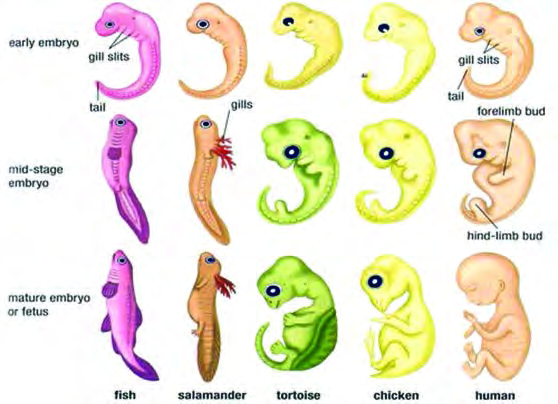
When the early stages of animals with backbones are studied, a striking similarity is found. The embryos of a fish, a salamander, a tortoise, a chicken and a human being are almost identical at the earliest stage: each one shows gill slits and a tail. Only as the embryos grow do differences begin to appear, and by maturity each animal takes its own form. Being so alike at the start can only mean that all these backboned animals must have developed from the same ancestor, and this too helps to confirm the theory of organic evolution.
The Five Evidences at a Glance
| Evidence | What is examined | What it proves |
| Fossils | Imprints and parts preserved in the layers of sedimentary rock | Simple organisms in the lowest layer, complex ones above, so development ran from simple to complex |
| Comparative morphology | The structure of organs across different animals | Animals with homologous organs share ancestors from one group |
| Vestigial organs | Organs lying inactive in the body | Human ancestors had tails, ate plants and could move their ears |
| Bridge animals | Animals carrying the characters of two classes | The higher class developed from the lower class |
| Embryonic evidence | The earliest embryos of backboned animals | All backboned animals share one ancestor |
The full lesson is waiting for you
The notes are free to read in full. A free account opens the rest of the practice, and tracks your progress and confidence score for every subject. Presentations and videos need approval from Learn Yeti.