Chemical Properties of Metals
You already know metals by what you can see and feel: they shine, most are hard, they ring when struck, and they carry heat and electricity well. These are physical properties. Testing them does not turn the metal into anything else. A chemical property is a different kind of property. It only shows itself when the metal reacts with another substance, and at the end of that reaction a new substance has been made.
Burning a strip of magnesium shows this clearly. The shiny grey ribbon flares up and disappears, and a soft white ash is left behind. That ash is not magnesium. Its colour, its texture and its behaviour are all different, so a new substance has formed. The fact that magnesium burns in air is therefore one of its chemical properties.
Chemical property: a property of a substance that shows only when it takes part in a chemical reaction and a new substance is formed.
Three chemical properties of metals matter most at this stage: how metals react with the oxygen in air, how they react with dilute acids, and how they react with water. Each of these reactions follows a fixed pattern. Once you know the pattern, you can predict the products for a metal even before you test it.
Active metal: a metal that reacts quickly and easily with other substances. Potassium, sodium, calcium and magnesium are active metals. Copper is far less active than these.
Metals and Oxygen: Basic Oxides
Most metals combine with the oxygen in air to make a metal oxide. Some do it slowly: an iron nail left in damp air gathers a reddish brown coating over days. Others do it fast: a magnesium ribbon held in a flame catches at once and burns with a dazzling white light.
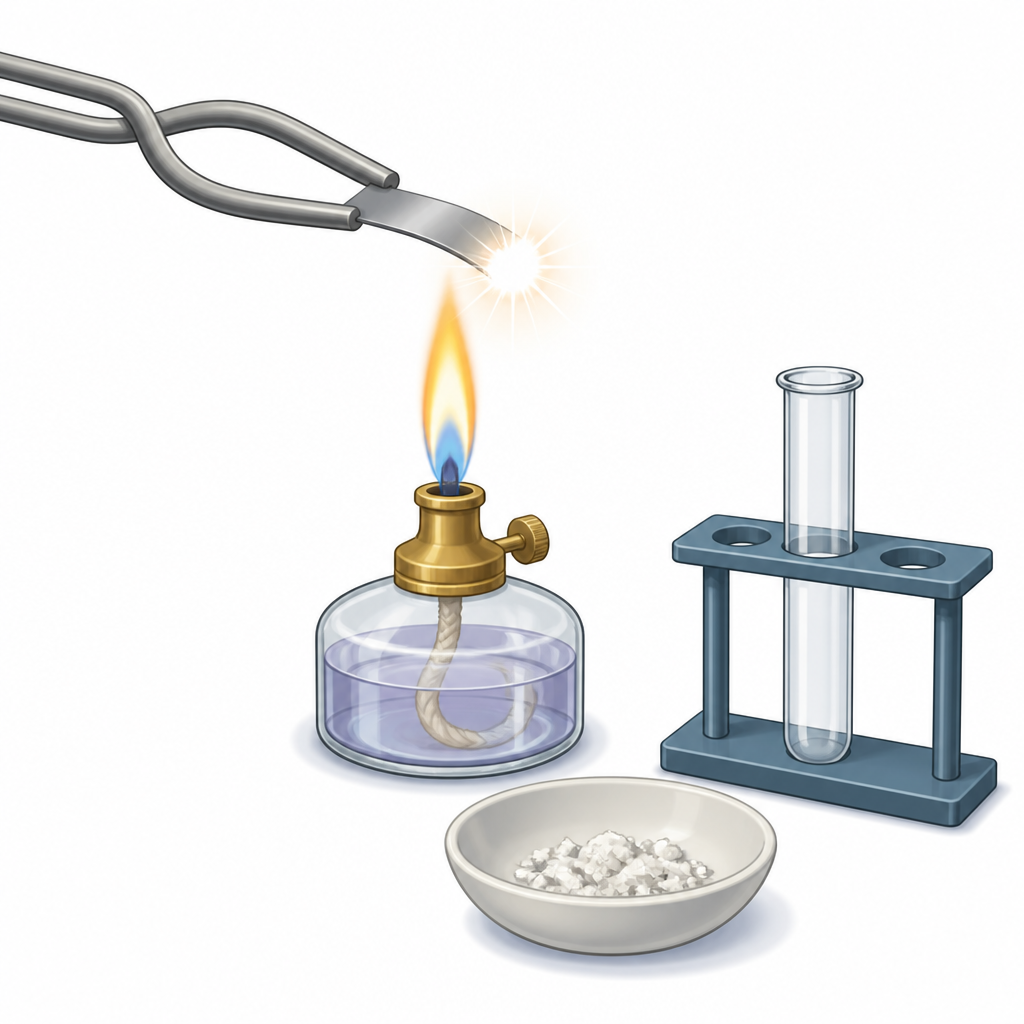
Always hold burning magnesium with tongs, never with your fingers. Its light is extremely bright, so do not stare straight at it.
If the white ash from burning magnesium is put in a test tube with a little water and shaken, a solution forms. Red litmus paper dipped in it turns blue, while blue litmus stays blue. A substance that turns red litmus blue is basic, so magnesium oxide is a basic oxide.
metal + oxygen → metal oxide (basic in nature)
Metal oxide: a compound made of a metal combined with oxygen, such as magnesium oxide, MgO.
Basic oxide: an oxide whose solution in water turns red litmus blue. Metal oxides are basic oxides.
Here are balanced equations for five metals reacting with oxygen. In every one, the number of each kind of atom on the left equals the number on the right.
\[ \begin{aligned} \mathrm{4Na + O_2} &\longrightarrow \mathrm{2Na_2O} \\ \mathrm{2Mg + O_2} &\longrightarrow \mathrm{2MgO} \\ \mathrm{4Al + 3O_2} &\longrightarrow \mathrm{2Al_2O_3} \\ \mathrm{4Fe + 3O_2} &\longrightarrow \mathrm{2Fe_2O_3} \\ \mathrm{2Cu + O_2} &\longrightarrow \mathrm{2CuO} \end{aligned} \]
| Metal | Oxide formed | Name of the oxide |
| Sodium (Na) | Na₂O | Sodium oxide |
| Magnesium (Mg) | MgO | Magnesium oxide |
| Aluminium (Al) | Al₂O₃ | Aluminium oxide |
| Iron (Fe) | Fe₂O₃ | Ferric oxide |
| Copper (Cu) | CuO | Copper oxide |
The equation \( \mathrm{2Mg + O_2 \longrightarrow 2MgO} \) reads like this: two atoms of magnesium combine with one molecule of oxygen to give two units of magnesium oxide. An oxygen molecule holds two atoms, so each of the two MgO units on the right gets one oxygen atom.
Metals and Dilute Acids: Salt and Hydrogen
An active metal placed in a dilute acid reacts with it. Drop a piece of magnesium ribbon into dilute hydrochloric acid in a test tube and tiny bubbles stream from its surface, the ribbon slowly gets smaller, and the tube feels warm. The gas coming off is hydrogen. What stays dissolved in the tube afterwards is a salt called magnesium chloride. Aluminium, iron and zinc react with dilute acids in the same way.
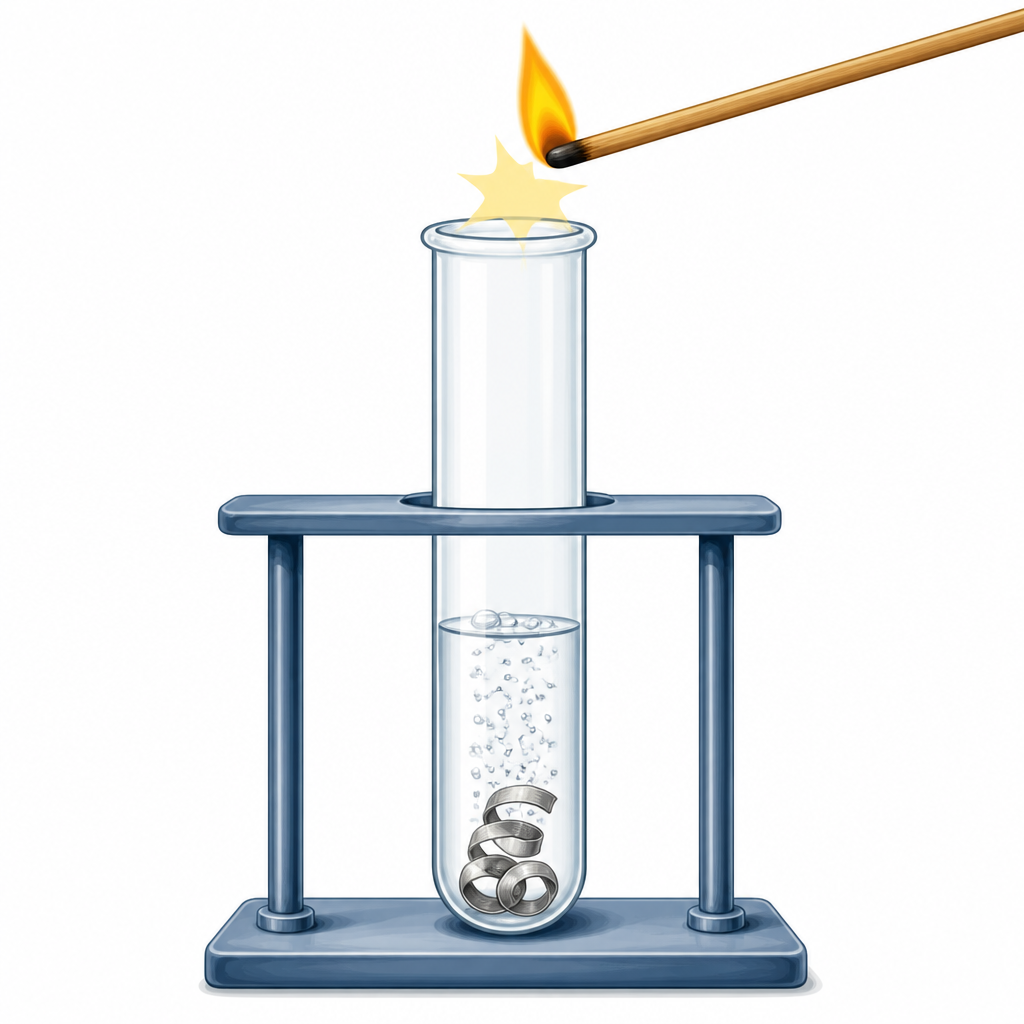
metal + dilute acid → salt of the metal + hydrogen gas
Salt: a compound formed when the hydrogen of an acid is replaced by a metal, such as magnesium chloride, MgCl₂, or zinc sulphate, ZnSO₄.
Hydrogen has a simple test. Bring a burning splint to the mouth of the test tube and the gas burns with a small squeaky pop. This happens because hydrogen is itself a gas that burns.
Even dilute acid must not touch your skin or eyes. Never point the mouth of the test tube at yourself or anyone else, and never taste an acid.
Equations for some metals reacting with dilute acids:
\[ \begin{aligned} \mathrm{Mg + 2HCl} &\longrightarrow \mathrm{MgCl_2 + H_2} \\ \mathrm{2Al + 6HCl} &\longrightarrow \mathrm{2AlCl_3 + 3H_2} \\ \mathrm{Fe + 2HCl} &\longrightarrow \mathrm{FeCl_2 + H_2} \\ \mathrm{Zn + H_2SO_4} &\longrightarrow \mathrm{ZnSO_4 + H_2} \\ \mathrm{Mg + 2HNO_3} &\longrightarrow \mathrm{Mg(NO_3)_2 + H_2} \end{aligned} \]
In every one of these the acid is dilute, and nitric acid gives hydrogen with magnesium only when it is very dilute. The acid used decides the second half of the salt's name:
- Hydrochloric acid, HCl, gives a chloride: magnesium chloride, aluminium chloride.
- Sulphuric acid, H₂SO₄, gives a sulphate: zinc sulphate.
- Nitric acid, HNO₃, gives a nitrate: magnesium nitrate.
Only active metals do this. A less active metal such as copper sits in dilute hydrochloric acid and no bubbles appear.
Metals and Water: Hydroxides and Hydrogen
The most active metals, lithium, sodium, potassium and calcium, react with plain water. They push hydrogen out of the water and take its place. The result is a metal hydroxide, and hydrogen gas bubbles off.
A small piece of sodium dropped into water floats, skims about the surface with a hissing sound, and is soon used up. Potassium is even more active and can burst into flame the moment it touches water. Calcium reacts more calmly, sending up a steady stream of bubbles. The water left behind turns red litmus blue, because the hydroxide formed is an alkali.
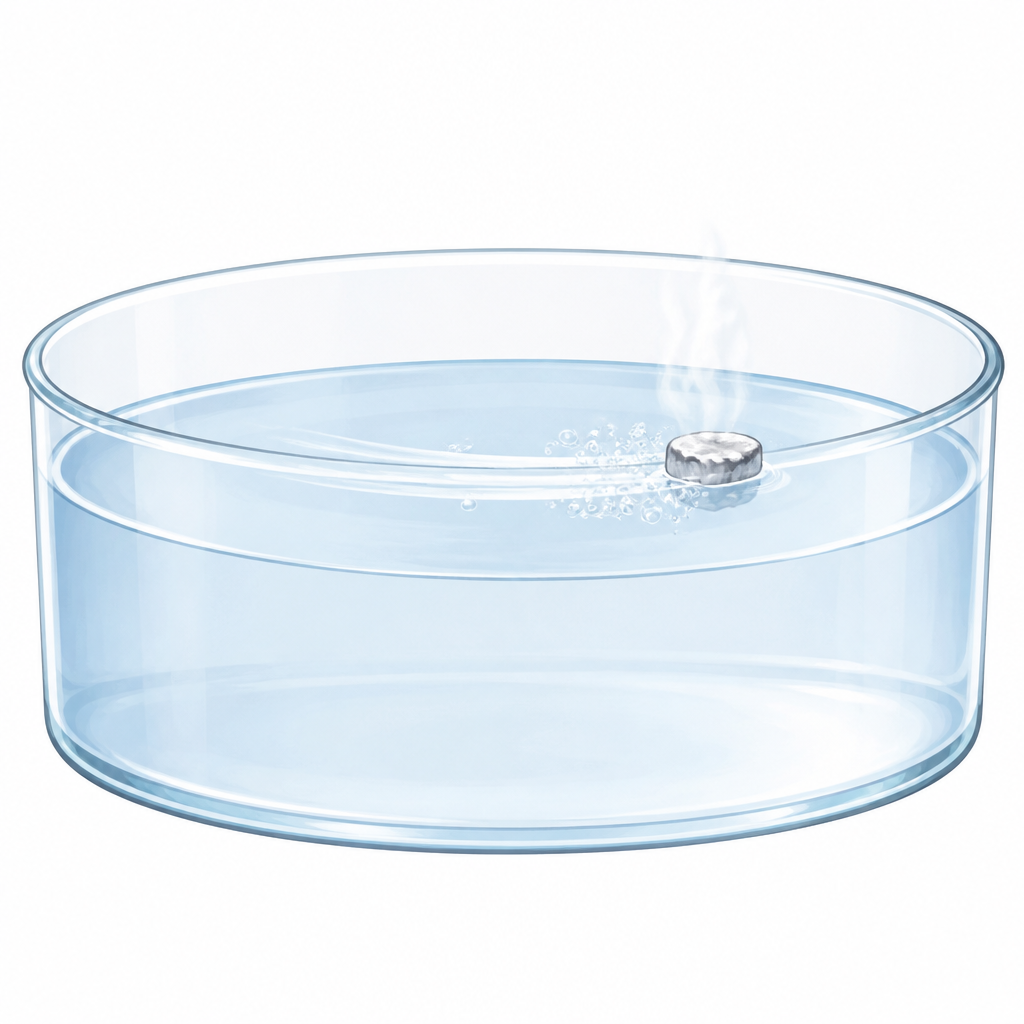
Sodium is so active that it can explode when put into water. Never touch active metals such as potassium and calcium with bare hands. Do this experiment only with a tiny piece and only while your teacher is watching.
active metal + water → metal hydroxide + hydrogen gas
\[ \begin{aligned} \mathrm{2Li + 2H_2O} &\longrightarrow \mathrm{2LiOH + H_2} \\ \mathrm{2Na + 2H_2O} &\longrightarrow \mathrm{2NaOH + H_2} \\ \mathrm{Ca + 2H_2O} &\longrightarrow \mathrm{Ca(OH)_2 + H_2} \\ \mathrm{2K + 2H_2O} &\longrightarrow \mathrm{2KOH + H_2} \end{aligned} \]
Metal hydroxide (alkali): a compound formed when an active metal reacts with water. It dissolves in water and turns red litmus blue. Examples are sodium hydroxide, NaOH, and potassium hydroxide, KOH.
Displacement: the process in which an active metal pushes hydrogen out of a compound and takes its place.
Differences Between Metals and Non-metals
Copper, iron and aluminium are metals. Coal, which is carbon, and sulphur are non-metals. The two groups behave almost like opposites, and the table sets them side by side point by point.
| No. | Property | Metals | Non-metals |
| 1. | Beaten into sheets | Can be hammered into thin sheets. | Cannot be hammered into sheets. |
| 2. | Drawn into wires | Can be drawn into long wires. | Cannot be drawn into wires. |
| 3. | Conducting electricity | Good conductors of electricity. | Poor conductors of electricity. |
| 4. | Conducting heat | Good conductors of heat. | Poor conductors of heat. |
| 5. | Melting and boiling points | Both are high. | Comparatively low. |
| 6. | Hardness | Mostly hard and cannot be crumbled. | Mostly soft and can be crumbled. |
Not every metal is hard. Sodium and potassium are metals, yet they are soft enough to cut with a knife. Diamond is a non-metal, yet it is the hardest substance known.
Metals and Non-metals in Chemical Reactions
Metals and non-metals differ in their reactions too. Carbon and sulphur also burn in oxygen to form oxides, but when these oxides dissolve in water the solution turns blue litmus red. So oxides of non-metals are acidic, while oxides of metals are basic.
\[ \begin{aligned} \mathrm{C + O_2} &\longrightarrow \mathrm{CO_2} \\ \mathrm{S + O_2} &\longrightarrow \mathrm{SO_2} \end{aligned} \]
| Reaction with | Metals | Non-metals |
| Oxygen | Form basic oxides. | Form acidic oxides. |
| Dilute acids | Active metals give a salt and hydrogen. | No hydrogen is given off. |
| Water | The most active metals give a hydroxide and hydrogen. | No hydrogen is given off. |
Both kinds of property help to sort an element into the right group. If you ever meet an unfamiliar element, testing whether its oxide is basic or acidic is one of the clearest clues you can get.
Words of This Topic
- Chemical property: a property seen only when a new substance forms.
- Active metal: a metal that reacts readily, such as sodium or potassium.
- Basic oxide: an oxide that turns red litmus blue in water.
- Salt: a compound in which a metal has replaced the hydrogen of an acid.
- Hydroxide (alkali): the base formed from an active metal and water.
- Displacement: a metal pushing hydrogen out and taking its place.
- Litmus paper: paper used to tell acids from bases.
The full lesson is waiting for you
The notes are free to read in full. A free account opens the rest of the practice, and tracks your progress and confidence score for every subject. Presentations and videos need approval from Learn Yeti.