Compounds Around Us
Look along a kitchen shelf and you will find many compounds: salt, sugar, water, cooking oil, baking soda, rice and the steel of a pot. Chemists sort this huge variety into two big groups. One pair of names for these groups is carbonic and non-carbonic compounds. The other, more common pair is organic and inorganic compounds. Both pairs describe the same division.
The division first came from where a compound is found. Compounds obtained from minerals, such as salt dug from rock or lime made from limestone, were called inorganic or non-carbonic compounds. Compounds obtained from plant and animal sources, such as sugar from sugarcane, oil from mustard seeds or ghee from milk, were called organic or carbonic compounds.
Inorganic compounds: Compounds obtained from minerals are called inorganic compounds or non-carbonic compounds.
Organic compounds: Compounds obtained from plant and animal sources are called organic compounds or carbonic compounds.
Every organic compound contains carbon. A few compounds that contain carbon are still treated as inorganic, though. So the rule chemists use is this: all the compounds of carbon, except its oxides, carbonates, bicarbonates and carbides, are organic compounds. Among the organic compounds, the simplest family is made of just two elements.
Hydrocarbons: The carbonic compounds composed of only carbon and hydrogen are called hydrocarbons.
The name tells you the recipe. "Hydro" stands for hydrogen and "carbon" for carbon, so a hydrocarbon contains those two elements and nothing else.
Things That Burn and Things That Do Not
A simple test with fire sorts common materials into two groups. Small amounts of wood pieces, sugar, stone, water, cooking oil, ghee, rice, maize, glass and iron pieces are collected. A wood fire is made in an open place, and the materials are put into it one at a time while someone watches what happens to each.
Sugar melts first, turns brown, then black, and catches fire. Oil and ghee burn with a bright flame. Rice and maize char and then burn. Wood keeps the fire going. Stone, glass and iron only get hot and never catch fire. Water does the opposite of burning and puts out part of the flame.
Combustible and non-combustible substances: A substance that burns in fire is a combustible substance. A substance that does not burn in fire is a non-combustible substance.
| Material | Does it burn? | Where it comes from |
| Wood | Burns | Trees (plant) |
| Sugar | Burns | Sugarcane (plant) |
| Cooking oil | Burns | Seeds such as mustard (plant) |
| Ghee | Burns | Milk (animal) |
| Rice and maize | Burn | Grain crops (plant) |
| Stone | Does not burn | Rock (mineral) |
| Glass | Does not burn | Sand (mineral) |
| Iron | Does not burn | Iron ore (mineral) |
| Water | Does not burn | Non-living natural source |
Now read the last column of the table. Every material that burned came from a plant or an animal. Every material that did not burn came from rock, a mineral or another non-living source. On this basis we conclude that combustible substances are organic and non-combustible substances are inorganic.
Do this test only with an adult present, in an open place away from houses, dry grass and drying clothes. Use tongs or a long stick to put materials into the fire, never your fingers. Stand back from burning oil and ghee, because they can spit. Keep sand nearby, and never pour water on burning oil.
The link between burning and being organic is a good guide for everyday materials, but it is not a perfect law. Carbon monoxide burns, yet it is one of the carbon compounds that are not counted as organic. Use the fire test to recognise common materials, and use the full definition when you must decide exactly.
Fuels of Everyday Life
The fire test also explains why we use certain materials as fuel. All combustible substances consist of carbon and hydrogen, and hydrocarbons are made of exactly these two elements. Think of the places where fire is used around you:
- Kerosene lamps are lit in villages where there is no hydroelectricity.
- Firewood is burnt to cook food in many homes.
- Spirit lamps are used in laboratories as a source of heat.
- Charcoal is burnt to heat and melt metals while making utensils.
All of these fuels contain carbon and hydrogen, and all of them come from plants and animals. Firewood and charcoal come from trees. Kerosene is made from petroleum, which formed deep underground over millions of years from the buried remains of ancient plants and animals. When such a fuel burns, its carbon and hydrogen combine with oxygen from the air and give out heat and light.
Organic compounds (by burning): Substances which are obtained from plants and animals and are combustible are called organic compounds.
Your own body is built largely from organic compounds. The protein, hormones, carbohydrates, fat, enzymes and protoplasm found in the human body are all organic compounds. That is where the word organic comes from: it means belonging to living organisms.
What Makes a Compound Organic
Source and burning make organic compounds easy to recognise, but chemists need a definition based on what is inside the molecule. That definition is about bonds. A carbon atom has four electrons in its outer shell. It completes its octet by sharing these electrons with other atoms, which forms covalent bonds. Carbon can share electrons with other carbon atoms to make long chains and rings, and it can share them with hydrogen atoms.
Organic compounds (by bonding): Generally, the compounds of carbon covalently bonded to other carbon atoms or hydrogen atoms are called organic compounds.
Carbon bonds with more than hydrogen. It can also form covalent bonds with oxygen, nitrogen, halogens such as chlorine and bromine, sulphur and phosphorus. So organic compounds are generally made of elements like carbon, hydrogen, oxygen, nitrogen, halogens, sulphur and phosphorus. Some organic compounds even contain a metal bonded to them. Chlorophyll, the green pigment of leaves, has a magnesium atom at its centre, and the haemoglobin in your blood contains iron.
Organic chemistry: The branch of chemistry which deals with the study of organic compounds is called organic chemistry or carbonic chemistry.
Carbon Compounds That Are Not Organic
Containing carbon does not automatically make a compound organic. The oxides of carbon, carbonates, bicarbonates and carbides all contain carbon atoms, yet they are counted as inorganic compounds. They behave like mineral compounds, and many of them are found in rocks and minerals.
| Group | Example | Formula |
| Oxide of carbon | Carbon dioxide | \( \text{CO}_2 \) |
| Oxide of carbon | Carbon monoxide | \( \text{CO} \) |
| Bicarbonate ion | Found in baking soda | \( \text{HCO}_3^- \) |
| Carbonate ion | Found in limestone and marble | \( \text{CO}_3^{2-} \) |
| Carbide | Calcium carbide | \( \text{CaC}_2 \) |
Because \( \text{HCO}_3^- \) contains both hydrogen and carbon, many students call it organic or even a hydrocarbon. It is neither. A bicarbonate is inorganic whatever elements it contains. When deciding whether a compound is organic, check the four exceptions first: oxides, carbonates, bicarbonates and carbides.
Examples of Organic Compounds
Organic compounds range from tiny molecules with one carbon atom to giant molecules with thousands of atoms. Here are some you will meet often:
- Methane: the main gas in biogas, with one carbon atom and four hydrogen atoms.
- Ethane: a gas found in natural gas.
- Ethene: a gas used to ripen fruit and to make plastics.
- Acetylene: a gas burnt in welding torches that join metals.
- Methanol: a poisonous alcohol used as a solvent.
- Chloroform: a liquid containing chlorine, once used to make patients unconscious.
- Urea: a nitrogen compound found in urine and used as a fertiliser.
- Insulin: a hormone that controls the amount of sugar in the blood.
- Protein: the building material of muscles, hair and skin.
- Oil: cooking oils pressed from seeds, and animal fats.
Methane, ethane, ethene and acetylene contain only carbon and hydrogen, so they are hydrocarbons. Methanol, chloroform, urea, insulin and protein contain other elements as well, so they are organic compounds but not hydrocarbons. Every hydrocarbon is an organic compound, but not every organic compound is a hydrocarbon.
Hydrocarbons
Hydrocarbons are the parent family of organic chemistry. Replace some of the hydrogen atoms of a hydrocarbon with other atoms and you get other organic compounds. For example, replacing three hydrogen atoms of methane, \( \text{CH}_4 \), with chlorine gives chloroform, \( \text{CHCl}_3 \). Replacing one hydrogen atom with an \( \text{OH} \) group gives methanol, \( \text{CH}_3\text{OH} \).
Petroleum is the main source of hydrocarbons. Crude petroleum pumped from underground is a mixture of many hydrocarbons, and it is separated into petrol, diesel, kerosene, cooking gas and other fuels. A cooking gas cylinder holds hydrocarbons such as propane and butane.
Hydrocarbons are classified into two groups on the basis of the type of bond between their carbon atoms:
- Saturated hydrocarbons: the carbon atoms are joined only by single covalent bonds.
- Unsaturated hydrocarbons: at least one double or triple covalent bond joins two carbon atoms.
Building a Model of a Hydrocarbon Molecule
A molecule is far too small to see, so a model helps you picture how its atoms are joined. In a ball-and-stick model, each ball is an atom and each stick is a covalent bond. Two rules decide the shape: a carbon atom always forms four bonds, and a hydrogen atom always forms one. In these models the bigger balls stand for carbon and the smaller balls for hydrogen.
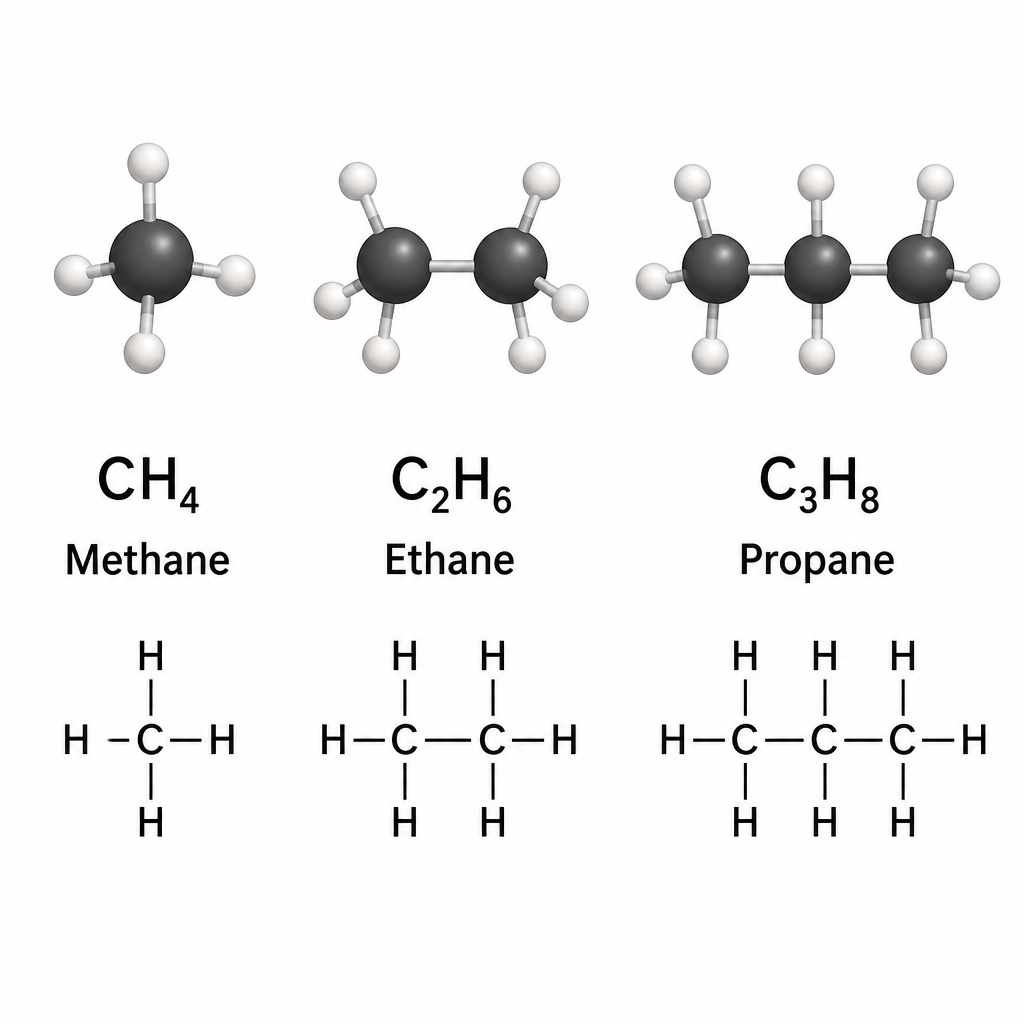
Methane, \( \text{CH}_4 \), has one carbon ball with a hydrogen ball on each of its four sticks. Ethane, \( \text{C}_2\text{H}_6 \), has two carbon balls joined by one stick. Each carbon uses its other three sticks for hydrogen, which gives six hydrogen atoms in all.
Propane, \( \text{C}_3\text{H}_8 \), has a chain of three carbon atoms. Each end carbon holds three hydrogen atoms, because only one of its sticks goes to another carbon. The middle carbon uses two sticks for its two carbon neighbours, so it holds only two hydrogen atoms. That makes \( 3 + 2 + 3 = 8 \) hydrogen atoms.
Under each model is its structural formula, in which each letter is an atom and each line is a bond. Count the sticks on any carbon in the models and you will always find four. Count the sticks on any hydrogen and you will always find one. If a model shows a carbon with only three sticks, or a hydrogen with two, it does not show a real molecule.
Carbon forms four bonds and hydrogen forms one. This single rule lets you build, or check, the model of any hydrocarbon.
The full lesson is waiting for you
The notes are free to read in full. A free account opens the rest of the practice, and tracks your progress and confidence score for every subject. Presentations and videos need approval from Learn Yeti.