Hydrocarbons and the Bonds Between Carbon Atoms
A hydrocarbon is a compound made of only two elements, carbon and hydrogen. The methane in natural gas, the propane and butane packed into a cooking gas cylinder, and the ethyne burned in a welding torch are all hydrocarbons. A carbon atom always forms four covalent bonds. In a hydrocarbon some of these bonds join carbon to hydrogen, and the rest join carbon to other carbon atoms.
Two carbon atoms can be joined in three ways. If they share one pair of electrons they form a single bond, \( \mathrm{C{-}C} \). If they share two pairs they form a double bond, \( \mathrm{C{=}C} \). If they share three pairs they form a triple bond, \( \mathrm{C{\equiv}C} \). The kind of bond between the carbon atoms decides which family a hydrocarbon belongs to and how easily it reacts.
Watch what happens to the hydrogen. In ethane each carbon uses one bond on the other carbon and three on hydrogen, so ethane has six hydrogen atoms. In ethene each carbon spends two bonds on the other carbon, leaving room for only two hydrogen atoms on each, four in all. In ethyne three bonds lie between the carbons, and just one hydrogen fits on each carbon. Every extra bond between the carbons costs two hydrogen atoms.
Saturated Hydrocarbons: The Alkanes
Saturated hydrocarbon: a hydrocarbon in which the carbon atoms are joined to each other by single covalent bonds only. Saturated hydrocarbons are also called alkanes.
Saturated means filled up. In an alkane every carbon atom already holds as many hydrogen atoms as its four bonds allow, so no more hydrogen can be added. Single bonds are strong and there is no spare bond for another substance to attack, so alkanes are very stable and react very little. That is why they are also known as paraffins, from Latin words meaning little affinity.
\[ \mathrm{C_nH_{2n+2}} \]
This is the general formula of the alkanes. Here n is the number of carbon atoms, and n = 1, 2, 3, 4 and so on. The number of hydrogen atoms is always two more than twice the number of carbon atoms.
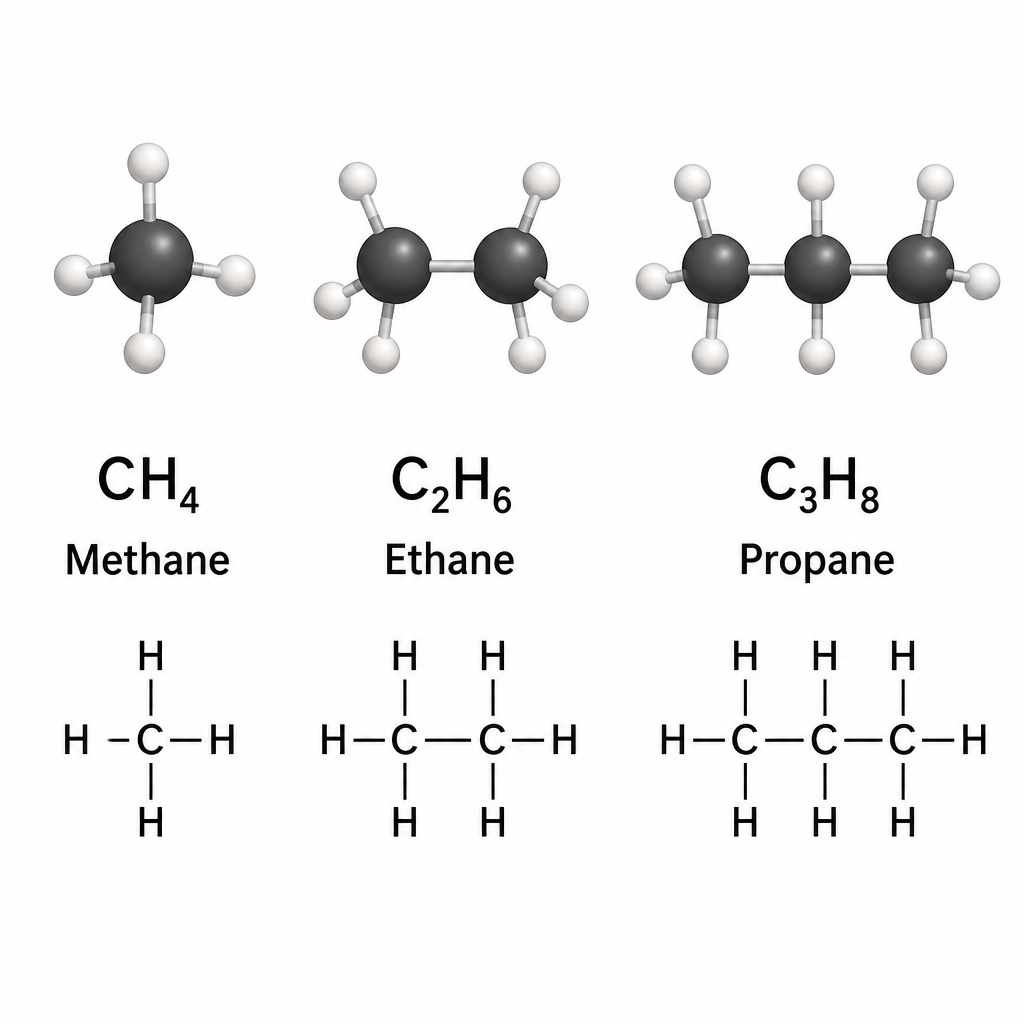
The First Five Alkanes
A hydrocarbon can be written in three ways, and each way shows something different:
- Molecular formula: only the number of each kind of atom, such as \( \mathrm{C_3H_8} \).
- Condensed formula: the atoms grouped carbon by carbon along the chain, such as \( \mathrm{H_3CCH_2CH_3} \), so you can see how the chain is built.
- Structural formula: a drawing that shows every atom, with every bond drawn as a line.
| Name | Molecular formula | Condensed formula |
| Methane | \( \mathrm{CH_4} \) | \( \mathrm{CH_4} \) |
| Ethane | \( \mathrm{C_2H_6} \) | \( \mathrm{H_3CCH_3} \) |
| Propane | \( \mathrm{C_3H_8} \) | \( \mathrm{H_3CCH_2CH_3} \) |
| Butane | \( \mathrm{C_4H_{10}} \) | \( \mathrm{H_3C(CH_2)_2CH_3} \) |
| Pentane | \( \mathrm{C_5H_{12}} \) | \( \mathrm{H_3C(CH_2)_3CH_3} \) |
Any row can be checked with the general formula. Butane has 4 carbon atoms, so it should have \( 2 \times 4 + 2 = 10 \) hydrogen atoms, and \( \mathrm{C_4H_{10}} \) has exactly 10. In the condensed formula, \( \mathrm{(CH_2)_2} \) means two \( \mathrm{CH_2} \) groups in a row in the middle of the chain.
Unsaturated Hydrocarbons
Unsaturated hydrocarbon: a hydrocarbon that has a double or triple covalent bond between its carbon atoms. Unsaturated hydrocarbons are of two kinds, alkenes and alkynes.
They are called unsaturated because they are not filled up with hydrogen. If one of the extra bonds in a double or triple bond opened, the carbon atoms there could hold more hydrogen. That extra bond is the weak point of the molecule. It opens easily when another substance reaches it, so unsaturated hydrocarbons are less stable and far more reactive than alkanes. They are known as olefins. The name comes from olefiant gas, an old name for ethene meaning oil-making gas, because ethene reacts with chlorine to give an oily liquid.
A double or triple bond needs two carbon atoms to sit between. So the smallest unsaturated hydrocarbon has two carbons, and there is no unsaturated hydrocarbon with only one carbon atom.
Alkenes: One Double Bond
Alkene: an unsaturated hydrocarbon that has a double covalent bond between two of its carbon atoms. Ethene, propene and butene are alkenes.
\[ \mathrm{C_nH_{2n}} \]
This is the general formula of the alkenes. Again n is the number of carbon atoms, but here it starts from 2. An alkene has exactly twice as many hydrogen atoms as carbon atoms. That is two fewer than the alkane with the same number of carbons, and those two missing hydrogen atoms are the price of the double bond.
| Name | Molecular formula | Condensed formula |
| Ethene | \( \mathrm{C_2H_4} \) | \( \mathrm{H_2C{=}CH_2} \) |
| Propene | \( \mathrm{C_3H_6} \) | \( \mathrm{H_3C{-}CH{=}CH_2} \) |
| Butene | \( \mathrm{C_4H_8} \) | \( \mathrm{H_3C{-}CH_2{-}CH{=}CH_2} \) |
Alkynes: One Triple Bond
Alkyne: an unsaturated hydrocarbon that has a triple covalent bond between two of its carbon atoms. Ethyne, propyne and butyne are alkynes.
\[ \mathrm{C_nH_{2n-2}} \]
This is the general formula of the alkynes, where n is the number of carbon atoms and starts from 2. A triple bond uses up one more bond on each of its two carbons than a double bond does, so an alkyne has four hydrogen atoms fewer than the alkane with the same number of carbons. Ethyne is better known as acetylene. It burns with a very hot flame and is used to cut and weld metals.
| Name | Molecular formula | Condensed formula |
| Ethyne | \( \mathrm{C_2H_2} \) | \( \mathrm{HC{\equiv}CH} \) |
| Propyne | \( \mathrm{C_3H_4} \) | \( \mathrm{H_3C{-}C{\equiv}CH} \) |
| Butyne | \( \mathrm{C_4H_6} \) | \( \mathrm{H_3C{-}CH_2{-}C{\equiv}CH} \) |
The three general formulas look alike and are easy to swap. Tie each one to its bond: single bonds only, \( \mathrm{C_nH_{2n+2}} \); a double bond, \( \mathrm{C_nH_{2n}} \); a triple bond, \( \mathrm{C_nH_{2n-2}} \). More bonds between the carbons always means fewer hydrogen atoms.
Reading a Name: Prefix and Ending
The name of a hydrocarbon tells you two things. The first part counts the carbon atoms, and the ending tells you the kind of bond.
| Prefix | Number of carbon atoms |
| meth | 1 |
| eth | 2 |
| prop | 3 |
| but | 4 |
| pent | 5 |
| Ending | Bond between carbons | Family |
| ane (ethane) | single | alkane |
| ene (ethene) | double | alkene |
| yne (ethyne) | triple | alkyne |
So propyne is prop, three carbons, with yne, a triple bond, which is \( \mathrm{C_3H_4} \). Butene is four carbons with a double bond, which is \( \mathrm{C_4H_8} \).
Using the General Formulas
Example 1: Find the molecular formula of the alkene that has 5 carbon atoms.
Step 1: Writing the general formula of the alkenes:
\[ \mathrm{C_nH_{2n}} \]
Step 2: Putting n = 5 into the number of hydrogen atoms:
\[ 2n = 2 \times 5 = 10 \]
Step 3: Writing the molecular formula with 5 carbons and 10 hydrogens:
\[ \mathrm{C_5H_{10}} \]
It has five carbons and a double bond, so its name is pentene.
Example 2: Find the molecular formula of the alkyne that has 5 carbon atoms.
Step 1: Writing the general formula of the alkynes:
\[ \mathrm{C_nH_{2n-2}} \]
Step 2: Putting n = 5 into the number of hydrogen atoms:
\[ 2n - 2 = 2 \times 5 - 2 = 8 \]
Step 3: Writing the molecular formula with 5 carbons and 8 hydrogens:
\[ \mathrm{C_5H_8} \]
This compound is pentyne.
Example 3: A hydrocarbon has the formula \( \mathrm{C_3H_4} \). Which family does it belong to?
Step 1: Counting the carbon atoms gives the value of n:
\[ n = 3 \]
Step 2: Working out the hydrogen an alkane with 3 carbons would have:
\[ 2 \times 3 + 2 = 8 \]
Step 3: Working out the hydrogen an alkene with 3 carbons would have:
\[ 2 \times 3 = 6 \]
Step 4: Working out the hydrogen an alkyne with 3 carbons would have:
\[ 2 \times 3 - 2 = 4 \]
The compound has 4 hydrogen atoms, and only the alkyne count matches. So \( \mathrm{C_3H_4} \) is an alkyne, and with three carbons it is propyne.
Hydrogenation: Changing Oil into Ghee
Hydrogenation: the process of adding hydrogen to an unsaturated compound so that it becomes saturated. Making Vanaspati ghee from vegetable oil is hydrogenation, and in it unsaturated fatty acids change into saturated fatty acids.
The extra bond of an alkene can open, so hydrogen can be added across it. When ethene and hydrogen are heated with a catalyst such as nickel, the double bond opens, each carbon takes one more hydrogen atom, and ethane is formed:
\[ \mathrm{H_2C{=}CH_2 + H_2 \rightarrow C_2H_6} \]
On the left is an alkene and on the right an alkane. Industry uses the same change on a large scale. Vegetable oils such as soybean and mustard oil contain unsaturated fatty acids, whose long carbon chains carry double bonds, and this keeps the oil liquid at room temperature. Hydrogen gas is bubbled through the warm oil with nickel as the catalyst. The double bonds take up hydrogen, the unsaturated fatty acids become saturated fatty acids, and the liquid oil sets into a soft solid, Vanaspati ghee.
Differences Between Saturated and Unsaturated Hydrocarbons
| Saturated hydrocarbon | Unsaturated hydrocarbon |
| Carbon atoms joined by single covalent bonds only | A double or triple covalent bond between carbon atoms |
| Stable, react very little | Less stable, chemically reactive |
| Also called alkanes, \( \mathrm{C_nH_{2n+2}} \) | Also called alkenes, \( \mathrm{C_nH_{2n}} \), and alkynes, \( \mathrm{C_nH_{2n-2}} \) |
| Known as paraffins | Known as olefins |
| Cannot take up more hydrogen | Take up hydrogen in hydrogenation |
| Examples: \( \mathrm{CH_4} \), \( \mathrm{C_2H_6} \), \( \mathrm{C_3H_8} \) | Examples: \( \mathrm{C_2H_4} \), \( \mathrm{C_2H_2} \), \( \mathrm{C_3H_4} \) |
Look at the bonds between the carbon atoms. Single bonds everywhere make a saturated alkane. One double bond makes an alkene. One triple bond makes an alkyne. Each extra bond between the carbons means two fewer hydrogen atoms and a more reactive molecule.
The full lesson is waiting for you
The notes are free to read in full. A free account opens the rest of the practice, and tracks your progress and confidence score for every subject. Presentations and videos need approval from Learn Yeti.