What People Mean by Alcohol
When people say 'alcohol' in everyday life, they almost always mean one particular compound. That compound is ethyl alcohol, whose formula is \( \mathrm{C_2H_5OH} \). Its other name is ethanol. It is a colourless liquid, and it dissolves in water.
In chemistry, however, the word alcohol names a whole family of compounds, and ethyl alcohol is only one member of it. Every member of the family carries the same small group of atoms, written -OH. This group is what makes a compound an alcohol, and once you can spot it, the rest of the topic follows from it.
How an Alcohol Is Made from an Alkane
Alcohols are produced from alkanes, the saturated hydrocarbons such as methane, ethane and propane. In an alkane molecule, carbon atoms are joined together and hydrogen atoms are attached all round them. Take away one of those hydrogen atoms and put an -OH group in its place, and the new compound is an alcohol. If more than one hydrogen atom is replaced by -OH groups, the compound is still an alcohol. It simply has more -OH groups.
Alcohol: a compound formed when one or more hydrogen atoms of an alkane are replaced by the hydroxyl group (-OH).
Hydroxyl group: the -OH group, made of one oxygen atom joined to one hydrogen atom. It is the functional group of alcohols, the group of atoms that gives every alcohol its shared chemical behaviour.
Here is the change worked through for the first two alkanes.
Step 1: Methane, the simplest alkane, has one carbon atom and four hydrogen atoms. Its molecular formula is:
\[ \mathrm{CH_4} \]
Step 2: Replacing one hydrogen atom with an -OH group leaves three hydrogen atoms on the carbon. The methyl alcohol formed has the formula:
\[ \mathrm{CH_4} \rightarrow \mathrm{CH_3OH} \]
Step 3: Doing the same to ethane, which has two carbon atoms, gives ethyl alcohol:
\[ \mathrm{C_2H_6} \rightarrow \mathrm{C_2H_5OH} \]
These two alcohols show a pattern. Methyl alcohol has 1 carbon and 3 hydrogens besides the -OH. Ethyl alcohol has 2 carbons and 5 hydrogens besides the -OH. In both, the number of hydrogen atoms on carbon is twice the number of carbon atoms, plus one. So the general formula of alcohols is:
\[ \mathrm{C_nH_{2n+1}OH} \]
Here n is the number of carbon atoms. Putting n = 1 gives \( \mathrm{CH_3OH} \), putting n = 2 gives \( \mathrm{C_2H_5OH} \), and putting n = 3 gives \( \mathrm{C_3H_7OH} \), which is propanol.
The general formula \( \mathrm{C_nH_{2n+1}OH} \) fits alcohols with a single -OH group. Glycol has two -OH groups and glycerol has three, so their formulas do not fit it. Count the -OH groups before you use the formula.
Monohydric, Dihydric and Trihydric Alcohols
Alcohols are sorted into three types by counting how many hydroxyl groups one molecule contains. The first part of each name is a number word: mono means one, di means two and tri means three. The '-hydric' ending points to the hydroxyl groups being counted.
Monohydric alcohol: an alcohol with only one hydroxyl group in its molecule. Examples: methyl alcohol and ethyl alcohol.
Dihydric alcohol: an alcohol with two hydroxyl groups in its molecule. Example: glycol.
Trihydric alcohol: an alcohol with three hydroxyl groups in its molecule. Example: glycerol.

| Type | Number of -OH groups | Example | Molecular formula |
| Monohydric | 1 | Methyl alcohol | \( \mathrm{CH_3OH} \) |
| Monohydric | 1 | Ethyl alcohol | \( \mathrm{C_2H_5OH} \) |
| Dihydric | 2 | Glycol | \( \mathrm{CH_2OHCH_2OH} \) |
| Trihydric | 3 | Glycerol | \( \mathrm{C_3H_5(OH)_3} \) |
Methyl Alcohol (Methanol)
Methyl alcohol is the simplest alcohol. It has one carbon atom and one hydroxyl group, so it is a monohydric alcohol. The name a compound gets under the international rules for naming compounds is its IUPAC name, and the IUPAC name of methyl alcohol is methanol. Its molecular formula is \( \mathrm{CH_3OH} \). In its structural formula the carbon atom sits in the middle, joined to three hydrogen atoms and one -OH group:
\[ \begin{array}{ccccc} & & \mathrm{H} & & \\ & & | & & \\ \mathrm{H} & - & \mathrm{C} & - & \mathrm{OH} \\ & & | & & \\ & & \mathrm{H} & & \end{array} \]
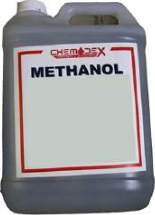
Methyl alcohol is used mostly in industry, as a solvent and as a starting material for making other substances. Its main uses are:
- To prepare methylated spirit.
- As a solvent for paints and varnishes.
- To prepare perfumes, paints, medicines and synthetic clothes.
- To manufacture formaldehyde.
- In dry cleaning.
Methyl alcohol is poisonous. Swallowing even a small amount can cause blindness or death. Never taste any alcohol kept in a laboratory, and never drink methylated spirit.
Ethyl Alcohol (Ethanol)
Ethyl alcohol has two carbon atoms and one hydroxyl group, so it is also a monohydric alcohol. Its IUPAC name is ethanol and its molecular formula is \( \mathrm{C_2H_5OH} \). This is the compound people mean when they say 'alcohol' in daily life. Its structure is ethane with one hydrogen atom replaced by -OH:
\[ \begin{array}{ccccccc} & & \mathrm{H} & & \mathrm{H} & & \\ & & | & & | & & \\ \mathrm{H} & - & \mathrm{C} & - & \mathrm{C} & - & \mathrm{OH} \\ & & | & & | & & \\ & & \mathrm{H} & & \mathrm{H} & & \end{array} \]
Ethyl alcohol kills germs, which is why hospitals use it on syringes and wounds. It also stops dead specimens from rotting, which is why laboratories keep specimens in it. Its main uses are:
- To prepare hard drinks such as whisky, wine and beer.
- To sterilise syringes and wounds in hospitals, health posts and nursing homes.
- To preserve biological specimens in laboratories.
- In thermometers.
- In the manufacture of polyethylene, terylene, soaps, paints, dyes and similar products.
- As an organic solvent.
Glycol (Ethane-1,2-diol)
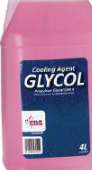
Glycol is a dihydric alcohol: its molecule carries two hydroxyl groups. The two groups are not on the same carbon. Each carbon atom holds one hydroxyl group. There are many different glycols, used in industry and in food stuff. The most common one is ethane diol, which is ethane with one hydrogen replaced by -OH on each of its two carbon atoms.
Its IUPAC name is ethane-1,2-diol. The numbers 1 and 2 tell you which carbon atoms carry the -OH groups, and 'diol' says there are two of them. Its molecular formula is \( \mathrm{CH_2OHCH_2OH} \) and its structural formula is:
\[ \begin{array}{ccccccc} & & \mathrm{H} & & \mathrm{H} & & \\ & & | & & | & & \\ \mathrm{H} & - & \mathrm{C} & - & \mathrm{C} & - & \mathrm{H} \\ & & | & & | & & \\ & & \mathrm{OH} & & \mathrm{OH} & & \end{array} \]
The two -OH groups of glycol sit on two different carbon atoms, one on each. A structure that puts both -OH groups on the same carbon is not glycol.
Glycerol (Propane-1,2,3-triol)
Start with propane, the alkane with three carbon atoms, \( \mathrm{C_3H_8} \). Replace three of its hydrogen atoms with three hydroxyl groups, one on each carbon, and the compound formed is glycerol. With three -OH groups it is a trihydric alcohol. It is also known as glycerine. Its name comes from a Greek word meaning sweet, because it tastes sweet.
Glycerol is a colourless, sweet and viscous liquid. Viscous means thick and slow-flowing, more like honey than water. It is soluble in water and in alcohol, but insoluble in ether.
Its IUPAC name is propane-1,2,3-triol: 'propane' for the three-carbon chain, '1,2,3' for the three carbons carrying -OH, and 'triol' for the three -OH groups. Its molecular formula is \( \mathrm{C_3H_5(OH)_3} \) and its structural formula is:
\[ \begin{array}{ccccccccc} & & \mathrm{H} & & \mathrm{H} & & \mathrm{H} & & \\ & & | & & | & & | & & \\ \mathrm{H} & - & \mathrm{C} & - & \mathrm{C} & - & \mathrm{C} & - & \mathrm{H} \\ & & | & & | & & | & & \\ & & \mathrm{OH} & & \mathrm{OH} & & \mathrm{OH} & & \end{array} \]
Glycerol holds on to moisture, and most of its uses come from that one property:
- To protect skin by trapping moisture and preventing its dryness.
- As a sweetening agent in food.
- To make good quality soap, lotion, cosmetics and shaving creams.
- To keep tobacco moist, and to stop fruits and foods from drying out and decaying.
The Four Alcohols Side by Side
| Alcohol | IUPAC name | -OH groups | Molecular formula |
| Methyl alcohol | Methanol | 1 | \( \mathrm{CH_3OH} \) |
| Ethyl alcohol | Ethanol | 1 | \( \mathrm{C_2H_5OH} \) |
| Glycol | Ethane-1,2-diol | 2 | \( \mathrm{CH_2OHCH_2OH} \) |
| Glycerol | Propane-1,2,3-triol | 3 | \( \mathrm{C_3H_5(OH)_3} \) |
Each alcohol also comes from a particular alkane. Methanol comes from methane, ethanol and glycol both come from ethane, and glycerol comes from propane. The first part of the IUPAC name points to that alkane.
To find the type of any alcohol, count its -OH groups: one makes it monohydric, two dihydric, three trihydric.
The full lesson is waiting for you
The notes are free to read in full. A free account opens the rest of the practice, and tracks your progress and confidence score for every subject. Presentations and videos need approval from Learn Yeti.