Where Ammonia Is Found
Ammonia is found in nature in two states: free and combined. In the free state it exists as a gas on its own. It is produced when substances that contain nitrogen, such as dead plants and animals, dung and urine, decay where there is no oxygen. The sharp smell near an uncleaned toilet or a heap of rotting dung is ammonia escaping into the air.
In the combined state, ammonia is locked up inside compounds. Ammonium chloride and ammonium sulphate are two such compounds. The scientist Lavoisier prepared this gas by heating a mixture of ammonium chloride and calcium hydroxide. School laboratories still make ammonia by the same reaction today.
Formula, Molecular Weight and Structure
| Symbol | Molecular weight |
| \( \mathrm{NH_3} \) | 17 |
One molecule of ammonia is made of one nitrogen atom joined to three hydrogen atoms, so its formula is \( \mathrm{NH_3} \). The atomic weight of nitrogen is 14 and that of hydrogen is 1. Adding them gives the molecular weight:
\[ 14 + 3 \times 1 = 17 \]
Nitrogen has five electrons in its outermost shell and needs three more to become stable. Each hydrogen atom has one electron and needs one more. So nitrogen shares one pair of electrons with each of the three hydrogen atoms, giving three shared pairs. Nitrogen's other two outer electrons are not shared with anyone. They stay on the nitrogen atom as a lone pair.
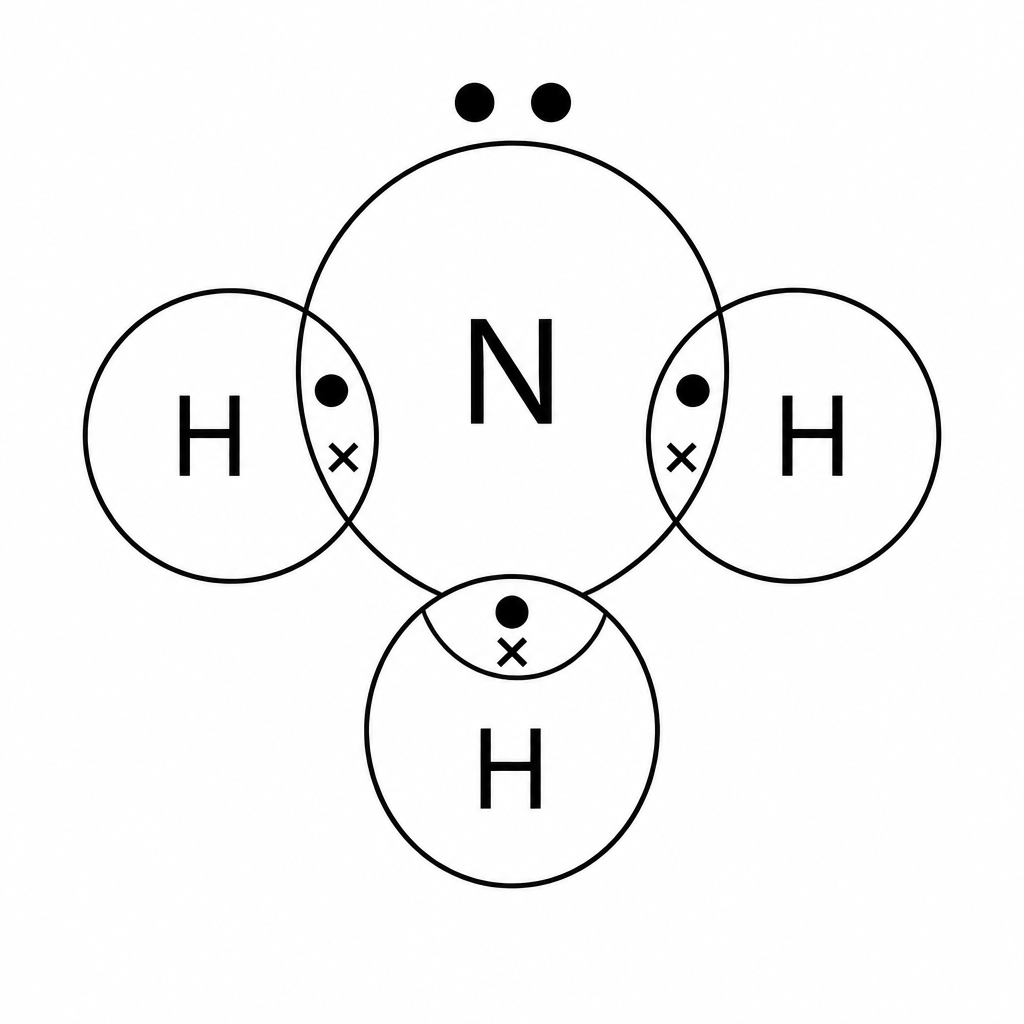
Why Ammonia Is Lighter than Air
Air is mostly nitrogen, with a molecular weight of 28, and oxygen, with a molecular weight of 32. It also holds a little carbon dioxide, with a molecular weight of 44. The molecular weight of ammonia is only 17, which is smaller than every one of these. A gas with a smaller molecular weight is lighter, so ammonia is lighter than air and rises when it is released.
| Gas | Molecular weight |
| Ammonia | 17 |
| Nitrogen | 28 |
| Oxygen | 32 |
| Carbon dioxide | 44 |
Because ammonia is lighter than air, the gas jar that collects it is held upside down. The gas rises into the jar and pushes the heavier air down and out.
Laboratory Preparation of Ammonia
In the laboratory, ammonia gas is prepared by heating a mixture of ammonium chloride and calcium hydroxide, in the ratio 2 : 1, in a hard glass test tube. The products are calcium chloride, water and ammonia gas.
Word equation: Ammonium chloride + Calcium hydroxide → Calcium chloride + Water + Ammonia
Balanced chemical equation:
\[ \begin{aligned} &\mathrm{2NH_4Cl(s) + Ca(OH)_2(s)} \\ &\rightarrow \mathrm{CaCl_2(s) + 2H_2O(l) + 2NH_3(g)} \end{aligned} \]
Apparatus required: hard glass test tube, source of heat, gas jar, stand, lime tower, delivery tube and rubber cork. Chemicals required: ammonium chloride and calcium hydroxide.
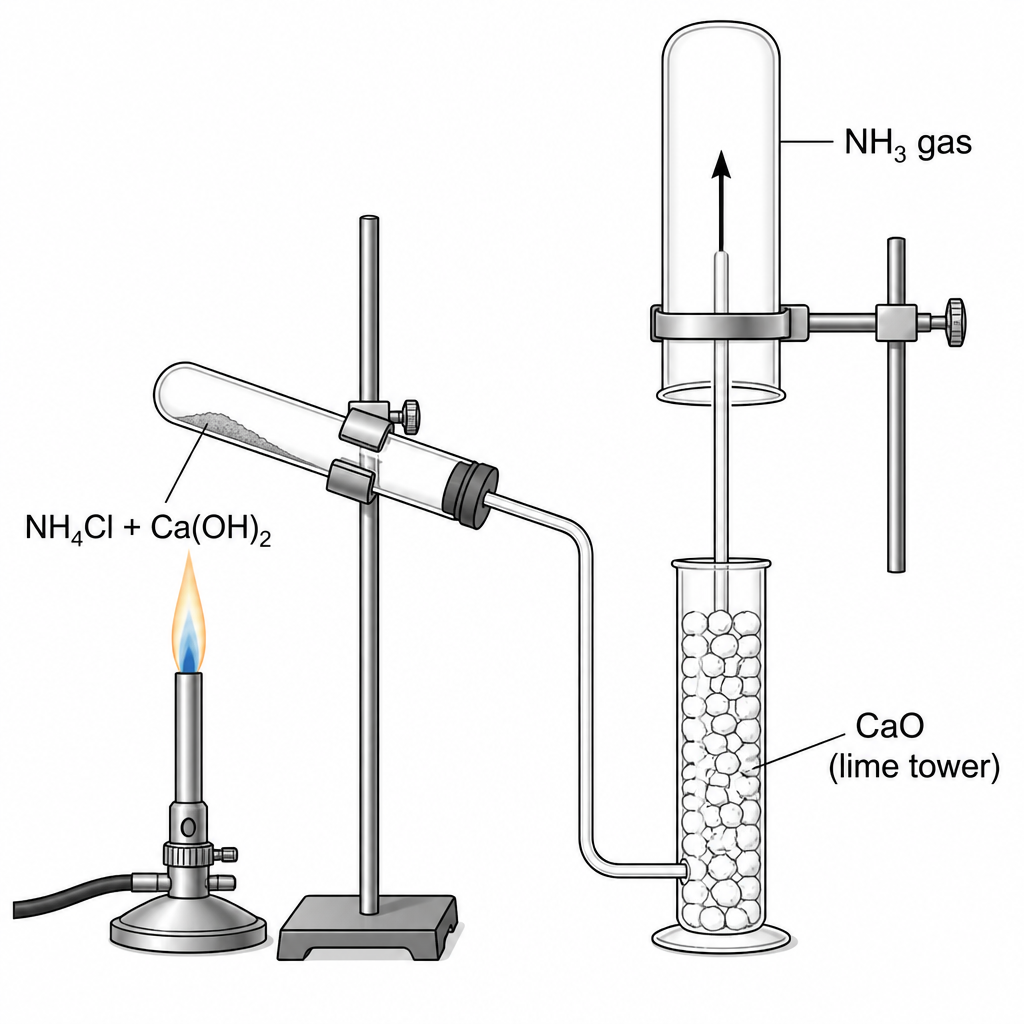
With the apparatus arranged as in the picture, the work is done in this order:
- Step 1: Collect the apparatus and chemicals needed to prepare ammonia gas.
- Step 2: Mix ammonium chloride and calcium hydroxide in the ratio 2 : 1 and put the mixture into the hard glass test tube.
- Step 3: Fit a delivery tube into the mouth of the test tube with a rubber cork so that it is airtight. Clamp the tube to the stand in a slightly tilted position.
- Step 4: Connect the other end of the delivery tube to the lime tower to obtain pure and dry ammonia. The experiment can be done without the lime tower, but the ammonia obtained is then impure.
- Step 5: Heat the mixture gently and observe the formation of ammonia gas.
- Step 6: Collect the gas coming out of the lime tower in an upside down gas jar by the downward displacement of air.
Lime tower: a tall glass tower packed with lumps of calcium oxide (quicklime). Calcium oxide absorbs moisture, so a gas passed through the tower comes out dry.
Calcium oxide absorbs moisture from ammonia. So when ammonia is passed through the lime tower, we get pure and dry ammonia.
Ammonia is highly soluble in water. If we tried to collect it over water, it would simply dissolve and be lost. So it is not collected by the displacement of water. Because it is lighter than air, it is collected by the downward displacement of air.
Downward displacement of air: a method of collecting a gas that is lighter than air. The gas jar is held upside down. The gas rises and fills the jar from the top, pushing the air inside down and out through the open mouth.
Precautions During the Preparation
- The mouth of the hard glass test tube should slope slightly downward. The water vapour formed in the reaction then passes through the delivery tube to the lime tower. It cannot run back onto the hot bottom of the tube, so the tube does not crack.
- The mouth of the test tube should be made airtight with the cork, so that no gas leaks out.
- To get dry ammonia, the gas should be passed through a lime tower. Since it is highly soluble in water, it should never be collected by the displacement of water.
Ammonia has a sharp, choking smell and stings the eyes and nose. Never put your nose over the mouth of the gas jar. If you must smell it, wave a little of the gas towards your nose with your hand.
Tests for Ammonia Gas
Two simple tests show whether a gas is ammonia.
- Red litmus test: hold a moist red litmus paper at the mouth of the gas jar. Ammonia is a basic gas, so the red litmus turns blue.
- Hydrochloric acid test: dip a glass rod in concentrated hydrochloric acid and bring it near the mouth of a gas jar containing ammonia. Dense white fumes come out.
The white fumes are countless tiny solid particles of ammonium chloride. They form when ammonia meets the hydrogen chloride given off by the acid:
\[ \mathrm{NH_3(g) + HCl(g) \rightarrow NH_4Cl(s)} \]
Physical Properties of Ammonia
- It is a colourless gas with a strong, pungent smell.
- It is lighter than air.
- It is highly soluble in water.
- It is a basic gas, so it turns moist red litmus blue.
- Ammonia liquefies at \( -33.4\,^\circ\mathrm{C} \) and solidifies at \( -78\,^\circ\mathrm{C} \).
A base turns red litmus blue. Turning blue litmus red is what an acid does. Ammonia is basic, so its test always uses red litmus, and the paper must be moist.
Chemical Properties of Ammonia
1. With water: ammonia dissolves in water and forms ammonium hydroxide.
\[ \mathrm{NH_3(g) + H_2O(l) \rightarrow NH_4OH(aq)} \]
Ammonium hydroxide: the solution formed when ammonia dissolves in water. It is also called ammonia solution, and it is basic.
2. With acids: ammonia reacts with acids to form ammonium salts. With hydrochloric acid it forms ammonium chloride:
\[ \mathrm{NH_3(g) + HCl(aq) \rightarrow NH_4Cl(aq)} \]
With sulphuric acid it forms ammonium sulphate:
\[ \begin{aligned} &\mathrm{2NH_3(g) + H_2SO_4(aq)} \\ &\rightarrow \mathrm{(NH_4)_2SO_4(aq)} \end{aligned} \]
Ammonium salt: a salt containing the ammonium group, \( \mathrm{NH_4} \), such as ammonium chloride and ammonium sulphate. It forms when ammonia or ammonia solution reacts with an acid.
3. Ammonia solution with acids: ammonium hydroxide is a base, so it reacts with an acid to form a salt and water. With sulphuric acid:
\[ \begin{aligned} &\mathrm{2NH_4OH(aq) + H_2SO_4(aq)} \\ &\rightarrow \mathrm{(NH_4)_2SO_4(aq) + 2H_2O(l)} \end{aligned} \]
With hydrochloric acid:
\[ \begin{aligned} &\mathrm{NH_4OH(aq) + HCl(aq)} \\ &\rightarrow \mathrm{NH_4Cl(aq) + H_2O(l)} \end{aligned} \]
4. With carbon dioxide: at a high temperature of 1500 °C and at high pressure, ammonia and carbon dioxide react to form urea. Urea is an important chemical fertiliser.
\[ \begin{aligned} &\mathrm{2NH_3(g) + CO_2(g)} \\ &\xrightarrow[\text{pressure}]{1500\,^\circ\mathrm{C}} \mathrm{NH_2\text{-}CO\text{-}NH_2(s) + H_2O(l)} \end{aligned} \]
5. Burning in oxygen: when ammonia burns in an atmosphere of oxygen, it produces nitrogen gas and water.
\[ \begin{aligned} &\mathrm{4NH_3(g) + 3O_2(g)} \\ &\rightarrow \mathrm{6H_2O(l) + 2N_2(g)} \end{aligned} \]
6. With oxygen over platinum: when a mixture of ammonia and oxygen is passed over platinum gauze at about 800 °C, nitric oxide is produced. The platinum speeds up the reaction without being used up.
\[ \begin{aligned} &\mathrm{4NH_3(g) + 5O_2(g)} \\ &\xrightarrow[\mathrm{Pt}]{800\,^\circ\mathrm{C}} \mathrm{6H_2O(l) + 4NO(g)} \end{aligned} \]
7. With molten sodium: when ammonia is passed over molten sodium, it forms sodamide and hydrogen gas.
\[ \begin{aligned} &\mathrm{2NH_3(g) + 2Na(s)} \\ &\rightarrow \mathrm{2NaNH_2(s) + H_2(g)} \end{aligned} \]
Uses of Ammonia
- To make fertilisers such as ammonium sulphate, ammonium nitrate, urea and ammonium phosphate.
- In the manufacture of nitric acid, plastics and similar products.
- To make washing soda.
- To make medicines that contain ammonium salts.
- To make blueprints of maps.
- As a cooling agent in refrigerators.
- As a cleansing agent to remove stains of oil, grease and the like.
The Fountain Experiment
A striking experiment shows just how soluble ammonia is in water. A round bottomed flask is filled with dry ammonia and closed tightly with a rubber cork. A long glass tube passes through the cork, and its lower end dips into a beaker of water to which a few drops of phenolphthalein have been added. A syringe or dropper holding a little water is also fitted into the cork.
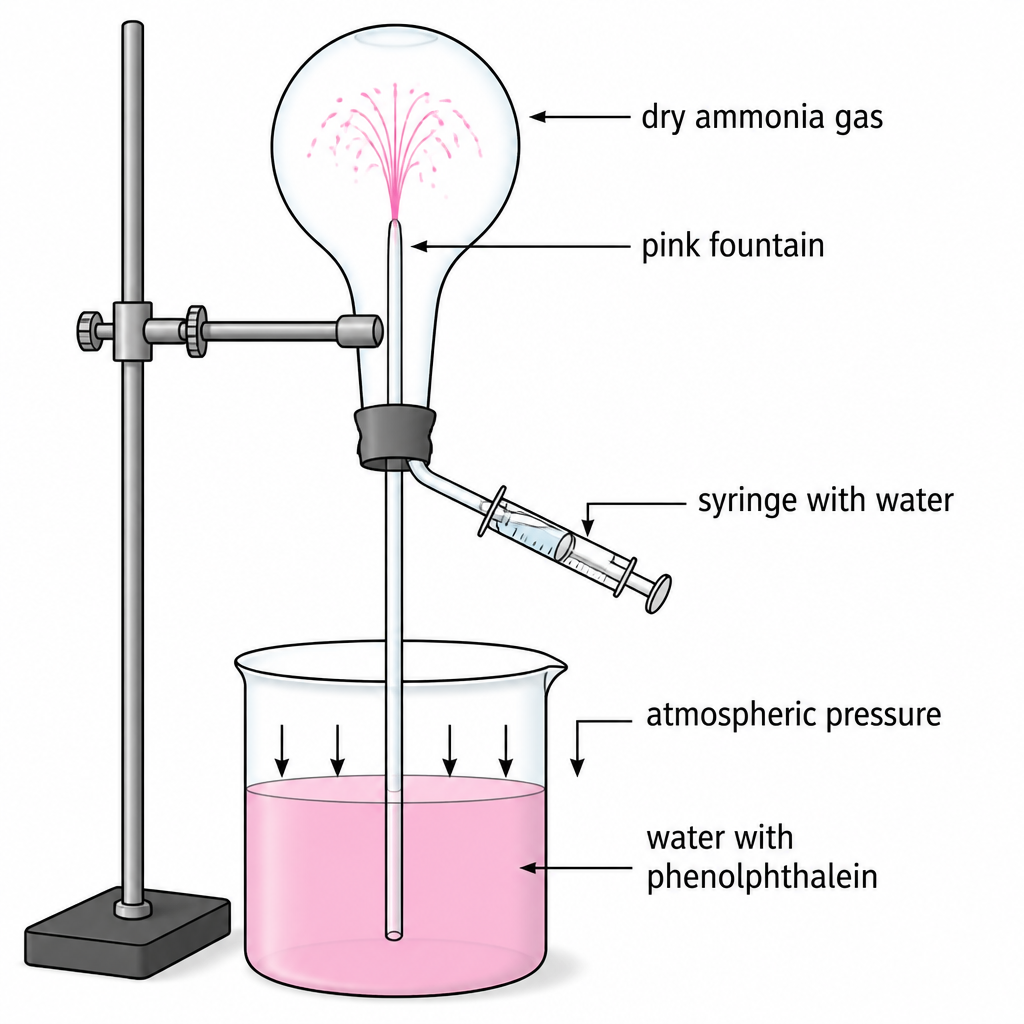
A few drops of water are squeezed from the syringe into the flask. Those few drops dissolve most of the ammonia inside. With the gas gone, a partial vacuum forms and the pressure inside the flask becomes much lower than the atmospheric pressure outside. The air outside presses down on the water in the beaker and forces it up the tube, and the water sprays into the flask like a fountain.
Phenolphthalein is colourless in plain water. When ammonia dissolves in water it forms ammonium hydroxide, which is basic, and phenolphthalein turns pink in a base. So the fountain turns pink. The experiment proves that ammonia is highly soluble in water and that its solution is basic.
A bottle of liquid ammonia should be placed in cold water or ice before its lid is opened. The pressure inside is high, and if the bottle is not cooled first, ammonia solution may spill out when the lid is removed.
The full lesson is waiting for you
The notes are free to read in full. A free account opens the rest of the practice, and tracks your progress and confidence score for every subject. Presentations and videos need approval from Learn Yeti.