Where Carbon Dioxide Comes From
Every so often there is news of people who climbed down to clean a deep well and never came back up. People who go deep into caves often find it hard to breathe. Both dangers have the same cause: a gas that has collected where fresh air cannot reach. That gas is carbon dioxide, the same gas you breathe out every few seconds.
Carbon dioxide forms whenever a substance containing carbon burns in air. Coal, wood, kerosene, fat, oil and wax all give it out as they burn, and the gas mixes into the air. Living things make it too. Plants and animals release it during respiration, volcanoes throw it out when they erupt, and dead organic matter gives it off as it decays. Together these sources keep about 0.03% of atmospheric air, by volume, as carbon dioxide.
Some of these sources are natural and some come from human activity. Burning fuel in vehicles, factories and kitchens, and cutting down forests, are the artificial sources that keep adding carbon dioxide to the atmosphere. Deforestation adds to the problem in a second way, because the trees that were cut would have taken carbon dioxide in.
| Source | Type |
| Respiration of plants and animals | Natural |
| Volcanic eruption | Natural |
| Decay of organic matter | Natural |
| Burning of fuel | Artificial |
| Deforestation | Artificial |
Carbon dioxide is about 1.5 times heavier than air. In a deep well or a cave it sinks and settles at the bottom, pushing the lighter air, and the oxygen in it, up and out. The gas itself is not poisonous, but a person who climbs down into it is breathing a gas with too little oxygen, and suffocates.
The Discovery of Carbon Dioxide
Carbon dioxide was known long before anyone could say what it was made of. Three scientists moved the story forward, one step each.
- 1630 AD: Van Helmont discovered carbon dioxide by burning wood.
- 1755 AD: Joseph Black prepared the gas by burning magnesium carbonate.
- Later, Lavoisier proved that carbon dioxide is a compound of carbon and oxygen.
Carbon Dioxide at a Glance
| Symbol | Molecular weight |
| \( \mathrm{CO_2} \) | 44 |
One molecule of carbon dioxide has one carbon atom joined to two oxygen atoms. Its molecular weight is found by adding the atomic weights. Carbon is 12 and each oxygen is 16, so:
\[ 12 + 2 \times 16 = 44 \]
A carbon atom has four electrons in its outer shell and needs four more. Each oxygen atom has six and needs two more. So carbon shares two pairs of electrons with each oxygen. Two shared pairs make a double bond, so the molecule has two double bonds and its structure is written:
\[ \mathrm{O=C=O} \]
Laboratory Preparation of Carbon Dioxide
In the laboratory, carbon dioxide is prepared by the reaction of limestone, which is calcium carbonate, with dilute hydrochloric acid. The products are calcium chloride, water and carbon dioxide. In words: calcium carbonate + dilute hydrochloric acid → calcium chloride + water + carbon dioxide. As a balanced equation:
\[ \begin{aligned} &\mathrm{CaCO_3(s) + 2HCl(aq)} \\ &\rightarrow \mathrm{CaCl_2(aq) + H_2O(l) + CO_2(g)} \end{aligned} \]
Any source of calcium carbonate will do: limestone, marble pieces, calcium carbonate powder, or even egg shells, which are mostly calcium carbonate. The other chemicals on the bench are there to test the gas once it is made: lime water, phenolphthalein, sodium hydroxide solution and blue litmus paper.
| Apparatus | Its job |
| Woulfe's bottle | A bottle with two necks in which the calcium carbonate and the acid react |
| Thistle funnel | Lets acid be poured in without opening the bottle |
| Delivery tube | Carries the gas from the bottle down into the gas jar |
| Rubber cork | Seals each neck so that no gas leaks out |
| Gas jar | Collects the gas |
| Test tubes | Hold small samples for testing the gas |
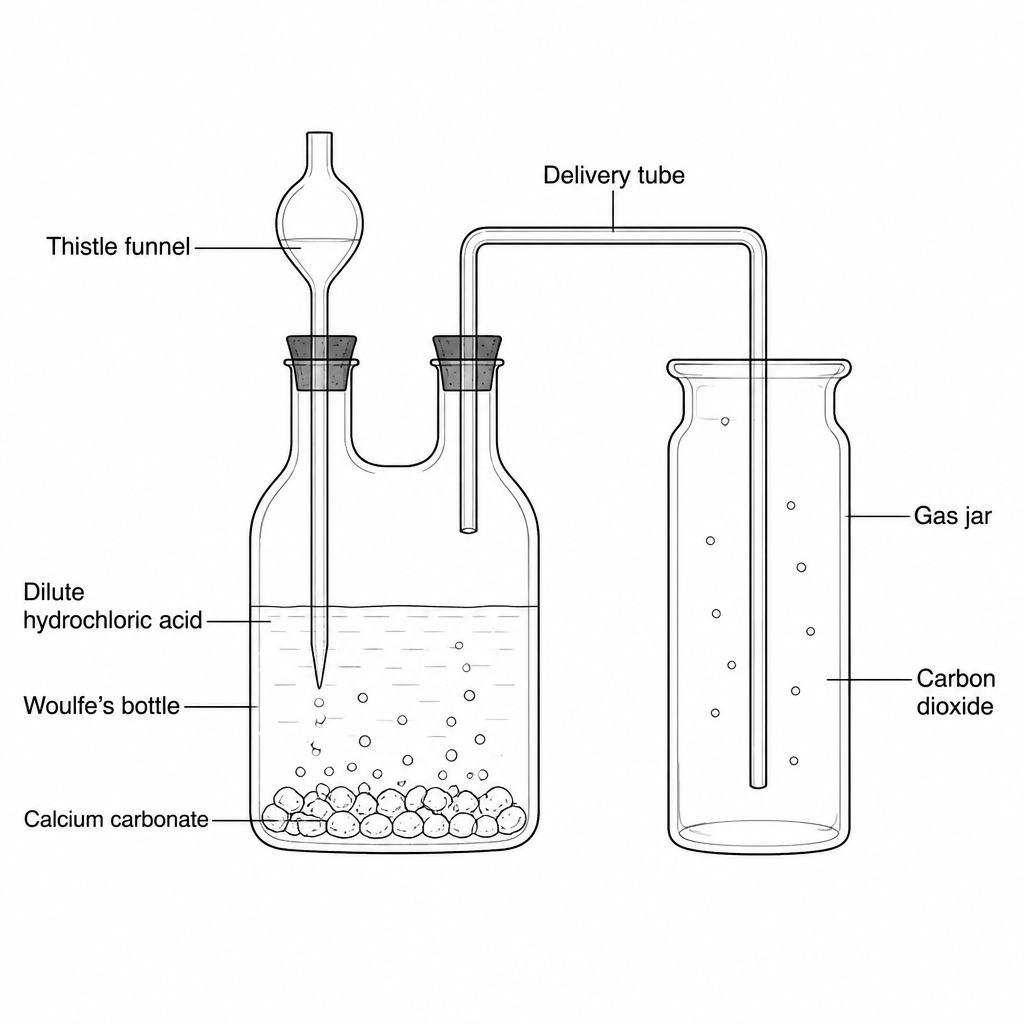
As soon as the acid poured down the thistle funnel covers the pieces of calcium carbonate, the mixture starts to fizz. The bubbles are carbon dioxide. The gas rises out of the bottle, travels along the delivery tube and flows into a gas jar standing upright. Because carbon dioxide is heavier than air, it sinks to the bottom of the jar and pushes the air up and out through the mouth. When the jar is full, the gas begins to spill over the top.
Upward displacement of air: a way of collecting a gas that is heavier than air. The gas is led to the bottom of an upright jar, where it pushes the lighter air up and out of the mouth of the jar.
The end of the thistle funnel must be dipped into the acid, or the gas escapes back up through the funnel. The end of the delivery tube must not be dipped into the acid, or the acid is pushed along the tube instead of the gas.
Do not touch or taste hydrochloric acid. If any splashes on your skin, wash it off at once with plenty of water.
Testing for Carbon Dioxide
Carbon dioxide has no colour and no smell, so you cannot tell a jar of it from a jar of air just by looking. Three tests identify it.
- The burning matchstick test: a burning matchstick brought near the mouth of the jar goes out at once, because carbon dioxide neither burns nor helps anything else burn.
- The indicator test: moist blue litmus paper held at the mouth of the jar turns red, and a few drops of phenolphthalein put inside the jar stay colourless. Both show that the gas is acidic.
- The lime water test: when carbon dioxide is bubbled through lime water in a test tube for some time, the clear liquid turns milky white.
Lime water: a clear solution of calcium hydroxide in water, used to test for carbon dioxide.
The milkiness is a solid. Carbon dioxide reacts with the calcium hydroxide in lime water to form calcium carbonate, which does not dissolve and hangs in the water as tiny white particles:
\[ \begin{aligned} &\mathrm{Ca(OH)_2(aq) + CO_2(g)} \\ &\rightarrow \mathrm{CaCO_3(s)}\text{ (milky)} + \mathrm{H_2O(l)} \end{aligned} \]
Keep the gas flowing for a long time and something surprising happens: the milkiness disappears and the liquid turns clear again. The extra carbon dioxide and water change the insoluble calcium carbonate into calcium bicarbonate, which dissolves:
\[ \begin{aligned} &\mathrm{CaCO_3(s) + CO_2(g) + H_2O(l)} \\ &\rightarrow \mathrm{Ca(HCO_3)_2(aq)}\text{ (colourless)} \end{aligned} \]
Lime water that went milky and then cleared again has not failed the test. It has simply had too much carbon dioxide. Stop the gas as soon as the milkiness appears.
Physical Properties of Carbon Dioxide
These properties describe the gas itself: its colour, smell and taste, how well it dissolves, how heavy it is compared with air, and what happens when it is cooled or squeezed.
- It is an acidic, or non-metallic, oxide. It is colourless and has no smell.
- It dissolves in water to form carbonic acid, so it tastes sour.
- It is only slightly soluble in water.
- It is 1.5 times heavier than air.
- It shows acidic properties and turns moist blue litmus paper red.
- It is not poisonous, but living things die in it by suffocation, because it leaves them no oxygen.
- It can be changed into a liquid at high pressure and low temperature.
- Cooled below \( -78^\circ\text{C} \), it becomes a solid known as dry ice.
- It neither burns nor supports burning.
Dry ice: solid carbon dioxide, formed when the gas is cooled below \( -78^\circ\text{C} \). It turns straight back into gas without melting into a liquid, so it leaves nothing wet behind, which is why it is called dry.
Combustible substance: a substance that can catch fire and burn, such as wood or kerosene.
Supporter of combustion: a substance that helps other things burn. In air, oxygen is the supporter of combustion.
Chemical Properties of Carbon Dioxide
Chemical properties show up when carbon dioxide reacts and new substances form. There are six to know.
1. It does not burn and does not support burning, which is why it helps put out fires. Burning magnesium is the exception. Plunged into a jar full of carbon dioxide, burning magnesium keeps burning brightly. It pulls the oxygen out of the carbon dioxide, leaving a white powder of magnesium oxide and a black powder of carbon. The black carbon shows that carbon dioxide contains carbon:
\[ \begin{aligned} &\mathrm{2Mg(s) + CO_2(g)} \\ &\rightarrow \mathrm{2MgO(s) + C(s)} \end{aligned} \]
2. It dissolves in water to form carbonic acid. The reaction can go both ways, so the equation uses a double arrow. Soft drinks have carbon dioxide dissolved in them at high pressure, which gives them their sour taste. When the bottle is opened the pressure drops and the gas escapes as bubbles.
\[ \mathrm{CO_2(g) + H_2O(l) \rightleftharpoons H_2CO_3(aq)} \]
3. It turns lime water milky white by forming insoluble calcium carbonate, and a long flow of the gas makes it clear again by forming soluble calcium bicarbonate. These are the two reactions of the lime water test.
4. It is absorbed by potassium hydroxide. When a few drops of potassium hydroxide are added inside a test tube filled with carbon dioxide and turned upside down in water, the water level inside the tube rises. The potassium hydroxide absorbs the carbon dioxide, the pressure inside the tube falls, and water rushes in to fill the space:
\[ \mathrm{2KOH + CO_2 \rightarrow K_2CO_3 + H_2O} \]
5. Green plants use it to make food. In the leaves, carbon dioxide taken from the air reacts with water absorbed by the roots, in the presence of sunlight trapped by chlorophyll, to form carbohydrate and oxygen:
\[ \begin{aligned} &\mathrm{6CO_2 + 6H_2O} \xrightarrow[\text{chlorophyll}]{\text{solar energy}} \\ &\mathrm{C_6H_{12}O_6 + 6O_2} \end{aligned} \]
6. It reacts with red hot coke at \( 900^\circ\text{C} \) to form carbon monoxide. Coke is almost pure carbon, and it takes one oxygen atom from each carbon dioxide molecule:
\[ \mathrm{CO_2 + C \rightarrow 2CO} \]
Uses of Carbon Dioxide
Most uses of carbon dioxide come straight from its properties. It does not support burning, it dissolves under pressure, it becomes very cold dry ice, and plants need it.
- It is dissolved in soft drinks at high pressure.
- Plants use it as a raw material for preparing their food.
- It is used to put out fires, in the fire extinguisher.
- It is used to make dry ice, which preserves fruits, vegetables and meat at low temperature.
- Liquid carbon dioxide is used to purify sugar in sugar mills, by the carbonation process.
- It is used to make urea \( \mathrm{(NH_2CONH_2)} \), washing soda \( \mathrm{(Na_2CO_3)} \) and baking soda \( \mathrm{(NaHCO_3)} \).
- It is used to make carbogen.
- Green plants use it for photosynthesis.
- It is used in bakery products.
Carbogen: a mixture of 95% oxygen and 5% carbon dioxide, used to give artificial respiration to patients suffering from pneumonia.
Carbonation: the process used in sugar mills in which liquid carbon dioxide purifies sugar.
How a Fire Extinguisher Works
A fire needs three things: something to burn, heat and oxygen. Take the oxygen away and the fire dies. A fire extinguisher does exactly this, by smothering the fire under carbon dioxide.
Fire extinguisher: a device used to put out a fire.
In the common type, the metal cylinder holds a concentrated solution of sodium bicarbonate. Near the mouth, a glass vessel attached to a plunger holds concentrated sulphuric acid. Nothing happens while the two are kept apart.
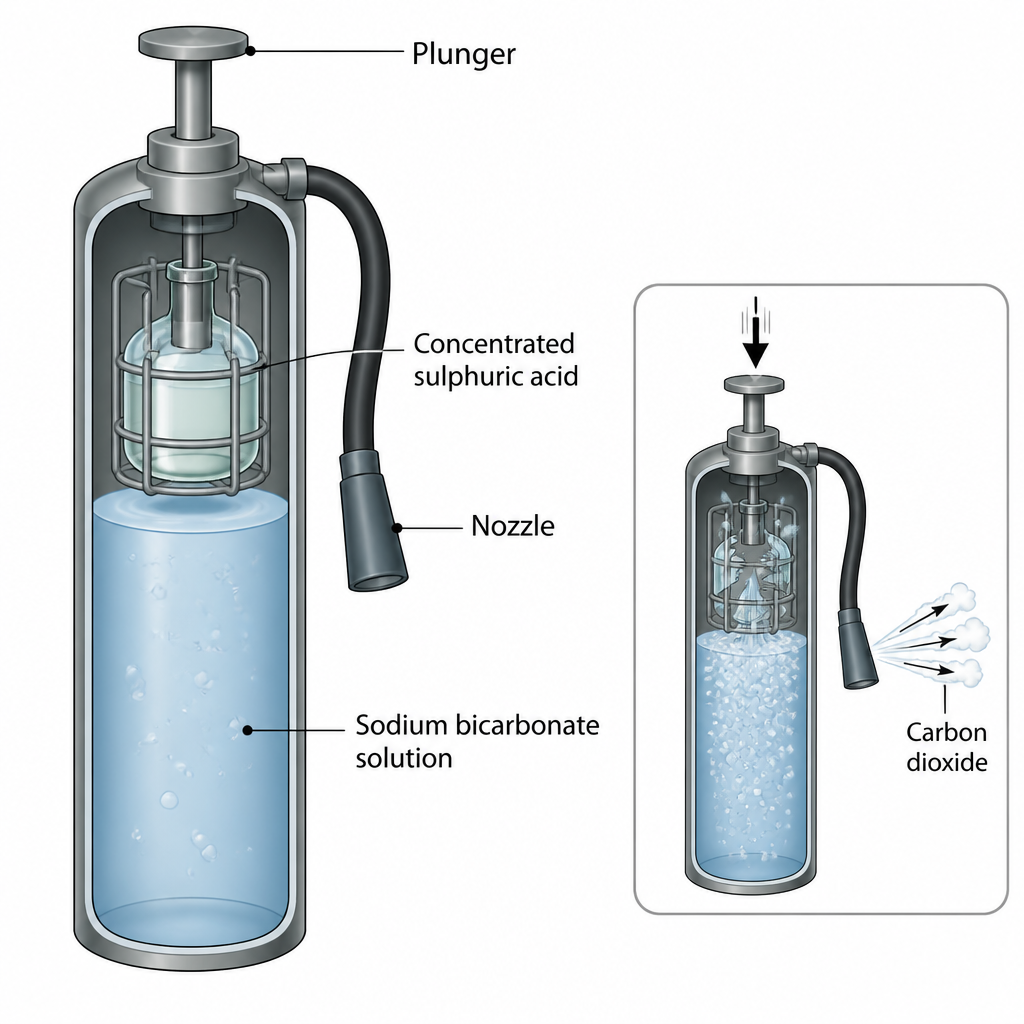
When the plunger is jerked, this happens in order:
- The glass vessel breaks and the sulphuric acid mixes with the sodium bicarbonate solution.
- The two react and produce a large amount of carbon dioxide inside the closed cylinder.
- The pressure of the gas drives it out of the nozzle at very high speed.
- Being heavier than air, the carbon dioxide covers the fire like a thick blanket.
- The blanket cuts off the oxygen, and the fire goes out.
The reaction inside the cylinder is:
\[ \begin{aligned} &\mathrm{2NaHCO_3 + H_2SO_4} \\ &\rightarrow \mathrm{Na_2SO_4 + 2H_2O + 2CO_2} \end{aligned} \]
Two properties make carbon dioxide good at fighting fire: it neither burns nor supports burning, and it is heavier than air, so it stays down over the flames instead of drifting away.
The full lesson is waiting for you
The notes are free to read in full. A free account opens the rest of the practice, and tracks your progress and confidence score for every subject. Presentations and videos need approval from Learn Yeti.