Why Cloudy Nights Feel Warmer
On a clear winter night the ground cools quickly, and by morning there may be frost. On a cloudy night it stays noticeably warmer. During the day the Sun warms the ground, and at night the ground gives that heat off again. Under a clear sky the heat escapes straight upward. Under clouds, much of it is stopped by the cloud layer and sent back down. The clouds work like a blanket over the ground.
People use the same idea on purpose. In parks, botanical gardens and agricultural farms you may have seen plastic tunnels or glass houses. Even when it is cold outside, it is warm inside them and plants grow well. These are greenhouses. Keep three questions in mind as you read. Why are greenhouses important in our daily life? What would happen if there were no greenhouses? What are their advantages?
Greenhouses and the Greenhouse Effect
The walls and roof of a greenhouse are transparent, so sunlight passes in easily. The heat that builds up inside cannot get out so easily. That is why the air inside a greenhouse is warmer than the air outside.
Greenhouse: a house made of transparent glass or plastic which stores the Sun's heat inside it, helps plants grow properly and keeps them green.
Greenhouse effect: the process of trapping solar energy inside a greenhouse, which increases the temperature inside it.
Greenhouses are of two kinds, natural and artificial. Houses made of transparent glass and plastic are artificial greenhouses. The earth itself is a natural greenhouse. For the earth, the job of the glass is done by certain gases in the atmosphere.
The Natural Greenhouse Effect
When radiation from the Sun reaches the earth's surface, some of it is reflected back and some is absorbed by the earth. The absorbed energy warms the ground, and the warm ground sends heat back upward. The earth's atmosphere contains layers of greenhouse gases. These gases return part of the outgoing radiation to the earth's surface instead of letting all of it escape to space. In this way the earth's surface stays warm.
The main greenhouse gases in the atmosphere are:
- carbon dioxide \( (\mathrm{CO_2}) \)
- methane \( (\mathrm{CH_4}) \)
- nitrous oxide \( (\mathrm{N_2O}) \)
- chlorofluorocarbons (CFCs)
- ozone \( (\mathrm{O_3}) \)
- water vapour
Greenhouse gases: gases of the atmosphere such as carbon dioxide, methane, nitrous oxide, chlorofluorocarbons and ozone, which let solar radiation in but return part of it to the earth's surface.
Natural greenhouse effect: the process of heating the earth's surface, in which greenhouse gases of the atmosphere trap part of the solar radiation.
A layer of greenhouse gases in the atmosphere is necessary. Without greenhouse gases the temperature of the earth would be very low, and life could not exist on the earth.
How Human Activities Increase the Greenhouse Effect
The layer of greenhouse gases in the atmosphere is growing because of human activities, industrialisation and pollution. Burning petrol and diesel in vehicles, burning coal in factories and brick kilns, and clearing and burning forests all release large amounts of carbon dioxide. Old refrigerators and air conditioners release chlorofluorocarbons. With more gas in the air, more radiation is sent back to the earth's surface and less of it escapes to space. So human activities increase the greenhouse effect.
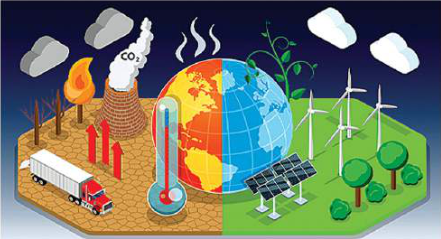
Where does the carbon dioxide in the atmosphere come from? It is released by the breathing of people and animals, by burning fuels such as firewood, coal, kerosene, petrol and diesel, by factory and vehicle smoke, by forest fires, by the decay of dead plants and animals, and by volcanoes. Because greenhouse gases are increasing, the temperature of the earth has been rising abnormally. As a result we are facing climate change, which brings many negative impacts.
The greenhouse effect is not harmful in itself. Without it the earth would be frozen and lifeless. The problem is the extra effect caused when human activities add more greenhouse gases to the air.
Consequences of Greenhouse Effect
When the greenhouse effect increases, its effects reach the weather, water, farming, mountains, seas and living things. The main consequences are:
- Increase in temperature: the average temperature of the earth rises and summers become harsher.
- Change in water cycle: rain falls out of season, with drought in some places and floods in others.
- Negative impacts on human health: heat makes people ill, and diseases spread by mosquitoes reach places that used to be too cool for them.
- Decrease in agricultural productivity: heat, drought and untimely rain damage crops.
- Melting of snow in the Himalayas and glaciers, and decrease of snow.
- Increase in sea level, causing sinking and flooding of coastal regions.
- Degradation in biodiversity: plants and animals that cannot adjust to the heat die out.
- Desertification: fertile land dries up and turns into desert.
- Imbalance in the ecosystem.
Artificial Greenhouse
Artificial greenhouse: a structure made of transparent glass or plastic to keep plants in, which allows solar radiation to enter. It is also known as a hot house.
The reason the temperature rises inside an artificial greenhouse lies in the length of the waves. Radiation from the Sun arrives as short waves, and short waves pass easily through glass or plastic. Once inside, this is what happens:
- Short waves of solar radiation enter the greenhouse through the transparent roof and walls.
- The soil, plants and pots inside absorb some of this energy.
- The absorbed energy is given out again as long waves, which have a long wavelength.
- The long waves cannot escape through the glass or plastic. They change into heat energy, the heat is stored inside, and the temperature rises.
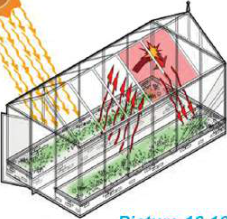
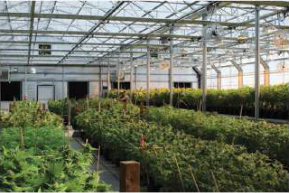
Artificial greenhouse effect: the rise in temperature inside a greenhouse, because the long waves formed inside cannot escape through the glass or plastic and change into heat energy.
Short waves get in, long waves are trapped. That is the whole secret of a warm greenhouse.
Importance and Utility of Artificial Greenhouse
Because it is always warm inside a greenhouse, plants of any season can be grown there. Farmers can earn money by growing unseasonal vegetables and selling them in winter. Plants that are going extinct because of an extremely cold climate can be protected, and rare plants found in cold places can be conserved. Its main uses are:
- Plants of any season can be grown inside it throughout the year.
- It helps food crops to grow in very cold places.
- It is useful for producing flowers, green leafy vegetables, fruits and different types of plants.
- Plants inside greenhouses can help control environmental pollution.
- Summer plants can be grown in the winter season as well.
- Plants of the summer season can be grown in cold places too.
How Is the Earth a Natural Greenhouse?
The earth is surrounded by an atmosphere of gases such as carbon dioxide, ozone and water vapour. These gases allow solar radiation to reach the earth's surface, but do not let it escape after it is reflected. So the rays are trapped around the earth.
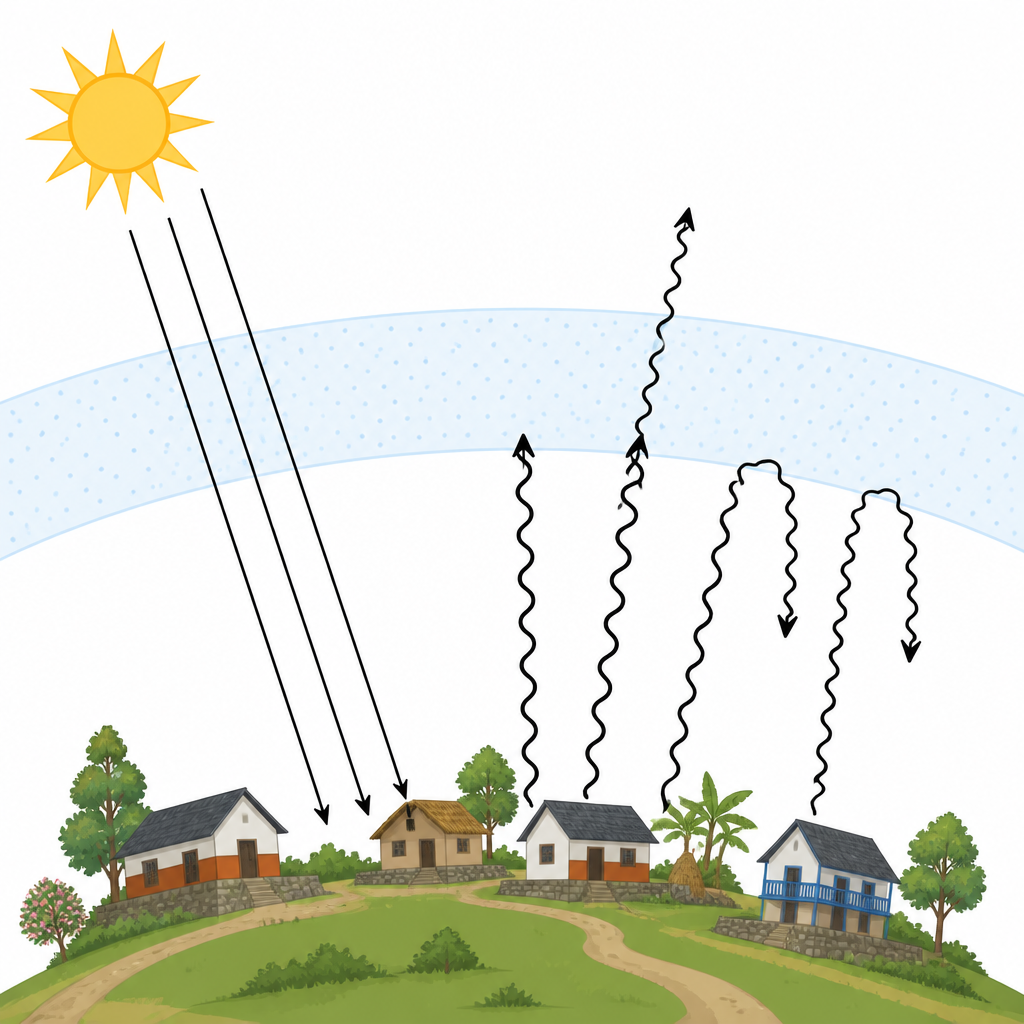
In this way the greenhouse gases increase the temperature of the earth. They play the same role as glass in an artificial greenhouse. That is why the earth is called a natural greenhouse. The two can be compared like this:
| Feature | Artificial greenhouse | The earth (natural greenhouse) |
| What covers it | Transparent glass or plastic | A layer of greenhouse gases |
| What traps the heat | The glass stops long waves | The gases return radiation to the surface |
| Made by | People | Nature |
| Result | Warm air for plants | Warm enough for life |
Ways to Decrease Greenhouse Effect on the Earth
To decrease the greenhouse effect, the production and use of greenhouse gases must be controlled. The following methods can be adopted:
- The production and use of chlorofluorocarbons must be fully banned.
- The use of petroleum products and coal should be decreased, and the use of renewable energy sources increased.
- Alternative sources of energy such as hydroelectricity, wind energy and solar energy must be promoted.
- Trees should be planted.
- Production of carbon dioxide must be reduced.
Acid Rain
What would happen if a few drops of acid fell on a leaf? The leaf would look scorched, turning brown and weak. Old temples, stupas and statues in our cities are fading day by day. Why is this happening, and what must be done to prevent it? One major cause is acid rain.

A bone shows clearly what an acid does. A piece of bone kept in hydrochloric acid for a day comes out soft and bendable. The acid dissolves the calcium compounds that make the bone hard. Marble and limestone are also made of calcium compounds, so they too are slowly worn away when acidic water keeps falling on them.
Hydrochloric acid burns the skin and can seriously harm the eyes. Wear gloves, take the bone out only with tongs, do not smell the acid, and do this experiment only under a teacher's supervision.
Acid rain: rain that brings down acids such as sulphuric acid, carbonic acid, nitric acid and hydrochloric acid, formed when gases from industries and vehicles mix with water vapour in the atmosphere.
How Acid Rain Forms
Acid rain was first confirmed in 1960 AD. Industries and vehicles release gases such as sulphur dioxide, carbon dioxide, nitrous oxide and chlorine. In the atmosphere these gases mix with water vapour and form acids such as sulphuric acid, carbonic acid, nitric acid and hydrochloric acid. The acids then come down with the rain water.
Ordinary rain water is also slightly acidic. Its pH is 6. The pH of acid rain ranges from 3 to 5.
The further the pH falls below 7, the more acidic the water. So rain of pH 3 is far more harmful than rain of pH 6.
First, sulphur dioxide combines with oxygen in the air to form sulphur trioxide:
\[ 2\mathrm{SO_2} + \mathrm{O_2} \rightarrow 2\mathrm{SO_3} \]
The sulphur trioxide then dissolves in water to form sulphuric acid:
\[ \mathrm{SO_3} + \mathrm{H_2O} \rightarrow \mathrm{H_2SO_4} \]
In the same way, carbon dioxide dissolves in water to form carbonic acid:
\[ \mathrm{CO_2} + \mathrm{H_2O} \rightarrow \mathrm{H_2CO_3} \]
Effects of Acid Rain on the Earth
Acid rain harms buildings, soil, water, living things and people:
- It fades monuments made of marble, such as temples, buildings and statues.
- It increases the acidity of soil, which decreases productivity.
- It gets mixed into water sources and affects aquatic animals.
- It causes skin diseases in humans.
- It causes negative effects on human health.
Marble is calcium carbonate. The sulphuric acid in acid rain reacts with it like this:
\[ \begin{aligned} &\mathrm{CaCO_3(s)} + \mathrm{H_2SO_4(aq)} \\ &\rightleftharpoons \mathrm{CaSO_4(s)} + \mathrm{CO_2(g)} + \mathrm{H_2O(l)} \end{aligned} \]
The smooth, shiny marble is changed into a rough layer of calcium sulphate. Rain slowly washes that layer away, so the surface of the monument wears down and loses its shine.
Methods to Prevent Acid Rain
The best way to prevent acid rain is to stop the acid-forming gases from reaching the air at all:
- Less production of oxides of nitrogen and sulphur.
- Use of renewable sources of energy in place of fossil fuel.
- Awareness raising about the causes and effects of acid rain.
The full lesson is waiting for you
The notes are free to read in full. A free account opens the rest of the practice, and tracks your progress and confidence score for every subject. Presentations and videos need approval from Learn Yeti.