Living Online for Hours
Mobile phones, tablets and computers are now found in almost every home. We use them to attend classes, look up information, talk to relatives who live far away, watch videos and play games. Each of these uses has real value. The difficulty is that the minutes quietly turn into hours. A short cartoon becomes a whole afternoon. A quick look at a new comment becomes an hour of scrolling. A message checked in bed keeps a person awake long after the lights go out.

Nobody in these pictures is harming themselves in that one moment. The harm comes from the habit. When long hours online are repeated day after day, and nothing balances them, such as sleep, exercise and time spent with people face to face, the body and the mind begin to suffer.
Health Problems of Too Much Time Online
Staying online for a long time without keeping the necessary physical balance is harmful to health. While we watch a screen, the body sits in one position, the eyes stay fixed on a bright surface close to the face, and the mind keeps receiving new messages and pictures. Four problems commonly follow:
- Obesity: sitting still for hours uses very little energy, and snacking in front of a screen is easy, so the body stores extra fat.
- Insomnia: difficulty in falling asleep or staying asleep. Using a phone late at night pushes bedtime back and keeps the mind busy when it should be resting.
- Vision problems: staring at a bright screen held close to the eyes for a long time tires and strains the eyes and can affect eyesight.
- Mental stress: a constant stream of messages, the pressure to reply at once and the worry about missing something keep the mind tense.
Unregulated internet use is use with no limit or control on how long we stay online or what we do there. It harms the mind and our relationships as well as the body. The table shows the problems it can cause and how each one may appear in everyday life.
| Problem | How it can show in daily life |
| Depression | Feeling sad, empty and uninterested in things for a long time |
| Anxiety | Constant worry, such as feeling restless when the phone is out of reach or when a post gets few likes |
| Dishonesty | Hiding real screen time from parents, or pretending to be someone else online |
| Low self-esteem | Comparing one's ordinary life with the polished photos others post, and feeling less valuable |
| Social isolation | Spending less and less time with family and friends in person |
| Loneliness | Feeling alone even with hundreds of friends on social media |
| Aggressiveness | Getting angry when a device is taken away or a game is lost, or writing rude comments |
What Digital Wellbeing Means
Because these problems are real, the idea of health is now applied to our online life too. We already look after the body with food, rest and exercise. In the same way, we can look after ourselves while using digital technology. This is called digital health, and its aim is digital wellbeing.
Digital wellbeing is the state of being healthy mentally, physically, socially and emotionally by balancing the time spent on online and offline activities.
The key word in this definition is balancing. Digital wellbeing does not ask anyone to give up phones or the internet. It asks us to use them in a way that does not damage our overall health. Compare two students. Sita watches a lesson video for forty minutes, then plays outside, eats dinner with her family and sleeps on time. Ramesh plays an online game for six hours, skips his meal and falls asleep after midnight. Both used the same kind of device. Only Sita kept her online and offline time in balance.
Digital wellbeing is about balance, not about avoiding technology. Use digital devices so that they do not harm your overall health.
The Four Aspects of Digital Wellbeing
The definition names four kinds of health, and each one is a separate aspect of digital wellbeing. They branch out from the same centre, because all four depend on how we balance our time.
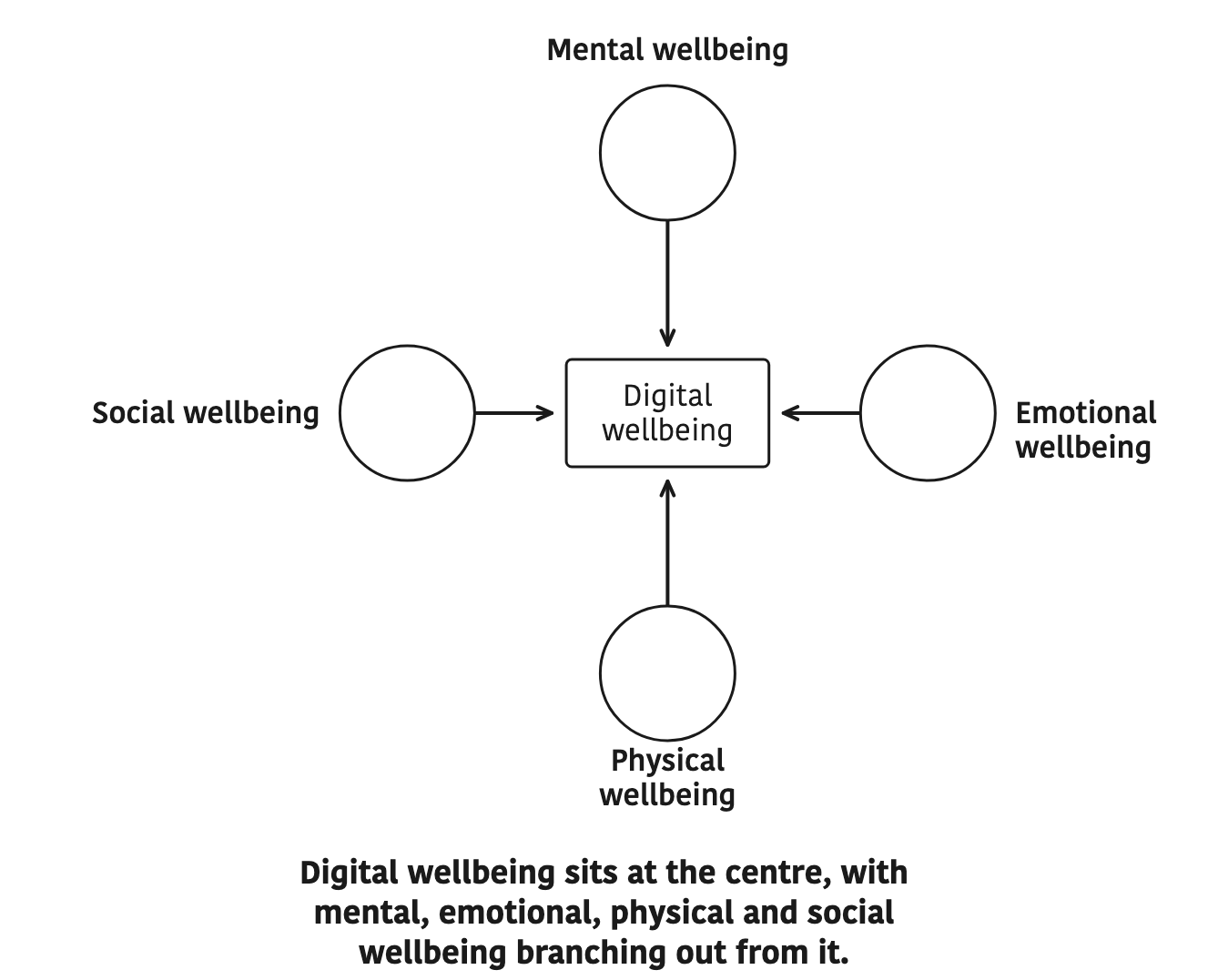
Mental wellbeing: a calm, clear mind that can concentrate, think and learn, and is not overloaded by endless alerts and information.
Physical wellbeing: a healthy body that gets enough sleep and exercise, sits in a good posture and rests the eyes.
Social wellbeing: good relationships with family, friends and neighbours in real life, together with polite and respectful behaviour online.
Emotional wellbeing: understanding and handling one's own feelings, and feeling good about oneself without depending on likes and comments.
The four aspects are linked, so damage to one spreads to the others. A boy who stays online until late loses sleep, which is physical. Next day he is irritable, which is emotional. He cannot follow the lesson, which is mental. He snaps at a friend, which is social. One habit has touched all four.
Balancing Time for Health
A healthy day is made of several different kinds of time, and each one feeds a different need. A wheel is a good way to picture this. Every slice has to get its share. Screen time is not a slice of its own. It has to fit inside the others without eating them up.
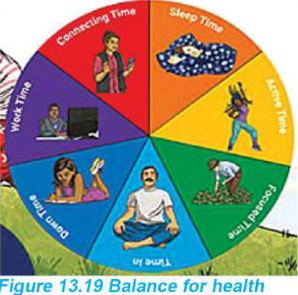
- Sleep time: the rest that the body and brain need every night.
- Active time: moving the body through play, sport, walking, dancing or work in the fields.
- Focused time: giving full attention to one task, such as study, homework or gardening.
- Time in: sitting quietly and looking inward at one's own thoughts and feelings, as in meditation.
- Down time: relaxing without any goal, letting the mind wander and rest.
- Work time: doing one's job, duties and household tasks.
- Connecting time: being with other people and talking to them face to face.
Too much screen use makes the wheel lopsided. It steals from sleep time, active time and connecting time first, because those are the easiest to put off. Balanced use lets screens serve the wheel instead. An online class belongs to focused time, and a video call to grandparents in another district is a form of connecting time.
Cautions for Digital Wellbeing
Addiction to digital technology makes our lifestyle chaotic. Meals are eaten late, homework is left half done, bedtime keeps moving later, and the hand reaches for the phone without any real reason. To avoid this, a person needs digital wellbeing skills. These skills begin with awareness: knowing the possible effects of the unnecessary use of digital technology, and noticing when one's own use has crossed that line.
Digital wellbeing is achieved by building a few simple habits:
- Separating screen time: keep fixed periods for using screens, and keep other periods, such as meals and family time, free of them.
- Setting time limits for social media use: decide beforehand how long to spend, for example thirty minutes a day, and stop when that time is over.
- Turning off mobile notifications at work: while studying or working, silence the alerts so that each new message does not break the concentration.
- Installing a digital wellbeing application on the smartphone, which builds awareness by showing how the phone is actually used.
Many people count only games and videos as screen time. Scrolling, chatting and checking notifications count too, and together they often add up to far more hours than people guess.
Digital Wellbeing Applications
Screen time is the amount of time a person spends using the screen of a digital device such as a mobile phone, tablet, computer or television.
Awareness of digital wellbeing can be built by installing a digital wellbeing application on a smartphone. Examples include Google's Digital Wellbeing (Beta), Action Dash, Digital Detox and Microsoft Launcher. Such applications help users reduce their screen time.
When the app is opened, it shows how long the phone was used that day, for example 4 hours 29 minutes, and divides that total among the apps in a ring. It also counts how many times the phone was unlocked and how many notifications arrived. With the same app the user can turn off notifications for any application, and can set a daily time limit for a particular application. Once that limit is used up, the application is paused until the next day.
The value of these numbers is that they make an invisible habit visible. A student who guesses that she spends one hour online and then sees four and a half hours on the screen has learnt something no lecture could teach her. A count of more than two hundred notifications in one day explains at once why her study keeps getting interrupted.
Using the Internet for Learning with Care
The internet is also a huge store of learning materials. For example, the YouTube channel NCEDVirtual, at youtube.com/c/NCEDVirtual, offers audio-visual lessons on different subjects, and more such material can be made by recording the content one needs. Searching for these materials still calls for care. A student who opens one science video can find herself, an hour later, watching something that has nothing to do with the lesson. So decide what you are looking for before you start, set a time for the search, and close the device once the work is done.
The full lesson is waiting for you
The notes are free to read in full. A free account opens the rest of the practice, and tracks your progress and confidence score for every subject. Presentations and videos need approval from Learn Yeti.