Adding the Terms of a Sequence
Take the first ten natural numbers: 1, 2, 3, 4, 5, 6, 7, 8, 9, 10. Each term is 1 more than the one before it, so this is an arithmetic sequence (AP) with common difference 1. Now put a plus sign between the terms: \( 1 + 2 + 3 + \cdots + 10 \). It is no longer a list of numbers. It is a series, and when you work it out its value is 55.
Arithmetic series: the expression formed by adding the terms of an arithmetic sequence. The single number you get by working it out is called the sum of the arithmetic series.
\( S_n \): the sum of the first n terms of an arithmetic series. So \( S_{10} \) is the sum of the first 10 terms and \( S_{25} \) is the sum of the first 25 terms.
Every problem in this topic uses the same five letters. Learn what each one stands for before going further:
- \( a \) is the first term.
- \( d \) is the common difference, found as \( t_2 - t_1 \). It can be positive, negative or a fraction.
- \( n \) is the number of terms. It is always a positive whole number.
- \( l \) is the last term. It is the same as \( t_n \), so \( l = a + (n-1)d \).
- \( S_n \) is the sum of those n terms.
The Pairing Trick
Adding ten numbers one by one is easy enough. Adding a hundred that way is slow and full of chances to slip. There is a far quicker way: write the series once forwards and once backwards, one line under the other, and add the two lines column by column.
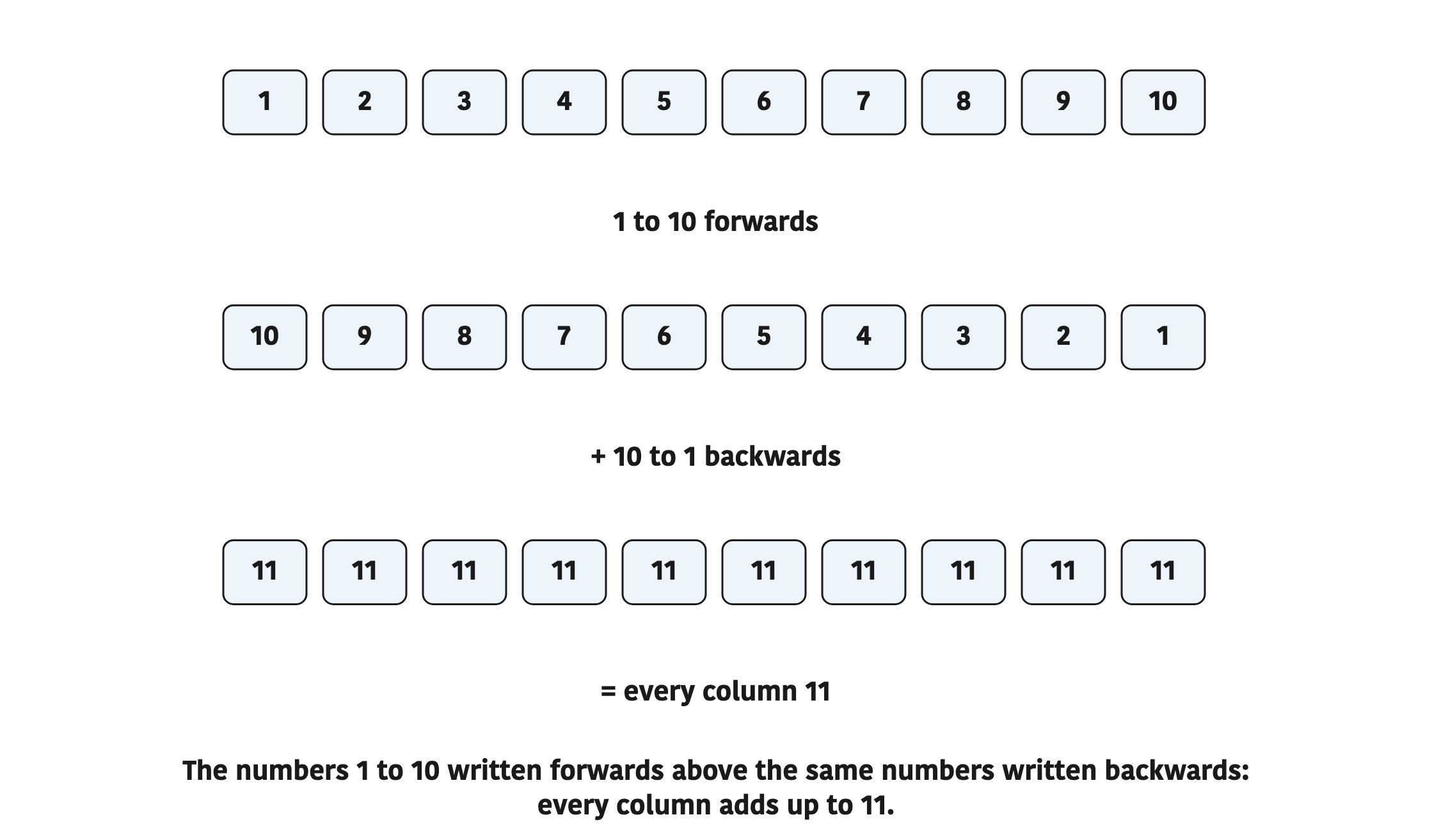
Step 1: Writing the series forwards. Call this line (i):
\[ S_{10} = 1 + 2 + 3 + \cdots + 9 + 10 \]
Step 2: Writing the same series in reverse order. Call this line (ii):
\[ S_{10} = 10 + 9 + 8 + \cdots + 2 + 1 \]
Step 3: Adding (i) and (ii) column by column. Each column gives 11, because 1 + 10, 2 + 9, 3 + 8 and so on all make 11, and there are ten columns:
\[ 2S_{10} = 11 + 11 + \cdots + 11 \]
Step 4: Writing ten elevens as a multiplication:
\[ 2S_{10} = 11 \times 10 = 110 \]
Step 5: Dividing both sides by 2 to get one copy of the sum:
\[ S_{10} = \frac{110}{2} = 55 \]
A term and its partner from the other end always add up to the same total: first term plus last term. Adding a series to its own reverse gives n copies of that total, which is exactly twice the sum.
The Formula for the Sum of n Terms
Now we do the same thing with letters, so that the result works for every arithmetic series. Let the first term be a, the common difference d, the number of terms n and the last term l. Going forwards, each term is d more than the one before. Going backwards from l, each term is d less.
Step 1: Writing the series forwards. Call this line (iii):
\[ S_n = a + (a+d) + \cdots + (l-d) + l \]
Step 2: Writing it in reverse order. Call this line (iv):
\[ S_n = l + (l-d) + \cdots + (a+d) + a \]
Step 3: Adding (iii) and (iv) column by column. In every column the d's cancel: \( a + l \), then \( (a+d) + (l-d) = a + l \), and so on to the end:
\[ 2S_n = (a+l) + (a+l) + \cdots + (a+l) \]
Step 4: Counting the columns. There are n of them, so there are n copies of \( (a+l) \):
\[ 2S_n = n(a+l) \]
Step 5: Dividing both sides by 2:
\[ S_n = \frac{n}{2}(a+l) \]
This formula needs the last term. Very often a problem gives the common difference instead. We already know that the last term is \( l = a + (n-1)d \), so we can put that in place of l. Replacing l in the formula:
\[ S_n = \frac{n}{2}[a + a + (n-1)d] \]
Collecting the two a's inside the bracket:
\[ S_n = \frac{n}{2}[2a + (n-1)d] \]
Important formulae. (i) \( S_n = \frac{n}{2}(a+l) \), used when the first and last terms are known. (ii) \( S_n = \frac{n}{2}[2a + (n-1)d] \), used when the first term and the common difference are known. Both give the same answer, because the second is the first with l written out.
Naming Three or Four Terms Cleverly
Some problems give the sum of a few consecutive terms and ask you to find them. If you name the terms so that they sit evenly around a centre, the d's cancel as soon as you add them, and one unknown disappears at once.
- Three consecutive terms are taken as \( a-d,\ a,\ a+d \). Their sum is \( 3a \), so the sum alone tells you a.
- Four consecutive terms are taken as \( a-3d,\ a-d,\ a+d,\ a+3d \). Their sum is \( 4a \), so again the sum alone tells you a.
In \( a-3d,\ a-d,\ a+d,\ a+3d \), neighbouring terms differ by \( 2d \), not d. So the common difference of that AP is 2d. Once you have found a and d, write the four terms out as numbers and read the gap from them.
Sum of the First n Natural Numbers
The natural numbers 1, 2, 3, 4, ..., n form an AP with first term \( a = 1 \) and common difference \( d = 1 \). Putting these into the second formula gives a short rule of its own.
Step 1: Writing the formula:
\[ S_n = \frac{n}{2}[2a + (n-1)d] \]
Step 2: Putting \( a = 1 \) and \( d = 1 \):
\[ S_n = \frac{n}{2}[2 \times 1 + (n-1) \times 1] \]
Step 3: Opening the bracket inside:
\[ S_n = \frac{n}{2}(2 + n - 1) \]
Step 4: Simplifying, since \( 2 - 1 = 1 \):
\[ S_n = \frac{n}{2}(n+1) \]
The sum of the first n natural numbers is \( \frac{n}{2}(n+1) \). For the first 10 natural numbers this gives \( \frac{10}{2} \times 11 = 55 \), the same answer the pairing trick gave.
Example: Find the sum \( 1 + 2 + 3 + \cdots + 20 \). Here the first term is \( a = 1 \), the common difference is \( d = 2 - 1 = 1 \) and the number of terms is \( n = 20 \).
Step 1: Putting the values into \( S_n = \frac{n}{2}[2a + (n-1)d] \):
\[ S_{20} = \frac{20}{2}[2 \times 1 + (20-1) \times 1] \]
Step 2: Working out the bracket, since \( 2 + 19 = 21 \), and \( \frac{20}{2} = 10 \):
\[ S_{20} = 10 \times 21 = 210 \]
The short rule gives the same answer straight away: \( \frac{20}{2}(20 + 1) = 10 \times 21 = 210 \). So \( S_{20} = 210 \).
Sum of the First n Even Natural Numbers
The first n even natural numbers are 2, 4, 6, ..., 2n. Their series is \( S_n = 2 + 4 + 6 + \cdots + 2n \), with first term \( a = 2 \) and common difference \( d = 2 \).
Step 1: Putting \( a = 2 \) and \( d = 2 \) into the second formula:
\[ S_n = \frac{n}{2}[2 \times 2 + (n-1) \times 2] \]
Step 2: Multiplying out inside the bracket:
\[ S_n = \frac{n}{2}(4 + 2n - 2) \]
Step 3: Collecting the numbers, since \( 4 - 2 = 2 \):
\[ S_n = \frac{n}{2}(2n + 2) \]
Step 4: Taking the common factor 2 out of the bracket:
\[ S_n = \frac{n}{2} \times 2(n+1) \]
Step 5: Cancelling the 2 on top with the 2 below:
\[ S_n = n(n+1) = n^2 + n \]
Check it on a small case. The first four even numbers are 2, 4, 6 and 8, and \( 2 + 4 + 6 + 8 = 20 \). The rule gives \( 4 \times 5 = 20 \). They agree.
Sum of the First n Odd Natural Numbers
The first n odd natural numbers are 1, 3, 5, ..., \( (2n-1) \). Their series is \( S_n = 1 + 3 + 5 + \cdots + (2n-1) \), with first term \( a = 1 \), common difference \( d = 3 - 1 = 2 \) and n terms.
Step 1: Putting \( a = 1 \) and \( d = 2 \) into the second formula:
\[ S_n = \frac{n}{2}[2 \times 1 + (n-1) \times 2] \]
Step 2: Multiplying out inside the bracket:
\[ S_n = \frac{n}{2}(2 + 2n - 2) \]
Step 3: The 2 and the minus 2 cancel, leaving 2n, and the 2's cancel again:
\[ S_n = \frac{n}{2} \times 2n = n^2 \]
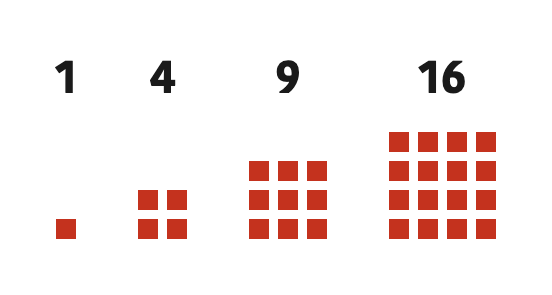
The three special series side by side:
| Series | First term a | Common difference d | Sum of first n terms |
| Natural numbers \( 1 + 2 + 3 + \cdots + n \) | 1 | 1 | \( \frac{n}{2}(n+1) \) |
| Even numbers \( 2 + 4 + 6 + \cdots + 2n \) | 2 | 2 | \( n(n+1) \) |
| Odd numbers \( 1 + 3 + 5 + \cdots + (2n-1) \) | 1 | 2 | \( n^2 \) |
Finding a Sum from a, d and n
Example: Find the sum of the first 10 terms of the AP 2, 7, 12, ... . The first term is \( a = 2 \), the common difference is \( d = 7 - 2 = 5 \) and the number of terms is \( n = 10 \). We need \( S_{10} \). The last term is not given, so the second formula is the one to use.
Step 1: Putting the values into \( S_n = \frac{n}{2}[2a + (n-1)d] \):
\[ S_{10} = \frac{10}{2}[2 \times 2 + (10-1) \times 5] \]
Step 2: Working out each part, since \( \frac{10}{2} = 5 \), \( 2 \times 2 = 4 \) and \( 9 \times 5 = 45 \):
\[ S_{10} = 5(4 + 45) \]
Step 3: Adding inside the bracket and multiplying:
\[ S_{10} = 5 \times 49 = 245 \]
So the sum of the first 10 terms is 245.
When the Last Term Is Given but n Is Not
Example: Find the sum of the series \( 34 + 32 + 30 + \cdots + 10 \). The first term is \( a = 34 \) and the last term is \( l = 10 \). Checking the differences: \( 32 - 34 = -2 \) and \( 30 - 32 = -2 \). They are equal, so this is an arithmetic series with \( d = -2 \). To use \( S_n = \frac{n}{2}(a+l) \) we first need n, and the last term gives it.
Step 1: Writing the last term as \( l = a + (n-1)d \) and putting in the values:
\[ 10 = 34 + (n-1)(-2) \]
Step 2: Subtracting 34 from both sides:
\[ -24 = -2(n-1) \]
Step 3: Dividing both sides by \( -2 \):
\[ n - 1 = 12 \]
Step 4: Adding 1 to both sides:
\[ n = 13 \]
Step 5: Now the first formula can be used, with \( n = 13 \), \( a = 34 \) and \( l = 10 \):
\[ S_{13} = \frac{13}{2}(34 + 10) \]
Step 6: Adding in the bracket and simplifying, since \( \frac{44}{2} = 22 \):
\[ S_{13} = \frac{13}{2} \times 44 = 13 \times 22 = 286 \]
The number of terms is not \( \frac{l-a}{d} \). Here \( \frac{10 - 34}{-2} = 12 \), and 12 counts the gaps between the terms, not the terms. There is always one more term than there are gaps, so n is 13. Working from \( l = a + (n-1)d \) every time avoids this slip.
Finding the Number of Terms from the Sum
Example: How many terms of the AP 24, 21, 18, ... must be taken so that their sum is 78? Here \( a = 24 \), \( d = 21 - 24 = -3 \) and \( S_n = 78 \). The unknown is n. Because n appears twice in the formula, we will get a quadratic equation.
Step 1: Putting the values into \( S_n = \frac{n}{2}[2a + (n-1)d] \):
\[ 78 = \frac{n}{2}[2 \times 24 + (n-1)(-3)] \]
Step 2: Simplifying the bracket, since \( 48 - 3n + 3 = 51 - 3n \):
\[ 78 = \frac{n}{2}(51 - 3n) \]
Step 3: Multiplying both sides by 2 and opening the bracket:
\[ 156 = 51n - 3n^2 \]
Step 4: Bringing every term to one side:
\[ 3n^2 - 51n + 156 = 0 \]
Step 5: Dividing every term by 3:
\[ n^2 - 17n + 52 = 0 \]
Step 6: Splitting the middle term, because \( 13 \times 4 = 52 \) and \( 13 + 4 = 17 \):
\[ n^2 - 13n - 4n + 52 = 0 \]
Step 7: Factorising in pairs, \( n(n-13) - 4(n-13) \):
\[ (n-13)(n-4) = 0 \]
Step 8: Either \( n - 13 = 0 \) or \( n - 4 = 0 \), so \( n = 13 \) or \( n = 4 \).
Both values are positive whole numbers, so both are accepted: the sum of the first 4 terms and the sum of the first 13 terms are both 78. You can see why. The first four terms give \( 24 + 21 + 18 + 15 = 78 \). The next nine terms are 12, 9, 6, 3, 0, \( -3 \), \( -6 \), \( -9 \), \( -12 \), and they add up to 0, so taking them as well changes nothing.
n counts terms, so it must be a positive whole number. If the quadratic gives a negative value or a fraction, reject that value and keep only the other. If both values are positive whole numbers, both are answers.
Finding the Common Difference from a Sum
Example: The first term of an arithmetic series is 2 and the sum of its first 10 terms is 120. Find the common difference. Here \( a = 2 \), \( n = 10 \), \( S_{10} = 120 \), and d is unknown.
Step 1: Putting the values into \( S_n = \frac{n}{2}[2a + (n-1)d] \):
\[ 120 = \frac{10}{2}[2 \times 2 + (10-1)d] \]
Step 2: Simplifying, since \( \frac{10}{2} = 5 \):
\[ 120 = 5(4 + 9d) \]
Step 3: Dividing both sides by 5:
\[ 24 = 4 + 9d \]
Step 4: Subtracting 4 from both sides:
\[ 9d = 20 \]
Step 5: Dividing by 9:
\[ d = \frac{20}{9} \]
The common difference does not have to be a whole number. A fraction like \( \frac{20}{9} \) is a perfectly good answer.
Sum of Multiples Below a Limit
Example: Find the sum of all natural numbers less than 100 that are exactly divisible by 6. These numbers are the multiples of 6: 6, 12, 18, ..., 96. The last one is 96 because \( 6 \times 16 = 96 \) and the next multiple, \( 6 \times 17 = 102 \), is more than 100. So \( a = 6 \), \( d = 6 \) and \( l = 96 \). First we find n.
Step 1: Using \( l = a + (n-1)d \):
\[ 96 = 6 + (n-1) \times 6 \]
Step 2: Subtracting 6 from both sides:
\[ 90 = 6(n-1) \]
Step 3: Dividing by 6, since \( \frac{90}{6} = 15 \):
\[ n - 1 = 15 \]
Step 4: Adding 1 to both sides:
\[ n = 16 \]
Step 5: Using \( S_n = \frac{n}{2}(a+l) \) with \( n = 16 \):
\[ S_{16} = \frac{16}{2}(6 + 96) \]
Step 6: Multiplying, since \( \frac{16}{2} = 8 \):
\[ S_{16} = 8 \times 102 = 816 \]
So the required sum is 816.
Two Sums Given: Finding a Term
Example: The sum of the first seven terms of an arithmetic series is 14 and the sum of the first ten terms is 125. Find the fourth term. Here \( S_7 = 14 \) and \( S_{10} = 125 \). Both a and d are unknown, so we use each sum to make one equation and solve the pair.
Step 1: Using \( S_7 = 14 \) in the second formula, with \( (7-1)d = 6d \):
\[ 14 = \frac{7}{2}(2a + 6d) \]
Step 2: Taking 2 out of the bracket, so that \( \frac{7}{2} \times 2 = 7 \):
\[ 14 = 7(a + 3d) \]
Step 3: Dividing by 7. Call this equation (i):
\[ a + 3d = 2 \]
Step 4: Using \( S_{10} = 125 \), with \( \frac{10}{2} = 5 \) and \( (10-1)d = 9d \):
\[ 125 = 5(2a + 9d) \]
Step 5: Dividing by 5. Call this equation (ii):
\[ 2a + 9d = 25 \]
Step 6: From (i), \( a = 2 - 3d \). Putting this into (ii):
\[ 2(2 - 3d) + 9d = 25 \]
Step 7: Opening the bracket, \( 4 - 6d + 9d = 4 + 3d \):
\[ 4 + 3d = 25 \]
Step 8: Subtracting 4 and dividing by 3, since \( \frac{21}{3} = 7 \):
\[ d = 7 \]
Step 9: Finding a from (i):
\[ a = 2 - 3 \times 7 = -19 \]
Step 10: The fourth term is \( t_4 = a + 3d \):
\[ t_4 = -19 + 3 \times 7 = 2 \]
Look at equation (i) again: \( a + 3d \) is exactly \( t_4 \). So \( t_4 = 2 \) was already there after Step 3. When the number of terms is odd, the sum equals the number of terms times the middle term: here \( S_7 = 7 \times t_4 \), so \( t_4 = 14 \div 7 = 2 \).
Getting a Term from Two Sums
\( S_n \) is the first n terms added together, and \( S_{n-1} \) is the same list with the last term left off. Take one away from the other and only that last term is left:
\[ t_n = S_n - S_{n-1} \]
For example, in the series \( 6 + 7 + 8 + 9 + 10 + 11 + \cdots \), the first six terms add up to \( S_6 = 51 \) and the first five to \( S_5 = 40 \). So the sixth term is \( t_6 = 51 - 40 = 11 \), which is exactly the sixth number in the list.
Three Terms with a Given Sum and Product
Example: The sum of three consecutive terms of an arithmetic series is 18 and their product is 192. Find the three terms. Let the three terms be \( a-d \), \( a \) and \( a+d \), so that the sum gives a straight away.
Step 1: Writing the first condition, the sum:
\[ (a-d) + a + (a+d) = 18 \]
Step 2: The d's cancel, leaving three a's:
\[ 3a = 18 \]
Step 3: Dividing by 3:
\[ a = 6 \]
Step 4: Writing the second condition, the product, with \( a = 6 \):
\[ (6-d) \times 6 \times (6+d) = 192 \]
Step 5: Dividing both sides by 6, and using \( (6-d)(6+d) = 36 - d^2 \):
\[ 36 - d^2 = 32 \]
Step 6: Rearranging, since \( 36 - 32 = 4 \):
\[ d^2 = 4 \]
Step 7: Taking the square root, which can be positive or negative:
\[ d = \pm 2 \]
Each value of d gives a set of three terms:
- When \( a = 6 \) and \( d = 2 \): the terms are \( 6 - 2 = 4 \), 6 and \( 6 + 2 = 8 \).
- When \( a = 6 \) and \( d = -2 \): the terms are \( 6 + 2 = 8 \), 6 and \( 6 - 2 = 4 \).
So the three terms are 4, 6, 8 or 8, 6, 4. Check: \( 4 + 6 + 8 = 18 \) and \( 4 \times 6 \times 8 = 192 \).
Choosing the Right Formula
Before writing anything, list what the question gives you and what it asks for. The list decides the formula:
| What you know | What to use |
| a, l and n | \( S_n = \frac{n}{2}(a+l) \) |
| a, d and n | \( S_n = \frac{n}{2}[2a + (n-1)d] \) |
| a, d and l, but not n | First \( l = a + (n-1)d \) for n, then \( S_n = \frac{n}{2}(a+l) \) |
| a, d and the sum, n unknown | Second formula, then solve the quadratic in n |
| Two sums | One equation from each sum, then solve for a and d |
| \( S_n \) and \( S_{n-1} \) | \( t_n = S_n - S_{n-1} \) |
| First n natural numbers | \( \frac{n}{2}(n+1) \) |
| First n even numbers | \( n(n+1) \) |
| First n odd numbers | \( n^2 \) |
The full lesson is waiting for you
The notes are free to read in full. A free account opens the rest of the practice, and tracks your progress and confidence score for every subject. Presentations and videos need approval from Learn Yeti.