What a Geometric Mean Is
Look at the three numbers 2, 6 and 18. Each number is 3 times the one before it, so they form a geometric sequence (a GP) with common ratio 3. The middle number, 6, has a special name. It is called the geometric mean of 2 and 18.
There is a quick way to get 6 straight from the two end numbers. Multiply them and take the square root: \( \sqrt{2 \times 18} = \sqrt{36} = 6 \). You will see shortly why this always works.
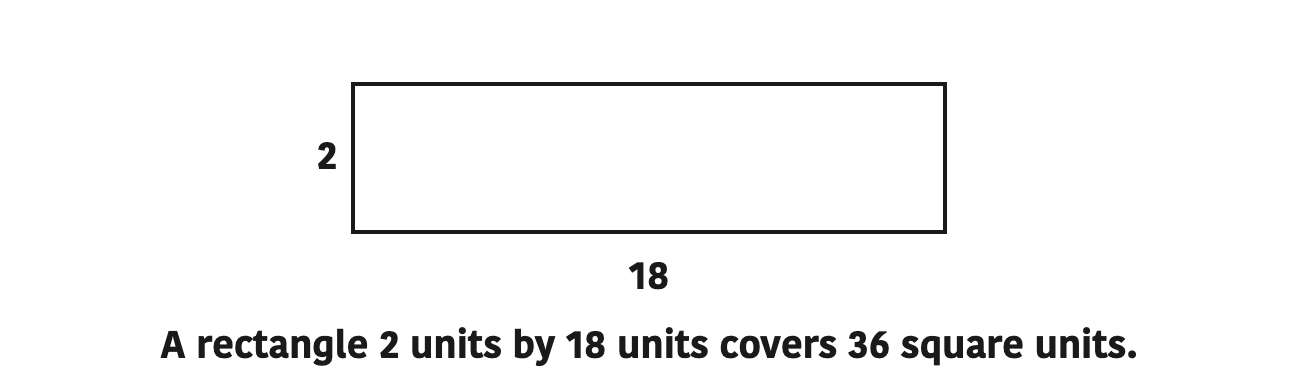
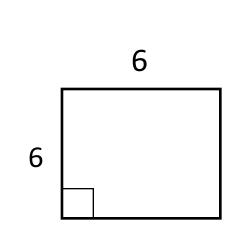
The idea also has a picture behind it. A rectangle 2 units wide and 18 units long covers \( 2 \times 18 = 36 \) square units. A square of side 6 covers \( 6 \times 6 = 36 \) square units as well. So the geometric mean of 2 and 18 is the side of the square whose area is the same as the area of the 2 by 18 rectangle.
A GP can have more than one term in the middle. In the GP 3, 6, 12, 24, 48 the first term is 3 and the last term is 48. The three terms between them, 6, 12 and 24, are all geometric means of 3 and 48. In the same way, in 5, 15, 45, 135 the two numbers 15 and 45 are the geometric means of 5 and 135.
Geometric means: the terms that lie between the first term and the last term of a geometric sequence (GP). In short they are written GMs.
Geometric Mean between Two Numbers a and b
Now we find a formula for the single geometric mean between any two numbers a and b. Let GM be that mean. Then a, GM, b form a GP, and in a GP every term divided by the term before it gives the same common ratio.
Step 1: The ratio of the second term to the first equals the ratio of the third term to the second:
\[ \frac{GM}{a} = \frac{b}{GM} \]
Step 2: Cross multiplying the two fractions:
\[ GM^2 = ab \]
Step 3: Taking the square root of both sides:
\[ GM = \sqrt{ab} \]
Geometric mean between a and b: if a, G, b are in GP, then G is the geometric mean between a and b, and \( G = \sqrt{ab} \).
So the geometric mean of two numbers is the square root of their product. For 3 and 12 it is \( \sqrt{36} = 6 \), and for 2 and 8 it is \( \sqrt{16} = 4 \).
The formula needs a and b to have the same sign. For two positive numbers the geometric mean is taken as the positive square root. For two numbers of opposite signs, such as -4 and 9, the product ab is negative, so there is no real geometric mean at all.
Example 1: One Geometric Mean between 5 and 20
Find the geometric mean between 5 and 20. Here the first term is a = 5 and the last term is b = 20. We need the one number GM that makes 5, GM, 20 a GP.
Step 1: The formula for the geometric mean between two numbers is:
\[ GM = \sqrt{ab} \]
Step 2: Putting a = 5 and b = 20 and multiplying under the root:
\[ GM = \sqrt{5 \times 20} = \sqrt{100} \]
Step 3: Taking the square root of 100:
\[ GM = 10 \]
So the geometric mean is 10. A quick check shows it is right: in 5, 10, 20 each term is 2 times the one before, so the three numbers really do form a GP.
Several Geometric Means between a and b
Often we are asked to place more than one number between a and b so that the whole list becomes a GP. Suppose we place n numbers \( m_1, m_2, m_3, \ldots, m_n \) between them. Then \( a, m_1, m_2, \ldots, m_n, b \) is a GP, and the numbers \( m_1 \) to \( m_n \) are the n geometric means between a and b.
Inserting geometric means: placing n numbers between a and b so that a, the n numbers and b together form a GP. The number of terms in that GP is n + 2.
In this GP the first term is a and the last term is b. The number of terms is the n means plus the two end numbers, which makes n + 2 terms. The whole job is to find the common ratio r. Once r is known, every mean follows by multiplying.
Step 1: The nth term formula of a GP is \( t_n = ar^{n-1} \). The last term b is term number n + 2, so:
\[ b = ar^{(n+2)-1} = ar^{n+1} \]
Step 2: Dividing both sides by a:
\[ \frac{b}{a} = r^{n+1} \]
Step 3: Raising both sides to the power \( \frac{1}{n+1} \):
\[ \left(\frac{b}{a}\right)^{\frac{1}{n+1}} = \left(r^{n+1}\right)^{\frac{1}{n+1}} \]
Step 4: On the right the powers multiply to 1, which leaves r by itself. This gives the common ratio:
\[ r = \left(\frac{b}{a}\right)^{\frac{1}{n+1}} \]
Here n stands for the number of means, not the number of terms.
Do not use the number of means as the number of terms. With 2 means between 6 and 48 the GP has 4 terms, and the power in the formula is \( \frac{1}{2+1} = \frac{1}{3} \), not \( \frac{1}{2} \).
With r known, each mean is simply a term of the GP. The first mean is the second term, the second mean is the third term, and so on. The kth mean is the (k + 1)th term, so it is a multiplied by r exactly k times:
\[ m_1 = ar = a\left(\frac{b}{a}\right)^{\frac{1}{n+1}} \]
\[ m_2 = ar^2 = a\left(\frac{b}{a}\right)^{\frac{2}{n+1}} \]
\[ m_3 = ar^3 = a\left(\frac{b}{a}\right)^{\frac{3}{n+1}} \]
\[ m_n = ar^n = a\left(\frac{b}{a}\right)^{\frac{n}{n+1}} \]
The last mean \( m_n \) is the (n + 1)th term, the one that sits just before b. For instance, to insert 2 means between 6 and 48 we get \( r = 8^{\frac{1}{3}} = 2 \), so the means are 12 and 24, and the GP is 6, 12, 24, 48.
Example 2: Finding p and q
Find the values of p and q if \( \frac{1}{8}, p, q, 8 \) are in GP. Here the first term is \( a = \frac{1}{8} \), the last term is b = 8, and p and q are the two means between them, so n = 2.
Step 1: Writing the formula for the common ratio with n = 2:
\[ r = \left(\frac{b}{a}\right)^{\frac{1}{n+1}} = \left(\frac{8}{\frac{1}{8}}\right)^{\frac{1}{2+1}} \]
Step 2: Dividing 8 by \( \frac{1}{8} \) is the same as multiplying 8 by 8, which gives 64. Writing 64 as a cube:
\[ r = (64)^{\frac{1}{3}} = (4^3)^{\frac{1}{3}} \]
Step 3: Multiplying the powers 3 and \( \frac{1}{3} \):
\[ r = 4 \]
Step 4: The first mean p is the second term, ar:
\[ p = \frac{1}{8} \times 4 = \frac{1}{2} \]
Step 5: The second mean q is the third term, \( ar^2 \):
\[ q = \frac{1}{8} \times 4^2 = \frac{16}{8} = 2 \]
So \( p = \frac{1}{2} \) and q = 2. The GP is \( \frac{1}{8}, \frac{1}{2}, 2, 8 \), and each term is 4 times the one before it.
Example 3: Counting the Geometric Means
Some geometric means are inserted between 1 and 64 so that the ratio of the first mean to the last mean is 1 : 16. Find the number of means.
Let \( m_1, m_2, \ldots, m_n \) be the n means. Then \( 1, m_1, m_2, \ldots, m_n, 64 \) form a GP with a = 1 and b = 64, and \( \frac{m_1}{m_n} = \frac{1}{16} \). We have to find n. The plan is to write r in two different ways and then set the two equal.
Step 1: Writing r from the common ratio formula:
\[ r = \left(\frac{64}{1}\right)^{\frac{1}{n+1}} = 64^{\frac{1}{n+1}} \quad \text{(i)} \]
Step 2: Writing the given ratio using \( m_1 = ar \) and \( m_n = ar^n \):
\[ \frac{ar}{ar^n} = \frac{1}{16} \]
Step 3: Cancelling a and subtracting the powers of r:
\[ r^{1-n} = \frac{1}{16} \]
Step 4: Raising both sides to the power \( \frac{1}{1-n} \):
\[ r = \left(\frac{1}{16}\right)^{\frac{1}{1-n}} \quad \text{(ii)} \]
Step 5: Equating (i) and (ii), since both are r:
\[ 64^{\frac{1}{n+1}} = \left(\frac{1}{16}\right)^{\frac{1}{1-n}} \]
Step 6: Turning \( \frac{1}{16} \) upside down changes the sign of its power, so the right side becomes \( 16^{\frac{1}{n-1}} \). Then writing \( 64 = 4^3 \) and \( 16 = 4^2 \):
\[ 4^{\frac{3}{n+1}} = 4^{\frac{2}{n-1}} \]
Step 7: The bases are equal, so the powers must be equal:
\[ \frac{3}{n+1} = \frac{2}{n-1} \]
Step 8: Cross multiplying:
\[ 3n - 3 = 2n + 2 \]
Step 9: Collecting n on one side and the numbers on the other:
\[ n = 5 \]
So there are 5 geometric means between 1 and 64. Checking: \( r = 64^{\frac{1}{6}} = 2 \), the means are 2, 4, 8, 16 and 32, and the first mean to the last mean is 2 : 32, which is 1 : 16.
Relation between Arithmetic and Geometric Means
Let a and b be two positive numbers, and let AM and GM be their arithmetic mean and geometric mean. The arithmetic mean is the middle term when a and b are made into an arithmetic sequence, and the geometric mean is the middle term when they are made into a GP:
\[ AM = \frac{a+b}{2} \]
\[ GM = \sqrt{ab} \]
Try a few pairs. For 4 and 16, AM = 10 and GM = 8. For 2 and 18, AM = 10 and GM = 6. The arithmetic mean comes out larger each time. The proof below shows that this is no accident.
Step 1: Subtracting GM from AM:
\[ AM - GM = \frac{a+b}{2} - \sqrt{ab} \]
Step 2: Writing everything over the common denominator 2:
\[ AM - GM = \frac{a+b-2\sqrt{ab}}{2} \]
Step 3: Since \( a = (\sqrt{a})^2 \), \( b = (\sqrt{b})^2 \) and \( \sqrt{ab} = \sqrt{a}\sqrt{b} \), the numerator can be rewritten:
\[ AM - GM = \frac{(\sqrt{a})^2 + (\sqrt{b})^2 - 2\sqrt{a}\sqrt{b}}{2} \]
Step 4: The numerator has the form \( x^2 + y^2 - 2xy \), which is \( (x-y)^2 \):
\[ AM - GM = \frac{(\sqrt{a}-\sqrt{b})^2}{2} \]
Step 5: The square of any real quantity is greater than or equal to zero, and dividing it by 2 keeps it that way, so:
\[ AM - GM \geq 0 \]
Step 6: Adding GM to both sides gives the result:
\[ AM \geq GM \]
The proof also tells us exactly when the two means are equal. There are two cases:
- Case I: When a = b, we get \( \sqrt{a} - \sqrt{b} = 0 \), so AM = GM. For 7 and 7, both means are 7.
- Case II: When a and b are different, \( (\sqrt{a} - \sqrt{b})^2 \) is a positive number, so AM > GM. For 4 and 16, AM = 10 is greater than GM = 8.
For any two positive numbers, AM ≥ GM. The two means are equal only when the two numbers are equal, and the gap between them is \( AM - GM = \frac{(\sqrt{a}-\sqrt{b})^2}{2} \).
That last formula is a handy check. For 4 and 16 it gives \( \frac{(2-4)^2}{2} = \frac{4}{2} = 2 \), which matches 10 minus 8.
Example 4: Two Numbers from Their AM and GM
The arithmetic mean of two positive numbers is 10 and their geometric mean is 8. Find the numbers. Let the numbers be a and b, with a the larger.
Step 1: The AM gives the sum of the numbers. From \( \frac{a+b}{2} = 10 \):
\[ a + b = 20 \]
Step 2: The GM gives the product. Squaring \( \sqrt{ab} = 8 \):
\[ ab = 64 \]
Step 3: Using the identity \( (a-b)^2 = (a+b)^2 - 4ab \):
\[ (a-b)^2 = 20^2 - 4 \times 64 = 400 - 256 = 144 \]
Step 4: Taking the positive square root, since a is the larger number:
\[ a - b = 12 \]
Step 5: Adding \( a + b = 20 \) and \( a - b = 12 \):
\[ 2a = 32 \]
So a = 16, and then b = 20 - 16 = 4. The numbers are 16 and 4. Checking: their AM is \( \frac{16+4}{2} = 10 \) and their GM is \( \sqrt{64} = 8 \).
Formulas at a Glance
| What you want | Formula |
| One GM between a and b | \( GM = \sqrt{ab} \) |
| Terms when n GMs are inserted | n + 2 |
| Common ratio with n GMs | \( r = \left(\frac{b}{a}\right)^{\frac{1}{n+1}} \) |
| The kth mean | \( m_k = ar^k \) |
| AM of a and b | \( AM = \frac{a+b}{2} \) |
| Gap between the means | \( \frac{(\sqrt{a}-\sqrt{b})^2}{2} \) |
| Relation for positive a, b | \( AM \geq GM \) |
The full lesson is waiting for you
The notes are free to read in full. A free account opens the rest of the practice, and tracks your progress and confidence score for every subject. Presentations and videos need approval from Learn Yeti.