Patterns That Grow
Numbers often come in patterns. Here are two patterns built from identical square blocks. In pattern (i) each figure is a small tower of blocks. In pattern (ii) each figure is a rectangle of blocks.
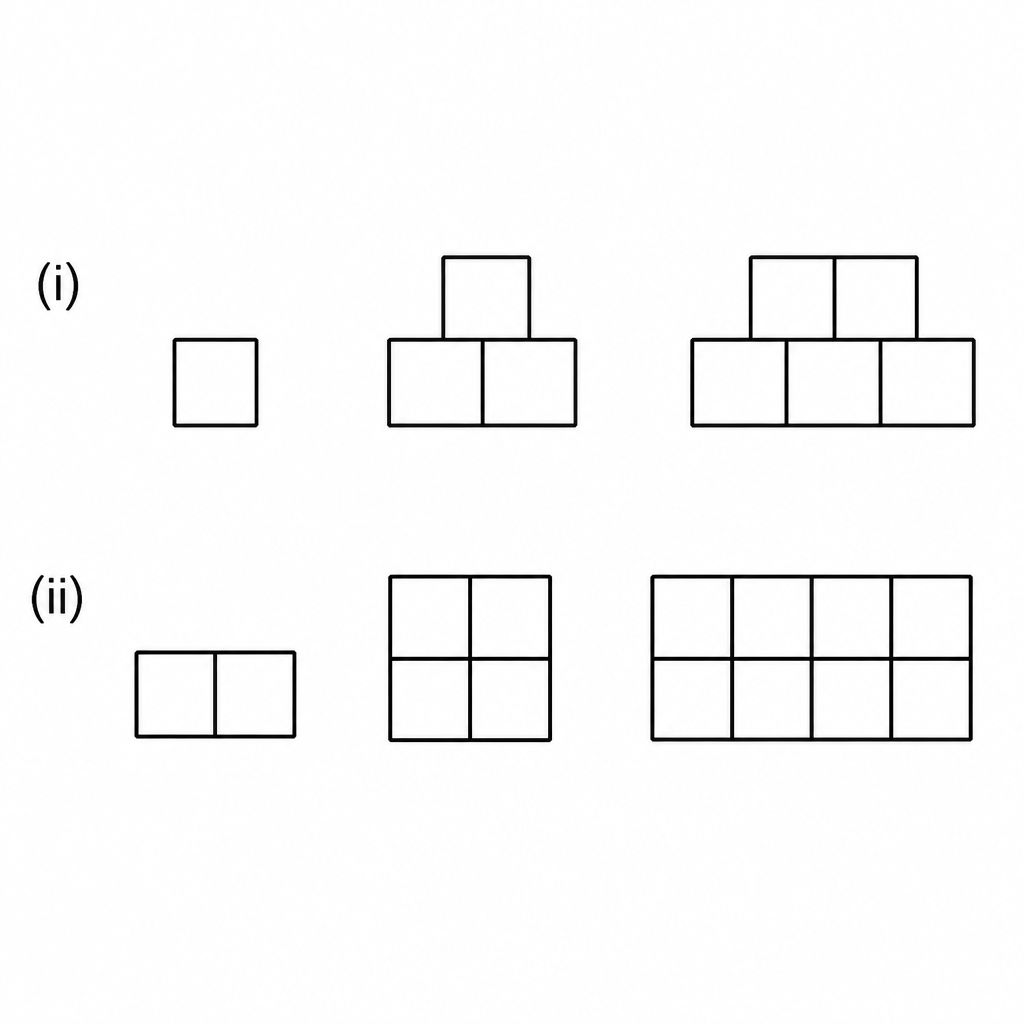
Study the two patterns and think about these questions:
- (a) Can you draw the next two figures of each pattern?
- (b) How many blocks are there in each figure?
- (c) How are the numbers of blocks increasing?
- (d) What rule connects each number to the one before it?
In pattern (i) the figures have 1, 3 and 5 blocks. Each new figure gets a new bottom row that is one block longer than before, and the old rows move up, so the figure gains 2 blocks. The next two figures have 7 and 9 blocks. The rule is: add 2.
In pattern (ii) the figures have 2, 4 and 8 blocks. Each figure is two copies of the one before it joined together, so the number of blocks doubles. The next two figures have 16 and 32 blocks. The rule is: multiply by 2.
Both lists of numbers, 1, 3, 5, 7, 9, ... and 2, 4, 8, 16, 32, ..., are made by a fixed rule. A list of numbers like this is called a sequence.
Sequence and Series
Sequence: A set of numbers formed under a definite mathematical rule is called a sequence. For example, 1, 3, 5, 7, ... and 2, 4, 8, 16, ... are sequences.
Term: Each number in a sequence is called a term. The first term is written \( t_1 \), the second term \( t_2 \), the third term \( t_3 \), and the term in the nth place is written \( t_n \).
The dots at the end of a sequence mean that it carries on in the same way. The rule decides every term, including the ones that are not written. In 1, 3, 5, 7, ... the rule "add 2" tells us that \( t_5 = 9 \) and \( t_6 = 11 \) even though they are not shown.
Series: The sum of the terms of a sequence is called a series. The sum of the first n terms of a series is denoted by \( S_n \).
The sequence 1, 3, 5, 7, ... gives the series 1 + 3 + 5 + 7 + .... The sequence 2, 4, 8, 16, ... gives the series 2 + 4 + 8 + 16 + .... The terms of a sequence are separated by commas, while the terms of a series are joined by plus signs. A sequence is a list; a series is a sum.
Arithmetic Sequence
Here are three sequences. Try to write the next term of each one before reading on.
- (i) 1, 2, 3, 4, ...
- (ii) 100, 70, 40, 10, ...
- (iii) -3, -2, -1, 0, ...
In (i), each term is 1 more than the term before it, so the next term is 5. In (ii), each term is 30 less than the term before it, so the next term is \( 10 - 30 = -20 \). In (iii), each term is found by adding 1 to the term before it, so the next term is 1.
| Sequence | Rule | Next term |
| 1, 2, 3, 4, ... | add 1 | 5 |
| 100, 70, 40, 10, ... | subtract 30 | -20 |
| -3, -2, -1, 0, ... | add 1 | 1 |
In all three sequences, each term is made by adding the same fixed number to the term before it. In (ii) that fixed number is -30, because subtracting 30 is the same as adding -30. Sequences built this way have a special name.
Arithmetic Sequence: A sequence is called an arithmetic sequence or arithmetic progression if the difference between a term and the term before it is constant throughout the whole sequence. It is denoted by AP.
The sequence 2, 4, 8, 16, ... from pattern (ii) is not an AP. Its differences are 2, 4, 8, ..., and they keep changing. The sequence 1, 3, 5, 7, ... from pattern (i) is an AP, because the difference is always 2.
Common Difference
Common Difference: The constant difference obtained by subtracting a term from the term that comes after it is called the common difference of an arithmetic sequence. It is denoted by d.
\[ d = t_2 - t_1 = t_3 - t_2 = t_n - t_{n-1} \]
For 1, 2, 3, 4, ... the common difference is \( 2 - 1 = 3 - 2 = 4 - 3 = 1 \). For 100, 70, 40, 10, ... it is \( 70 - 100 = -30 \). For -3, -2, -1, 0, ... it is \( -2 - (-3) = 1 \).
The common difference can be positive or negative. When d is positive the terms go up, and when d is negative the terms come down.
Always subtract the earlier term from the later term. For 100, 70, 40, ... working out 100 - 70 gives 30, which has the wrong sign. The common difference is 70 - 100 = -30.
Arithmetic Series: The series formed by adding the terms of an arithmetic sequence is called the arithmetic series associated with that sequence. For example, 1 + 2 + 3 + 4 + ... is the arithmetic series associated with the arithmetic sequence 1, 2, 3, 4, ....
Testing Whether a Sequence Is an AP
To decide whether a sequence is an AP, find the difference between every pair of neighbouring terms, always later term minus earlier term. If all the differences are equal, the sequence is an AP and that equal value is d. If even one difference is not equal to the others, the sequence is not an AP.
Example: Is 4, 9, 14, 19, ... an AP? The differences are \( 9 - 4 = 5 \), \( 14 - 9 = 5 \) and \( 19 - 14 = 5 \). They are all equal, so it is an AP with \( d = 5 \).
Example: Is 2, 5, 9, 14, ... an AP? The differences are \( 5 - 2 = 3 \), \( 9 - 5 = 4 \) and \( 14 - 9 = 5 \). They are not equal, so it is not an AP. It still has a rule, since the differences grow by 1, so it is a sequence, but not an arithmetic one.
General Term or nth Term of an AP
Let the first term of an AP be a and its common difference be d. Starting at a and adding d again and again gives the terms:
\[ a,\; a + d,\; a + 2d,\; a + 3d,\; \ldots \]
Now match each term with its position. Let \( t_1, t_2, t_3, t_4, \ldots, t_n \) be the first, second, third, fourth, ..., nth terms. Then:
\[ t_1 = a = a + (1 - 1)d \]
\[ t_2 = a + d = a + (2 - 1)d \]
\[ t_3 = a + 2d = a + (3 - 1)d \]
\[ t_4 = a + 3d = a + (4 - 1)d \]
\[ \vdots \]
\[ t_n = a + (n - 1)d \]
Think of each d as one jump. The first term needs no jump, the second needs 1 jump, the third needs 2 jumps and the fourth needs 3 jumps. The number of jumps is always one less than the position of the term, so the nth term needs \( (n - 1) \) jumps of d.
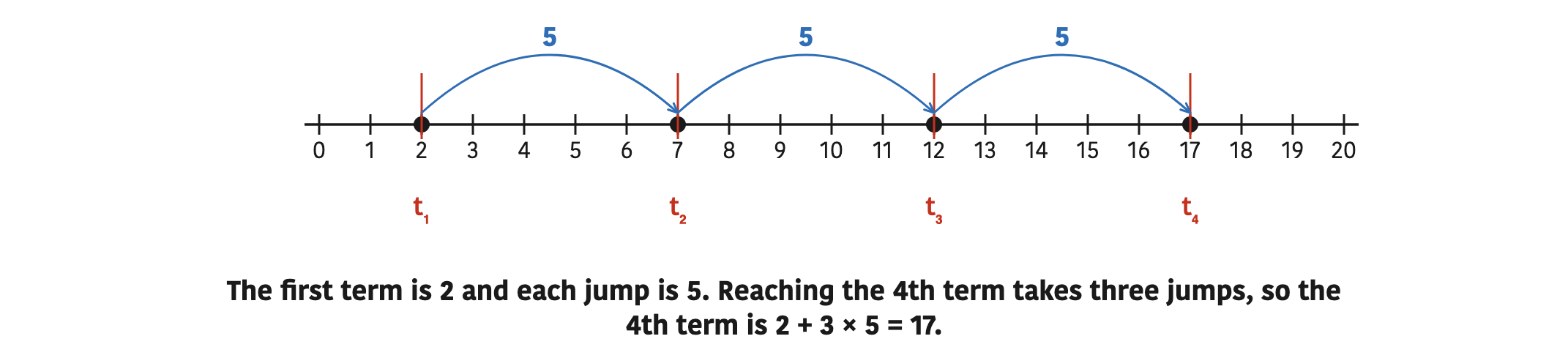
General Term: The nth term of an AP, also called its general term, is \( t_n = a + (n - 1)d \), where a is the first term, d is the common difference and n is the position of the term.
\[ t_n = a + (n - 1)d \]
What is the least information needed to know an AP completely? The first term alone is not enough: 5, 6, 7, ... and 5, 10, 15, ... both begin with 5. The common difference alone is not enough either: 1, 3, 5, ... and 10, 12, 14, ... both have \( d = 2 \). We need both the first term a and the common difference d. Once these two are known, the formula gives every term of the AP.
The two formulae of this topic are:
- General term or nth term: \( t_n = a + (n - 1)d \)
- Common difference: \( d = t_2 - t_1 = t_3 - t_2 = t_n - t_{n-1} \)
Finding the Common Difference
Example: Write the common difference of the arithmetic sequence 20, 25, 30, 35, ....
Step 1: Writing the formula for the common difference:
\[ d = t_2 - t_1 \]
Step 2: Putting in the second term 25 and the first term 20:
\[ d = 25 - 20 = 5 \]
The next pair agrees, since \( 30 - 25 = 5 \). So the common difference is 5.
Finding Any Term
Example: Find the 20th term of the AP 2, 7, 12, ....
Step 1: Reading the first term:
\[ a = 2 \]
Step 2: Working out the common difference from the first two terms:
\[ d = t_2 - t_1 = 7 - 2 = 5 \]
Step 3: Writing the general term with \( n = 20 \):
\[ t_{20} = a + (20 - 1)d \]
Step 4: Putting \( a = 2 \) and \( d = 5 \) into it:
\[ t_{20} = 2 + 19 \times 5 \]
Step 5: Multiplying first, then adding:
\[ t_{20} = 2 + 95 = 97 \]
So the 20th term of the AP is 97. The same method works when d is negative. For 40, 37, 34, ..., we have \( a = 40 \) and \( d = -3 \), so \( t_{12} = 40 + 11 \times (-3) = 40 - 33 = 7 \).
Multiply d by (n - 1), not by n. Using 20 × 5 instead of 19 × 5 above gives 102, which is the 21st term, not the 20th.
Finding the Common Difference from Two Terms
Example: The first and fifth terms of an AP are 50 and 30. Find its common difference.
Here \( a = 50 \), \( t_5 = 30 \) and \( n = 5 \). We have to find d.
Step 1: Writing the general term for the fifth term:
\[ t_5 = a + (5 - 1)d \]
Step 2: Putting in \( t_5 = 30 \) and \( a = 50 \):
\[ 30 = 50 + 4d \]
Step 3: Subtracting 50 from both sides:
\[ 30 - 50 = 4d \]
\[ -20 = 4d \]
Step 4: Dividing both sides by 4:
\[ d = \frac{-20}{4} = -5 \]
The common difference is -5. It is negative because the terms fall from 50 to 30. Written out, the AP is 50, 45, 40, 35, 30, ..., and the fifth term really is 30.
Finding Which Term a Number Is
Example: 21, 18, 15, ... is an arithmetic sequence. Find the value of n for which \( t_n = -81 \), and find n for which \( t_n = 0 \). Justify the second answer.
Step 1: Reading the first term and working out the common difference:
\[ a = 21 \]
\[ d = t_2 - t_1 = 18 - 21 = -3 \]
Step 2: Putting \( t_n = -81 \), \( a = 21 \) and \( d = -3 \) into the general term:
\[ -81 = 21 + (n - 1)(-3) \]
Step 3: Subtracting 21 from both sides:
\[ -102 = (n - 1)(-3) \]
Step 4: Dividing both sides by -3:
\[ n - 1 = \frac{-102}{-3} = 34 \]
Step 5: Adding 1 to both sides:
\[ n = 35 \]
So -81 is the 35th term. Now repeat the method with \( t_n = 0 \).
Step 6: Putting \( t_n = 0 \) into the general term:
\[ 0 = 21 + (n - 1)(-3) \]
Step 7: Subtracting 21 and dividing by -3:
\[ n - 1 = \frac{-21}{-3} = 7 \]
Step 8: Adding 1:
\[ n = 8 \]
So the 8th term is 0. This makes sense: the sequence decreases by 3 each time, and writing it out gives 21, 18, 15, 12, 9, 6, 3, 0. The eighth number in that list is zero.
Finding an AP from Two of Its Terms
Example: Find the AP whose 3rd term is 5 and 7th term is 9.
Step 1: Writing the 3rd term using the general term with \( n = 3 \):
\[ a + 2d = 5 \quad \ldots (i) \]
Step 2: Writing the 7th term using the general term with \( n = 7 \):
\[ a + 6d = 9 \quad \ldots (ii) \]
Step 3: Subtracting equation (i) from equation (ii), so that a cancels out:
\[ 4d = 4 \]
\[ d = 1 \]
Step 4: Putting \( d = 1 \) back into equation (i) to find a:
\[ a = 5 - 2 \times 1 = 3 \]
Step 5: Building the terms from \( a = 3 \) and \( d = 1 \):
\[ t_2 = a + d = 3 + 1 = 4 \]
\[ t_3 = a + 2d = 3 + 2 = 5 \]
So the required AP is 3, 4, 5, 6, .... Check: the 7th term is \( 3 + 6 \times 1 = 9 \), as it should be. Notice why subtracting works: from the 3rd term to the 7th term there are 4 jumps, so the 4 extra units must be 4 jumps of d.
Checking Whether a Number Is a Term
Example: Check whether 301 is a term of the arithmetic sequence 5, 11, 17, 23, ....
Step 1: Reading the first term and working out the common difference:
\[ a = 5 \]
\[ d = 11 - 5 = 6 \]
Step 2: Supposing 301 is the nth term and putting it into the general term:
\[ 301 = 5 + (n - 1) \times 6 \]
Step 3: Opening the bracket:
\[ 301 = 5 + 6n - 6 \]
Step 4: Adding 1 to both sides, since \( 5 - 6 = -1 \):
\[ 302 = 6n \]
Step 5: Dividing both sides by 6:
\[ n = \frac{302}{6} = \frac{151}{3} \]
But n is the position of a term, so it must be a positive whole number. There is a 50th term and a 51st term, but no "50 and one third"th term. Since \( \frac{151}{3} \) is not a whole number, 301 is not a term of this sequence. Indeed, the 50th term is 299 and the 51st term is 305, and 301 falls between them.
n counts positions, so it must be a positive whole number: 1, 2, 3, and so on. If n comes out as a fraction, zero or a negative number, the given number is not a term of the sequence.
Three Terms in AP
If three numbers are in AP, the second minus the first equals the third minus the second, because both differences are the common difference d.
Example: If \( k + 1 \), \( k + 5 \) and \( 3k + 1 \) are in AP, find the value of k and the three terms.
Step 1: Setting the two differences equal:
\[ (k + 5) - (k + 1) = (3k + 1) - (k + 5) \]
Step 2: Removing the brackets and collecting like terms on each side:
\[ 4 = 2k - 4 \]
Step 3: Adding 4 to both sides and dividing by 2:
\[ k = \frac{8}{2} = 4 \]
Step 4: Putting \( k = 4 \) into each expression to get the three terms:
\[ k + 1 = 4 + 1 = 5 \]
\[ k + 5 = 4 + 5 = 9 \]
\[ 3k + 1 = 3 \times 4 + 1 = 13 \]
So \( k = 4 \) and the three terms are 5, 9 and 13. They differ by 4 each time, which confirms that they are in AP.
When the nth Term Is Given as an Expression
Sometimes the nth term is given directly as an expression in n. Putting \( n = 1, 2, 3, \ldots \) into it produces the terms, and the common difference follows.
Example: The nth term of an AP is \( 4n - 3 \). Find the common difference.
Step 1: Putting \( n = 1 \) to get the first term:
\[ t_1 = 4 \times 1 - 3 = 1 \]
Step 2: Putting \( n = 2 \) to get the second term:
\[ t_2 = 4 \times 2 - 3 = 5 \]
Step 3: Subtracting the first term from the second:
\[ d = t_2 - t_1 = 5 - 1 = 4 \]
The same answer comes from any two neighbouring terms. Replacing n by \( n - 1 \) gives \( t_{n-1} = 4n - 7 \), and then:
\[ t_n - t_{n-1} = (4n - 3) - (4n - 7) = 4 \]
When the nth term has the form \( t_n = pn + q \), the common difference is p, the number that multiplies n.
Arithmetic Sequences in Daily Life
Anything that grows or shrinks by the same amount each time forms an AP: a salary with a fixed yearly rise, rows of seats that each hold two more seats than the row in front, or weekly savings that go up by a fixed sum. The general term then answers questions about the future.
Example: Sita saves Rs. 50 in the first week. Each week after that she saves Rs. 15 more than the week before. In which week will she save Rs. 200?
Step 1: Recognising the AP: the weekly savings are 50, 65, 80, ..., so \( a = 50 \), \( d = 15 \) and \( t_n = 200 \). Putting these into the general term:
\[ 200 = 50 + (n - 1) \times 15 \]
Step 2: Subtracting 50 from both sides:
\[ 150 = (n - 1) \times 15 \]
Step 3: Dividing both sides by 15:
\[ n - 1 = 10 \]
Step 4: Adding 1 to both sides:
\[ n = 11 \]
Sita saves Rs. 200 in the 11th week. In a problem about years, count the starting year as the first term: if a salary begins in 2019, then 2019 is year 1, 2020 is year 2, and so on.
The full lesson is waiting for you
The notes are free to read in full. A free account opens the rest of the practice, and tracks your progress and confidence score for every subject. Presentations and videos need approval from Learn Yeti.