Terms Between the First and the Last
Here are two arithmetic sequences. In each one, the same number is added every time to get the next term.
\[ 5,\ 10,\ 15 \]
\[ 4,\ 8,\ 12,\ 16,\ 20 \]
In the first sequence the common difference is 5. Only one term stands between the first term 5 and the last term 15, and that term is 10. In the second sequence the common difference is 4, and three terms stand between the first term 4 and the last term 20. They are 8, 12 and 16. The terms standing inside, away from the two ends, have a special name. In the first sequence, 10 is called the arithmetic mean. In the second sequence, 8, 12 and 16 are called the arithmetic means.
Arithmetic mean (AM): The terms between the first term and the last term of an arithmetic progression are called arithmetic means. An arithmetic mean is written in short as AM.
The two end terms are never counted as means. A sequence of 3 terms has 1 mean, and a sequence of 5 terms has 3 means. So if an AP holds n means, the whole AP has n + 2 terms: the n means together with the first term and the last term. This small count is used in every problem of this topic.
Inserting arithmetic means: To insert n arithmetic means between two numbers a and b is to find n numbers which, placed between a and b, make a, (the n numbers), b an arithmetic progression.
Putting means between two numbers is the same job as building an AP that starts at the first number and finishes at the second. Find the common difference and the means follow.
Arithmetic Mean Between Two Numbers
Suppose we want just one number m that fits between two numbers a and b so that a, m, b is an AP. In an AP the gap from each term to the next is the same, so the gap from a up to m must equal the gap from m up to b. That fact alone gives the formula.
Step 1: Since a, m, b are in AP, the second term minus the first equals the third term minus the second, that is \( t_2 - t_1 = t_3 - t_2 \). So:
\[ m - a = b - m \]
Step 2: Adding m and a to both sides, so that every m is on the left:
\[ m + m = a + b \]
Step 3: Collecting the two m's into one term:
\[ 2m = a + b \]
Step 4: Dividing both sides by 2:
\[ m = \frac{a+b}{2} \]
One arithmetic mean between a and b is \( \frac{a+b}{2} \): add the two numbers and halve the sum. It always lands exactly halfway between them.
Here is the formula at work on the numbers 7 and 19.
Step 1: Putting \( a = 7 \) and \( b = 19 \) into the formula:
\[ AM = \frac{7 + 19}{2} \]
Step 2: Adding the numerator and dividing by 2:
\[ AM = \frac{26}{2} = 13 \]
The sequence 7, 13, 19 goes up by 6 and then by 6 again, so 13 really is the arithmetic mean. The same formula also tells us something useful about any three consecutive terms of an AP: the middle one is always the arithmetic mean of the two beside it.
Inserting n Arithmetic Means Between a and b
Now suppose we want several means, not just one. Let \( m_1, m_2, m_3, \ldots, m_n \) be n arithmetic means between a and b. Then the whole list below is an arithmetic sequence:
\[ a,\ m_1,\ m_2,\ \ldots,\ m_n,\ b \]
Let d be its common difference. The number of terms is the number of means plus 2, which is n + 2. The first term is a, and the last term, which is the \( (n+2) \)th term, is b. The general term of an AP is \( t_n = a + (n-1)d \). Here the last term is term number n + 2, so n + 2 takes the place of n.
Step 1: Writing the last term b using the general term formula with n + 2 terms:
\[ b = a + (n + 2 - 1)d \]
Step 2: Simplifying the bracket and moving a to the left side:
\[ b - a = (n + 1)d \]
Step 3: Dividing both sides by n + 1:
\[ d = \frac{b-a}{n+1} \]
In this formula a is the first number, b is the last number and n is the number of means being inserted. Once d is known, each mean is found by adding d to a the right number of times. The first mean is the second term of the AP, the second mean is the third term, and so on, so the kth mean is always one term further along than its own number.
| Mean | Term of the AP | Value |
| First mean \( m_1 \) | \( t_2 \) | \( a + d = a + \frac{b-a}{n+1} \) |
| Second mean \( m_2 \) | \( t_3 \) | \( a + 2d = a + 2\left(\frac{b-a}{n+1}\right) \) |
| Third mean \( m_3 \) | \( t_4 \) | \( a + 3d = a + 3\left(\frac{b-a}{n+1}\right) \) |
| nth mean \( m_n \) | \( t_{n+1} \) | \( a + nd = a + n\left(\frac{b-a}{n+1}\right) \) |
In \( d = \frac{b-a}{n+1} \), n is the number of MEANS, not the number of terms. Five means between two numbers make an AP of seven terms, so you divide by 6, never by 5 and never by 7. Also, the 5th mean is the 6th term, not the 5th term.
Important Formulae
- An arithmetic mean between a and b: \( AM = \frac{a+b}{2} \)
- Common difference when n means are inserted between a and b: \( d = \frac{b-a}{n+1} \)
- First mean: \( m_1 = a + d \)
- Second mean: \( m_2 = a + 2d \), and so on, up to the nth mean \( m_n = a + nd \)
Worked Example 1: The Mean of Two Algebraic Expressions
Find the arithmetic mean between \( (m-n)^2 \) and \( (m+n)^2 \). The formula works for expressions exactly as it works for numbers. Here the first term is \( a = (m-n)^2 \) and the last term is \( b = (m+n)^2 \), and we need one AM.
Step 1: Putting a and b into the formula for one arithmetic mean:
\[ AM = \frac{(m-n)^2 + (m+n)^2}{2} \]
Step 2: Expanding the first square:
\[ (m-n)^2 = m^2 - 2mn + n^2 \]
Step 3: Expanding the second square:
\[ (m+n)^2 = m^2 + 2mn + n^2 \]
Step 4: Adding the two expansions in the numerator. The terms \( -2mn \) and \( +2mn \) cancel:
\[ AM = \frac{2m^2 + 2n^2}{2} \]
Step 5: Taking 2 common from the numerator and cancelling it with the 2 below:
\[ AM = \frac{2(m^2 + n^2)}{2} = m^2 + n^2 \]
So the arithmetic mean is \( m^2 + n^2 \).
Worked Example 2: A Missing Middle Term
The 12th and 14th terms of an AP are -7 and 23. Find the 13th term. There is no need to find the first term or the common difference. The 13th term sits between the 12th and the 14th, so these three are consecutive terms of an AP, and the middle one is the arithmetic mean of the other two.
Step 1: Writing the 13th term as the mean of its two neighbours:
\[ t_{13} = \frac{t_{12} + t_{14}}{2} \]
Step 2: Substituting \( t_{12} = -7 \) and \( t_{14} = 23 \):
\[ t_{13} = \frac{-7 + 23}{2} \]
Step 3: Adding the numerator and dividing by 2:
\[ t_{13} = \frac{16}{2} = 8 \]
So the 13th term is 8. As a check, -7 to 8 is a rise of 15, and 8 to 23 is also a rise of 15.
Worked Example 3: Filling the Gaps in an AP
Find p, q and r if 3, p, q, r, 27 are in AP. The letters p, q and r are three arithmetic means between 3 and 27. So the first term is \( a = 3 \), the last term is \( b = 27 \) and the number of means is \( n = 3 \).
Step 1: Putting these values into the formula for the common difference:
\[ d = \frac{b-a}{n+1} = \frac{27-3}{3+1} \]
Step 2: Simplifying the fraction:
\[ d = \frac{24}{4} = 6 \]
Step 3: The first mean is a plus one common difference:
\[ p = m_1 = a + d = 3 + 6 = 9 \]
Step 4: The second mean is a plus two common differences:
\[ q = m_2 = a + 2d = 3 + 2 \times 6 = 15 \]
Step 5: The third mean is a plus three common differences:
\[ r = m_3 = a + 3d = 3 + 3 \times 6 = 21 \]
Hence \( p = 9 \), \( q = 15 \) and \( r = 21 \). The full AP is 3, 9, 15, 21, 27.
Worked Example 4: Inserting Five Means
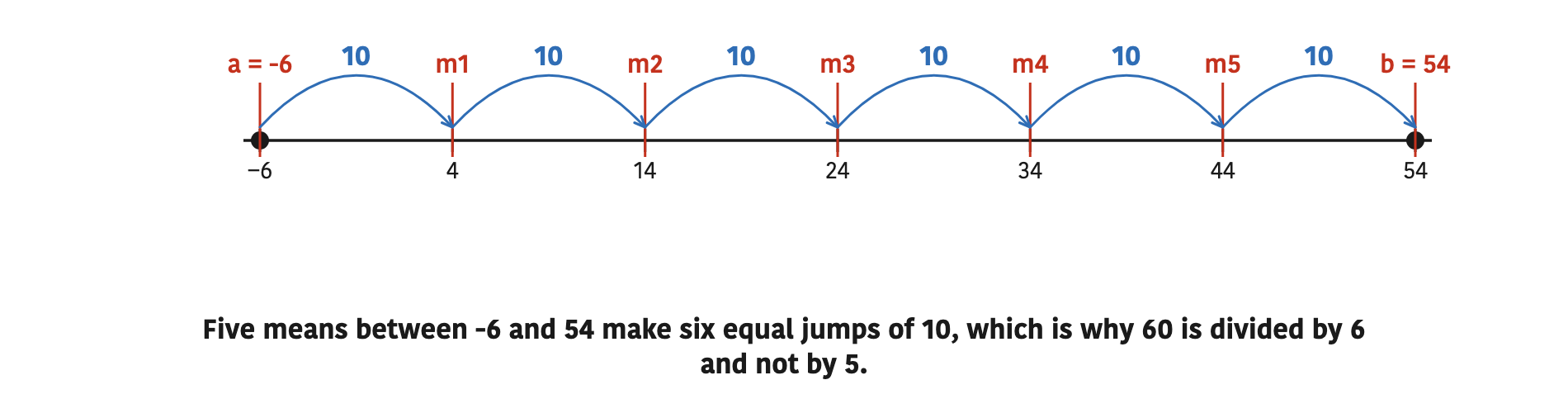
Insert 5 arithmetic means between -6 and 54. Let \( m_1, m_2, m_3, m_4, m_5 \) be the five means, so that -6, \( m_1, m_2, m_3, m_4, m_5 \), 54 are in AP. The first term is \( a = -6 \), the last term is \( b = 54 \) and the number of means is \( n = 5 \).
Step 1: Putting these values into the formula for the common difference. Subtracting -6 is the same as adding 6:
\[ d = \frac{54 - (-6)}{5+1} = \frac{54 + 6}{6} \]
Step 2: Simplifying the fraction:
\[ d = \frac{60}{6} = 10 \]
Step 3: Finding each mean by adding the right number of common differences to a:
| Mean | Working | Value |
| First mean \( m_1 \) | \( a + d = -6 + 10 \) | 4 |
| Second mean \( m_2 \) | \( a + 2d = -6 + 2 \times 10 \) | 14 |
| Third mean \( m_3 \) | \( a + 3d = -6 + 3 \times 10 \) | 24 |
| Fourth mean \( m_4 \) | \( a + 4d = -6 + 4 \times 10 \) | 34 |
| Fifth mean \( m_5 \) | \( a + 5d = -6 + 5 \times 10 \) | 44 |
So the five arithmetic means are 4, 14, 24, 34 and 44. On a number line they cut the stretch from -6 to 54 into six equal jumps.
Worked Example 5: Finding the Number of Means from a Ratio
n arithmetic means are inserted between 20 and 5. The ratio of the third mean to the last mean is 31 : 13. Find n. Here \( a = 20 \) and \( b = 5 \), and n is unknown, so d and every mean will be written in terms of n. Then the given ratio becomes an equation in n.
Step 1: Writing the common difference in terms of n:
\[ d = \frac{b-a}{n+1} = \frac{5-20}{n+1} = \frac{-15}{n+1} \]
When the last number is smaller than the first, b - a is negative, so d is negative and the means get smaller one after another. Always subtract in the order b - a and keep the minus sign.
Step 2: The third mean is a plus three common differences:
\[ m_3 = a + 3d = 20 + 3\left(\frac{-15}{n+1}\right) \]
Step 3: Writing \( m_3 \) over the single denominator n + 1 and simplifying:
\[ m_3 = \frac{20(n+1) - 45}{n+1} = \frac{20n - 25}{n+1} \]
Step 4: The last mean is the nth mean, which is a plus n common differences:
\[ m_n = a + nd = 20 + n\left(\frac{-15}{n+1}\right) \]
Step 5: Writing \( m_n \) over the denominator n + 1 and simplifying:
\[ m_n = \frac{20n + 20 - 15n}{n+1} = \frac{5n + 20}{n+1} \]
Step 6: Using the given ratio \( m_3 : m_n = 31 : 13 \). Both means have the same denominator n + 1, so it cancels:
\[ \frac{20n - 25}{5n + 20} = \frac{31}{13} \]
Step 7: Taking 5 common from the top and the bottom and cancelling it:
\[ \frac{5(4n - 5)}{5(n + 4)} = \frac{4n - 5}{n + 4} = \frac{31}{13} \]
Step 8: Cross multiplying:
\[ 52n - 65 = 31n + 124 \]
Step 9: Collecting the n terms on the left and the numbers on the right:
\[ 21n = 189 \]
Step 10: Dividing both sides by 21:
\[ n = 9 \]
So 9 means were inserted. To check, with \( n = 9 \) the common difference is \( \frac{-15}{10} = -1.5 \). The third mean is \( 20 - 4.5 = 15.5 \) and the ninth mean is \( 20 - 13.5 = 6.5 \). Doubling both gives 31 and 13, so the ratio is 31 : 13, exactly as given.
Checking Your Means
Every answer in this topic can be checked in a few seconds, and the check catches most mistakes. Add the common difference once more to the last mean you found. You must land exactly on b. In Worked Example 4 the last mean was 44, and 44 + 10 = 54, which is b. In Worked Example 3 the last mean was 21, and 21 + 6 = 27, which is b. If you land somewhere else, you have almost certainly divided by the wrong number, usually n or n + 2 instead of n + 1.
- Count the means: the number of means is n, and the AP has n + 2 terms.
- Find d from \( d = \frac{b-a}{n+1} \), keeping its sign.
- Build the means as a + d, a + 2d, and so on up to a + nd.
- Check that the last mean plus d equals b.
The full lesson is waiting for you
The notes are free to read in full. A free account opens the rest of the practice, and tracks your progress and confidence score for every subject. Presentations and videos need approval from Learn Yeti.