From a Room's Area to an Equation
A school is putting carpet in its rectangular office room, and exactly 80 m² of carpet covers the whole floor. What are the length and the breadth of the room? Try a few answers. A room 10 m long and 8 m wide has an area of 80 m². So does a room 16 m long and 5 m wide, and so does one measuring 20 m by 4 m. Many different rectangles share the same area, so the area alone cannot tell us the size of the room.
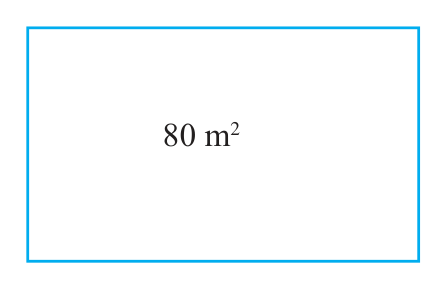
Now add one more fact: the length of the room is 2 m more than its breadth. This second fact settles the answer. Let the breadth of the room be \( x \) m. Then the length is \( (x + 2) \) m, and since the area of a rectangle is length × breadth:
\[ (x + 2)x = 80 \]
Multiplying out the bracket gives \( x^2 + 2x = 80 \). Subtracting 80 from both sides, so that one side is zero:
\[ x^2 + 2x - 80 = 0 \]
This equation is different from linear equations such as \( 3x - 5 = 10 \), because the variable appears squared. In earlier classes you learned to factorise expressions such as \( x^2 + 2x - 80 \). That same skill is what solves equations like this one, and it will give the real length and breadth of this room.
What Is a Quadratic Equation?
The degree of an equation is the highest power of its variable. In \( 3x - 5 = 10 \) the highest power of \( x \) is 1, so it is a first degree, or linear, equation. In \( x^2 + 2x - 80 = 0 \) the highest power is 2, so it is a second degree equation. A second degree equation in one variable has a special name.
Quadratic equation: a second degree equation in one variable. Its standard form is \( ax^2 + bx + c = 0 \), where \( a \), \( b \) and \( c \) are numbers and \( a \neq 0 \).
\[ ax^2 + bx + c = 0, \quad a \neq 0 \]
In this form, \( a \) is the coefficient of \( x^2 \), \( b \) is the coefficient of \( x \), and \( c \) is the constant term. The condition \( a \neq 0 \) matters. If \( a \) were 0, the \( x^2 \) term would vanish and only \( bx + c = 0 \) would be left, which is a linear equation. The numbers \( b \) and \( c \), however, are allowed to be zero. The equation \( x^2 + 4x = 0 \) has no constant term and \( x^2 - 9 = 0 \) has no \( x \) term, yet both are quadratic.
| Equation | a | b | c |
| \( x^2 + 2x - 80 = 0 \) | 1 | 2 | \( -80 \) |
| \( 2x^2 + x - 300 = 0 \) | 2 | 1 | \( -300 \) |
| \( x^2 + 4x = 0 \) | 1 | 4 | 0 |
| \( x^2 - x - 6 = 0 \) | 1 | \( -1 \) | \( -6 \) |
| \( 2x^2 + 7x + 6 = 0 \) | 2 | 7 | 6 |
Notice that in \( x^2 - x - 6 = 0 \) the coefficient of \( x \) is \( -1 \), since \( -x \) means \( -1 \times x \). A coefficient is always read together with its sign.
Root: a value of the variable that makes the equation true, that is, makes its left side equal to zero. A quadratic equation has two values of the variable that satisfy it.
For example, \( x = 8 \) is a root of \( x^2 + 2x - 80 = 0 \) because \( 8^2 + 2 \times 8 - 80 = 64 + 16 - 80 = 0 \). Solving a quadratic equation means finding both of its roots.
The Zero Product Rule
Think about two numbers whose product is zero. If one of them is 7, the other must be 0, because 7 times any other number is not zero. Two numbers that are both non-zero can never multiply to give zero. So whenever a product is zero, at least one of its factors must itself be zero.
Zero product rule: if the product of two factors is zero, then at least one of the factors is zero. In symbols, if \( p \times q = 0 \), then \( p = 0 \) or \( q = 0 \).
This rule is the key to the factorization method. When a quadratic equation has zero on one side and the other side is factorised into two brackets, the rule turns one hard equation into two easy linear ones. For instance, if \( (x + 10)(x - 8) = 0 \), then either \( x + 10 = 0 \) or \( x - 8 = 0 \), which gives \( x = -10 \) or \( x = 8 \).
The rule works only when the product equals zero. From \( (x - 1)(x - 2) = 6 \) you cannot say \( x - 1 = 6 \), because 6 can come from many products such as \( 3 \times 2 \) or \( 1 \times 6 \). First move every term to one side so that the other side is 0, and only then factorise.
Splitting the Middle Term
To factorise \( ax^2 + bx + c \), the middle term \( bx \) is broken into two terms. The two numbers used for the break are chosen so that:
- their product equals \( a \times c \), the coefficient of \( x^2 \) times the constant term;
- their sum equals \( b \), the coefficient of \( x \).
Once the middle term is split, the four terms are grouped in pairs and a common factor is taken out of each pair. If the numbers were chosen correctly, both pairs leave the same bracket behind. That bracket is then taken out as a common factor, and the expression becomes a product of two brackets.
Factorization method: a way of solving a quadratic equation by writing it as \( ax^2 + bx + c = 0 \), factorising the left side into two linear factors, and setting each factor equal to zero.
The signs of \( a \times c \) and \( b \) tell you the signs of the two numbers before you start searching:
| \( a \times c \) | \( b \) | The two numbers | Example |
| positive | positive | both positive | \( x^2 + 6x + 8 \): 4 and 2 |
| positive | negative | both negative | \( x^2 - 5x + 6 \): \( -3 \) and \( -2 \) |
| negative | positive | opposite signs, the larger one positive | \( x^2 + 2x - 80 \): 10 and \( -8 \) |
| negative | negative | opposite signs, the larger one negative | \( x^2 - x - 6 \): \( -3 \) and 2 |
To split the middle term, look for two numbers whose product is \( a \times c \) and whose sum is \( b \). Write the factor pairs of \( a \times c \) in order and test each pair until the sum is right.
Solving the Office Room Problem
Now the room equation can be solved. Here \( a = 1 \), \( b = 2 \) and \( c = -80 \), so we need two numbers with product \( 1 \times (-80) = -80 \) and sum 2. The product is negative, so the numbers have opposite signs. The sum is positive, so the larger one is positive. Among the factor pairs of 80, the pair 10 and 8 differs by 2, so the numbers are 10 and \( -8 \).
Step 1: The equation in standard form:
\[ x^2 + 2x - 80 = 0 \]
Step 2: Splitting \( 2x \) as \( 10x - 8x \):
\[ x^2 + 10x - 8x - 80 = 0 \]
Step 3: Taking \( x \) common from the first pair and \( -8 \) common from the second pair:
\[ x(x + 10) - 8(x + 10) = 0 \]
Step 4: Taking out the common bracket \( (x + 10) \):
\[ (x + 10)(x - 8) = 0 \]
Step 5: By the zero product rule, setting the first bracket equal to zero:
\[ x + 10 = 0 \Rightarrow x = -10 \]
Step 6: Or setting the second bracket equal to zero:
\[ x - 8 = 0 \Rightarrow x = 8 \]
The equation has two roots, \( -10 \) and 8. But \( x \) stands for the breadth of a room, and a breadth of \( -10 \) m is not possible, so that root is rejected. The breadth is 8 m and the length is \( 8 + 2 = 10 \) m. As a check, \( 10 \times 8 = 80 \), which is exactly the area of the carpet.
The Playground Problem
A rectangular playground has an area of 300 m². Its length is 1 m more than twice its breadth. Find its length and breadth.
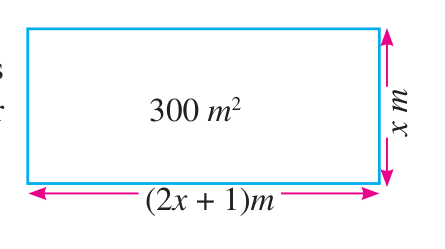
Let the breadth be \( x \) m. Twice the breadth is \( 2x \) m, so the length is \( (2x + 1) \) m.
Step 1: Writing area = length × breadth:
\[ (2x + 1)x = 300 \]
Step 2: Multiplying out and subtracting 300 from both sides:
\[ 2x^2 + x - 300 = 0 \]
This is a quadratic equation with \( a = 2 \), \( b = 1 \) and \( c = -300 \). Now \( a \times c = 2 \times (-300) = -600 \), so we need two numbers whose product is \( -600 \) and whose sum is 1. The product is negative and the sum positive, so the numbers have opposite signs, the larger one is positive, and they differ by 1. Listing some factor pairs of 600:
| Factor pair of 600 | Difference |
| 10 and 60 | 50 |
| 12 and 50 | 38 |
| 15 and 40 | 25 |
| 20 and 30 | 10 |
| 24 and 25 | 1 |
The pair 24 and 25 differs by 1, so the numbers are 25 and \( -24 \). Check: \( 25 \times (-24) = -600 \) and \( 25 + (-24) = 1 \).
Step 3: Splitting \( x \) as \( 25x - 24x \):
\[ 2x^2 + 25x - 24x - 300 = 0 \]
Step 4: Taking \( x \) common from the first pair and \( -12 \) common from the second pair, since \( 24 = 12 \times 2 \) and \( 300 = 12 \times 25 \):
\[ x(2x + 25) - 12(2x + 25) = 0 \]
Step 5: Taking out the common bracket \( (2x + 25) \):
\[ (2x + 25)(x - 12) = 0 \]
Step 6: Setting the first bracket equal to zero:
\[ 2x + 25 = 0 \Rightarrow x = -\frac{25}{2} \]
Step 7: Setting the second bracket equal to zero:
\[ x - 12 = 0 \Rightarrow x = 12 \]
A breadth of \( -\frac{25}{2} \) m is impossible, so the breadth is 12 m. The length is \( 2 \times 12 + 1 = 25 \) m. Check: \( 25 \times 12 = 300 \). The playground is 25 m long and 12 m wide.
Both roots of an equation are correct answers to the equation. In a word problem, a root is rejected only when it makes no sense for the quantity, such as a negative length, breadth, age or number of people.
Checking a Root
A root can always be tested. Put the value in place of \( x \) in the left-hand side (LHS) of the equation and work it out. If the result equals the right-hand side (RHS), which is 0, the value is a root. If it does not, a mistake has been made somewhere.
For example, suppose someone claims that \( x = 4 \) is a root of \( x^2 + 6x + 8 = 0 \). Putting \( x = 4 \), the LHS becomes \( 4^2 + 6 \times 4 + 8 \), which is:
\[ 16 + 24 + 8 = 48 \]
Since 48 is not 0, the LHS does not equal the RHS, and 4 is not a root. Every worked example below checks both of its roots in this way.
Worked Example: No Constant Term
Solve \( x^2 + 4x = 0 \) and check the roots. There is no constant term here, so there is nothing to split. Both terms contain \( x \), and that common factor is taken out directly.
Step 1: Taking \( x \) common from both terms:
\[ x(x + 4) = 0 \]
Step 2: By the zero product rule, the first factor can be zero:
\[ x = 0 \]
Step 3: Or the second factor can be zero:
\[ x + 4 = 0 \Rightarrow x = -4 \]
Checking \( x = 0 \): the LHS becomes \( 0^2 + 4 \times 0 \), which is:
\[ 0 + 0 = 0 \]
Checking \( x = -4 \): the LHS becomes \( (-4)^2 + 4 \times (-4) \), which is:
\[ 16 - 16 = 0 \]
Both values make LHS = RHS, so the roots are 0 and \( -4 \).
Never divide both sides of \( x^2 + 4x = 0 \) by \( x \). It leaves \( x + 4 = 0 \) and only the root \( -4 \), and the root 0 is lost, because dividing by \( x \) quietly assumes that \( x \) is not 0. Take \( x \) out as a factor instead.
Worked Example: All Terms Positive
Solve \( x^2 + 6x + 8 = 0 \) and check the roots. Here \( a \times c = 1 \times 8 = 8 \) and \( b = 6 \). Both are positive, so both numbers are positive. The factor pairs of 8 are 1 and 8, with sum 9, and 2 and 4, with sum 6. So the numbers are 4 and 2.
Step 1: Splitting \( 6x \) as \( 4x + 2x \):
\[ x^2 + 4x + 2x + 8 = 0 \]
Step 2: Taking \( x \) common from the first pair and 2 common from the second pair:
\[ x(x + 4) + 2(x + 4) = 0 \]
Step 3: Taking out the common bracket \( (x + 4) \):
\[ (x + 4)(x + 2) = 0 \]
Step 4: Setting the first bracket equal to zero:
\[ x + 4 = 0 \Rightarrow x = -4 \]
Step 5: Setting the second bracket equal to zero:
\[ x + 2 = 0 \Rightarrow x = -2 \]
Checking \( x = -2 \): the LHS becomes \( (-2)^2 + 6 \times (-2) + 8 \), which is:
\[ 4 - 12 + 8 = 0 \]
Checking \( x = -4 \): the LHS becomes \( (-4)^2 + 6 \times (-4) + 8 \), which is:
\[ 16 - 24 + 8 = 0 \]
So the roots are \( -2 \) and \( -4 \). When every term of the equation is positive, no positive value of \( x \) can make the total zero, so it makes sense that both roots are negative.
Worked Example: A Negative Middle Term
Solve \( x^2 - 5x + 6 = 0 \) and check the roots. The product \( a \times c = 6 \) is positive and \( b = -5 \) is negative, so both numbers are negative. The pair \( -3 \) and \( -2 \) has product 6 and sum \( -5 \).
Step 1: Splitting \( -5x \) as \( -3x - 2x \):
\[ x^2 - 3x - 2x + 6 = 0 \]
Step 2: Taking \( x \) common from the first pair and \( -2 \) common from the second pair:
\[ x(x - 3) - 2(x - 3) = 0 \]
Taking out \( -2 \), and not 2, is what makes the second bracket match the first: \( -2 \times x = -2x \) and \( -2 \times (-3) = +6 \).
Step 3: Taking out the common bracket \( (x - 3) \):
\[ (x - 3)(x - 2) = 0 \]
Step 4: Setting the first bracket equal to zero:
\[ x - 3 = 0 \Rightarrow x = 3 \]
Step 5: Setting the second bracket equal to zero:
\[ x - 2 = 0 \Rightarrow x = 2 \]
Checking \( x = 2 \): the LHS becomes \( 2^2 - 5 \times 2 + 6 \), which is:
\[ 4 - 10 + 6 = 0 \]
Checking \( x = 3 \): the LHS becomes \( 3^2 - 5 \times 3 + 6 \), which is:
\[ 9 - 15 + 6 = 0 \]
Both checks give LHS = RHS, so the roots are 2 and 3.
Worked Example: A Negative Constant Term
Solve \( x^2 - x - 6 = 0 \) and check the roots. Here \( a \times c = 1 \times (-6) = -6 \) and \( b = -1 \). The product is negative, so the numbers have opposite signs. The sum is negative, so the larger one is negative. The pair \( -3 \) and 2 works: \( (-3) \times 2 = -6 \) and \( -3 + 2 = -1 \).
Step 1: Splitting \( -x \) as \( -3x + 2x \):
\[ x^2 - 3x + 2x - 6 = 0 \]
Step 2: Taking \( x \) common from the first pair and 2 common from the second pair:
\[ x(x - 3) + 2(x - 3) = 0 \]
Step 3: Taking out the common bracket \( (x - 3) \):
\[ (x - 3)(x + 2) = 0 \]
Step 4: Setting the first bracket equal to zero:
\[ x - 3 = 0 \Rightarrow x = 3 \]
Step 5: Setting the second bracket equal to zero:
\[ x + 2 = 0 \Rightarrow x = -2 \]
Checking \( x = 3 \): the LHS becomes \( 3^2 - 3 - 6 \), which is:
\[ 9 - 9 = 0 \]
Checking \( x = -2 \): the LHS becomes \( (-2)^2 - (-2) - 6 \), which is:
\[ 4 + 2 - 6 = 0 \]
So the roots are 3 and \( -2 \). Notice how the sign changes when a negative number is subtracted: \( -(-2) = +2 \).
Worked Example: A Leading Coefficient Other Than 1
Solve \( 2x^2 + 7x + 6 = 0 \) and check the roots. Now \( a = 2 \), so the product to look for is \( a \times c = 2 \times 6 = 12 \), not 6. The numbers must have product 12 and sum 7. The factor pairs of 12 are 1 and 12, 2 and 6, and 3 and 4, and only 3 and 4 add up to 7.
Step 1: Splitting \( 7x \) as \( 4x + 3x \):
\[ 2x^2 + 4x + 3x + 6 = 0 \]
Step 2: Taking \( 2x \) common from the first pair and 3 common from the second pair:
\[ 2x(x + 2) + 3(x + 2) = 0 \]
Step 3: Taking out the common bracket \( (x + 2) \):
\[ (x + 2)(2x + 3) = 0 \]
Step 4: Setting the first bracket equal to zero:
\[ x + 2 = 0 \Rightarrow x = -2 \]
Step 5: Setting the second bracket equal to zero, where \( x \) has coefficient 2 and both sides are divided by 2:
\[ 2x + 3 = 0 \Rightarrow x = -\frac{3}{2} \]
Checking \( x = -2 \): the LHS becomes \( 2(-2)^2 + 7 \times (-2) + 6 \), which is:
\[ 8 - 14 + 6 = 0 \]
Checking \( x = -\frac{3}{2} \): the LHS becomes \( 2\left(-\frac{3}{2}\right)^2 + 7\left(-\frac{3}{2}\right) + 6 \). Squaring gives \( \frac{9}{4} \), and \( 2 \times \frac{9}{4} = \frac{9}{2} \), so the LHS is:
\[ \frac{9}{2} - \frac{21}{2} + 6 = -6 + 6 = 0 \]
Both roots check, so the roots of \( 2x^2 + 7x + 6 = 0 \) are \( -2 \) and \( -\frac{3}{2} \). A root does not have to be a whole number.
When \( a \) is not 1, the two numbers must multiply to \( a \times c \), not just to \( c \). Using only \( c = 6 \) here would lead to 6 and 1, with product 6 and sum 7, and the grouping \( 2x^2 + 6x + x + 6 \) gives \( 2x(x + 3) + 1(x + 6) \), whose brackets do not match.
The Factorization Method in Short
Every example above followed the same order. To solve a quadratic equation by factorization:
- Bring every term to one side so that the equation reads \( ax^2 + bx + c = 0 \).
- Find two numbers whose product is \( a \times c \) and whose sum is \( b \).
- Split the middle term using those two numbers.
- Group the terms in pairs and take the common factor out of each pair.
- Take out the common bracket, so that the left side is a product of two factors.
- Set each factor equal to zero and solve the two linear equations.
- Check each root in the original equation, and in a word problem reject any root that cannot be the answer.
The full lesson is waiting for you
The notes are free to read in full. A free account opens the rest of the practice, and tracks your progress and confidence score for every subject. Presentations and videos need approval from Learn Yeti.