The Standard Form of a Quadratic Equation
A quadratic equation in one variable is an equation in which the highest power of the variable is 2. However it is first written, all its terms can be gathered on the left side with 0 alone on the right. This arrangement is called the standard form:
\[ ax^2 + bx + c = 0, \quad a \neq 0 \]
Quadratic equation: an equation that can be written as \( ax^2 + bx + c = 0 \), where \( a \), \( b \) and \( c \) are real numbers and \( a \neq 0 \).
Coefficients and constant term: in \( ax^2 + bx + c = 0 \), \( a \) is the coefficient of \( x^2 \), \( b \) is the coefficient of \( x \), and \( c \) is the constant term.
The condition \( a \neq 0 \) matters. If \( a \) were 0, the \( x^2 \) term would disappear and the equation would shrink to \( bx + c = 0 \), a linear equation with just one root. A quadratic equation can have two roots, and sometimes the two roots turn out to be equal.
Two methods for solving these equations are already familiar. Factorisation is quick when the constant term splits neatly, as in \( x^2 - 5x + 6 = (x - 2)(x - 3) \). Completing the square works on every equation, but it takes many lines each time. The strengths of both can be combined: complete the square once, on the letters \( a \), \( b \) and \( c \) themselves. The result is a formula, and after that any quadratic equation is solved simply by putting its numbers into it.
Deriving the Quadratic Formula
Start from the general equation and complete the square exactly as you would with numbers. Each step below says what is done and why it is allowed.
Step 1: The general quadratic equation is:
\[ ax^2 + bx + c = 0 \]
Step 2: Subtracting \( c \) from both sides, so that only the terms containing \( x \) stay on the left:
\[ ax^2 + bx = -c \]
Step 3: Dividing both sides by \( a \), which is allowed because \( a \neq 0 \). This makes the coefficient of \( x^2 \) equal to 1:
\[ x^2 + \frac{b}{a}x = -\frac{c}{a} \]
Step 4: Completing the square. Half of the coefficient of \( x \) is \( \frac{b}{2a} \), so its square is added to both sides:
\[ \begin{aligned} &x^2 + \frac{b}{a}x + \left(\frac{b}{2a}\right)^2 \\ &\quad = \left(\frac{b}{2a}\right)^2 - \frac{c}{a} \end{aligned} \]
Step 5: Writing the left side as a perfect square. It follows the pattern \( p^2 + 2pq + q^2 = (p + q)^2 \) with \( p = x \) and \( q = \frac{b}{2a} \). On the right, the fraction is squared:
\[ \left(x + \frac{b}{2a}\right)^2 = \frac{b^2}{4a^2} - \frac{c}{a} \]
Step 6: Bringing the right side to the common denominator \( 4a^2 \). Since \( \frac{c}{a} = \frac{4ac}{4a^2} \), the right side becomes one fraction:
\[ \left(x + \frac{b}{2a}\right)^2 = \frac{b^2 - 4ac}{4a^2} \]
Step 7: Taking the square root of both sides. Every positive number has two square roots, one positive and one negative, so the sign \( \pm \) appears:
\[ x + \frac{b}{2a} = \pm \sqrt{\frac{b^2 - 4ac}{4a^2}} \]
Step 8: Simplifying the root of the denominator, because \( \sqrt{4a^2} = 2a \):
\[ x + \frac{b}{2a} = \pm \frac{\sqrt{b^2 - 4ac}}{2a} \]
Step 9: Subtracting \( \frac{b}{2a} \) from both sides to leave \( x \) on its own:
\[ x = -\frac{b}{2a} \pm \frac{\sqrt{b^2 - 4ac}}{2a} \]
Step 10: Writing both terms over the common denominator \( 2a \):
\[ x = \frac{-b \pm \sqrt{b^2 - 4ac}}{2a} \]
Quadratic formula: the roots of \( ax^2 + bx + c = 0 \), where \( a \neq 0 \), are given by \( x = \frac{-b \pm \sqrt{b^2 - 4ac}}{2a} \).
The sign \( \pm \) holds two answers in one line. Using the plus sign gives one root, \( \frac{-b + \sqrt{b^2 - 4ac}}{2a} \), and using the minus sign gives the other, \( \frac{-b - \sqrt{b^2 - 4ac}}{2a} \).
Steps for Solving by the Formula
Every equation is solved by the same routine:
- Rearrange the equation into the standard form \( ax^2 + bx + c = 0 \), with 0 alone on one side.
- Compare with the standard form and write down \( a \), \( b \) and \( c \), each with its own sign.
- Work out \( b^2 - 4ac \), the number under the square root, separately.
- Substitute into the formula and simplify the square root.
- Use the plus sign for one root and the minus sign for the other, and simplify each fraction.
- Check each root by putting it back into the original equation.
A sign belongs to its number. In \( x^2 - 5x + 6 = 0 \), \( b = -5 \), not 5. So \( -b = 5 \) and \( b^2 = (-5)^2 = 25 \). Always put a negative value inside brackets when you substitute it.
Worked Example: Two Whole-Number Roots
Solve \( x^2 - 5x + 6 = 0 \) by using the formula.
Step 1: Comparing with \( ax^2 + bx + c = 0 \):
\[ a = 1,\ b = -5,\ c = 6 \]
Step 2: Working out the number under the square root:
\[ \begin{aligned} b^2 - 4ac &= (-5)^2 - 4 \times 1 \times 6 \\ &= 25 - 24 \\ &= 1 \end{aligned} \]
Step 3: Substituting into the formula, where \( -b = -(-5) = 5 \) and \( 2a = 2 \):
\[ x = \frac{5 \pm \sqrt{1}}{2} = \frac{5 \pm 1}{2} \]
Step 4: Taking the plus sign:
\[ x = \frac{5 + 1}{2} = \frac{6}{2} = 3 \]
Step 5: Taking the minus sign:
\[ x = \frac{5 - 1}{2} = \frac{4}{2} = 2 \]
So the roots are 3 and 2. Checking with 3: \( 3^2 - 5 \times 3 + 6 = 9 - 15 + 6 = 0 \). Checking with 2: \( 2^2 - 5 \times 2 + 6 = 4 - 10 + 6 = 0 \). Factorising gives \( (x - 2)(x - 3) = 0 \) and the same two roots. That is exactly what should happen, since the formula is only completing the square done in advance.
Worked Example: An Equation with Fractions
Solve \( x\left(x - \frac{2}{7}\right) = \frac{3}{49} \) by using the formula.
Step 1: Expanding the bracket on the left:
\[ x^2 - \frac{2}{7}x = \frac{3}{49} \]
Step 2: Moving \( \frac{3}{49} \) to the left so that the right side is 0:
\[ x^2 - \frac{2}{7}x - \frac{3}{49} = 0 \]
Step 3: Multiplying every term by 49, the LCM of 7 and 49, to clear the fractions:
\[ 49x^2 - 14x - 3 = 0 \]
Step 4: Comparing with \( ax^2 + bx + c = 0 \):
\[ a = 49,\ b = -14,\ c = -3 \]
Step 5: Working out the number under the square root. Because \( c \) is negative, \( -4ac \) is positive:
\[ \begin{aligned} b^2 - 4ac &= (-14)^2 - 4 \times 49 \times (-3) \\ &= 196 + 588 \\ &= 784 \end{aligned} \]
Step 6: Substituting into the formula, using \( \sqrt{784} = 28 \), \( -b = 14 \) and \( 2a = 98 \):
\[ x = \frac{14 \pm 28}{98} \]
Step 7: Taking the plus sign:
\[ x = \frac{14 + 28}{98} = \frac{42}{98} = \frac{3}{7} \]
Step 8: Taking the minus sign:
\[ x = \frac{14 - 28}{98} = \frac{-14}{98} = -\frac{1}{7} \]
So the roots are \( \frac{3}{7} \) and \( -\frac{1}{7} \). Multiplying by 49 did not change the roots, because both sides were multiplied by the same non-zero number. It only turned awkward fractions into whole numbers.
Worked Example: Roots in Surd Form
Solve \( x^2 + 4x + 1 = 0 \). No two whole numbers multiply to 1 and add to 4, so factorisation does not work here. The formula still does.
Step 1: Comparing with \( ax^2 + bx + c = 0 \):
\[ a = 1,\ b = 4,\ c = 1 \]
Step 2: Working out the number under the square root:
\[ \begin{aligned} b^2 - 4ac &= 4^2 - 4 \times 1 \times 1 \\ &= 16 - 4 \\ &= 12 \end{aligned} \]
Step 3: Simplifying the square root. Since \( 12 = 4 \times 3 \) and 4 is a perfect square:
\[ \sqrt{12} = \sqrt{4 \times 3} = 2\sqrt{3} \]
Step 4: Substituting into the formula, with \( -b = -4 \) and \( 2a = 2 \):
\[ x = \frac{-4 \pm 2\sqrt{3}}{2} \]
Step 5: Dividing each term of the numerator by 2:
\[ x = -2 \pm \sqrt{3} \]
So the roots are \( -2 + \sqrt{3} \) and \( -2 - \sqrt{3} \). A square root that does not come out as a whole number or a fraction, such as \( \sqrt{3} \), is called a surd. Roots of this kind are simplified and then left in surd form, because their decimal values never end.
The fraction bar runs under the whole numerator, so the 2 below divides both \( -4 \) and \( 2\sqrt{3} \). Dividing only one of them gives \( -4 \pm \sqrt{3} \) or \( -2 \pm 2\sqrt{3} \), and both of those are wrong.
Worked Example: An Equation to Rearrange First
Solve \( x - \frac{1}{x} = \frac{3}{2} \). Here \( x \) cannot be 0, because \( \frac{1}{x} \) has no meaning when \( x = 0 \). This equation is not yet in standard form, so it must be rearranged before the formula can be used.
Step 1: Multiplying every term by \( 2x \), the LCM of the denominators \( x \) and 2:
\[ 2x^2 - 2 = 3x \]
Step 2: Subtracting \( 3x \) from both sides:
\[ 2x^2 - 3x - 2 = 0 \]
Step 3: Comparing with \( ax^2 + bx + c = 0 \):
\[ a = 2,\ b = -3,\ c = -2 \]
Step 4: Working out the number under the square root:
\[ \begin{aligned} b^2 - 4ac &= (-3)^2 - 4 \times 2 \times (-2) \\ &= 9 + 16 \\ &= 25 \end{aligned} \]
Step 5: Substituting, using \( \sqrt{25} = 5 \), \( -b = 3 \) and \( 2a = 4 \):
\[ x = \frac{3 \pm 5}{4} \]
Step 6: Taking the plus sign:
\[ x = \frac{3 + 5}{4} = \frac{8}{4} = 2 \]
Step 7: Taking the minus sign:
\[ x = \frac{3 - 5}{4} = \frac{-2}{4} = -\frac{1}{2} \]
Neither root is 0, so both are accepted: \( x = 2 \) or \( x = -\frac{1}{2} \). Checking with 2: \( 2 - \frac{1}{2} = \frac{3}{2} \), which is correct.
Worked Example: A Problem About a Rectangle
The length of a rectangular garden is 7 m more than its breadth, and its diagonal is 13 m. Find the length and the breadth of the garden.
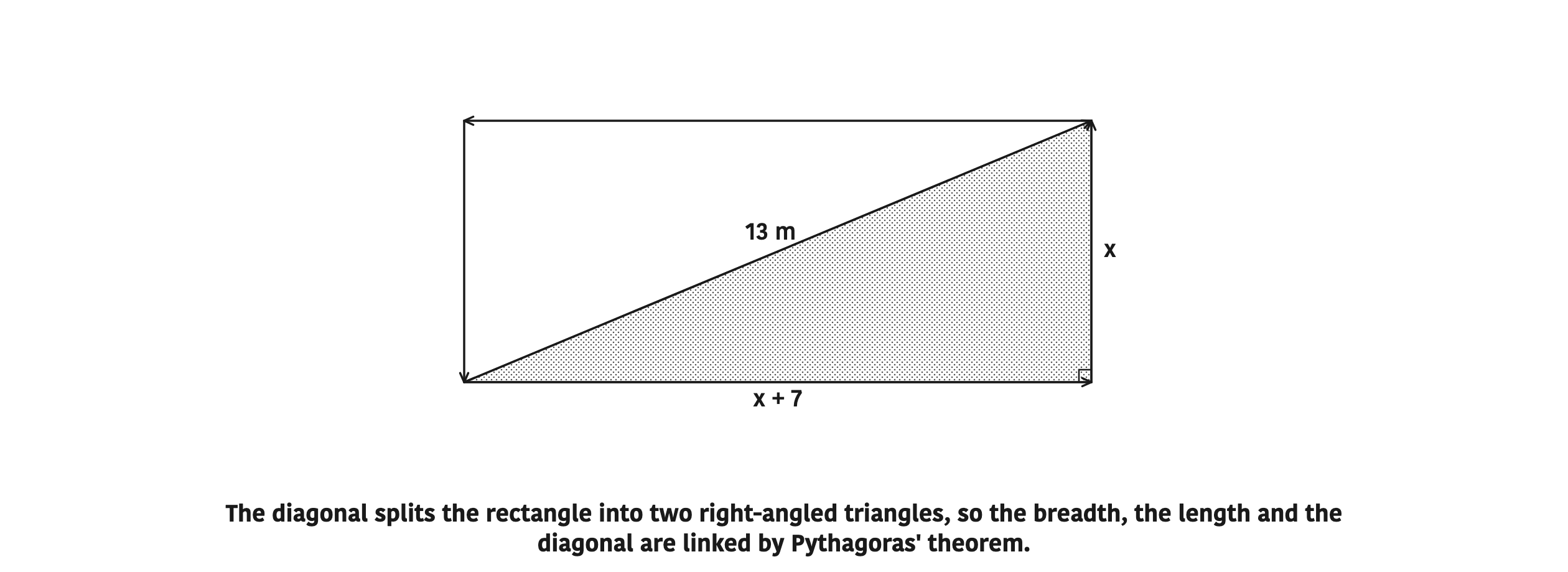
Let the breadth be \( x \) m. Then the length is \( (x + 7) \) m. The diagonal divides the rectangle into two right-angled triangles. In each triangle the breadth and the length are the two sides that meet at the right angle, and the diagonal is the hypotenuse.
Step 1: By Pythagoras' theorem:
\[ x^2 + (x + 7)^2 = 13^2 \]
Step 2: Expanding \( (x + 7)^2 \) and squaring 13:
\[ x^2 + x^2 + 14x + 49 = 169 \]
Step 3: Collecting like terms and subtracting 169 from both sides:
\[ 2x^2 + 14x - 120 = 0 \]
Step 4: Dividing every term by 2 to make the numbers smaller:
\[ x^2 + 7x - 60 = 0 \]
Step 5: Comparing with \( ax^2 + bx + c = 0 \):
\[ a = 1,\ b = 7,\ c = -60 \]
Step 6: Working out the number under the square root:
\[ \begin{aligned} b^2 - 4ac &= 7^2 - 4 \times 1 \times (-60) \\ &= 49 + 240 \\ &= 289 \end{aligned} \]
Step 7: Substituting into the formula, using \( \sqrt{289} = 17 \):
\[ x = \frac{-7 \pm 17}{2} \]
Step 8: Taking the plus sign:
\[ x = \frac{-7 + 17}{2} = \frac{10}{2} = 5 \]
Step 9: Taking the minus sign:
\[ x = \frac{-7 - 17}{2} = \frac{-24}{2} = -12 \]
A breadth cannot be negative, so \( x = -12 \) is rejected. The breadth is 5 m and the length is \( 5 + 7 = 12 \) m. Checking: \( 5^2 + 12^2 = 25 + 144 = 169 = 13^2 \).
Both roots satisfy the equation, but they may not both fit the situation. A negative length, a negative age or a fraction of a person is rejected. Write one short sentence saying which root is rejected and why.
Choosing a Method
Every quadratic equation can now be solved in three ways. All three always give the same roots, because they are the same mathematics arranged differently. Which one to choose depends on the numbers:
| Method | Works best when | Example |
| Factorisation | the constant term splits into two numbers with the right sum | \( x^2 + x - 12 = 0 \) |
| Completing the square | the coefficient of \( x^2 \) is 1 and the coefficient of \( x \) is even | \( x^2 + 8x = 9 \) |
| Formula | the numbers are awkward or the roots are surds, and in fact always | \( 3x^2 - 7x + 1 = 0 \) |
When a question names a method, that method must be used. When it does not, the formula is the safe choice, because it works for every quadratic equation, whatever its numbers.
The full lesson is waiting for you
The notes are free to read in full. A free account opens the rest of the practice, and tracks your progress and confidence score for every subject. Presentations and videos need approval from Learn Yeti.