Turning a situation into an equation
Sumitra is 12 years old and her sister is 18. Right now their ages multiply to \( 12 \times 18 = 216 \). Every year both of them become one year older, so the product keeps growing. After how many years will the product of their ages be 280?
A sensible first attempt is to go year by year, writing both ages and multiplying them in a table.
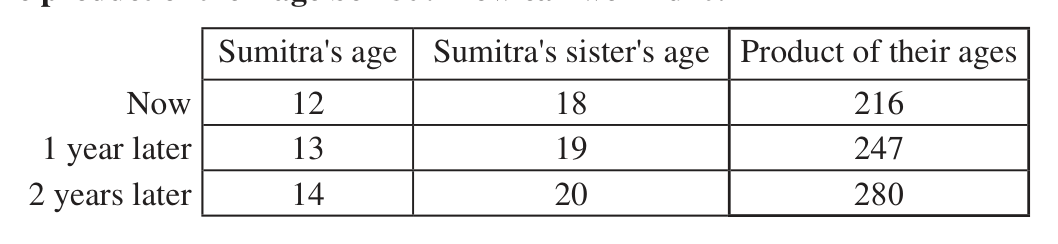
The table worked here only because the answer is a small whole number. Had the answer been 17 years, the table would need 18 rows, and had it been a fraction, the table would never find it. Algebra goes straight to the answer. Call the unknown number of years \( x \). After \( x \) years Sumitra will be \( 12 + x \) years old and her sister will be \( 18 + x \) years old.
Step 1: The condition says the product of the two ages is 280:
\[ (12 + x)(18 + x) = 280 \]
Step 2: Multiplying out the brackets:
\[ 216 + 18x + 12x + x^2 = 280 \]
Step 3: Collecting like terms and moving 280 to the left so that one side is zero:
\[ x^2 + 30x - 64 = 0 \]
Step 4: Splitting the middle term, because \( 32 \times (-2) = -64 \) and \( 32 + (-2) = 30 \), and factorising:
\[ \begin{aligned} x^2 + 32x - 2x - 64 &= 0 \\ x(x + 32) - 2(x + 32) &= 0 \\ (x + 32)(x - 2) &= 0 \end{aligned} \]
Step 5: A product is zero only when one of its factors is zero, so either \( x + 32 = 0 \) or \( x - 2 = 0 \). This gives two roots:
\[ x = -32, \quad x = 2 \]
The root \( x = -32 \) would mean 32 years ago, when Sumitra would have been \( -20 \) and her sister \( -14 \). Negative ages are impossible, so this root is rejected. So \( x = 2 \): after 2 years the product of their ages will be 280. Checking: \( 14 \times 20 = 280 \).
Solving the equation is not the end of the work. Every root must be tested against the story. A root that gives a negative age, a negative length or half a person is rejected, even though it satisfies the equation.
A method for every word problem
Every problem in this topic tells a different story, but each one is solved in the same order. Learn the order once and it works everywhere.
- Read the problem twice and decide exactly what is unknown.
- Name the unknown with a letter such as \( x \). If there are two unknowns, write the second one in terms of \( x \) whenever you can.
- Write every quantity in the story using \( x \).
- Turn the condition given in the problem into an equation.
- Rearrange it so that one side is zero, in the form \( ax^2 + bx + c = 0 \).
- Solve it, usually by splitting the middle term and factorising.
- Test each root against the story and reject any root that cannot be true.
- Write the answer as a sentence, with its unit.
Word problem on a quadratic equation: a problem told in words whose condition, once written with an unknown, becomes an equation of the form \( ax^2 + bx + c = 0 \), where \( a \neq 0 \).
A quadratic equation usually gives two roots, but the equation knows nothing about the story. Deciding which root fits the story is your job, and it is part of the answer.
Problems about numbers
Number problems give facts about the sums, products or squares of unknown numbers. Even when there are two numbers, the key move is to write one in terms of the other so that the equation has only one letter.
Problem: The sum of two positive numbers is 18 and their product is 77. Find the numbers.
Let the numbers be \( x \) and \( y \). Then \( x + y = 18 \) and \( xy = 77 \). From the first fact \( y = 18 - x \), so one letter is enough.
Step 1: Putting \( y = 18 - x \) into the product:
\[ x(18 - x) = 77 \]
Step 2: Expanding and moving every term to one side:
\[ x^2 - 18x + 77 = 0 \]
Step 3: Splitting \( -18x \) into \( -11x - 7x \), because \( (-11)(-7) = 77 \) and \( -11 - 7 = -18 \), and factorising:
\[ \begin{aligned} x^2 - 11x - 7x + 77 &= 0 \\ x(x - 11) - 7(x - 11) &= 0 \\ (x - 11)(x - 7) &= 0 \end{aligned} \]
Step 4: Setting each factor equal to zero:
\[ x = 11, \quad x = 7 \]
If \( x = 11 \), then \( y = 18 - 11 = 7 \). If \( x = 7 \), then \( y = 11 \). Both roots lead to the same pair, so the numbers are 7 and 11.
Problem: When 11 is subtracted from the square of a positive integer, the result is 38. Find the integer.
Step 1: Taking the integer as \( x \), its square is \( x^2 \) and the condition is:
\[ x^2 - 11 = 38 \]
Step 2: Adding 11 to both sides:
\[ x^2 = 49 \]
Step 3: Taking the square root of both sides, which gives a positive and a negative value:
\[ x = \pm 7 \]
The problem asks for a positive integer, so \( -7 \) is rejected. The integer is 7. Checking: \( 7^2 - 11 = 49 - 11 = 38 \).
Consecutive even numbers: even numbers that follow one another, such as 4 and 6. Each is 2 more than the one before, so if the smaller is \( x \), the next is \( x + 2 \).
Consecutive odd numbers: odd numbers that follow one another, such as 7 and 9. They also differ by 2, so if the smaller is \( x \), the next is \( x + 2 \).
Problem: The product of two consecutive positive even numbers is 24. Find the numbers.
Step 1: Taking the numbers as \( x \) and \( x + 2 \), the product condition is:
\[ x(x + 2) = 24 \]
Step 2: Expanding and moving 24 to the left:
\[ x^2 + 2x - 24 = 0 \]
Step 3: Splitting \( 2x \) into \( 6x - 4x \), because \( 6 \times (-4) = -24 \) and \( 6 - 4 = 2 \), and factorising:
\[ \begin{aligned} x^2 + 6x - 4x - 24 &= 0 \\ x(x + 6) - 4(x + 6) &= 0 \\ (x + 6)(x - 4) &= 0 \end{aligned} \]
Step 4: Setting each factor equal to zero:
\[ x = -6, \quad x = 4 \]
The numbers must be positive, so \( x = -6 \) is rejected. With \( x = 4 \), the numbers are 4 and \( 4 + 2 = 6 \). Checking: \( 4 \times 6 = 24 \).
A number and its reciprocal
Reciprocal: the reciprocal of a non-zero number \( x \) is \( \frac{1}{x} \). A number multiplied by its reciprocal gives 1. The reciprocal of 5 is \( \frac{1}{5} \), and the reciprocal of \( \frac{2}{3} \) is \( \frac{3}{2} \).
Problem: The sum of a number and its reciprocal is \( \frac{26}{5} \). Find the number.
Step 1: Taking the number as \( x \), its reciprocal is \( \frac{1}{x} \) and the condition is:
\[ x + \frac{1}{x} = \frac{26}{5} \]
Step 2: Writing the left side as a single fraction:
\[ \frac{x^2 + 1}{x} = \frac{26}{5} \]
Step 3: Cross-multiplying to remove the fractions:
\[ 5x^2 + 5 = 26x \]
Step 4: Bringing every term to the left:
\[ 5x^2 - 26x + 5 = 0 \]
Step 5: Here \( a \times c = 5 \times 5 = 25 \), and \( -25 \) and \( -1 \) multiply to 25 and add to \( -26 \). Splitting the middle term and factorising:
\[ \begin{aligned} 5x^2 - 25x - x + 5 &= 0 \\ 5x(x - 5) - 1(x - 5) &= 0 \\ (5x - 1)(x - 5) &= 0 \end{aligned} \]
Step 6: Setting each factor equal to zero:
\[ x = \frac{1}{5}, \quad x = 5 \]
Nothing in this problem rules out either root, so both are kept. The number is 5 or \( \frac{1}{5} \). This makes sense, because 5 and \( \frac{1}{5} \) are reciprocals of each other: whichever one you call the number, the other is its reciprocal. Checking: \( 5 + \frac{1}{5} = \frac{26}{5} \).
Two roots are not always a problem. When both roots fit the story, both are answers.
Problems about ages
Age problems rest on two facts. First, time changes everyone's age by the same amount: after \( x \) years each age increases by \( x \), and \( x \) years ago each age was \( x \) less. Second, an age can never be negative.
Problem: The sum of the ages of two brothers is 34 years and the product of their ages is 288. Find their present ages.
Let the elder brother be \( x \) years old and the younger \( y \) years old. Since \( x + y = 34 \), we have \( y = 34 - x \), and also \( xy = 288 \).
Step 1: Putting \( y = 34 - x \) into the product:
\[ x(34 - x) = 288 \]
Step 2: Expanding and rearranging:
\[ x^2 - 34x + 288 = 0 \]
Step 3: Splitting \( -34x \) into \( -16x - 18x \), because \( 16 \times 18 = 288 \) and \( 16 + 18 = 34 \), and factorising:
\[ \begin{aligned} x^2 - 16x - 18x + 288 &= 0 \\ x(x - 16) - 18(x - 16) &= 0 \\ (x - 16)(x - 18) &= 0 \end{aligned} \]
Step 4: Setting each factor equal to zero:
\[ x = 16, \quad x = 18 \]
If \( x = 16 \), then \( y = 18 \), which would make the elder brother younger than the younger one. That contradicts the story, so it is rejected. If \( x = 18 \), then \( y = 16 \). The elder brother is 18 years old and the younger is 16. Checking: \( 18 + 16 = 34 \) and \( 18 \times 16 = 288 \).
Problem: A father is 42 years old and his son is 16. How many years ago was the product of their ages 272?
Step 1: Taking the number of years as \( x \), their ages then were \( 42 - x \) and \( 16 - x \), so:
\[ (42 - x)(16 - x) = 272 \]
Step 2: Expanding, using \( 42 \times 16 = 672 \):
\[ 672 - 42x - 16x + x^2 = 272 \]
Step 3: Collecting terms and moving 272 to the left:
\[ x^2 - 58x + 400 = 0 \]
Step 4: Splitting \( -58x \) into \( -50x - 8x \), because \( 50 \times 8 = 400 \) and \( 50 + 8 = 58 \), and factorising:
\[ \begin{aligned} x^2 - 50x - 8x + 400 &= 0 \\ x(x - 50) - 8(x - 50) &= 0 \\ (x - 50)(x - 8) &= 0 \end{aligned} \]
Step 5: Setting each factor equal to zero:
\[ x = 50, \quad x = 8 \]
The son is only 16 now, so 50 years ago he had not been born. His age would have been \( 16 - 50 = -34 \) and his father's \( -8 \). Because \( (-8) \times (-34) = 272 \), the equation accepts this root, but the story cannot. So \( x = 8 \): 8 years ago the father was 34 and the son was 8, and \( 34 \times 8 = 272 \).
In an age problem, a root is not rejected only when it is negative itself. A root is also rejected if it makes anyone's age zero or negative. Here 50 is a positive number and is still impossible.
Problems about the digits of a number
Two-digit number: a number whose tens digit is \( x \) and units digit is \( y \) has the value \( 10x + y \). With its digits reversed it becomes \( 10y + x \). For 36, \( 10 \times 3 + 6 = 36 \), and reversed, \( 10 \times 6 + 3 = 63 \).
A number with digits \( x \) and \( y \) is not \( xy \) and not \( x + y \). In algebra \( xy \) means \( x \) multiplied by \( y \), not the number itself.
Problem: The product of the digits of a two-digit number is 18. When 27 is added to the number, its digits are reversed. Find the number.
Let the tens digit be \( x \) and the units digit be \( y \), so the number is \( 10x + y \).
Step 1: The first condition, the product of the digits:
\[ xy = 18 \]
Step 2: This gives \( x = \frac{18}{y} \). The second condition says the number plus 27 equals the reversed number:
\[ 10x + y + 27 = 10y + x \]
Step 3: Moving every term to the left gives \( 9x - 9y + 27 = 0 \). Dividing by 9:
\[ x - y + 3 = 0 \]
Step 4: Replacing \( x \) with \( \frac{18}{y} \) from the first condition:
\[ \frac{18}{y} - y + 3 = 0 \]
Step 5: Multiplying every term by \( y \) gives \( 18 - y^2 + 3y = 0 \). Multiplying by \( -1 \) to make the square term positive:
\[ y^2 - 3y - 18 = 0 \]
Step 6: Splitting \( -3y \) into \( -6y + 3y \), because \( (-6) \times 3 = -18 \) and \( -6 + 3 = -3 \), and factorising:
\[ \begin{aligned} y^2 - 6y + 3y - 18 &= 0 \\ y(y - 6) + 3(y - 6) &= 0 \\ (y - 6)(y + 3) &= 0 \end{aligned} \]
Step 7: Setting each factor equal to zero:
\[ y = 6, \quad y = -3 \]
A digit is one of 0, 1, 2 and so on up to 9, so \( y = -3 \) is rejected. With \( y = 6 \), \( x = \frac{18}{6} = 3 \). The number is 36. Checking: \( 3 \times 6 = 18 \), and \( 36 + 27 = 63 \), which is 36 with its digits reversed.
Sides of a right-angled triangle
Pythagoras theorem: in a right-angled triangle, the square of the hypotenuse equals the sum of the squares of the other two sides, \( h^2 = p^2 + b^2 \), where \( h \) is the hypotenuse, \( p \) the perpendicular and \( b \) the base. The hypotenuse is the side opposite the right angle, and it is always the longest side.
Problem: The hypotenuse of a right-angled triangle is 13 m. The other two sides differ by 7 m. Find their lengths.
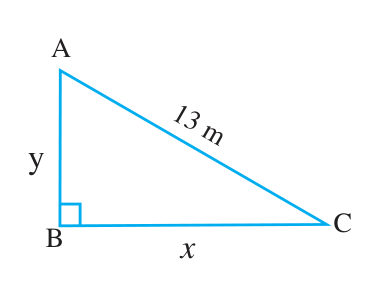
Here BC is the longer of the two sides that meet at the right angle, so their difference gives \( x - y = 7 \), that is \( x = y + 7 \).
Step 1: Applying Pythagoras theorem to triangle ABC:
\[ AC^2 = AB^2 + BC^2 \]
Step 2: Putting in \( AC = 13 \), \( AB = y \) and \( BC = y + 7 \):
\[ 13^2 = y^2 + (y + 7)^2 \]
Step 3: Expanding with \( (y + 7)^2 = y^2 + 14y + 49 \):
\[ 169 = 2y^2 + 14y + 49 \]
Step 4: Subtracting 169 from both sides and dividing every term by 2:
\[ y^2 + 7y - 60 = 0 \]
Step 5: Splitting \( 7y \) into \( 12y - 5y \), because \( 12 \times (-5) = -60 \) and \( 12 - 5 = 7 \), and factorising:
\[ \begin{aligned} y^2 + 12y - 5y - 60 &= 0 \\ y(y + 12) - 5(y + 12) &= 0 \\ (y + 12)(y - 5) &= 0 \end{aligned} \]
Step 6: Setting each factor equal to zero:
\[ y = -12, \quad y = 5 \]
A length cannot be negative, so \( y = -12 \) is rejected. So AB = 5 m and BC = \( 5 + 7 = 12 \) m. The remaining sides are 5 m and 12 m. Checking: \( 5^2 + 12^2 = 25 + 144 = 169 = 13^2 \).
Length and breadth of a rectangular land
Rectangle problems usually give the area and the perimeter. The area gives a product \( xy \) and the perimeter gives a sum \( x + y \), so this is really the sum and product problem again, dressed as a piece of land.
Problem: A rectangular piece of land has an area of \( 500 \text{ m}^2 \) and a perimeter of 90 m. If it is to be made a square, by what percentage should its length be reduced?
Let the length be \( x \) m and the breadth \( y \) m. The area gives \( xy = 500 \). The perimeter gives \( 2(x + y) = 90 \), so \( x + y = 45 \) and \( y = 45 - x \).
Step 1: Putting \( y = 45 - x \) into the area:
\[ x(45 - x) = 500 \]
Step 2: Expanding and rearranging:
\[ x^2 - 45x + 500 = 0 \]
Step 3: Splitting \( -45x \) into \( -25x - 20x \), because \( 25 \times 20 = 500 \) and \( 25 + 20 = 45 \), and factorising:
\[ \begin{aligned} x^2 - 25x - 20x + 500 &= 0 \\ x(x - 25) - 20(x - 25) &= 0 \\ (x - 25)(x - 20) &= 0 \end{aligned} \]
Step 4: Setting each factor equal to zero:
\[ x = 25, \quad x = 20 \]
If \( x = 25 \), then \( y = 20 \); if \( x = 20 \), then \( y = 25 \). The length is the longer side, so the land is 25 m long and 20 m wide.
A square has all its sides equal. Keeping the breadth at 20 m, the length must come down from 25 m to 20 m, a cut of 5 m.
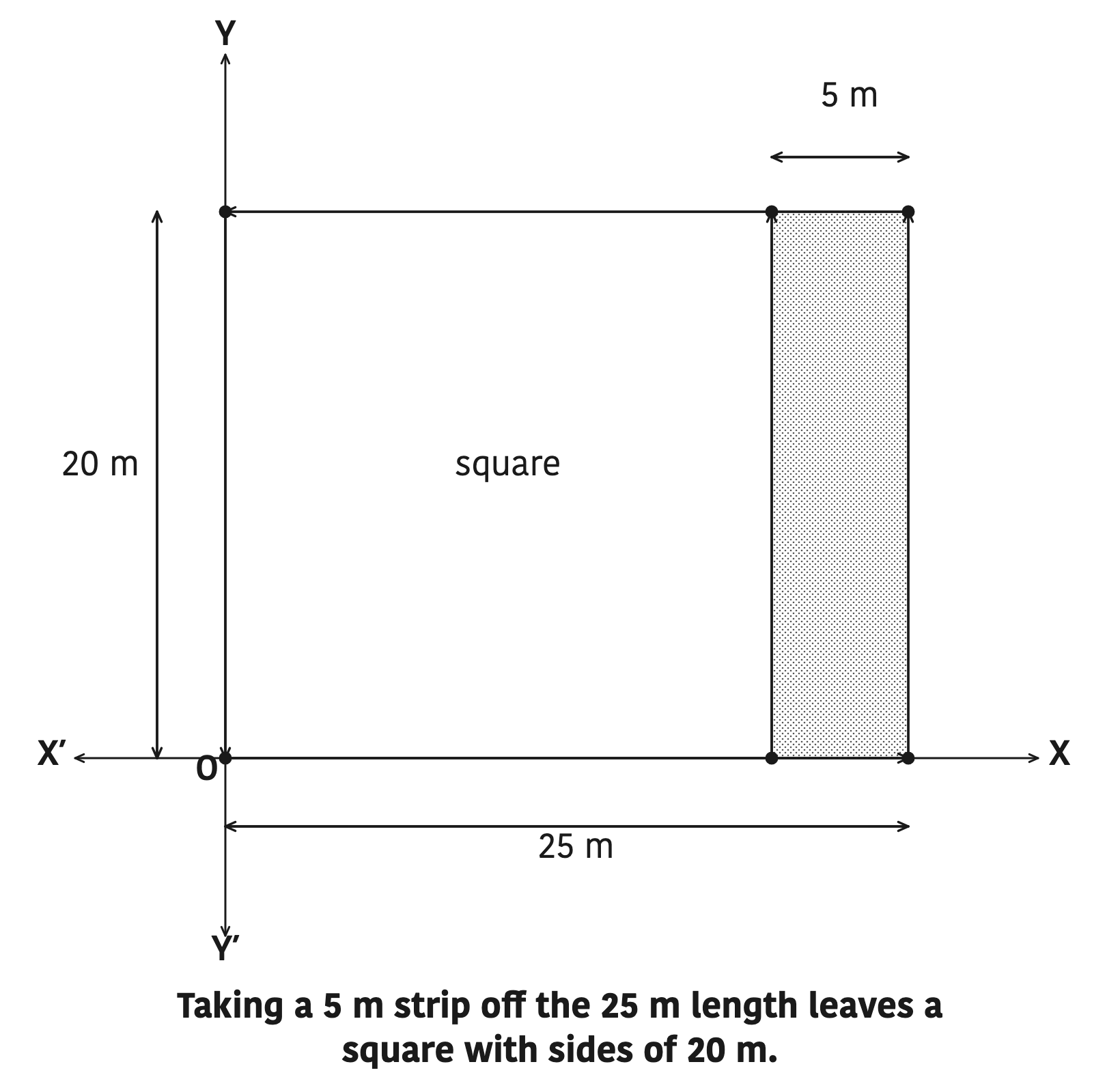
Step 5: Writing the cut as a percentage of the original length:
\[ \frac{5}{25} \times 100\% = 20\% \]
So the length must be reduced by 20% to make the land a square.
The percentage is always taken of the original length. Dividing by the new length, \( \frac{5}{20} \times 100\% = 25\% \), answers a different question.
Sharing a fixed amount of money
When a fixed amount is shared equally and fewer people turn up, each person's share goes up. Each share is a fraction, the total divided by the number of people, and clearing those fractions produces a quadratic equation.
Problem: Some grade 10 students planned a picnic with a budget of Rs. 42,000, to be collected equally from each of them. On the picnic day 5 students were absent, so each student who came had to pay Rs. 700 more.
- (a) How many students attended the picnic?
- (b) How much did each participant have to pay?
Let \( x \) be the number of students in the plan. Each would have paid Rs. \( \frac{42000}{x} \). Only \( x - 5 \) came, so each paid Rs. \( \frac{42000}{x - 5} \), which is Rs. 700 more.
Step 1: Writing the condition as an equation:
\[ \frac{42000}{x - 5} = \frac{42000}{x} + 700 \]
Step 2: Moving \( \frac{42000}{x} \) to the left and dividing every term by 700:
\[ \frac{60}{x - 5} - \frac{60}{x} = 1 \]
Step 3: Multiplying every term by \( x(x - 5) \) to clear the fractions:
\[ 60x - 60(x - 5) = x(x - 5) \]
Step 4: The left side simplifies to \( 60x - 60x + 300 = 300 \). Rearranging:
\[ x^2 - 5x - 300 = 0 \]
Step 5: Splitting \( -5x \) into \( -20x + 15x \), because \( (-20) \times 15 = -300 \) and \( -20 + 15 = -5 \), and factorising:
\[ \begin{aligned} x^2 - 20x + 15x - 300 &= 0 \\ x(x - 20) + 15(x - 20) &= 0 \\ (x - 20)(x + 15) &= 0 \end{aligned} \]
Step 6: Setting each factor equal to zero:
\[ x = 20, \quad x = -15 \]
A number of students cannot be negative, so \( x = -15 \) is rejected. There were 20 students in the plan.
- (a) Students who attended the picnic: \( 20 - 5 = 15 \).
- (b) Amount paid by each participant: Rs. \( \frac{42000}{15} = 2800 \).
Checking: under the plan each would have paid Rs. \( \frac{42000}{20} = 2100 \), and \( 2800 - 2100 = 700 \).
Which root to keep
Every problem above produced two roots. Whether a root is kept depends only on what \( x \) stands for.
| What \( x \) stands for | Roots found | Root kept | Reason |
| Years from now (Sumitra and her sister) | \( 2, -32 \) | 2 | A negative age is impossible |
| A number, with sum 18 | \( 11, 7 \) | Both | Both give the same pair, 7 and 11 |
| A positive integer | \( 7, -7 \) | 7 | It must be positive |
| A number and its reciprocal | \( 5, \frac{1}{5} \) | Both | Nothing rules either out |
| The elder brother's age | \( 16, 18 \) | 18 | The elder must be older |
| Years ago (father and son) | \( 50, 8 \) | 8 | The son was not born 50 years ago |
| A units digit | \( 6, -3 \) | 6 | A digit is only 0 to 9 |
| A side of a triangle | \( 5, -12 \) | 5 | A length cannot be negative |
| Length of the land | \( 25, 20 \) | 25 | The length is the longer side |
| Number of students | \( 20, -15 \) | 20 | A count of people cannot be negative |
A root answers the equation. Only a root that makes sense in the story answers the problem.
The full lesson is waiting for you
The notes are free to read in full. A free account opens the rest of the practice, and tracks your progress and confidence score for every subject. Presentations and videos need approval from Learn Yeti.