Listing the Results of Two Coin Tosses
A coin can land in only two ways: head (H) or tail (T). Toss it once and there are two results. Toss it a second time and each of those two results splits again, because the second toss can also land either way. The neatest way to see every result is to draw the tosses one after another, as a picture that grows from left to right.
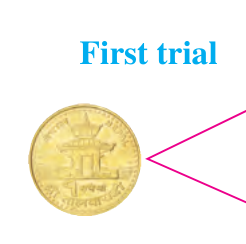
The first toss sends out two branches, one to H and one to T. Now follow the H branch. From that H the second toss sends out two more branches. The pair of letters at the end of each branch records both tosses in order: HH means head and then head, HT means head and then tail.
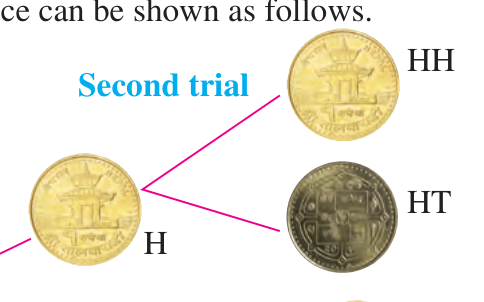
The T branch works in exactly the same way. A tail on the first toss is followed by a second toss that can again show either face.
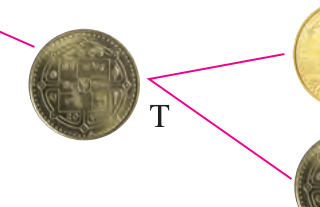
Those two branches end at TH and TT.
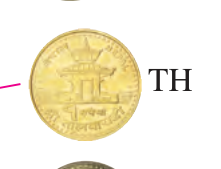
Put the pieces together and the whole picture has four ends. Each end is one possible outcome, and no outcome is missing or counted twice.
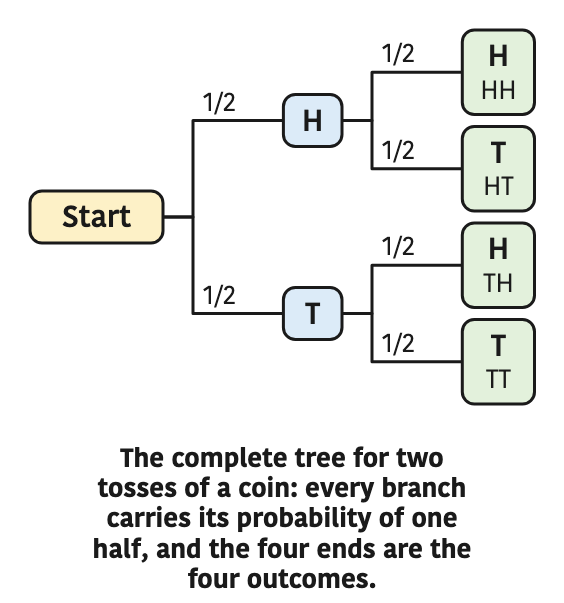
So the sample space of tossing a coin twice is:
\[ S = \{HH, HT, TH, TT\} \]
What a Tree Diagram Shows
Tree diagram: a picture of a random experiment in which each stage splits into branches, one branch for each result of that stage. Every branch shows the probability of its result, and together the branches show all the possible outcomes and their probabilities.
A tree has three parts worth naming. The starting point is where nothing has happened yet. A branch is a line from one point to the next, and it carries a probability written beside it. A path is the whole route from the starting point to one end, and each end names one outcome of the experiment.
Four rules turn the tree from a list of outcomes into a tool for working out probabilities.
- The branches leaving any one point share out all the possibilities of that stage, so their probabilities add up to 1.
- The probability of one path is found by multiplying the probabilities along it.
- When an event is made of several paths, the probabilities of those paths are added.
- The probabilities of all the ends of a tree add up to 1, which is a quick check that nothing has gone wrong.
In the two-toss tree, the path to HH passes through two branches of one half each. Multiplying along it:
\[ P(HH) = \frac{1}{2} \times \frac{1}{2} = \frac{1}{4} \]
HT, TH and TT work out the same way, and the four ends together give \( \frac{1}{4} + \frac{1}{4} + \frac{1}{4} + \frac{1}{4} = 1 \), just as the fourth rule says.
Along a path you multiply; across different paths you add. Adding along a path gives a number bigger than either branch, and that cannot be right, because two things happening in a row is never more likely than the first one happening alone.
Steps for Drawing a Probability Tree
Whatever the experiment, a probability tree is built in the same order.
- Step 1: Mark a starting point on the left.
- Step 2: Draw one branch for every result of the first stage, and write that result at the end of its branch.
- Step 3: Write the probability of each result beside its branch, and check that the branches from that point add up to 1.
- Step 4: From the end of every first-stage branch, draw the branches of the second stage in the same way. If the first result changes what is left, as when a card is not put back, work out new probabilities for each end separately.
- Step 5: Repeat for any further stages.
- Step 6: At the end of each path, write the outcome and its probability, found by multiplying along the path.
Worked Example: A Die and a Coin Together
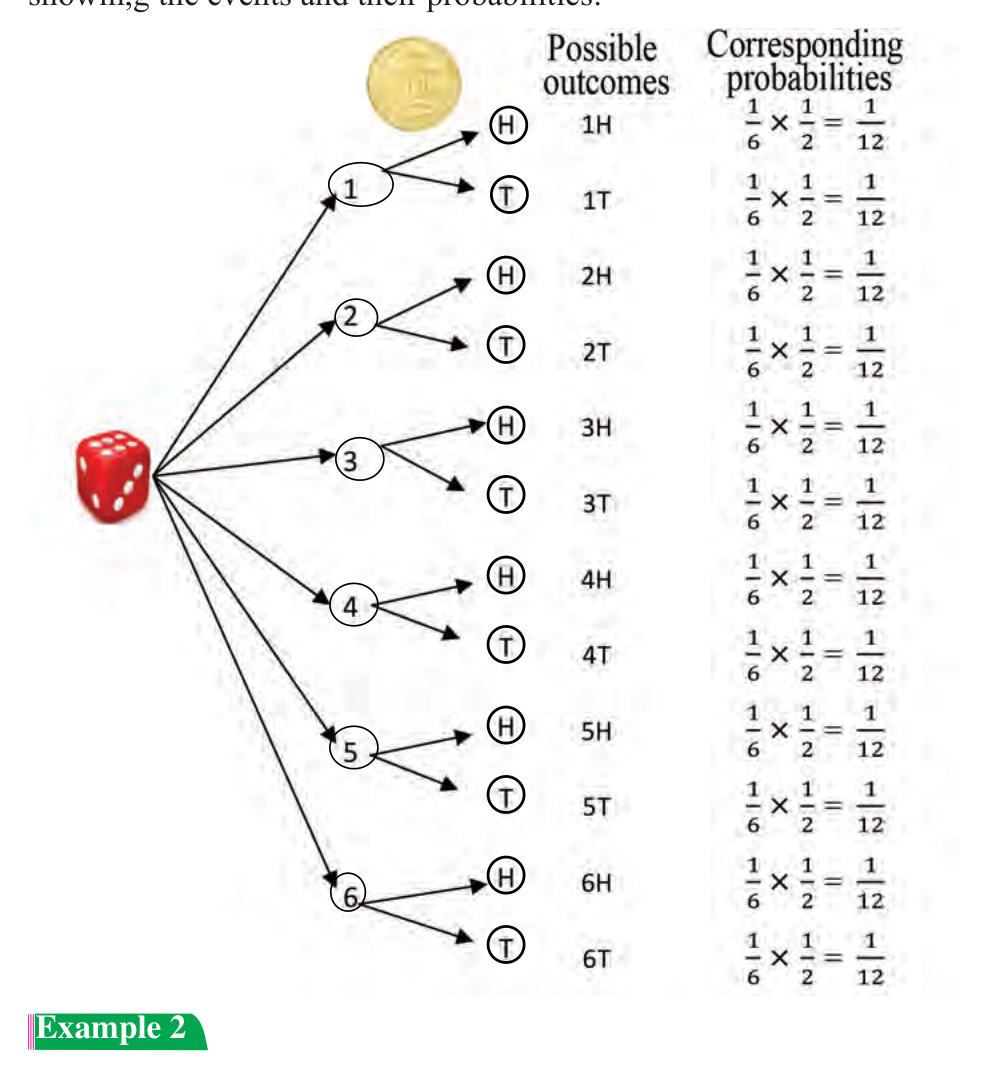
A die is rolled and a coin is tossed at the same time, and the task is to draw a tree showing every result and its probability. A die has six equally likely faces and a coin has two, so the die makes the first stage and the coin the second.
Step 1: Six branches leave the starting point, one for each face, and each carries:
\[ P(1) = P(2) = \dots = P(6) = \frac{1}{6} \]
Step 2: From each number, two branches go to H and T, and each carries:
\[ P(H) = P(T) = \frac{1}{2} \]
Step 3: Multiplying along the path that ends at 1H:
\[ P(1H) = \frac{1}{6} \times \frac{1}{2} = \frac{1}{12} \]
Step 4: Every other path is worked the same way and also gives one twelfth. The twelve outcomes make the sample space:
\[ \begin{aligned} S = \{&1H, 1T, 2H, 2T, 3H, 3T,\\ &4H, 4T, 5H, 5T, 6H, 6T\} \end{aligned} \]
Step 5: Checking that the twelve ends add up to 1:
\[ 12 \times \frac{1}{12} = 1 \]
Worked Example: Two Cards Without Replacement
A well-shuffled deck of 52 cards holds 26 red cards and 26 black cards. Two cards are drawn one after the other, and the first is not put back before the second is drawn. The tree has to show the probabilities of getting a red or a black card each time. This is where a tree diagram really earns its place, because the second draw depends on the first.
Without replacement: an object drawn at random is kept out before the next draw, so both the total and the number of that kind go down by one.
Step 1: For the first card, 26 of the 52 cards are red:
\[ P_1(R) = \frac{26}{52} \]
and 26 of the 52 cards are black:
\[ P_1(B) = \frac{26}{52} \]
Step 2: If the first card was red, 51 cards remain: 25 red and 26 black. The branches from R therefore carry:
\[ P_2(R) = \frac{25}{51} \]
\[ P_2(B) = \frac{26}{51} \]
Step 3: If the first card was black, the 51 cards left are 26 red and 25 black. The branches from B carry:
\[ P_2(R) = \frac{26}{51} \]
\[ P_2(B) = \frac{25}{51} \]
Step 4: Multiplying along the path red and then red:
\[ P(RR) = \frac{26}{52} \times \frac{25}{51} = \frac{25}{102} \]
Step 5: Multiplying along the path red and then black:
\[ P(RB) = \frac{26}{52} \times \frac{26}{51} = \frac{13}{51} \]
Step 6: Multiplying along the two paths that start with black:
\[ P(BR) = \frac{26}{52} \times \frac{26}{51} = \frac{13}{51} \]
\[ P(BB) = \frac{26}{52} \times \frac{25}{51} = \frac{25}{102} \]
Step 7: Checking the four ends, with every fraction written over 102:
\[ \frac{25 + 26 + 26 + 25}{102} = \frac{102}{102} = 1 \]
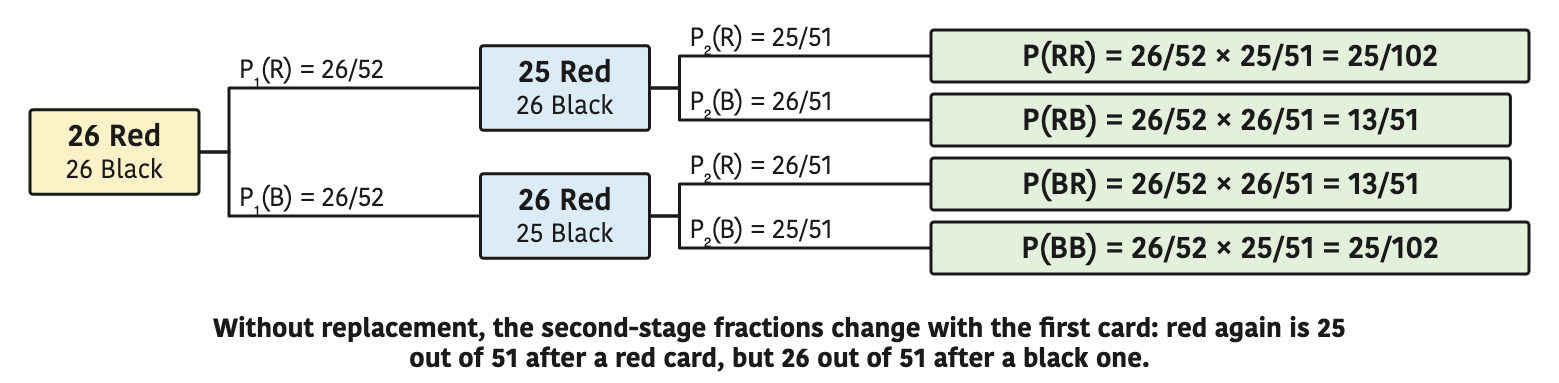
In a without-replacement tree, the second-stage denominator is one less than the first, and the colour already drawn has lost one. Writing 26 over 52 again for the second card treats the first card as if it had been put back.
Worked Example: Three Coins One After Another
Three coins are tossed one after another. There are two tasks:
- (a) Draw a tree diagram showing all the possible outcomes and their probabilities.
- (b) Find the probability of getting at least two heads (H).
(a) Each toss is a stage with two branches of one half. Three stages give \( 2 \times 2 \times 2 = 8 \) paths, and every path passes through three branches, so every outcome has probability:
\[ \frac{1}{2} \times \frac{1}{2} \times \frac{1}{2} = \frac{1}{8} \]
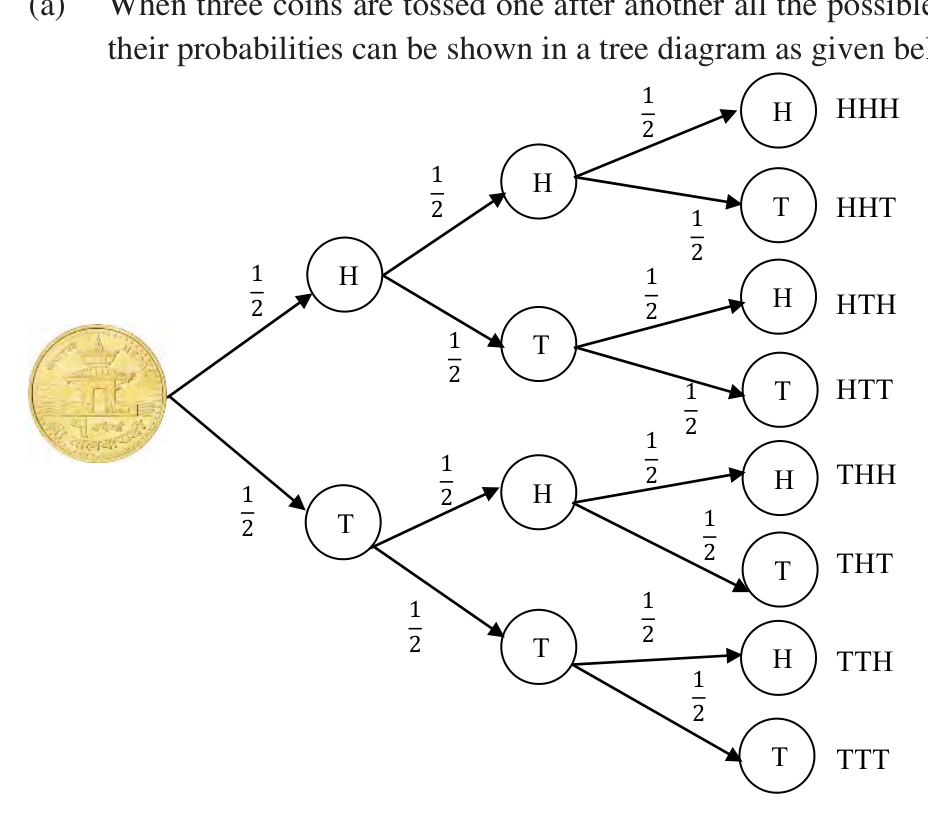
(b) Step 1: Reading the eight ends of the tree gives the sample space:
\[ \begin{aligned} S = \{&HHH, HHT, HTH, HTT,\\ &THH, THT, TTH, TTT\} \end{aligned} \]
so \( n(S) = 8 \).
Step 2: Let A be the event of getting at least two heads, which means two heads or three. Picking out those ends:
\[ A = \{HHH, HHT, HTH, THH\} \]
so \( n(A) = 4 \).
Step 3: Dividing the number of favourable outcomes by the number of all outcomes:
\[ P(A) = \frac{n(A)}{n(S)} = \frac{4}{8} = \frac{1}{2} \]
The tree gives the same answer another way: four paths of one eighth each add up to \( \frac{4}{8} = \frac{1}{2} \). So the probability of getting at least two heads is one half.
At least two heads includes three heads. Leaving out HHH gives three eighths, which is the probability of exactly two heads, not at least two.
Worked Example: Three Colours of Balls
A bag holds 12 blue, 15 green and 18 white balls that are identical except for colour, 45 in all. Two balls are drawn one after another without replacement. The tree shows every outcome, and three probabilities are then read from it:
- (a) both balls are blue;
- (b) the first ball is white and the second is green;
- (c) one ball is blue and the other is white.
Step 1: Each colour's share of the 45 balls gives the three first-stage branches:
\[ P_1(B) = \frac{12}{45} \]
\[ P_1(G) = \frac{15}{45} \]
\[ P_1(W) = \frac{18}{45} \]
Step 2: One ball is now out, so 44 remain, and only the colour just drawn has one fewer. The table shows what is left after each first ball.
| First ball | Blue left | Green left | White left | Total left |
| Blue | 11 | 15 | 18 | 44 |
| Green | 12 | 14 | 18 | 44 |
| White | 12 | 15 | 17 | 44 |
Step 3: Multiplying along each of the nine paths:
| Path | Working | Probability |
| BB | \( \frac{12}{45} \times \frac{11}{44} \) | \( \frac{1}{15} \) |
| BG | \( \frac{12}{45} \times \frac{15}{44} \) | \( \frac{1}{11} \) |
| BW | \( \frac{12}{45} \times \frac{18}{44} \) | \( \frac{6}{55} \) |
| GB | \( \frac{15}{45} \times \frac{12}{44} \) | \( \frac{1}{11} \) |
| GG | \( \frac{15}{45} \times \frac{14}{44} \) | \( \frac{7}{66} \) |
| GW | \( \frac{15}{45} \times \frac{18}{44} \) | \( \frac{3}{22} \) |
| WB | \( \frac{18}{45} \times \frac{12}{44} \) | \( \frac{6}{55} \) |
| WG | \( \frac{18}{45} \times \frac{15}{44} \) | \( \frac{3}{22} \) |
| WW | \( \frac{18}{45} \times \frac{17}{44} \) | \( \frac{17}{110} \) |
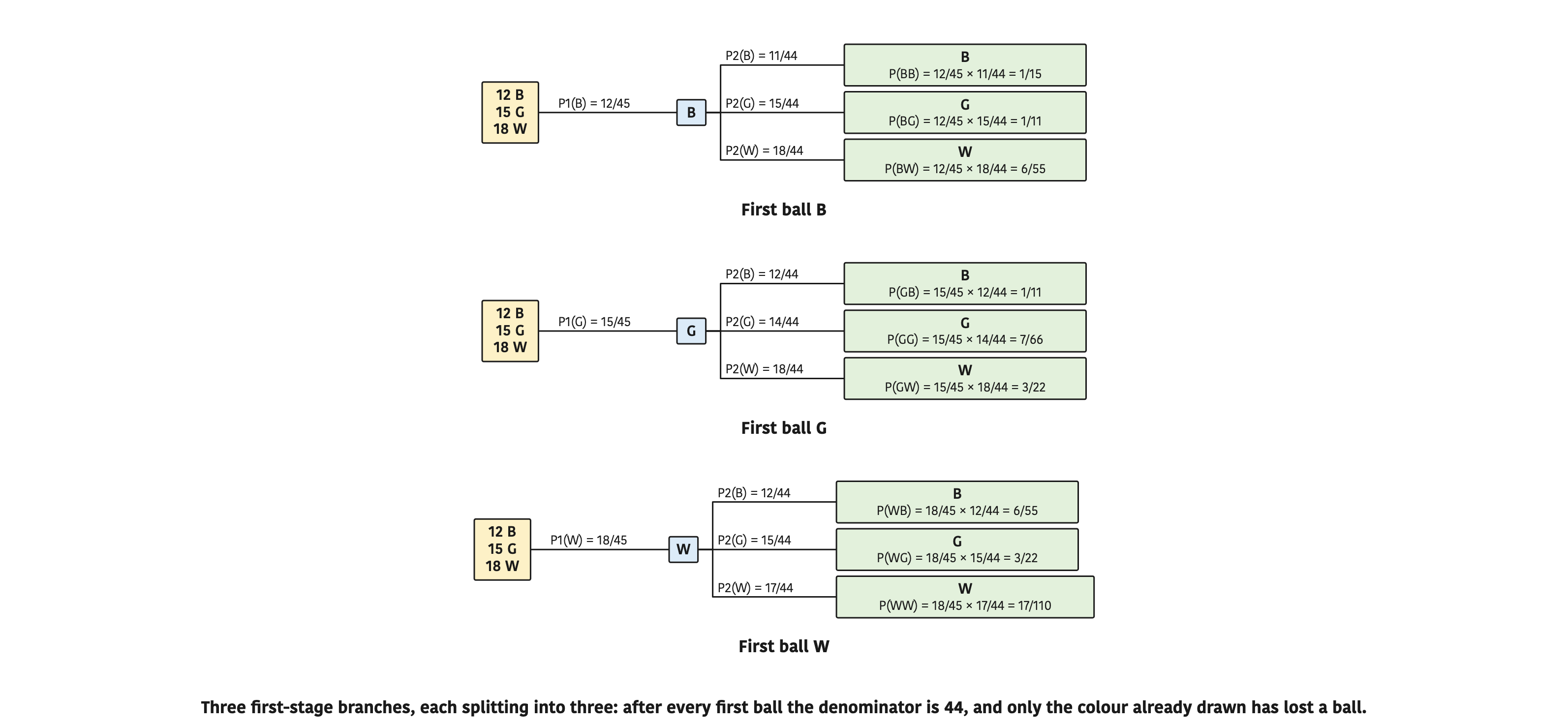
(a) Both balls blue is the single path BB:
\[ P(BB) = \frac{12}{45} \times \frac{11}{44} = \frac{1}{15} \]
(b) White first and green second is the single path WG. The order is fixed here, so GW is not included:
\[ P(WG) = \frac{18}{45} \times \frac{15}{44} = \frac{3}{22} \]
(c) One blue and one white can come in either order, so the two paths BW and WB are added:
\[ P(BW) + P(WB) = \frac{6}{55} + \frac{6}{55} = \frac{12}{55} \]
With Replacement and Without Replacement
Every drawing problem in this topic is one of two kinds, and the tree looks different for each.
With replacement: the object drawn is put back and mixed in before the next draw, so every draw starts from the same collection.
| Feature | With replacement | Without replacement |
| Total for the second draw | same as the first | one less than the first |
| Second-stage branches | the same on every part of the tree | different after each first result |
| The two draws are | independent events | dependent events |
| 7 red and 8 yellow balls, both red | \( \frac{7}{15} \times \frac{7}{15} = \frac{49}{225} \) | \( \frac{7}{15} \times \frac{6}{14} = \frac{1}{5} \) |
Coins, dice and spinners always behave like drawing with replacement. A coin does not remember the last toss, and a die rolled after a coin has no idea what the coin showed, so their branches never change from one part of the tree to another.
A quick test: look at the second-stage branches. If they are the same after every first result, the events are independent. If they change, the events are dependent.
Checking a Tree Before Using It
A tree drawn in an exam is easy to check, and the check takes less than a minute.
- Count the ends. Two stages of two branches give 4 ends, three such stages give 8, a die followed by a coin gives 12, and three colours drawn twice give 9.
- Add the branches leaving each point. They must make 1.
- In a without-replacement tree, check that every second-stage denominator is one less than the first.
- Add the probabilities of all the ends. They must make 1.
For the ball example, every end written over 1980 has numerator 132, 180, 216, 180, 210, 270, 216, 270 or 306. These nine numerators add up to 1980, so:
\[ \frac{1980}{1980} = 1 \]
The full lesson is waiting for you
The notes are free to read in full. A free account opens the rest of the practice, and tracks your progress and confidence score for every subject. Presentations and videos need approval from Learn Yeti.