Experiments, Sample Space and Probability
Roll a die, toss a coin or pull one card from a well-shuffled pack, and you cannot say beforehand what will come up. An action like this is called a random experiment. Each result it can give is an outcome. When a die is rolled the outcomes are 1, 2, 3, 4, 5 and 6. When two coins are tossed together they are HH, HT, TH and TT, where H stands for a head and T for a tail.
Sample space: the set of all possible outcomes of an experiment. It is written S, and the number of outcomes in it is written n(S). For one roll of a die, \( S = \{1, 2, 3, 4, 5, 6\} \) and \( n(S) = 6 \).
Event: any subset of the sample space. For one roll of a die, getting a number greater than 4 is the event {5, 6}.
When every outcome is equally likely, the probability of an event E compares the number of outcomes in E with the number in the whole sample space:
\[ P(E) = \frac{n(E)}{n(S)} \]
Probability of an event: the number of outcomes favourable to the event divided by the total number of outcomes. It is never less than 0 and never more than 1. An impossible event has probability 0 and a sure event has probability 1.
For example, when two coins are tossed together, getting two heads is the event {HH}. It holds one of the four outcomes, so its probability is \( \frac{1}{4} \). Many questions ask for the chance of one thing or another: an even number or a prime number on a die, an ace or a face card from a pack. To answer them you need a rule for joining two events, and that rule depends on whether the two events can happen together.
Mutually Exclusive Events
Roll a die once and look at three events. A is getting an even number, B is getting an odd number and C is getting a prime number. Written as sets, \( A = \{2, 4, 6\} \), \( B = \{1, 3, 5\} \) and \( C = \{2, 3, 5\} \).
A and B have no number in common. Whatever shows on top is either even or odd, never both, so if A happens then B cannot happen on that roll. In set language their intersection is empty: \( A \cap B = \emptyset \). Events like A and B are called mutually exclusive.
A and C are different. The number 2 is in both. If a 2 shows, the number is even and prime at the same time, so A and C have happened together. They are not mutually exclusive. B and C share both 3 and 5, so they are not mutually exclusive either.
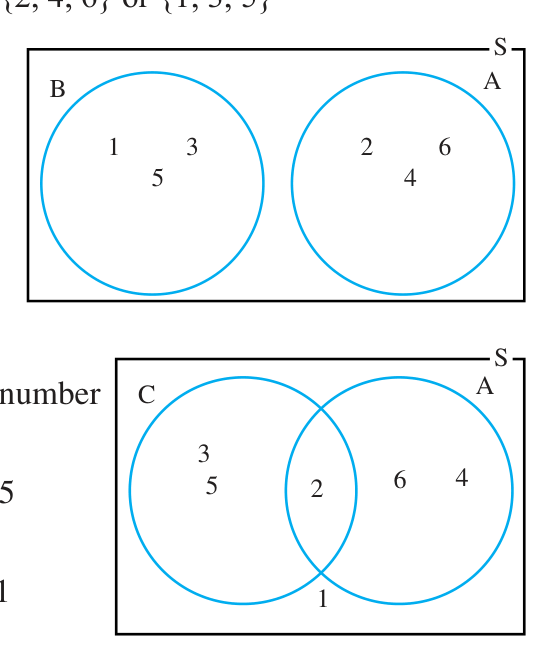
Mutually exclusive events: events of an experiment in which the occurrence of any one rules out the occurrence of the others. They have no outcome in common, so for two such events \( A \cap B = \emptyset \).
To test any pair of events, list the outcomes of each and look for one that belongs to both. A single shared outcome is enough to make the events not mutually exclusive. The table shows a few pairs.
| Pair of events | Shared outcome | Mutually exclusive? |
| Die: less than 3, greater than 4 | None | Yes |
| Die: a multiple of 3, an even number | 6 | No |
| Card: a king, a queen | None | Yes |
| Card: a king, a heart | The king of hearts | No |
Mutually exclusive does not mean that the two events share out the whole sample space between them. Even and odd numbers do cover every face of a die, but a king and a queen leave 44 cards that are neither. The only test is whether the events have an outcome in common.
Probability of One Event or Another
In probability the word 'or' means that at least one of the events happens. That is the union of the two sets, so the probability of A or B is written \( P(A \cup B) \). One way to find it is to write the union, count its members and divide by n(S). Take the same die, where \( n(S) = 6 \):
| Event | Outcomes | Cardinality | Probability |
| Even (A) | 2, 4, 6 | 3 | \( \frac{3}{6} = \frac{1}{2} \) |
| Odd (B) | 1, 3, 5 | 3 | \( \frac{3}{6} = \frac{1}{2} \) |
| Prime (C) | 2, 3, 5 | 3 | \( \frac{3}{6} = \frac{1}{2} \) |
First case: an even number or an odd number. These two events are mutually exclusive.
Step 1: Joining the two sets gives every face of the die:
\[ A \cup B = \{1, 2, 3, 4, 5, 6\} \]
Step 2: Counting the union and dividing by n(S):
\[ P(A \cup B) = \frac{6}{6} = 1 \]
Step 3: Adding the two separate probabilities, for comparison:
\[ P(A) + P(B) = \frac{1}{2} + \frac{1}{2} = 1 \]
The two answers agree. A and B have no outcome in common, so when their probabilities are added each outcome is counted exactly once. For mutually exclusive events, \( P(A \cup B) = P(A) + P(B) \).
Second case: an even number or a prime number. These two events are not mutually exclusive, because both contain 2.
Step 1: Joining the two sets, writing the 2 only once:
\[ A \cup C = \{2, 3, 4, 5, 6\} \]
Step 2: Counting the union and dividing by n(S):
\[ P(A \cup C) = \frac{5}{6} \]
Step 3: Adding the two separate probabilities:
\[ P(A) + P(C) = \frac{1}{2} + \frac{1}{2} = 1 \]
This time the sum is too large. An answer of 1 would mean the event is certain, yet a 1 can show on the die and 1 is neither even nor prime. The error comes from the number 2, which sits in A and in C and so was counted twice. The shared part is \( A \cap C = \{2\} \), and its probability is \( \frac{1}{6} \).
Step 4: Subtracting the probability of the outcome that was counted twice:
\[ P(A) + P(C) - P(A \cap C) \]
\[ = 1 - \frac{1}{6} = \frac{5}{6} \]
Now the answer matches the one found by counting the union.
The Addition Law of Probability
The two cases lead to one rule, called the addition law of probability. It has two forms.
Addition law of probability: if A and B are mutually exclusive events, \( P(A \cup B) = P(A) + P(B) \). If A and B are not mutually exclusive, \( P(A \cup B) = P(A) + P(B) - P(A \cap B) \).
For mutually exclusive events:
\[ P(A \cup B) = P(A) + P(B) \]
For events that are not mutually exclusive:
\[ P(A \cup B) = P(A) + P(B) - P(A \cap B) \]
The second form works for every pair of events. When A and B are mutually exclusive, \( A \cap B \) is empty and \( P(A \cap B) = 0 \), so the second form turns into the first. The same idea stretches to three or more events when every pair of them is mutually exclusive: \( P(A \cup B \cup C) = P(A) + P(B) + P(C) \).
Before adding two probabilities, ask one question: can both events happen on the same trial? If they cannot, add. If they can, add and then subtract the probability of the overlap.
Adding \( P(A) \) and \( P(B) \) straight away when the events share outcomes. The shared outcomes are counted twice and the answer comes out too large. A probability of 1 or more for an event that can clearly fail to happen is a sign of this mistake.
Any question that asks for one event or another can be solved in the same order:
- Write the sample space and count its outcomes.
- Write each event as a set and find its probability.
- Look for outcomes that belong to both events.
- If there are none, the events are mutually exclusive, so add their probabilities.
- If there are some, add the probabilities and subtract the probability of the shared outcomes.
- Simplify the fraction and state the answer in a sentence.
Worked Example 1: Days of the Week
One name is picked at random from the seven days of the week. Find the probability that the name begins with W or with T.
Step 1: The sample space is S = {Sunday, Monday, Tuesday, Wednesday, Thursday, Friday, Saturday}. Counting its members:
\[ n(S) = 7 \]
Step 2: Let A be the event that the name begins with W. Only Wednesday does, so A = {Wednesday}, n(A) = 1 and:
\[ P(A) = \frac{n(A)}{n(S)} = \frac{1}{7} \]
Step 3: Let B be the event that the name begins with T. B = {Tuesday, Thursday}, so n(B) = 2 and:
\[ P(B) = \frac{n(B)}{n(S)} = \frac{2}{7} \]
Step 4: No name begins with both W and T, so A and B are mutually exclusive. Adding their probabilities by the addition law:
\[ P(A \cup B) = \frac{1}{7} + \frac{2}{7} = \frac{3}{7} \]
So the probability that the name begins with W or T is \( \frac{3}{7} \). A quick count agrees: three of the seven names, Tuesday, Wednesday and Thursday, qualify.
Worked Example 2: Coloured Balls in a Bag
A bag holds 4 black, 6 yellow and 5 red balls, all of the same shape and size. One ball is drawn at random. Find the probability that it is:
- (a) black or red
- (b) yellow or red
Step 1: Adding the balls of all three colours to get the total:
\[ n(S) = 4 + 6 + 5 = 15 \]
Step 2: Writing B for black, Y for yellow and R for red, finding the probability of each colour:
\[ P(B) = \frac{4}{15} \]
\[ P(Y) = \frac{6}{15} \]
\[ P(R) = \frac{5}{15} \]
Step 3: A ball has only one colour, so no ball is both black and red. The events are mutually exclusive, and for part (a) their probabilities are added:
\[ P(B \cup R) = \frac{4}{15} + \frac{5}{15} = \frac{9}{15} = \frac{3}{5} \]
Step 4: Yellow and red are mutually exclusive for the same reason. Adding their probabilities for part (b):
\[ P(Y \cup R) = \frac{6}{15} + \frac{5}{15} = \frac{11}{15} \]
So the probability of a black or red ball is \( \frac{3}{5} \), and the probability of a yellow or red ball is \( \frac{11}{15} \).
Worked Example 3: Numbers Divisible by 4 or by 3
Twenty cards are numbered 1 to 20, and one is drawn at random. Find the probability that its number is divisible by 4 or by 3.
Step 1: There are twenty cards, so:
\[ n(S) = 20 \]
Step 2: Let A be the event of a number divisible by 4. Listing the multiples of 4 up to 20 and finding the probability:
\[ A = \{4, 8, 12, 16, 20\} \]
\[ P(A) = \frac{5}{20} \]
Step 3: Let B be the event of a number divisible by 3. Listing the multiples of 3 up to 20 and finding the probability:
\[ B = \{3, 6, 9, 12, 15, 18\} \]
\[ P(B) = \frac{6}{20} \]
Step 4: Looking for numbers that are in both lists. Only 12 is divisible by both 4 and 3:
\[ A \cap B = \{12\} \]
\[ P(A \cap B) = \frac{1}{20} \]
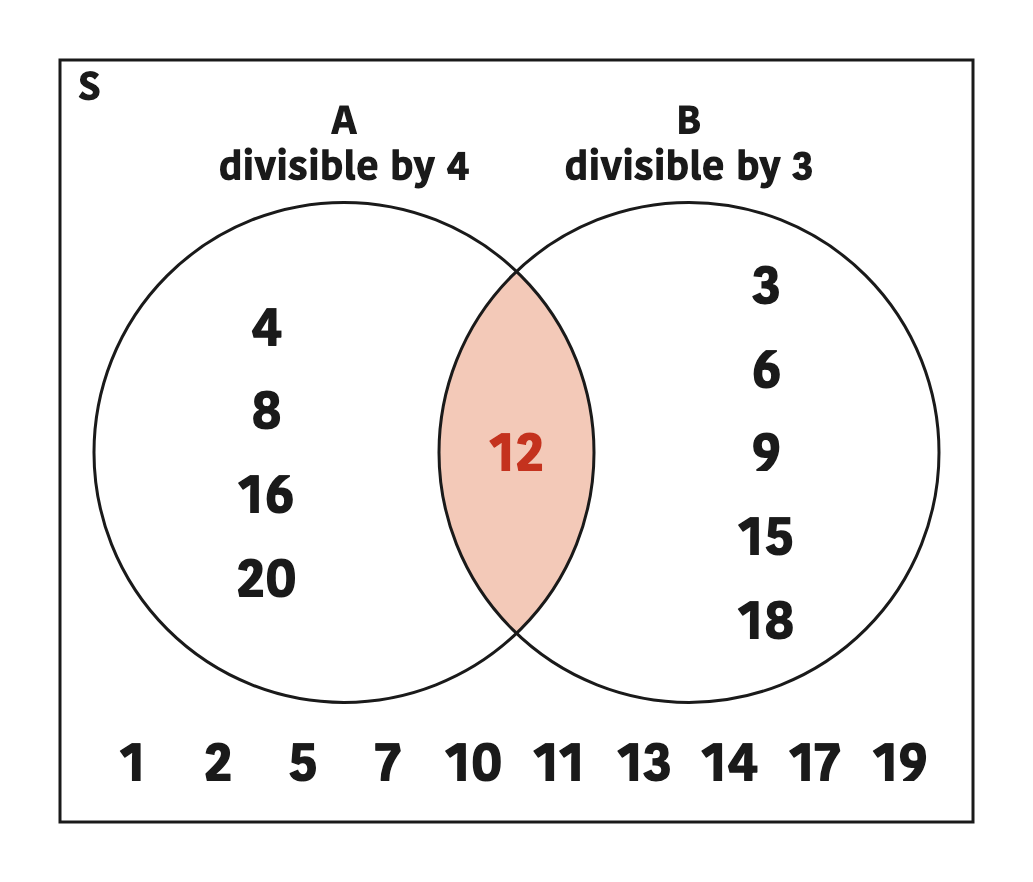
Step 5: Since A and B share 12, they are not mutually exclusive, so the full addition law is used:
\[ P(A \cup B) = P(A) + P(B) - P(A \cap B) \]
Step 6: Substituting the three probabilities:
\[ = \frac{5}{20} + \frac{6}{20} - \frac{1}{20} \]
Step 7: Combining the numerators over the common denominator and simplifying:
\[ = \frac{5 + 6 - 1}{20} = \frac{10}{20} = \frac{1}{2} \]
So the probability is \( \frac{1}{2} \). Counting confirms it: the union {3, 4, 6, 8, 9, 12, 15, 16, 18, 20} has 10 numbers, and \( \frac{10}{20} = \frac{1}{2} \). Without the subtraction the answer would have been \( \frac{11}{20} \), which counts 12 twice.
Worked Example 4: King, Queen or Jack
A pack of 52 playing cards has four suits of 13 cards each: spades, hearts, diamonds and clubs. Every suit has one king, one queen and one jack, so the pack holds 4 of each. One card is drawn at random from a well-shuffled pack. Find the probability that it is a king, a queen or a jack.
Step 1: The total number of outcomes is:
\[ n(S) = 52 \]
Step 2: Let K, Q and J be the events of drawing a king, a queen and a jack. There are 4 kings, so:
\[ P(K) = \frac{4}{52} = \frac{1}{13} \]
In the same way there are 4 queens and 4 jacks, so \( P(Q) = \frac{1}{13} \) and \( P(J) = \frac{1}{13} \).
Step 3: A card cannot be two of these at once, so K, Q and J are mutually exclusive. Writing the addition law for three events:
\[ P(K \cup Q \cup J) = P(K) + P(Q) + P(J) \]
Step 4: Substituting the three probabilities and adding:
\[ = \frac{1}{13} + \frac{1}{13} + \frac{1}{13} = \frac{3}{13} \]
So the probability of a king, a queen or a jack is \( \frac{3}{13} \). The count agrees: 12 of the 52 cards are kings, queens or jacks, and \( \frac{12}{52} = \frac{3}{13} \).
The Two Cases Side by Side
| Point | Mutually exclusive | Not mutually exclusive |
| Shared outcomes | None | At least one |
| Intersection | \( A \cap B = \emptyset \) | \( A \cap B \neq \emptyset \) |
| \( P(A \cup B) \) | \( P(A) + P(B) \) | \( P(A) + P(B) - P(A \cap B) \) |
| Die example | Even or odd: 1 | Even or prime: \( \frac{5}{6} \) |
Both forms answer the same question: how likely is it that at least one of the events happens? The only difference is whether some outcomes would be counted twice. Check for shared outcomes first, and the right form chooses itself.
The full lesson is waiting for you
The notes are free to read in full. A free account opens the rest of the practice, and tracks your progress and confidence score for every subject. Presentations and videos need approval from Learn Yeti.