Two Events Happening Together
Many probability questions ask about two things at once: a head on a coin and a 4 on a die, or a king on the first card and an ace on the second. Before any calculation, decide how the two events are linked, because the method depends on it. The probability of a single event E is still found in the usual way, \( P(E) = \frac{n(E)}{n(S)} \), where \( n(E) \) is the number of favourable outcomes and \( n(S) \) is the number of outcomes in the sample space.
Independent events: Two events are independent when the result of one does not change the probability of the other.
Dependent events: Two events are dependent when the result of one changes the probability of the other.
A coin and a die are independent. Whatever the coin shows, the die still has six faces and each one is equally likely. Two cards drawn one after another from a pack, with the first card kept out, are dependent. If the first card is a king, only 3 kings are left among 51 cards, so the chance of a king on the second draw falls from \( \frac{4}{52} \) to \( \frac{3}{51} \).
A Coin and a Die Together
Toss a coin and roll a cubical die at the same moment. The coin can show a head (H) or a tail (T). The die can show any number from 1 to 6.
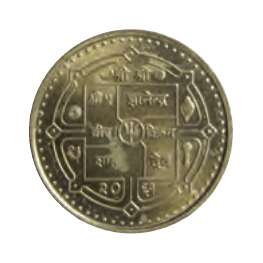
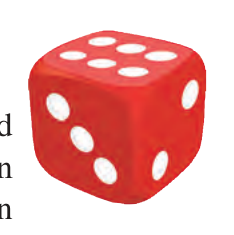
Each object has its own sample space. For the coin:
\[ S_1 = \{H, T\} \]
so \( n(S_1) = 2 \). For the die:
\[ S_2 = \{1, 2, 3, 4, 5, 6\} \]
so \( n(S_2) = 6 \). The coin does not affect the die and the die does not affect the coin, so the results on them are independent events. When both are used together, each of the 2 coin results can pair with each of the 6 die results, giving \( 2 \times 6 = 12 \) outcomes. The table shows all of them.
| Die shows | With a head | With a tail |
| 1 | (H, 1) | (T, 1) |
| 2 | (H, 2) | (T, 2) |
| 3 | (H, 3) | (T, 3) |
| 4 | (H, 4) | (T, 4) |
| 5 | (H, 5) | (T, 5) |
| 6 | (H, 6) | (T, 6) |
So for the coin and die together \( n(S) = 12 \). Now let A be the event of getting H on the coin and B the event of getting 4 on the die. In the coin's own sample space \( n(A) = 1 \), and in the die's \( n(B) = 1 \). Both happen together in exactly one outcome, \( A \cap B = \{(H, 4)\} \), so \( n(A \cap B) = 1 \). Now find the three probabilities.
Step 1: The probability of a head, using the coin's 2 outcomes:
\[ P(A) = \frac{n(A)}{n(S_1)} = \frac{1}{2} \]
Step 2: The probability of a 4, using the die's 6 outcomes:
\[ P(B) = \frac{n(B)}{n(S_2)} = \frac{1}{6} \]
Step 3: The probability of both together, counted from the 12 joint outcomes:
\[ P(A \cap B) = \frac{n(A \cap B)}{n(S)} = \frac{1}{12} \]
The Multiplication Principle of Probability
Look at the three answers side by side: \( \frac{1}{2} \), \( \frac{1}{6} \) and \( \frac{1}{12} \). There is a simple link between them.
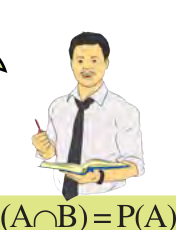
Multiplying the first two probabilities:
\[ P(A) \times P(B) = \frac{1}{2} \times \frac{1}{6} = \frac{1}{12} \]
The product is exactly \( P(A \cap B) \). This is no coincidence. The coin has 2 results and the die has 6, so the pairs number \( 2 \times 6 = 12 \). One result is wanted on the coin and one on the die, so the wanted pairs number \( 1 \times 1 = 1 \). Because the counts multiply, the fractions built from them multiply too. That gives the rule.
Multiplication principle of probability: If two events A and B are independent, the probability that both happen is the product of their separate probabilities: \( P(A \text{ and } B) = P(A \cap B) = P(A) \times P(B) \).
\[ P(A \cap B) = P(A) \times P(B) \]
The word "and" joining two events in a question is the signal to multiply. The symbol \( A \cap B \) is read "A and B" and means that both events happen.
The principle matters because listing is not always possible. Drawing two cards from a pack of 52, with the first put back, gives \( 52 \times 52 = 2704 \) ordered pairs. Nobody lists those, but two fractions multiplied in one line give the answer at once.
Worked Example: A Coin and a Spinner
A coin is tossed and a spinner coloured green, blue and red is spun at the same time. Each colour is equally likely to be under the needle when it stops. What is the probability of getting a tail (T) on the coin and the needle stopping on green?
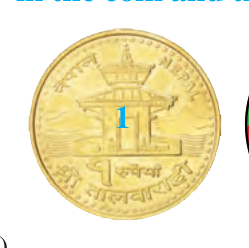
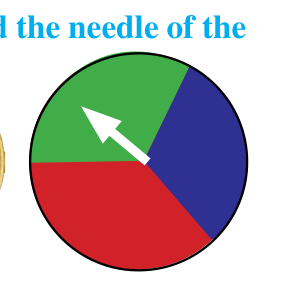
Step 1: The coin has \( S_1 = \{H, T\} \), so \( n(S_1) = 2 \), and one of these outcomes is a tail. The probability of a tail:
\[ P(T) = \frac{n(T)}{n(S_1)} = \frac{1}{2} \]
Step 2: Let G be the event of green. The spinner has \( S_2 = \{\text{green, blue, red}\} \), so \( n(S_2) = 3 \). The probability of green:
\[ P(G) = \frac{n(G)}{n(S_2)} = \frac{1}{3} \]
Step 3: The coin and the spinner do not affect each other, so T and G are independent events. Applying the multiplication principle:
\[ \begin{aligned} P(T \cap G) &= P(T) \times P(G) \\ &= \frac{1}{2} \times \frac{1}{3} \\ &= \frac{1}{6} \end{aligned} \]
So the probability of a tail and green together is \( \frac{1}{6} \).
Checking by Listing the Outcomes
A small experiment like this one can also be solved by writing down every joint outcome. Each of the 2 coin results pairs with each of the 3 colours:
\[ \begin{aligned} S = \{&(H, \text{Green}), (H, \text{Blue}), \\ &(H, \text{Red}), (T, \text{Green}), \\ &(T, \text{Blue}), (T, \text{Red})\} \end{aligned} \]
so \( n(S) = 6 \). The event wanted is a tail with green, and it holds one outcome: \( A = \{(T, \text{Green})\} \), so \( n(A) = 1 \). Therefore:
\[ P(A) = \frac{n(A)}{n(S)} = \frac{1}{6} \]
Both methods give \( \frac{1}{6} \). Listing works when the outcomes are few. Multiplying works every time and is much quicker.
Two Cards With Replacement
A pack of playing cards has 52 cards, and among them are 4 kings and 4 aces. When two cards are drawn one after another, it matters whether the first card goes back into the pack.
Drawing with replacement: The first object drawn is put back and mixed in before the second draw, so the second draw is made from exactly the same collection. Draws with replacement are independent events.
Question: Two cards are drawn at random in succession, with replacement, from a well-shuffled pack of 52 cards. Find the probability that the first card is a king (K) and the second is an ace (A).
Step 1: For the first draw \( n(S) = 52 \) and \( n(K) = 4 \). The probability of a king:
\[ P(K) = \frac{n(K)}{n(S)} = \frac{4}{52} = \frac{1}{13} \]
Step 2: The king is put back, so the pack again has 52 cards and still 4 aces. The probability of an ace on the second draw:
\[ P(A) = \frac{n(A)}{n(S)} = \frac{4}{52} = \frac{1}{13} \]
Step 3: The first draw has no effect on the second, so K and A are independent. Multiplying the two probabilities:
\[ \begin{aligned} P(K \cap A) &= P(K) \times P(A) \\ &= \frac{4}{52} \times \frac{4}{52} \\ &= \frac{1}{169} \end{aligned} \]
So the probability that the first card is a king and the second an ace is \( \frac{1}{169} \).
Two Cards Without Replacement
Drawing without replacement: The first object drawn is kept out, so the second draw is made from one object fewer. The second probability then depends on what came out first, so draws without replacement are dependent events.
For dependent events the same multiplication is used, with one change: the second probability is worked out from what is left after the first event has happened.
Question: Two cards are drawn at random in succession, without replacement, from a well-shuffled pack of 52 cards. Find the probability that the first card is a king (K) and the second is an ace (A).
Step 1: The first draw is from the full pack, with \( n(S) = 52 \) and \( n(K) = 4 \). The probability of a king:
\[ P(K) = \frac{n(K)}{n(S)} = \frac{4}{52} = \frac{1}{13} \]
Step 2: The king is not put back, so \( 52 - 1 = 51 \) cards remain. The card taken out was a king, not an ace, so there are still 4 aces. With \( n(S_1) = 51 \) and \( n(A) = 4 \), the probability of an ace:
\[ P(A) = \frac{n(A)}{n(S_1)} = \frac{4}{51} \]
Step 3: The second probability depended on the first draw, so K and A are dependent events. Multiplying the first probability by the second:
\[ \begin{aligned} P(K \cap A) &= P(K) \times P(A) \\ &= \frac{4}{52} \times \frac{4}{51} \\ &= \frac{4}{663} \end{aligned} \]
The answer \( \frac{4}{663} \) is slightly larger than the \( \frac{1}{169} \) found with replacement. Once a king has left the pack, the 4 aces make up a slightly bigger share of the cards that remain.
Without replacement, always lower the total by one. Then ask separately whether the number you want also falls. For a king then an ace, the aces stay at 4. For a king then another king, the kings fall to 3 and the second probability is \( \frac{3}{51} \).
Marbles Drawn Both Ways
Question: A bag contains 5 blue and 6 red marbles. Two marbles are drawn at random one after another. Find the probability that the first is red and the second is blue when:
- (a) the first marble is put back before the second draw;
- (b) the first marble is not put back.
Let B be the event of a blue marble and R the event of a red marble. Then \( n(B) = 5 \), \( n(R) = 6 \) and \( n(S) = 5 + 6 = 11 \). For one draw from the full bag:
\[ P(R) = \frac{n(R)}{n(S)} = \frac{6}{11} \]
\[ P(B) = \frac{n(B)}{n(S)} = \frac{5}{11} \]
Part (a), with replacement. The red marble goes back, so the second draw is again from 11 marbles, 5 of them blue. The draws are independent. Multiplying \( P(R) \) by \( P(B) \):
\[ \begin{aligned} P(R \cap B) &= P(R) \times P(B) \\ &= \frac{6}{11} \times \frac{5}{11} \\ &= \frac{30}{121} \end{aligned} \]
Part (b), without replacement.
Step 1: The first draw is from the full bag. The probability of red:
\[ P(R) = \frac{6}{11} \]
Step 2: The red marble is kept out, so \( 11 - 1 = 10 \) marbles remain. A red one left, so the blue marbles are still 5. With \( n(S_1) = 10 \) and \( n(B) = 5 \), the probability of blue:
\[ P(B) = \frac{n(B)}{n(S_1)} = \frac{5}{10} \]
Step 3: The first marble was not replaced, so R and B are dependent. Multiplying the two probabilities:
\[ \begin{aligned} P(R \cap B) &= P(R) \times P(B) \\ &= \frac{6}{11} \times \frac{5}{10} \\ &= \frac{30}{110} = \frac{3}{11} \end{aligned} \]
| With replacement | Without replacement | |
| Marbles at the second draw | 11 | 10 |
| Probability of blue second | \( \frac{5}{11} \) | \( \frac{5}{10} \) |
| Red then blue | \( \frac{30}{121} \) | \( \frac{3}{11} \) |
| Type of events | Independent | Dependent |
Since \( \frac{3}{11} = \frac{33}{121} \), the answer without replacement is the larger one. Taking a red marble out leaves the blue marbles a bigger share of the bag, so blue becomes more likely on the second draw.
Adding Cases: Same Colour, Either Order, At Least One
Some questions can come true in more than one way. "Both the same colour" can mean both white or both black. Work out each way as a product with the multiplication principle, then add the products. Adding is allowed because two different ways cannot both happen in the same pair of draws.
Question: A bag holds 4 white and 6 black balls of the same size. Two balls are drawn one after another without replacement. Find the probability that both are the same colour. Write WW for white on both draws and BB for black on both draws.
Step 1: Both white. The first is white with probability \( \frac{4}{10} \), and then 3 of the remaining 9 are white:
\[ P(WW) = \frac{4}{10} \times \frac{3}{9} = \frac{12}{90} \]
Step 2: Both black. The first is black with probability \( \frac{6}{10} \), and then 5 of the remaining 9 are black:
\[ P(BB) = \frac{6}{10} \times \frac{5}{9} = \frac{30}{90} \]
Step 3: Adding the two ways:
\[ \begin{aligned} P(WW) + P(BB) &= \frac{12}{90} + \frac{30}{90} \\ &= \frac{42}{90} = \frac{7}{15} \end{aligned} \]
Either order. "One white and one black" can happen as white then black (WB) or black then white (BW). Each order is a product, and the two are added:
\[ \begin{aligned} P(WB) + P(BW) &= \frac{4}{10} \times \frac{6}{9} + \frac{6}{10} \times \frac{4}{9} \\ &= \frac{24}{90} + \frac{24}{90} \\ &= \frac{48}{90} = \frac{8}{15} \end{aligned} \]
This agrees with \( 1 - \frac{7}{15} = \frac{8}{15} \), because two balls are either the same colour or different colours, never both.
At least one. "At least one black ball" fails only when both balls are white, so it is quicker to subtract that one case from 1:
\[ 1 - P(WW) = 1 - \frac{12}{90} = \frac{78}{90} = \frac{13}{15} \]
"At least one black" is not the same as "both black". Here the first is \( \frac{13}{15} \) and the second is only \( \frac{30}{90} = \frac{1}{3} \). Read which one the question asks before you calculate.
Solving Any Two-Draw Question
Every question in this topic, whether it uses coins, dice, spinners, cards or marbles, can be solved with the same short routine:
- Write the total number of objects and the number of each kind before the first draw.
- Decide whether the first object goes back. Put back means independent events; kept out means dependent events.
- Find the probability of the first result.
- Find the probability of the second result from the collection as it stands after the first draw.
- Multiply the two probabilities.
- If the question can come true in more than one way, do this for each way and add the answers.
- Write the final fraction in its lowest terms.
The full lesson is waiting for you
The notes are free to read in full. A free account opens the rest of the practice, and tracks your progress and confidence score for every subject. Presentations and videos need approval from Learn Yeti.