Getting to Know Mushrooms
In the rainy season, small umbrella shaped growths appear on mounds of soil, heaps of dung, rotting straw and the bark of trees. These are mushrooms. A mushroom is a kind of fungus. Although it looks like a plant, it is not one, because a mushroom has no chlorophyll. Without chlorophyll it cannot make its own food using sunlight. A mushroom is therefore saprotrophic: it absorbs its food from dead and decaying matter. That is exactly why mushrooms spring up on rotting material and nowhere else.
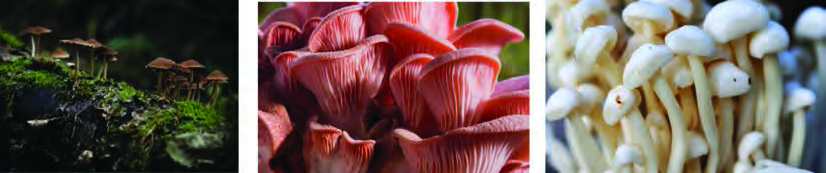
Saprotroph: an organism that lives by absorbing food from dead and decaying organic matter. A mushroom is a saprotrophic fungus.
Some mushrooms are edible. The button mushroom, the paddy straw mushroom and the oyster mushroom are common examples that people grow and eat, and some wild kinds are collected as food too. Other wild mushrooms, however, can be poisonous. Because mushrooms are tasty and nutritious, mushroom farming is now growing into a source of income for many families.
Never pick or eat a wild mushroom you cannot identify. An edible mushroom and a poisonous one can look almost the same, so a wild mushroom must not be eaten unless a knowledgeable person has identified it.
Structure of a Mushroom
The body of a mushroom is divided into two parts: the mycelium and the fruiting body. The part that stays below the soil is called the mycelium, and it is the vegetative part of the mushroom. The mycelium is made of fine thread like fibres called hyphae. Through the mycelium the mushroom absorbs water and organic food from the soil. So the mushroom we see standing above the ground is not the whole organism; a large part of it lies hidden below the soil.
Mycelium: the vegetative part of a mushroom that stays below the soil, made of fine thread like fibres called hyphae, and absorbs water and organic food.
The part above the ground is called the fruiting body, and it is the reproductive part of the mushroom. A mushroom has a stalk and an umbrella like top. The stalk is called the stipe. The umbrella like upper part is called the pileus. On the underside of the pileus there are thin leaf like plates called gills. The gills carry the spores, called basidiospores, from which new mushrooms grow.
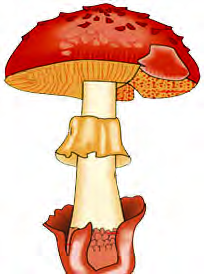
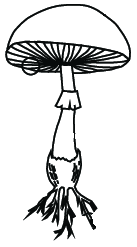
| Part | Where it is | What it does |
| Mycelium | Below the soil | Absorbs water and organic food |
| Stipe (stalk) | Above the ground | Holds the pileus up |
| Pileus | On top of the stipe | The umbrella like part that covers the gills |
| Gills | Under the pileus | Produce the basidiospores |
The Three Layers of a Gill
On the inner side of the pileus lie the thin plates called gills. In an adult mushroom each gill has three layers: the trama, the subhymenium and the hymenium. The trama is the middle of the gill, the subhymenium lies over it, and the outermost layer is called the hymenium. The main work of producing spores happens in this outermost layer, the hymenium.
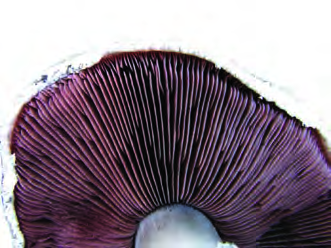
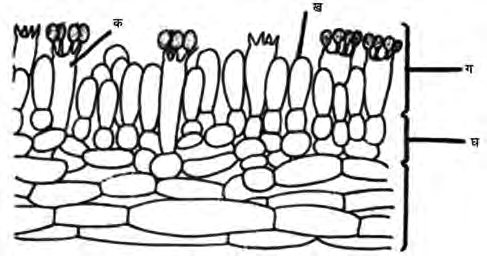
Hymenium: the outermost layer of the gill of an adult mushroom, which contains two kinds of cells, the basidia and the paraphyses.
The hymenium contains two kinds of cells: basidia and paraphyses. A paraphysis is sterile, which means it never produces spores. Spore production is the job of the basidium. Inside a basidium there are two haploid nuclei, one of the plus strain and one of the minus strain.
Basidium: the spore producing cell of the hymenium, holding two haploid nuclei, one of the plus strain and one of the minus strain.
Paraphysis: a sterile cell that stands beside the basidia in the hymenium and does not produce spores.
How Basidiospores Form
A new mushroom begins its story inside the basidium. Basidiospores form in this order:
- The two haploid nuclei inside the basidium, one plus strain and one minus strain, fuse together to form one diploid nucleus.
- That diploid nucleus divides by meiosis and forms four haploid nuclei, of which two are plus strain and two are minus strain.
- Then four finger like structures grow at the tip of the basidium. These structures are called sterigmata.
- Each sterigma swells up, and one haploid nucleus moves into each of them.
- In this way one basidiospore forms on each sterigma. Of these basidiospores, two are plus strain and two are minus strain.
- When a basidiospore ripens, it breaks away from its sterigma.
Each basidium produces four basidiospores: two of the plus strain and two of the minus strain.
From Spore to Adult Mushroom
Each spore that breaks away from its sterigma germinates when it finds favourable conditions, and grows into a primary mycelium. Every cell of a primary mycelium carries only one nucleus. Next, a primary mycelium of the plus strain and a primary mycelium of the minus strain fuse, and this fusion produces the secondary mycelium. A cell of the secondary mycelium carries two nuclei, one from each strain, and for that reason it is called a dikaryotic mycelium.
Dikaryotic mycelium: the secondary mycelium formed by the fusion of primary mycelia of different strains, whose cells carry two nuclei, one from each strain.
When the secondary mycelium finds favourable temperature and moisture, a mushroom sprouts from it. At first the young mushroom is small and round. When it matures, it opens out into the umbrella shape. On the surface of the hymenium layer under the pileus, spores are produced in very large numbers. Once these spores ripen, the air carries them and scatters them in all directions. Wherever a spore finds favourable air, water, temperature and organic matter, it grows into a new mushroom mycelium. In this way the life cycle of the mushroom is completed.
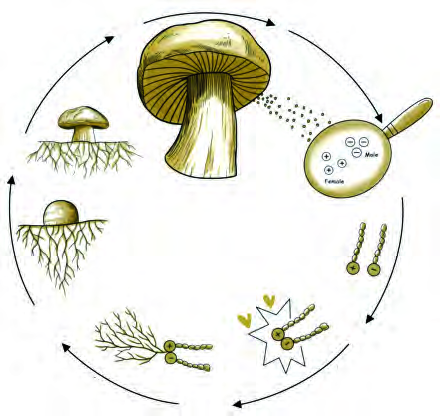
The primary mycelium and the secondary mycelium are not the same thing. A primary mycelium grows from one spore and each of its cells has one nucleus. A secondary mycelium forms when two primary mycelia of different strains fuse, its cells carry two nuclei, and it is this mycelium that the mushroom grows from.
The Life Cycle at a Glance
| Stage | What happens |
| Basidiospore | Ripens, breaks off the sterigma and is scattered by the air |
| Germination | In favourable conditions the spore starts to grow |
| Primary mycelium | One nucleus per cell, all of one strain |
| Fusion | Primary mycelia of the plus and minus strains join |
| Secondary mycelium | Two nuclei per cell, and therefore dikaryotic |
| Small round mushroom | Sprouts from the secondary mycelium in favourable temperature and moisture |
| Adult mushroom | Opens out into the umbrella shape |
| Spore production | The hymenium surface makes many spores and the cycle begins again |
The full lesson is waiting for you
The notes are free to read in full. A free account opens the rest of the practice, and tracks your progress and confidence score for every subject. Presentations and videos need approval from Learn Yeti.