Living Beings Around Us
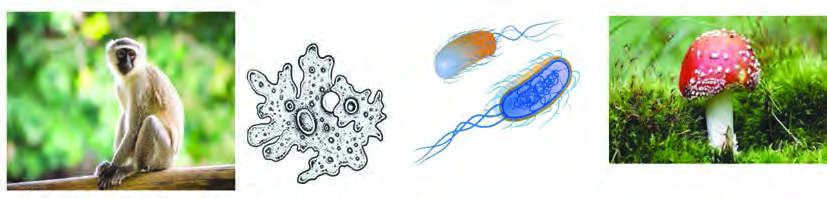
All kinds of living beings are found around us. On the basis of body structure, habitat and body processes, some of them are alike and some are very different. Some live in water while others live on land. Plants that contain chlorophyll make their own food, so they are autotrophs. Other living beings depend on ready made food, so they are heterotrophs. Tiny organisms such as the amoeba and the paramecium carry out only simple life processes, while mammals carry out highly developed ones.
What Classification of Living Beings Is
There are millions of living beings in the world, and nobody can study them one by one. So scientists sort them into groups using the characteristics found in them, such as body structure, the way they take food, reproduction and evolution. Living beings that share the same nature and qualities are kept in the same group.
The process of dividing living beings into groups and subgroups on the basis of their similar and dissimilar characteristics is called classification of living beings.
Importance of Classification of Living Beings
The study of classification helps us in the following ways:
- Classification helps scientists discover facts about evolution.
- With its help, an enormous number of living beings can be studied in a short time.
- It makes the scientific naming of living beings easier.
- It explains the natural relationships among living beings.
- It makes the study of living beings simple and scientific.
Organisms That Resemble Each Other
Look carefully at the pictures below. Some organisms match each other so closely that at first glance they seem to belong to one family.

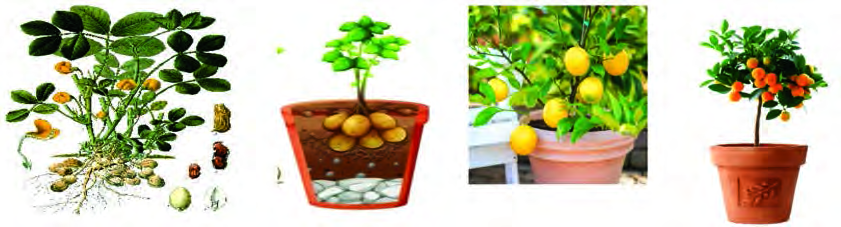
The tiger and the lion are both large flesh eating animals with very similar bodies. The donkey and the horse are grass eating animals of much the same build. Among the plants, the groundnut and the potato both grow the part we eat under the soil, while the lime and the orange are sour fruits of the same kind. Such close resemblance is a signal that these organisms are naturally related. Scientists use exactly these matching and non matching characteristics to put organisms into groups and to give them names.
The Binomial System of Nomenclature
Carolus Linnaeus made the greatest contribution to the classification of living beings. He divided all living beings into two kingdoms, the Animal Kingdom and the Plant Kingdom. He also prepared a framework for naming living beings. Because Linnaeus was the first person to study the classification and scientific naming of living beings in detail, he is called the Father of Modern Taxonomy.
When Linnaeus named animals and plants, he used two words of the Latin language. The first word is the Genus, also called the generic name, and the second is the Species, also called the specific name.
The process of naming living beings with two names, a generic name and a specific name, is called the binomial system of nomenclature. It is the scientific system of naming.
The same organism is known by different names in different places and languages. The plant we call potato in English has other names in other languages. A scientific name, on the other hand, is the same all over the world. When a scientist in any country writes Solanum tuberosum, everyone understands the same plant. This is what makes the binomial system so useful in science.
In this system a name is written using the genus and the species. The first letter of the genus is written as a capital letter, and the first letter of the species is written as a small letter. The scientific name of the tiger is Panthera tigris. Here Panthera is the genus and tigris is the species.
Many students write the first letter of both words in capitals. Panthera Tigris is wrong. Only the genus begins with a capital letter, and the species always begins with a small letter. The correct form is Panthera tigris.
The scientific names of some familiar plants and animals are given below:
| Common Name | Generic Name | Specific Name |
| Mustard | Brassica | campestris |
| Pea | Pisum | sativum |
| Maize | Zea | mays |
| Paddy | Oryza | sativa |
| Potato | Solanum | tuberosum |
| Tiger | Panthera | tigris |
| Man | Homo | sapiens |
| Cat | Felis | catus |
| Dog | Canis | lupus |
| Cow | Bos | taurus |
| Lion | Panthera | leo |
Genus and Species
A group of species whose characteristics match most closely is called a genus. In classification it is placed below the family and above the species. For example, the genus Canis contains animals such as the dog, the jackal and the wolf.
A group of living beings that have mostly the same characteristics and are able to breed among themselves is called a species. It is the smallest unit of taxonomy.
The tiger and the lion make this clear. Both belong to the genus Panthera, because so many of their characteristics match. But the tiger belongs to the species tigris and the lion to the species leo. A tiger can breed and raise young only with another tiger. So the tiger and the lion share a genus, yet they are different species.
The Seven Levels of Classification
When living beings are classified, they are divided into a series of levels. On the basis of their characteristics they are classified into seven levels: Kingdom, Phylum, Class, Order, Family, Genus and Species. In the classification of plants, the level Phylum is also called Division.
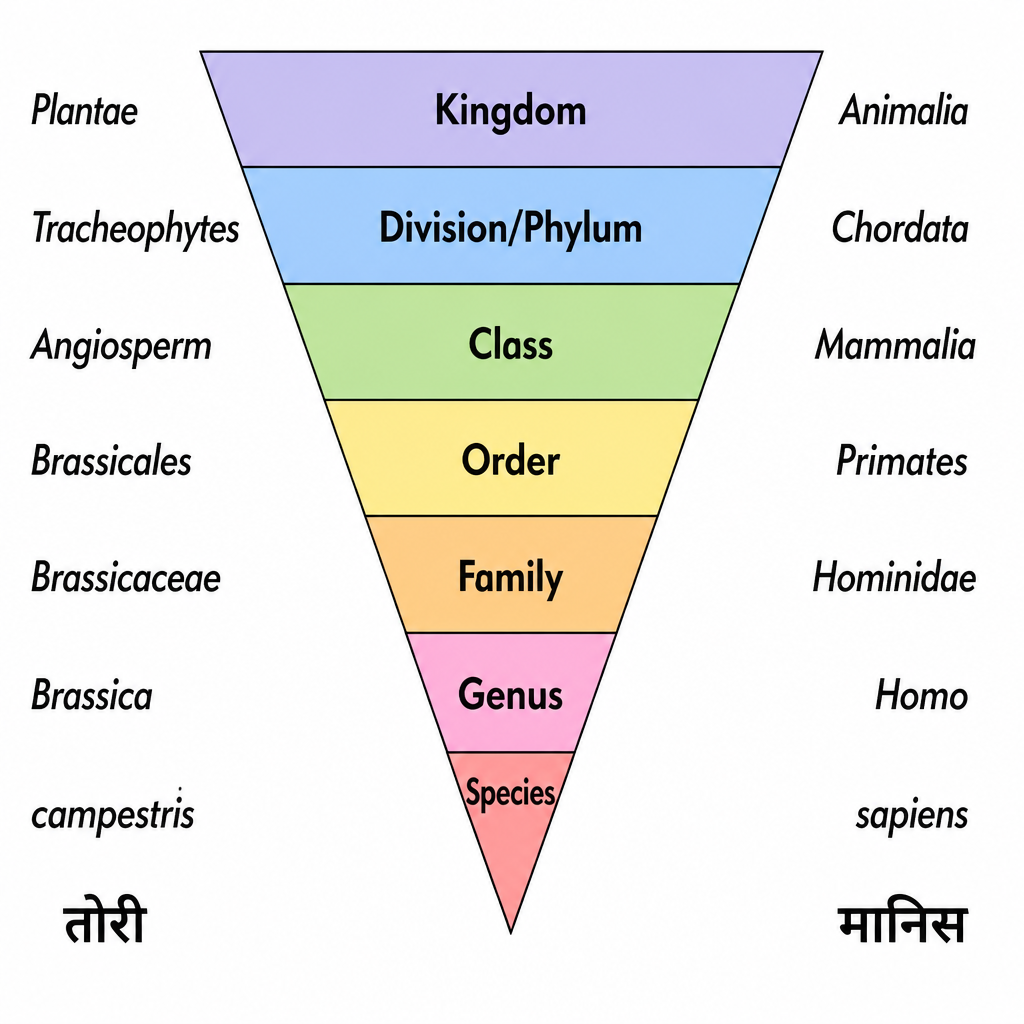
The higher we go in these levels, the more living beings each level holds, and the lower we come, the closer we get to a single fixed species. Follow the classification of man. The kingdom holds all animals: those with a backbone and those without, unicellular and multicellular alike. Within the kingdom, the phylum Chordata holds only the animals that have a backbone. The class Mammalia holds only the mammals. The order Primates holds monkeys, gorillas, gibbons, lemurs and man. Within the order, the family Hominidae holds the chimpanzee, the gorilla, man and the orangutan, and the lowest level, the genus Homo, holds man alone. So the top level gathers a huge crowd of living beings, while the lowest level holds just one species.
| Level | Mustard | Man |
| Kingdom | Plantae | Animalia |
| Division/Phylum | Tracheophytes | Chordata |
| Class | Angiosperm | Mammalia |
| Order | Brassicales | Primates |
| Family | Brassicaceae | Hominidae |
| Genus | Brassica | Homo |
| Species | campestris | sapiens |
Moving from the lowest level up to the highest confirms that living beings are related to one another. The lower you go, the more closely the members of a group match each other.
The full lesson is waiting for you
The notes are free to read in full. A free account opens the rest of the practice, and tracks your progress and confidence score for every subject. Presentations and videos need approval from Learn Yeti.