From Two Kingdoms to Five
Scientists have recommended different systems for classifying living beings. The oldest and simplest of these divided every organism into just two kingdoms, plants and animals, and it is called the two kingdom system of classification. When only a small number of organisms were known, this worked well enough. But as scientists studied more and more living things, the two boxes started to feel far too small for the variety of life they were finding.
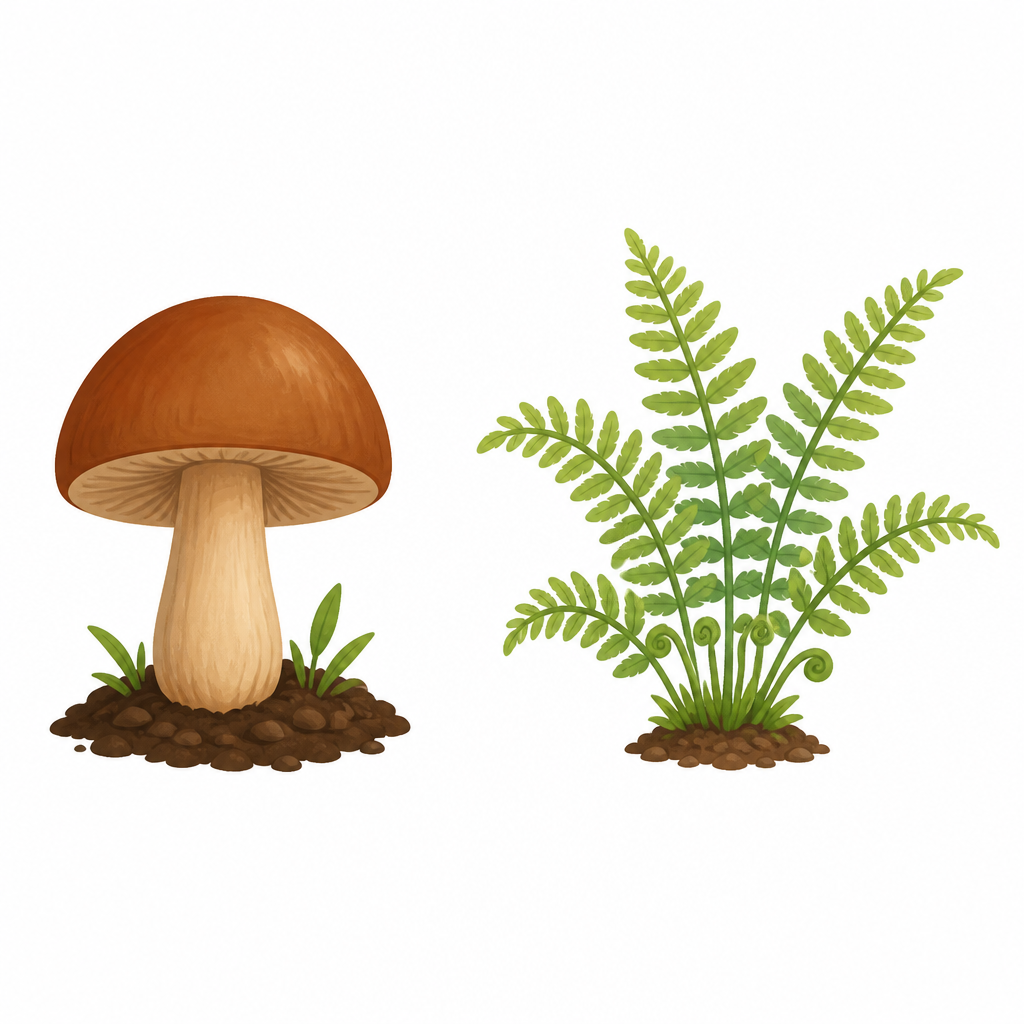
Look at one example. A mushroom has no chlorophyll, so it cannot make its own food. A fern has chlorophyll and makes its own food by photosynthesis. In the matter of feeding, these two are complete opposites. Yet the two kingdom system placed the mushroom and the fern together, both counted as non flowering plants. When organisms this different land in one group, the classification hides most of what makes each of them what it is. This is why the five kingdom system is now used far more widely than the two kingdom system.
Weaknesses of the Two Kingdom System
A good classification system must place every organism in a group that matches its real features. The two kingdom system could not manage this. Its main weaknesses are these:
- It does not clearly separate prokaryotic organisms from eukaryotic ones.
- It does not separate unicellular organisms from multicellular ones.
- It does not clearly separate algae, which can photosynthesise, from fungi, which cannot.
- It has not been able to include all living beings.
The five kingdom system came into use to remove these weaknesses and to make the classification of living beings more relevant and more scientific.
Whitaker's Five Kingdom System
The concept of the five kingdom system of classification was brought in 1969 AD by the American taxonomist Robert Harding Whitaker. This system tries to bring as many organisms as possible into classification. Under it, all living beings are divided into five kingdoms: Monera, Protista, Plantae, Fungi and Animalia. An organism like a mushroom no longer has to be squeezed into the plant group, because organisms like it now have a kingdom of their own, the kingdom Fungi.
Under the five kingdom system, every living being belongs to one of five kingdoms: Monera, Protista, Plantae, Fungi or Animalia.
Bases of the Five Kingdom System of Classification
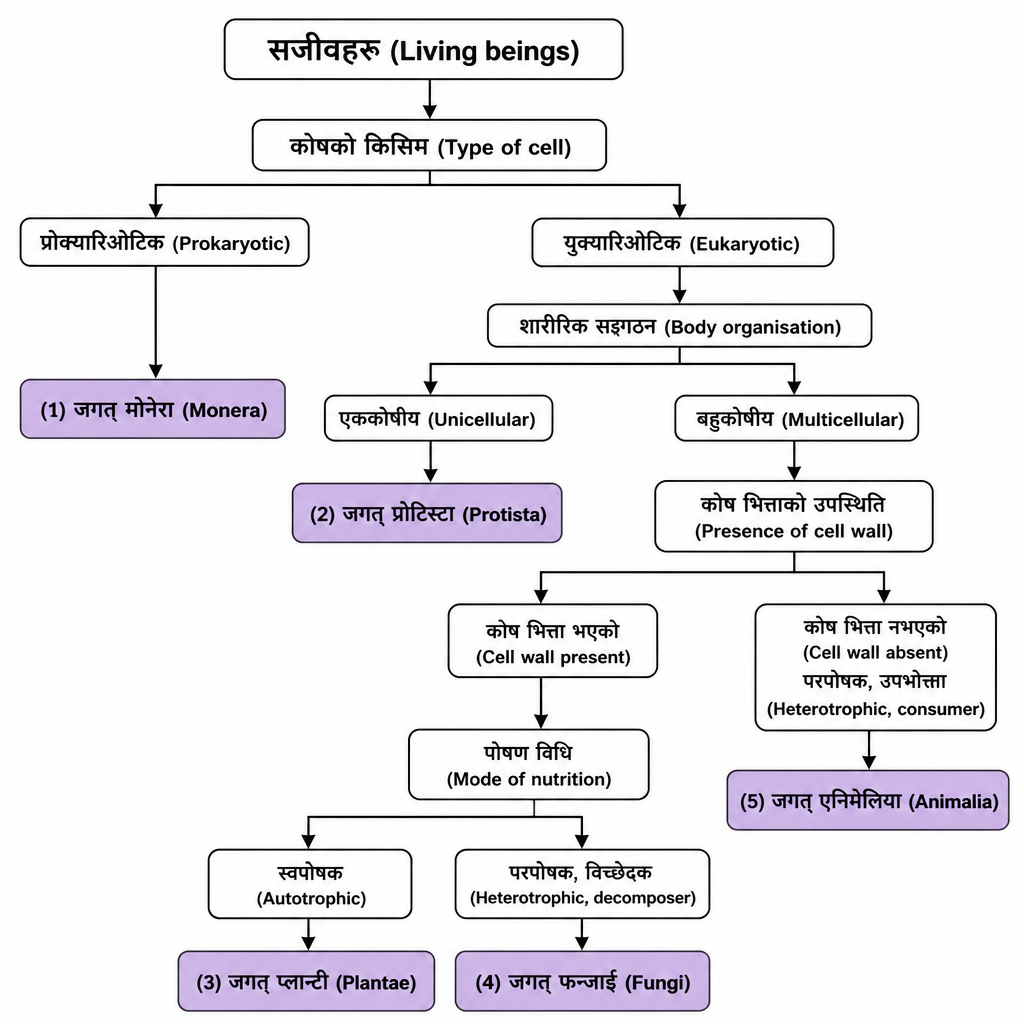
How is it decided which kingdom an organism belongs to? The work is done by asking one question after another. Each question's answer splits a large group of organisms into two parts, and as the splitting continues, every organism arrives in its own kingdom. These questions are the bases of the five kingdom system of classification.
Prokaryotic cell: a cell that has no organised nucleus is called a prokaryotic cell. Organisms made of such cells are prokaryotic organisms.
Eukaryotic cell: a cell that has an organised nucleus is called a eukaryotic cell. The organisms of the four kingdoms other than Monera are eukaryotic.
Now take the questions in order:
- First basis, type of cell: all living beings are first split into two on the basis of cell type. Organisms with prokaryotic cells are placed in the kingdom Monera, while eukaryotic organisms move on to the next question.
- Second basis, body organisation: the remaining organisms are split on the basis of the number of cells. Unicellular organisms are placed in the kingdom Protista, while multicellular ones move on to the next question.
- Third basis, presence of the cell wall: the remaining multicellular organisms are split into those with a cell wall and those without one. Organisms with no cell wall, which are heterotrophic consumers, are placed in the kingdom Animalia.
- Fourth basis, mode of nutrition: organisms that do have a cell wall are split once more on the basis of how they feed. Autotrophic organisms are placed in the kingdom Plantae, and heterotrophic decomposers in the kingdom Fungi.
Autotrophic: an organism that makes its own food by photosynthesis is called autotrophic, for example a green plant.
Heterotrophic: an organism that cannot make its own food and depends on other organisms is called heterotrophic, for example mushrooms and animals.
Decomposer: an organism that takes its nutrition by rotting down dead organisms and their remains is called a decomposer. The organisms of the kingdom Fungi are decomposers.
Consumer: an organism that lives by eating ready made food, either plants or other animals, is called a consumer. The organisms of the kingdom Animalia are consumers.
So all living beings were first divided in two on the basis of cell type, and the prokaryotic ones went to the kingdom Monera. Among the remaining eukaryotic organisms, the unicellular ones went to the kingdom Protista. The remaining multicellular organisms were then divided by the presence or absence of a cell wall. Those with a cell wall were divided once more by their mode of nutrition: the autotrophs went to the kingdom Plantae and the heterotrophs to the kingdom Fungi. The organisms with no cell wall, which play the role of consumers in the ecosystem, went to the kingdom Animalia.
Both Heterotrophs, Different Roles
A question can arise here: if Fungi and Animalia are both heterotrophic, why were they put in different kingdoms? Fungi have a cell wall and Animalia do not, and although both are heterotrophic, they play different roles in the ecosystem. Fungi play the role of decomposers, taking their nutrition by rotting down dead organisms. Animals play the role of consumers, eating ready made food. The autotrophic plants with cell walls are the producers, because they are the ones that make food in the first place. In this way, the role an organism plays in the ecosystem also became a basis of classification, and this completes the division of living beings in the five kingdom system.
A mushroom does not move and grows straight out of the ground, so many students take it for a plant. But a mushroom has no chlorophyll and cannot make its own food, so it belongs in the kingdom Fungi, not in the kingdom Plantae.
Bases and Kingdoms at a Glance
| Basis of classification | Kingdom |
| Type of cell: prokaryotic | Monera |
| Structure of the body: unicellular | Protista |
| Cell wall present, autotrophic, producer | Plantae |
| Cell wall present, heterotrophic decomposer | Fungi |
| Cell wall absent, heterotrophic, consumer | Animalia |
So the five kingdom system of classification rests on five bases: the structure of the cell, the structure of the body, the presence of the cell wall, the mode of nutrition, and the role played in the ecosystem. Hold on to these five bases and you can place any organism in the world into its kingdom.
The full lesson is waiting for you
The notes are free to read in full. A free account opens the rest of the practice, and tracks your progress and confidence score for every subject. Presentations and videos need approval from Learn Yeti.