Materials Farmers Add to Their Fields
Most of the food we eat comes from plants. Rice, bread, lentils, vegetables and fruit all begin as crops growing in a field, and those crops draw the nutrients they need from the soil. When the same soil is farmed year after year without anything being added back, the elements it can supply are slowly used up and the soil turns poor and dry. On top of that, crops catch many kinds of disease as the seasons change. Together these two problems lower the fertility of the soil, and the harvest suffers.
Soil fertility is the capacity of soil to grow a good crop by supplying the nutrients plants need.
To raise the soil's fertility and to destroy disease, farmers use different chemical substances. Chemical fertilizers are added so that plants grow and develop well, and pesticides are sprayed to protect the crop from disease and from insects.
Chemical fertilizers and pesticides are useful, but they also have negative effects. They must be used carefully, and only after understanding what the soil and the crop actually need.
What Harkabahadur's Field Taught Him
Harkabahadur once planted an improved variety of maize seed in his field. Although the seed was improved, it did not sprout well for a long time. As the seedlings grew, something stranger appeared: the size of the stalks, leaves and flowers differed from one patch of the field to another. In some patches the roots were so weak that plants fell over, leaves turned yellow and dropped, and some plants simply dried up.
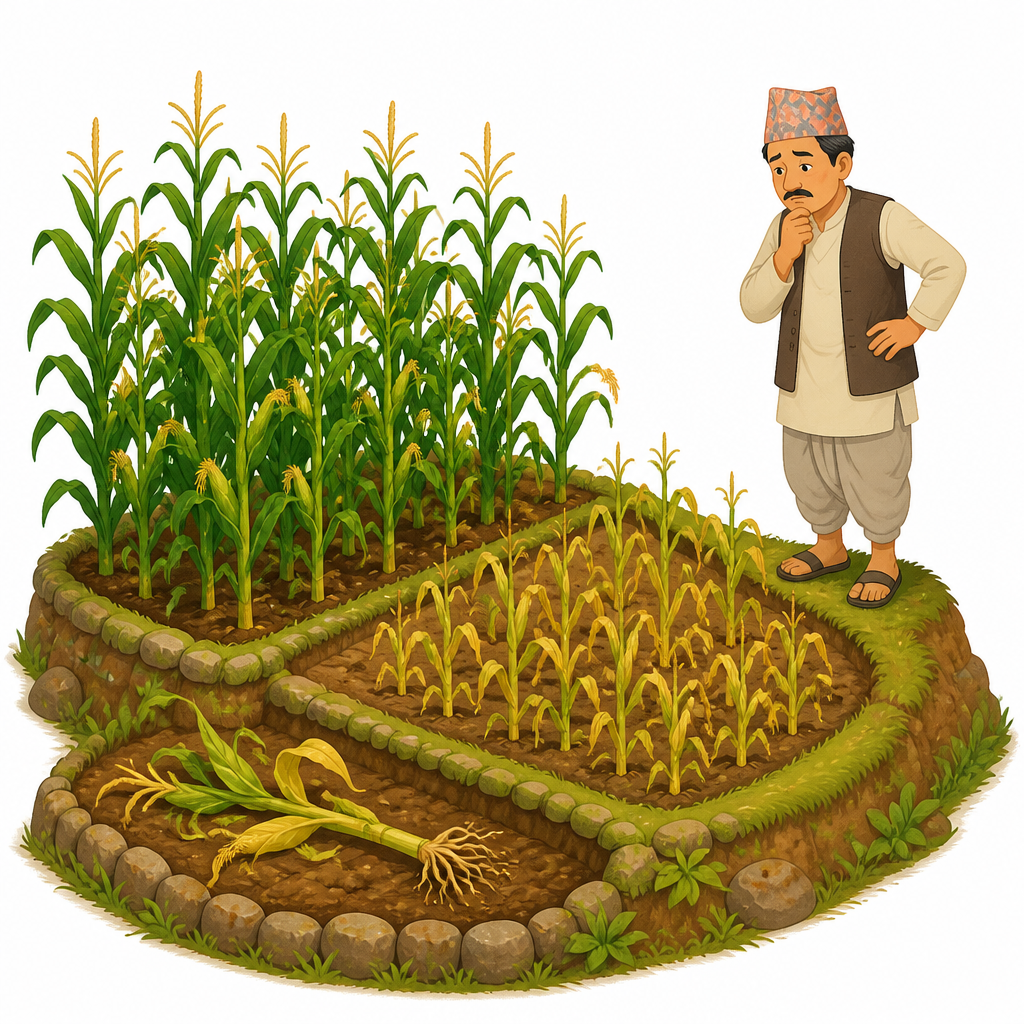
On a neighbour's advice he spread urea fertilizer on the field. Within a few days the plants in some patches shot up, but the problems in the other patches did not go away, and the maize cobs and seeds still came out in unequal sizes. Why did one fertilizer work in some places and fail in others? That question led him to his next step.
Following the suggestion of an expert at the agriculture office, he had the soil from different parts of the field tested. The test revealed that different parts of the field were short of different elements, and that the acidity of the soil also varied from place to place. For the next crop he used chemical fertilizers matched to the report, urea in some places, ammonium phosphate in others, potassium sulphate in still others. Likewise he applied lime in some spots and calcium chloride in others. This second time the crop grew well everywhere. But now insects attacked it, so on the expert's advice he carefully sprayed pesticide and saved his harvest.
Soil is not the same everywhere. Only a soil test, never a guess, can tell which element a patch of soil lacks, and the crop improves when exactly that missing element is added.
The Plant Life Cycle and Essential Elements
A seed sprouts in the soil. The young plant grows into an adult, the adult flowers, the flower turns into fruit, and inside the fruit a new seed is made, from which a new plant will sprout again. In this way the life cycle of a plant runs on and on. To complete this cycle, a plant cannot do without certain elements.
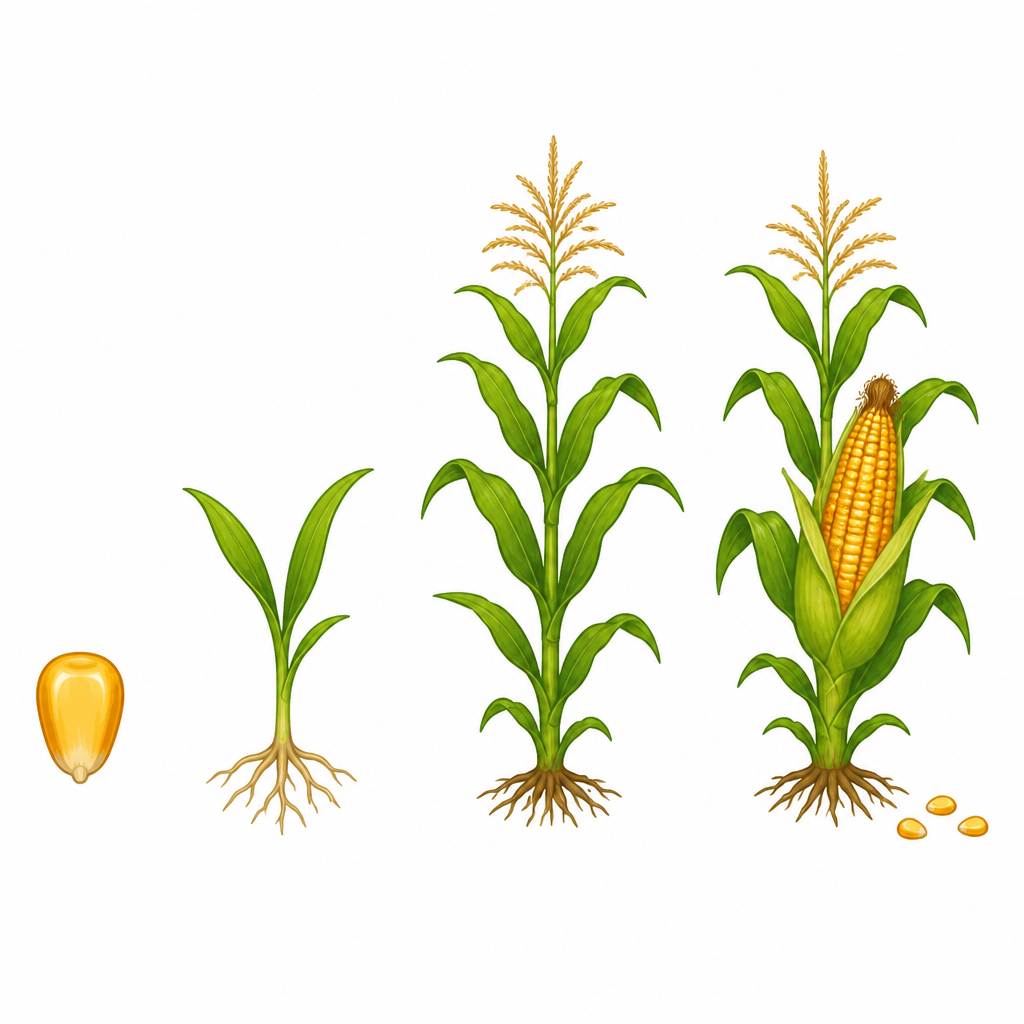
All the elements a plant needs for its growth, development and the completion of its life cycle are called essential elements.
Plants obtain the elements needed for their life processes from the soil. Whether the soil holds these elements or not is therefore what decides how the crop turns out.
The 17 Essential Elements
Scientists have found that a plant needs 17 elements in all. Some of these are needed in large amounts and some in very small amounts, but each element has its own job, and a shortage of even one of them shows up as a problem in the plant.
- Carbon (C)
- Hydrogen (H)
- Oxygen (O)
- Nitrogen (N)
- Phosphorus (P)
- Potassium (K)
- Sulphur (S)
- Calcium (Ca)
- Magnesium (Mg)
- Boron (B)
- Chlorine (Cl)
- Copper (Cu)
- Iron (Fe)
- Manganese (Mn)
- Molybdenum (Mo)
- Nickel (Ni)
- Zinc (Zn)
The nutrient elements a plant needs are divided into two groups, primary nutrients and secondary nutrients. The division is made on the basis of how much of each element the plant requires.
Primary Nutrients
Nitrogen (N), phosphorus (P) and potassium (K), which a plant needs in large amounts, are the primary nutrients.
For a plant to grow and develop well, the management of these three elements in the soil is absolutely necessary. Look back at the fertilizers Harkabahadur used: urea supplies nitrogen, ammonium phosphate supplies nitrogen and phosphorus, and potassium sulphate supplies potassium. It is now clear why different parts of his field needed different fertilizers, because each patch of soil was short of a different primary element.
Secondary Nutrients
The elements a plant needs in smaller amounts than the primary nutrients are the secondary nutrients.
Calcium, magnesium, sulphur, boron, iron and zinc are examples of secondary nutrients. Even though only small amounts are needed, a shortage of them in the soil halts the growth and development of plants and lowers their production. This is why Harkabahadur added calcium chloride in some spots: the soil there was short of calcium.
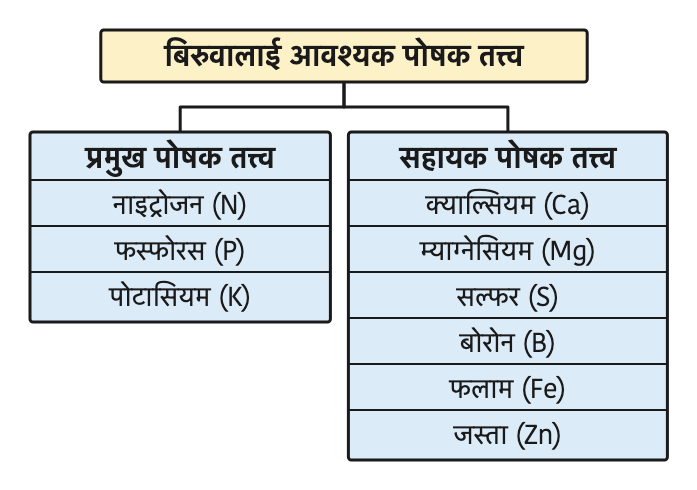
| Group | Elements | Amount needed |
| Primary nutrients | Nitrogen (N), phosphorus (P), potassium (K) | Large |
| Secondary nutrients | Calcium (Ca), magnesium (Mg), sulphur (S), boron (B), iron (Fe), zinc (Zn) and others | Smaller |
Secondary does not mean less important. The division into primary and secondary is made by the amount needed, not by importance. A shortage of a secondary nutrient also halts a plant's growth and cuts its production.
When Nutrients Run Short
Nutrients form in soil naturally as organic matter decays. When fallen leaves, dead organisms and animal waste rot in the soil, the elements inside them return to the soil. But when a field is farmed continuously, each crop carries those elements away, and the soil slowly runs short of them. To make up that shortage, chemical substances containing the missing elements have to be placed in the soil as fertilizer.
Every crop carries elements away from the soil, so soil that is farmed continuously must have its lost elements returned. Which element to return is what the soil test report tells the farmer.
The full lesson is waiting for you
The notes are free to read in full. A free account opens the rest of the practice, and tracks your progress and confidence score for every subject. Presentations and videos need approval from Learn Yeti.