Mass Is Neither Lost Nor Made
When wood burns, it seems to vanish and leave only a little ash. When iron rusts, it seems to become slightly heavier. From these it is easy to think that a chemical reaction can destroy matter or make new matter out of nothing. Careful weighing shows that neither happens. If everything that takes part is collected, including the gases that fly off and the gases taken from the air, the total mass before the reaction is exactly equal to the total mass after it.
Law of conservation of mass: in a chemical reaction, mass is neither destroyed nor created. The total mass of the reactants is equal to the total mass of the products.
The law holds because atoms are never destroyed in a reaction, and no new atoms appear. Bonds between atoms break and new bonds form, so the same atoms are rearranged into new substances. Every atom on the left side of an equation is still present on the right side, inside some molecule. So the number of atoms of each element must be the same on both sides. An equation written like this is called a balanced chemical equation. Chemical equations are balanced because of the law of conservation of mass.
For every element: number of atoms on the left = number of atoms on the right. That is exactly what balanced means.
The Hit and Trial Method
The usual method for balancing a chemical equation is the hit and trial method. You place a number in front of a formula, count the atoms again, and keep adjusting until both sides match. It is not blind guessing, because every try is checked by counting.
Hit and trial method: a way of balancing an equation by placing suitable numbers in front of formulas and counting the atoms after each try, until every element has the same number of atoms on both sides.
Four rules guide this method:
- (a) First, write the reaction as a word equation, using the names of the substances.
- (b) Then write the formula equation, giving each reactant and product its correct molecular formula.
- (c) While balancing, never change the subscripts inside a formula.
- (d) Finally, write a suitable number just in front of a formula wherever it is needed, so that the atoms become equal on both sides.
Changing \( \mathrm{H_2O} \) into \( \mathrm{H_2O_2} \) to get one more oxygen atom is wrong. \( \mathrm{H_2O_2} \) is not water at all; it is hydrogen peroxide. Changing a subscript changes the substance, so change only the number in front.
Reading the Numbers in a Formula
Before balancing, you need to tell apart the two kinds of numbers seen in a formula. One is written full size in front of the formula. The other is written small and low, just after a symbol.
Coefficient: the number written just in front of a formula. It tells how many molecules or atoms of that substance take part in the reaction.
Subscript: the small number written low after a symbol in a formula. It tells how many atoms of that element are in one molecule.
To count the total atoms of an element, multiply the coefficient by the subscript. A symbol with no subscript stands for one atom. For example, \( 2\mathrm{H_2O} \) has \( 2 \times 2 = 4 \) hydrogen atoms and \( 2 \times 1 = 2 \) oxygen atoms.
| Formula | Coefficient | Atoms counted |
| \( 3\mathrm{O_2} \) | 3 | oxygen: \( 3 \times 2 = 6 \) |
| \( 4\mathrm{Na} \) | 4 | sodium: \( 4 \times 1 = 4 \) |
| \( 2\mathrm{Na_2O} \) | 2 | sodium 4, oxygen 2 |
| \( 2\mathrm{Fe_2O_3} \) | 2 | iron 4, oxygen 6 |
Worked Example: Hydrogen and Oxygen Form Water
Hydrogen gas reacts with oxygen to form water. Here is the equation for this reaction, balanced one step at a time.
Step 1: Writing the word equation: hydrogen + oxygen → water
Step 2: Writing the formula equation, with the correct formula for each substance:
\[ \mathrm{H_2} + \mathrm{O_2} \rightarrow \mathrm{H_2O} \]
Step 3: Counting the atoms of each element on both sides:
| Element | Atoms in reactants | Atoms in products |
| Hydrogen | 2 | 2 |
| Oxygen | 2 | 1 |
Hydrogen is already equal, but oxygen has 2 atoms on the left and only 1 on the right. The equation is not balanced.
Step 4: Putting 2 in front of water to make the oxygen equal:
\[ \mathrm{H_2} + \mathrm{O_2} \rightarrow 2\mathrm{H_2O} \]
Oxygen is now 2 on each side. But \( 2\mathrm{H_2O} \) holds 4 hydrogen atoms, so hydrogen has become unequal: 2 on the left, 4 on the right.
Step 5: Putting 2 in front of hydrogen on the left to make hydrogen equal:
\[ 2\mathrm{H_2} + \mathrm{O_2} \rightarrow 2\mathrm{H_2O} \]
Step 6: Counting the atoms again to check:
| Element | Left side (reactants) | Right side (products) |
| Hydrogen | 4 | 4 |
| Oxygen | 2 | 2 |
Both elements now have equal atoms on the two sides. The equation is balanced.
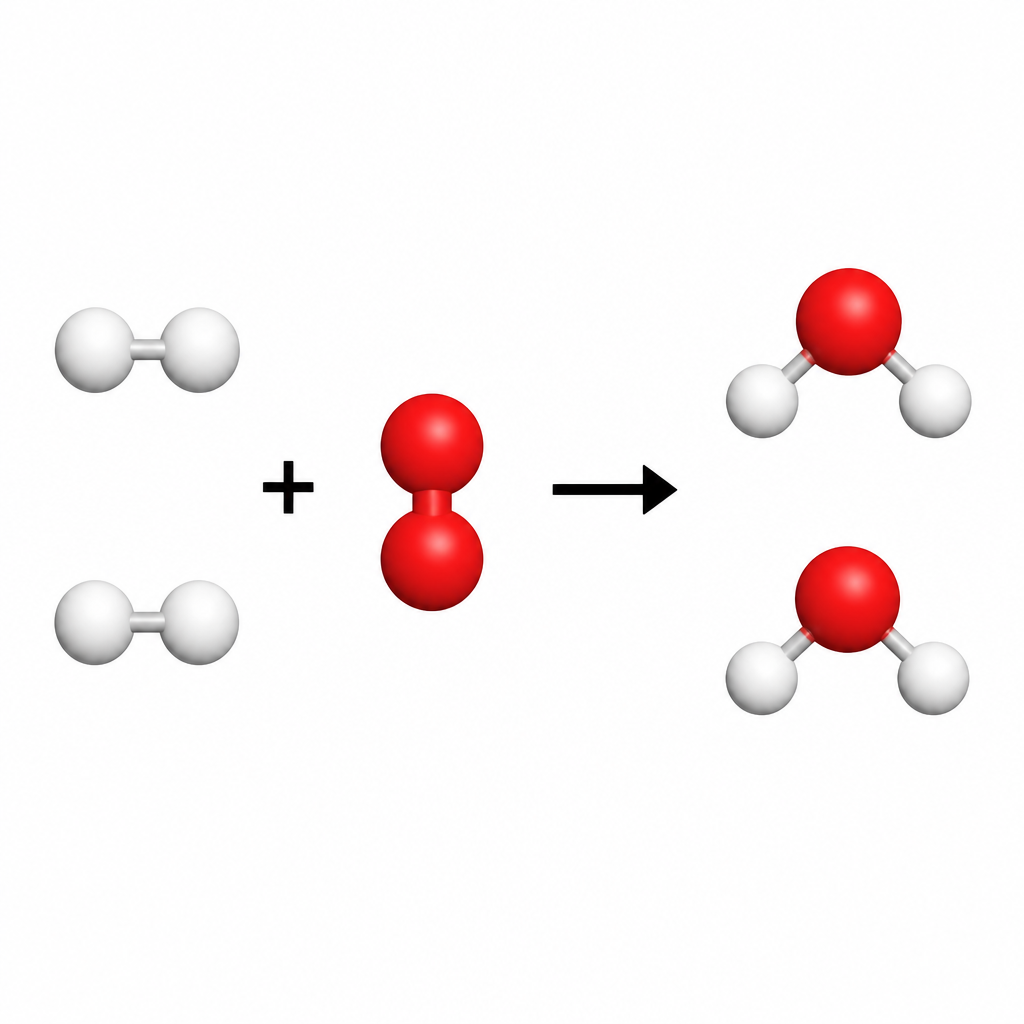
Mass gives the same check. Taking the atomic mass of hydrogen as 1 and of oxygen as 16, \( 2\mathrm{H_2} \) has mass 4, \( \mathrm{O_2} \) has mass 32 and \( 2\mathrm{H_2O} \) has mass 36. So 4 g of hydrogen and 32 g of oxygen form 36 g of water:
\[ 4\ \text{g} + 32\ \text{g} = 36\ \text{g} \]
Worked Example: Sodium Burns in Oxygen
Sodium metal reacts with oxygen to form sodium oxide. Watch how fixing one element changes another, and how the numbers grow until both are equal.
Step 1: Writing the word equation: sodium + oxygen → sodium oxide
Step 2: Writing the formula equation:
\[ \mathrm{Na} + \mathrm{O_2} \rightarrow \mathrm{Na_2O} \]
Counting shows sodium is 1 on the left and 2 on the right, and oxygen is 2 on the left and 1 on the right. Both are unequal.
Step 3: Putting 2 in front of sodium oxide to make the oxygen equal:
\[ \mathrm{Na} + \mathrm{O_2} \rightarrow 2\mathrm{Na_2O} \]
Oxygen is now 2 on each side, but sodium on the right has become \( 2 \times 2 = 4 \) while the left still has 1.
Step 4: Putting 4 in front of sodium on the left to make sodium equal:
\[ 4\mathrm{Na} + \mathrm{O_2} \rightarrow 2\mathrm{Na_2O} \]
Step 5: Checking: sodium is 4 on the left and 4 on the right; oxygen is 2 on the left and 2 on the right. The equation is balanced.
More Balanced Equations
The equations below are balanced. The sign \( \Delta \) written over the arrow means the reaction needs heat. Count the atoms in each one yourself and check that both sides are equal.
- Heating calcium carbonate gives calcium oxide and carbon dioxide: \( \mathrm{CaCO_3} \xrightarrow{\Delta} \mathrm{CaO} + \mathrm{CO_2} \)
- Heating hydrogen peroxide gives water and oxygen: \( 2\mathrm{H_2O_2} \xrightarrow{\Delta} 2\mathrm{H_2O} + \mathrm{O_2} \)
- Sodium hydroxide and hydrochloric acid give sodium chloride and water: \( \mathrm{NaOH} + \mathrm{HCl} \rightarrow \mathrm{NaCl} + \mathrm{H_2O} \)
- Heating aluminium with nitrogen gives aluminium nitride: \( 2\mathrm{Al} + \mathrm{N_2} \xrightarrow{\Delta} 2\mathrm{AlN} \)
- Sodium and oxygen give sodium oxide: \( 4\mathrm{Na} + \mathrm{O_2} \rightarrow 2\mathrm{Na_2O} \)
The equations for calcium carbonate and for sodium hydroxide needed no numbers added, because they were balanced as soon as they were written. Where no coefficient is written, it is understood to be 1. In the hydrogen peroxide equation, the left has \( 2 \times 2 = 4 \) oxygen atoms, and the right also has 4: two in the water and two in the oxygen molecule.
Information Obtained from a Balanced Chemical Equation
A balanced equation looks like a short line, but it holds a great deal of information about a reaction. A student who can read one learns these things from it:
- (a) the names and molecular formulas of the reactants and the products
- (b) the number of molecules and atoms of the reactants and the products
- (c) the ratio of the masses of the reacting molecules and the product molecules
- (d) the type of chemical reaction
A balanced equation does not tell how fast a reaction happens or how long it takes. It tells which substances take part and in what amounts.
Reading the Equation for Iron and Oxygen
Iron combines with oxygen to form iron oxide (ferric oxide). Its balanced equation is:
\[ 4\mathrm{Fe} + 3\mathrm{O_2} \rightarrow 2\mathrm{Fe_2O_3} \]
The four kinds of information can be read from it like this:
- (a) The reactants are iron (\( \mathrm{Fe} \)) and oxygen (\( \mathrm{O_2} \)); the product is iron oxide (\( \mathrm{Fe_2O_3} \)).
- (b) 4 atoms of iron and 3 molecules of oxygen (6 oxygen atoms) form 2 molecules of iron oxide. Each side has 4 iron and 6 oxygen atoms, 10 atoms in all.
- (c) Taking the atomic mass of iron as 56 and of oxygen as 16, the masses are in the ratio \( 224 : 96 : 320 \).
- (d) Two substances join to make a single new substance, so this is a combination reaction.
| Substance | In the equation | Mass |
| Iron | \( 4\mathrm{Fe} \) | \( 4 \times 56 = 224 \) |
| Oxygen | \( 3\mathrm{O_2} \) | \( 3 \times 32 = 96 \) |
| Iron oxide | \( 2\mathrm{Fe_2O_3} \) | \( 2 \times 160 = 320 \) |
Conservation of mass shows here too: \( 224 + 96 = 320 \). So if 224 g of iron reacts completely with 96 g of oxygen, 320 g of iron oxide forms. Dividing the ratio by 32 gives \( 7 : 3 : 10 \).
A balanced equation is a short language that gives the substances, the count of atoms, the ratio of masses and the type of reaction all at once.
The full lesson is waiting for you
The notes are free to read in full. A free account opens the rest of the practice, and tracks your progress and confidence score for every subject. Presentations and videos need approval from Learn Yeti.