Heat and Chemical Reactions
When wood burns in a stove, everyone sitting near it feels warm. Yet to cook rice, the heat of the stove has to get into the pot, or the rice stays raw. Both jobs involve chemical reactions, but the heat moves in opposite directions. In one, heat comes out. In the other, heat is taken in.
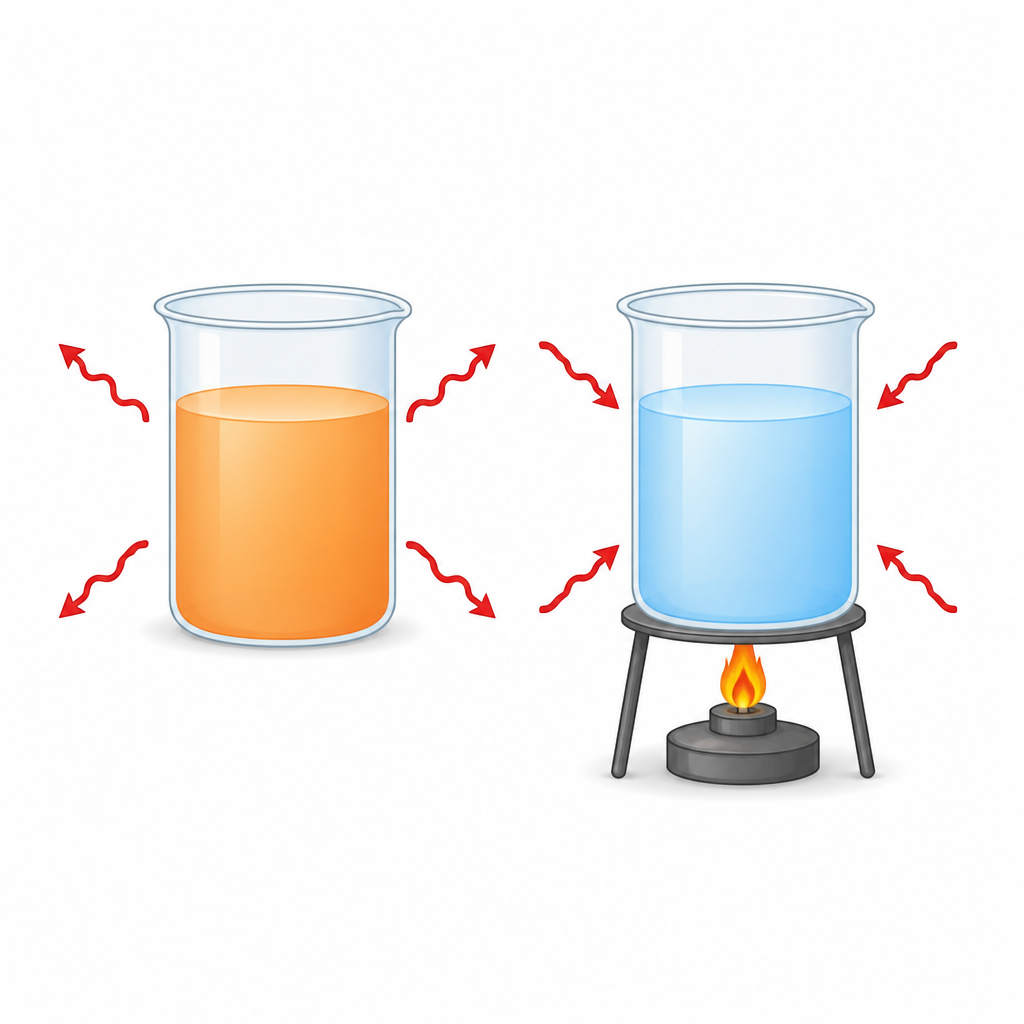
In every chemical reaction, the starting substances change into new substances. As this happens, energy is also exchanged, and most often that energy shows up as heat. So chemical reactions can be sorted into two groups by asking one question: does the reaction give heat to its surroundings, or take heat from them? The two groups are exothermic reactions and endothermic reactions.
Exothermic Reactions
Put some water in a test tube and drop in a few pellets of sodium hydroxide. Within a short time the tube becomes warm, and you can feel it clearly by touching the outside. In the same way, when quicklime is placed in water, the water heats up so strongly that it may hiss and give off steam. In both cases the change inside the tube produces heat, and that heat passes through the glass to your hand.
Exothermic reaction: a chemical reaction in which heat is produced and given out to the surroundings.
A container holding an exothermic reaction feels hot, because heat leaves the reaction and passes into the container and the air around it. The new substances formed hold less energy than the substances you started with. The extra energy is released as heat.
Exothermic Reactions Around Us
Exothermic reactions happen everywhere in daily life, not only in the laboratory. Here are some familiar ones:
- Digestion of food: as food is broken down inside the body, energy is released, which gives us the power to work.
- Cellular respiration: inside our cells, glucose reacts with oxygen and releases energy. This is one reason our body stays warm.
- Burning a candle: burning wax gives out both heat and light.
- Mixing water and quicklime: quicklime gives out a lot of heat when it reacts with water. This is what happens when lime is soaked for whitewashing walls.
- Burning fuel: wood, coal, gas and kerosene give out heat as they burn, which we use to cook and to keep homes warm.
Sodium hydroxide and quicklime can burn the skin and harm the eyes. Never pick them up with your fingers; use a spatula or tongs. Touch the test tube only on the outside, and never point its open end towards anyone.
Writing Exothermic Reactions as Equations
When an exothermic reaction is written as an equation, '+ Heat' is written on the product side. This shows that heat is one of the things that comes out of the reaction. The symbols (s), (l), (g) and (aq) in brackets tell us whether each substance is a solid, a liquid, a gas, or dissolved in water.
Cellular respiration: glucose and oxygen form carbon dioxide, water and heat:
\[ \begin{aligned} &\mathrm{C_6H_{12}O_6(aq) + 6O_2(g)} \\ &\rightarrow \mathrm{6CO_2(g) + 6H_2O(l) + Heat} \end{aligned} \]
Quicklime and water: calcium oxide (quicklime) reacts with water to form calcium hydroxide:
\[ \mathrm{CaO(s) + H_2O(l) \rightarrow Ca(OH)_2(aq) + Heat} \]
Burning charcoal: carbon burns in oxygen to form carbon dioxide:
\[ \mathrm{C(s) + O_2(g) \rightarrow CO_2(g) + Heat} \]
An acid meeting a base: sodium hydroxide and hydrochloric acid form common salt (sodium chloride) and water, and the solution warms up:
\[ \mathrm{NaOH(aq) + HCl(aq) \rightarrow NaCl(aq) + H_2O(l) + Heat} \]
Endothermic Reactions
Cooking needs heat. Burning gas in a stove is an exothermic reaction, because it gives out heat. But rice turning into cooked rice, or vegetables softening in the pot, is an endothermic reaction, because it absorbs the heat coming from the flame. Turn off the flame and the cooking stops too.
Endothermic reaction: a chemical reaction in which heat is absorbed, so the reaction must take in heat from its surroundings to happen.
In an endothermic reaction, the new substances hold more energy than the starting substances. That extra energy is supplied by heat taken in from outside. This is why most endothermic reactions keep going only while they are being heated.
Writing Endothermic Reactions as Equations
In the equation of an endothermic reaction, the word 'Heat' is written above the arrow. It means: heat must be supplied for this reaction to take place.
Hot carbon and steam: when steam is passed over red hot coke, carbon monoxide and hydrogen gas are formed:
\[ \mathrm{C(s) + H_2O(l) \overset{Heat}{\longrightarrow} CO(g) + H_2(g)} \]
Nitrogen and oxygen: these two gases sit side by side in air but do not react at ordinary temperatures. Only at a very high temperature, such as in a flash of lightning, do they form nitrogen dioxide:
\[ \mathrm{N_2(g) + 2O_2(g) \overset{Heat}{\longrightarrow} 2NO_2(g)} \]
Heating calcium carbonate: limestone (calcium carbonate) breaks down into quicklime and carbon dioxide only when it is strongly heated in a kiln:
\[ \mathrm{CaCO_3(s) \overset{Heat}{\longrightarrow} CaO(s) + CO_2(g)} \]
You can tell the type from the equation: if 'Heat' is added with a '+' on the product side, the reaction is exothermic; if 'Heat' is written over the arrow, it is endothermic.
Comparing the Two Kinds
| Basis | Exothermic reaction | Endothermic reaction |
| Direction of heat | Heat is given out | Heat is taken in |
| Touching the container | Feels hot | Must be heated, or feels cold |
| Heat in the equation | '+ Heat' on the product side | 'Heat' above the arrow |
| Energy | Products hold less energy | Products hold more energy |
| Examples | Digestion, respiration, burning fuel, quicklime and water | Cooking food, heating CaCO₃, NO₂ forming in lightning |
Both Kinds in One Everyday Task
Picture someone cooking rice on a wood fire. The burning of wood is an exothermic reaction, because wood combines with oxygen and gives out heat and light. The rice cooking in the pot is an endothermic reaction, because the rice cooks only by absorbing the heat that comes from the fire. The heat given out by one reaction is used by the other.
To decide which kind any reaction is, always ask the same question: does it give heat to its surroundings, or take heat from them? If it gives heat, it is exothermic. If it takes heat, it is endothermic.
A reaction is not endothermic just because it needs a flame to start. A candle needs a match to light it, but once burning it keeps giving out heat by itself, so it is exothermic. An endothermic reaction needs heat supplied the whole time it runs.
The full lesson is waiting for you
The notes are free to read in full. A free account opens the rest of the practice, and tracks your progress and confidence score for every subject. Presentations and videos need approval from Learn Yeti.